Inspired by the 1932 Olympic Games held in Southern California, UCLA set a precedent for other southern schools by establishing crew. The team experienced a glamorous beginning led by its charismatic first coach, Major [his name not a military rank] Goodsell.
Major Goodsell’s Year followed by Ben Wallace

1933 - 1943
|
1933 - 1943 |
Major James Goodsell of Australia progressed to the professional sculling ranks after WW I. On December 10, 1924 James Paddon (AUS, age 38) relinquished his World sculling title to W. Mc Devitt on condition that he meets Major Goodsell in a title radd blockace. Paddon had held the title since winning it from Darcy Hadfield (NZL) in 1923. Paddon defeated Major Goodsell by twelve lengths on September 20, 1924 in a race for the championship. Goodsell capsized after about a quarter of a mile into the race but got back into his shell and resumed rowing.
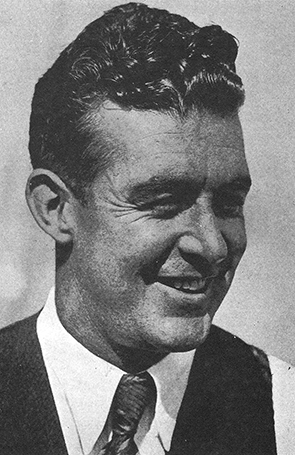
Major Goodsell
On March 21, 1925 Major Goodsell won the world’s profession sculling championship over Bill McDevitt by fourteen lengths and then defended the title against J Pat Hannan (NZL) on June 27, 1925 and James Paddon on November 7. Next Goodsell defeated challenger Tom Saul (AUS) on May 3, 1926. Goodsell sailed from Australia to the US in June 1926 “to do theatrical and rowing coaching work.” In August 1926 Goodsell was cited as being in the United States to defend his title in a series of races against American scullers. His Australian backers were willing to put up $50,000 for him in any race over three miles. He was featured in a publicity picture instructing two members of the Balboa Beach Girls Rowing Club. In October he was cited as taking up residency in Los Angeles. Part of a theatre performance, Goodsell “has a stationary rowing machine in his act at the Dome theatre, which registers on a dial his pulling power.” Venice Evening Vanguard, 13 Dec 1926, 2.
In February 1927 Goodsell was said to be held for ransom by bandits in Mexico for 5,000 Mexican pesos, that after being involved in an auto accident in Wilmington on December 6, 1926. Goodsell defended his title in Vancouver against England’s Bert Barry, winner of the 1925 Doggett’s Coat and Badge, on September, 5 1927 for a £10,000 purse, though the ten length victory was reversed by Barry in a December 26 rematch. In March 1929 Goodsell was coaching at the Bay Area’s South End Rowing Club.
After five years away from competitive racing, Goodsell attempted a comeback in a 4,000 meter race on September 5, 1932 following the Olympics at the Long Beach Marine Stadium. He had challenged the world professional title holder Ted Phelps of Great Britain. Phelps had defeated Barry twice in 1930 and held the title since that time. Phelps won by 3.8 seconds in a time of 17:06.2 over Goodsell. The course was rowed in four laps beginning and finishing at the grandstands, twice around a turn for the first time in deciding the title.
From the time Major Goodsell began coaching the UCLA team in September of 1932 and the 1933 season, until his death over fifty years later he was known as the first coach of UCLA’s rowing team. In Robert Frassetto’s history of UCLA Crew he cites, “A member of the original Bruin crew claims, had Goodsell not left UCLA after one year as crew coach, he would have left after twenty-five years as Chancellor; he was that kind of man.” Robert Frassetto, UCLA Crew – A Half Century (Los Angeles, 1978), 13. Major Goodsell acted in the 1933 movie “Sweetheart of Sigma Chi” released in October. The movie stared Buster Crabbe and Mary Carlisle, with Goodsell as the rowing coach of the male leads. By 1934 following the termination of the UCLA team in the fall of 1933, Goodsell was contracted as an assistant motion picture director.
In March 1934 Goodsell filed a suit demanding the year’s salary of $5,000 ($938 for the time served and $4.062 in damages) from ASUCLA claiming that he had not been paid for his employment from September 15, 1933 until November 23 when the school decided to drop rowing as a varsity sport. In July 1934 Goodsell was again in the news as a driver in a fatal roll-over car accident near Rialto that resulted in injury to the other occupants of the car. In later years Goodsell was still cited as “former UCLA rowing coach.” In 1941 Major Goodsell was in the news as a race horse owner and trainer. In 1949 he was alleged to have administered a stimulant to one of his horses by the Arizona Racing Commission, he was later exonerated. In 1966 Major was cited as giving advice about athletes preparing for the altitude of the Mexico Olympics and was involved in the rescue of three fishermen from an overturned boat in a frigid Oregon lake.
Major Goodsell passed away on March 31, 1988.
1933
Rowing at a competitive national-level already existed at Washington and Cal, along with fledgling teams at Sacramento Junior College [fall 1928] and Oregon State [1929] though officially it was under the department of physical education not as a varsity sport. Corvallis (OR) Gazette-Times, 24 May 1934, 6. When UCLA began in the fall of 1932 there was a great deal of excitement and it was expected that USC and perhaps Long Beach Junior College might follow soon after and that Stanford might resume their program, after terminating after their 1920 season. Stanford would not return to rowing competition until a one-year resumption in 1943 before shutting down during World War II and restarting in 1947. USC finally began a team in 1948 and Long Beach State in 1957.
The 1933 UCLA Southern Campus included eight pages devoted to the new sport of crew, and was placed it immediately before the pages devoted to football. UCLA’s exposure to rowing began with great ceremony chronicled in the 1933 Southern Campus:
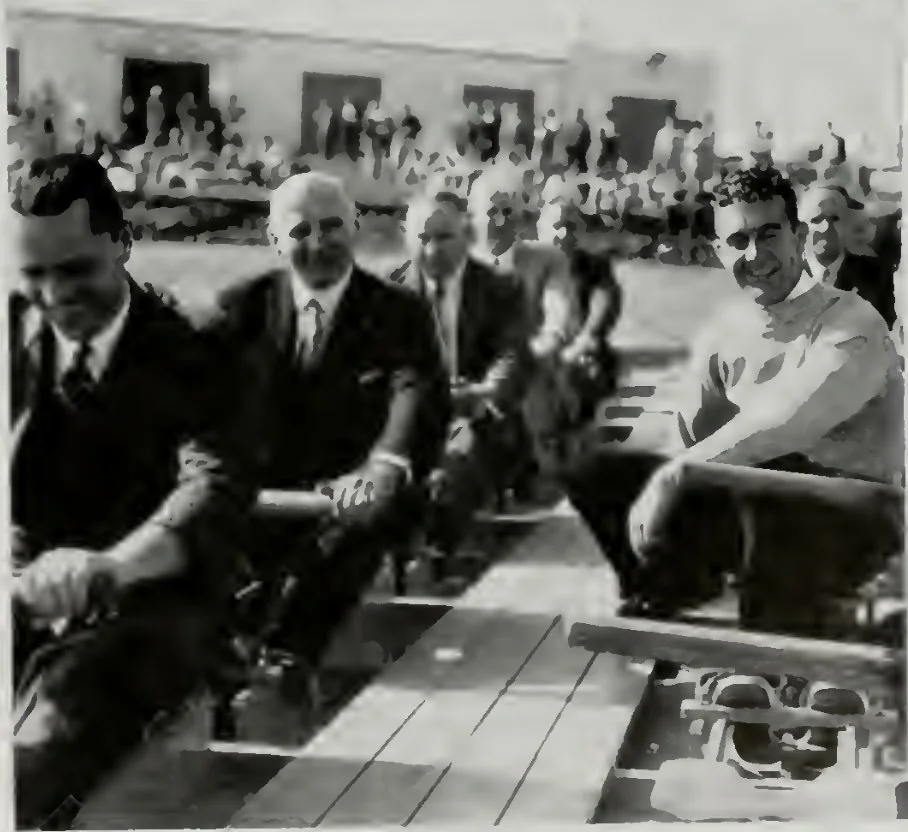
A ceremony held at Long Beach on October 8 marked the advent of crew as a U.C.L.A. sport, and the Bruin’s introduction to the gentle art of galley-slaving. Arriving at the rowing stadium, they found about 500 fellow students and citizens of the beach city gathered to watch the initial workout. The first to welcome them was the Hon. Frank Merriam, Lieutenant Governor of the state, who in a few words expressed his support of this latest Uclan sport. Clyde Doyle, chairman of the Long Beach Recreation Board, was next on the program to express his hope that the facilities would prove satisfactory. Stephen Cunningham thanked him on behalf of the A.S.U.C., telling the assemblage that it was because of Doyle’s assistance that the course was available for the Bruins. Other speakers were Mayor Frickling, City Manager Dobbins and Dean Miller.
Dignitaries take to seats in the barge under the supervision of
Coach Goodsell. 1933 Southern Campus, 251.
Initial plans were that the Bruins would train in Wilmington on the Cerritos Channel being several miles closer to campus but race at the Olympic course in Long Beach. There was great hope that since the Long Beach Marine Stadium could be closed off and admission charged there would be a way to at least partially generate financial support for the team. The team initially had three eight-oared shells. The renamed “Westwood” used by the freshmen had been the shell of the 1932 German Olympic crew, while the varsity and junior varsity used two new shells named “Southern Bear” and “Uclan.”

The renamed “Westwood” used by the freshmen had been the shell of the 1932 German Olympic crew.
Leading up to their first race, there was a week-long series of events on campus, with article on the front page of the California Daily Bruin and numerous advertisements that included rowing themes.
The 1933 Cal varsity contained three rowers (Tower, Hall, Chandler) and the coxswain (Graham) of the 1932 Olympic gold medal crew. But Cal had lost in a clean sweep to Washington in their dual of the Estuary the week prior.
On April 15 UCLA participated in its first rowing competition but finished last in all four events. In the featured varsity eight event, Washington was the winner in 6:30, 7.2 seconds faster than Cal, “the determined but inexperienced crew from the University of California at Los Angeles,” was three lengths farther back. Without an entry from Washington,
Cal (6:54.2) defeated UCLA in the junior varsity eight by three lengths. UCLA had its highest hopes on their freshman
crew that had been competitive with its varsity eight. UCLA’s freshman finished third but within a length of first place Washington (6:50.2) and California. In a four-oared event, UCLA finished about three lengths behind winner Washington (7:44.8) and Cal.
In a sports column in May 1933, Henry McLemore poked fun at the young Bruin team, “A new high in optimism: U.C.L.A. took up rowing this year for the first time and the freshman crew immediately took up German, looking forward to Berlin to compete in the 1936 Olympics.” Henry McLemore, “Brooklyn’s Third Baseman Proves Roughest Man On Bats in Baseball”, Toronto Daily Star, 16 May 1933, 9.
In 1933 the IRA was cancelled following a campaign by Cornell that had suspended athletics in January. The IRA stewards decided that the event was too expensive to hold during the height of the Great Depression. In stepped local businessmen in Long Beach, California, to host the “National Inter-Collegiate Crew Regatta” scheduled for July at the 1933 Long Beach Marine Stadium course. Initially six nationally recognized crews (Yale, Cornell, and Washington, and though they did not ultimately attend, Pennsylvania, MIT and Wisconsin) were invited and tentatively indicated that they would attend. Cal was invited but had initially indicated that they would not attend since their academic year ended in early March. Harvard had won the four-mile Harvard-Yale race in 1933 (and Yale won in 1934 and 1935) but both were willing to come west. Italy, the silver medalist eight from the 1932 Olympics and Cambridge University were also invited. This marked a first of East Coast crews coming to race on the West Coast. The sponsors underwrote the expenses of the event including travel expenses of the teams. The Junior Chamber of Commerce, and city and county of Los Angeles were hoping for 100,000 spectators to pay admission, which was twice the number attending the rowing event at the previous year’s Olympic rowing. This event was not a financial success. It was only the second regatta for the first-year UCLA varsity. Of the six crews, California and UCLA had both finished third in the two three-boat heats and raced a consolation race, with the Bears triumphant.
Heat 1 : Yale 6:44.6 | Cornell 6:49.2 | California 6:55.6
Heat 2 : Washington 6:40 | Harvard 6:51.6 | UCLA 7:01.6
Consolation : California 6:50 | UCLA 7:05
Final : Washington 6:38.8 | Yale 6:39 | Cornell 6:50 | Harvard 7:01.4

1934
The UCLA rowing program was terminated in the fall of 1933 when “the accounting department found that its cost was more than the Associated Students could bear without diverting funds from or abolishing many minor sports programs.” The Bruin Boat Club under coxswain Maury Grossman was actively engaged in lobbying for reinstatement of the program and obtaining outside funds. It was also reported that Goodsell who had coached the Bruins during their first season had recently gone under contract with a motion picture studio as an assistant director and would not be available. “Bruins May Reinstate Crew Sport in Spring”, Los Angeles Times, 25 Jan 1934, 25.
The reinstatement of the UCLA program was announced on 26 January 1934. In its second season the team would be under the leadership of volunteer coach Ben Wallis [Yale stroke from 1909-10 and crew coach at California 1916-1924], with assistants Charley Loscamp coaching the JV and Don Locke guiding the freshman, both former Cal rowers. Wallis had been a volunteer coach for the Bears and again donated his time to coach the Bruins while continuing his insurance business. The varsity began training in late February. Members of the Bruin squad spent their own gasoline money to complete the 60-mile round trip to train in at the Cerritos Channel in Willington, the Bruins choosing that location over Long Beach since it was several miles closer to campus.
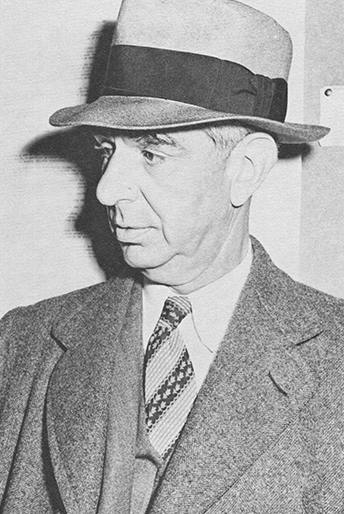
Ben Wallace
UCLA rowed to its first victory over Sacramento Junior College on March 31. The race marked the first appearance of the six-year old Sacramento team in Southern California and the first appearance of a high school team in Southern California. The Bruin varsity was not expected to do well since they had not equaled times from the preceding year during practice against the favored Panthers from Sacramento, they still came on strong. The Bruin JV placed third in the varsity race, and the freshman eight placed second in their race. In the varsity event, UCLA (6:55.3) finished first by one and one-half lengths. The first crew from Sacramento JC (6:59) was second and three lengths further back was UCLA’s junior varsity (7:10). After a furious sprint in the final 150 meters Sacramento’s JV (6:59) finished one length ahead of the UCLA freshmen (7:07), third was Long Beach Rowing Association (7:18) three lengths behind the UCLA freshmen and one-half length ahead of Woodrow Wilson High School (7:25) making its first appearance.
“Bruin Crew Conquers Sacramento J.C. Eight in First Oar Victory”,
Los Angeles Times, 1 Apr 1934, 57.
On April 19 on the Wilmington course, the Bruin freshmen defeated Wilson High School, for a second time this season.
“Bruin Frosh Crew Trims Wilson High”, (Los Angeles) Post Record, 20 Apr 1934, 10.
The varsity and junior varsity traveled by car, with an overnight stop in Bakersfield for their first competition away from southern California to race Cal on the Oakland Estuary.
“Bruin Oarsmen en Route to Berkeley for Races”, Los Angeles Times, 18 Apr 1934, 33.
On April 21 Cal (10:30) defeated UCLA (10:54) by six-lengths over a two-mile course with a “boatload of tall sophomores
[6 sophomores and 3 juniors] which Coach Ky Ebright is pointing toward the 1936 Olympics.”
“Bears Defeat UCLA Crew”, Coos Bay (OR) Times, 21 Apr 1934, 2.
A junior varsity race over 2000 meters was also scheduled to take place as a preliminary event between Cal and UCLA. Cal’s varsity had lost to Washington by three-quarters of a length the week prior.
Twenty Bruin oarsmen were part of the 1934 motion picture “Student Tour” that featured Charles Butterworth, Jimmy Durante, Maxine Doyle, Phil Regan and Betty Grable that began production in June.
“Student Tour’ Before MGM Cameras”, Los Angeles Evening Post-Record, 2 Jun 1934, 2.
The Los Angles Junior Chamber of Commerce announced plans in early May 1934 for a second National Intercollegiate Sprint Regatta that would again include the Bruins, however Yale declined since there would only be two weeks instead
of three between the Harvard-Yale race and the event in Long Beach.
“Yale Declines Coast Crew Bid”, (Phoenix) Arizona Republic, 13 May 1934, 18.
The IRA regatta resumed in 1934 as the stewards cited improving economic conditions. At the 1934 IRA regatta in Poughkeepsie, Cal and Washington finished in first and second among the seven varsity eights in the four-mile race.
Cal also placed fourth of five in the junior varsity event and Washington won the six crew freshmen eight.
1935
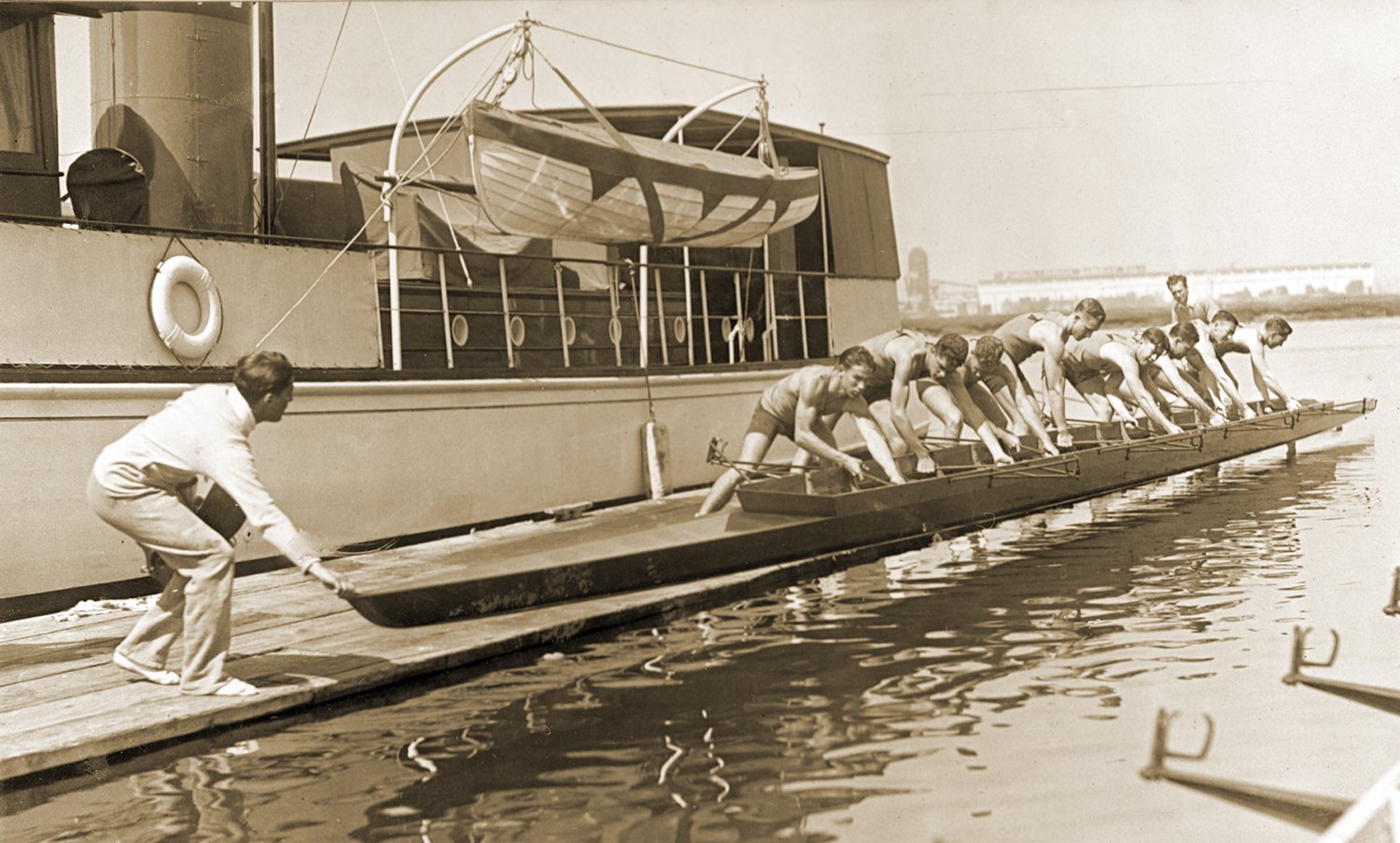
The 1935 team consisted of a varsity and junior varsity and two freshman eights. The JV had given the varsity crew tough competition in practice. Both of the Bruin’s races were held in Long Beach. The first against Sacramento JC and the second against Cal.

At Long Beach on April 6, Sacramento JC (6:45.8) defeated UCLA (+ :00.2) in the varsity eight event racing by one-foot after pulling ahead from the start with the Bruins. At the start UCLA was at a 40, taking the rate down as Sacramento pulled even by the halfway point rowing at a steady 32. The Bruins were pulling at a 36 rating as Sacramento pulled ahead still at 32 strokes per minute. The Bruin JV finished in third place, four-lengths behind the leaders. Walt Shatford, “First Bruin Boat Beaten by Jaysees”, California Daily Bruin, 8 Apr 1935, 1. The Southern Campus lamented that the “most experienced men were not in the boat and the usual coxswain was missing from the shell,” and that the Bruin crew did not raise the stroke rate until too late. UCLA Southern Campus, 1935, 292. The UCLA freshmen pea-greeners (6:46.6) earned their first victory in their race over the Sacramento JC junior varsity by a margin cited as either three and one-half or just one-half lengths. Competing against the two Long Beach high schools, UCLA’s second freshman eight appears to have finished behind the varsity crews from both Long Beach Poly and Wilson High School. Long Beach Poly captured the first city rowing title in Long Beach winning the varsity and junior varsity races, while Wilson won the lightweight eight event.
The Bruin shell the “Southern Bear” was damaged when a Westwood co-ed from the Wilshire Girls' Rowing Club, posing
for photographs in the shell, put her foot through the bottom. Robert Frassetto, UCLA Crew – A Half Century (Los Angeles, 1978), 16.
On April 13, Washington defeated California by a slim two-fifths of a second after trailing the Bears for most of the three mile race on the Oakland Estuary, resulting in a Huskie sweep in all three events.
UCLA crews competed in five of the ten events of the regatta on April 18. UCLA’s varsity eight won a moral victory though losing to Cal, having taken rapid strides in improvement though termed a complete Bruin washout. “Golden Bear Eights Win Over Locals at Long Beach”, California Daily Bruin, 22 Apr 1935, 3. The ten race schedule included competition between Long Beach JC and Compton JC, and a four-oared race between Cal, UCLA and Long Beach Rowing Association. Most of the events were 2000 meters though several were 1500 meters. In the varsity eight event California (6:56) defeated UCLA (7:03) by two lengths with Cal at a stroke rate between 22 and 28 during the body of the race and the Bruins up to a 34. Cal pulled a low, powerful stroke until the 1500 meter mark when first the UCLA coxswain called up the stroke rating narrowing the margin to one and one-half length then Cal also increased their stroke rate. The UCLA junior varsity finished last in their event that was won by an entry from the San Diego Rowing Club (7:10.4), two and one-quarter lengths ahead of the U.S.S. Tennessee No. 2 crew (7:19), four lengths ahead of the UCLA junior varsity (7:32.4). In the freshman eight event California (7:00.6) won by one and one-quarter lengths over UCLA (7:06) keeping the stroke rate down at 28 through the body of the race. The four-oared event was won by California (7:45) finishing nine lengths ahead of second place Long Beach Rowing Club (8:12.4) yet another five lengths ahead of a Bruin Rowing Club (8:28) entry. In one of the 1500 meter races Long Beach Poly HS (5:21.1) defeated Wilson HS (5:21.2) by one foot, while Wilson HS finished one length ahead of the UCLA freshmen reserves (5:24). Another of the 1500 meter races included two local junior colleges competing for the first time. In that event the U.S.S. Tennessee No. 1 crew (5:33) was the victor by four lengths, with Compton JC upper division varsity (5:48) in second and Long Beach JC varsity (5:52) one length further back.
“Bear Crews Triumphant”, Los Angeles Times, 21 Apr 1935, 27.
Following the race with Cal, the varsity and freshman crews continued training since there was still a race scheduled in Seattle versus Washington on 11 May, but that was called off on 4 May since the Bruins were not able to obtain the funds necessary to make the trip.
At the 1935 IRA regatta the order of finish in the varsity event was California, Cornell, Washington, Navy, Syracuse, Pennsylvania, and Columbia. Washington also won both the junior varsity and freshman eight titles, with California placing second in the freshman eight. Wisconsin had skipped the regatta in Poughkeepsie but had finished fourth of six, with Pennsylvania second, at Marietta, Ohio for the Dad Vail Trophy in May.
A second National Collegiate Sprint Rowing Regatta was hosted again in Long Beach in June 1935 after an unsuccessful attempt in 1934. However, this time it had a smaller attendance of about 5,000 on the first day and, by generous estimate, between 7,000 and 10,000 for the finals on Saturday. Tickets ranged from $2.20, and 55 cents. The event again lost money
Heat 1 : California 6:40.8 | Syracuse 6:51.2 | Wisconsin
Heat 2 : Washington 6:57.2 | Pennsylvania 7.09.8 | UCLA
Consolation : UCLA 6:41.4 | Wisconsin 6.41.8
Final : California 6:15.6 | Washington 1/3 length back | Syracuse | Pennsylvania
The regatta was June 28-29 and the final mirrored the order at the IRA among the crews attending. UCLA was said to have rowed to a “strong third” in the elimination heat. In the consolation, UCLA earned its second varsity victory, this time over a major college program. Wisconsin had opened an early lead in the more protected lane but UCLA finished ahead by four feet. The Bruin eight contained six oarsmen from the most recent varsity line-up along with two oarsmen and the coxswain from the season’s freshman crew.
1936
After its three years training in Wilmington on the Cerritos Channel, UCLA made a move to the Olympic boathouse at the Long Beach Marine Stadium. “Bruin Crew Moves to New Rowing Quarters”, Los Angeles Times, 8 Feb 1936, 16.
The move was necessitated because the site the Bruins had been using in Willington was needed by the oil company that had loaned the site. The Bruins were led by head coach Ben Wallis and Don Locke leading the freshmen, with Charles Loskamp pulled away from coaching by demands of his work. Walter Busch was the team’s rigger, along with the assistance of four student-managers. The popularity of rowing versus football at UCLA was cited as having 150 candidates for rowing compared to 75 for football. “Bill Henry Says”, Los Angeles Times, 18 Jan 1936, 13, 16. This year’s team consisted of crews for five shells. There was mention of a possible future 3-mile rowing course being dug at Del Rey on Ballona Creek.
UCLA’s first opponent was Oregon State College. Prior to the race Bernhardt Mortensen was elected as UCLA’s captain. Mortensen had begun rowing as a freshman at UCLA in 1933 during the team’s first season. He replaced captain-elect Claude Brown, the 1935 team captain, had resigned due to conflicts as a member of the rugby team (1935 and 1936) and illness early in the spring season. “Bruin Oarsmen Meet Oregon State Tomorrow on Long Beach Course”, Los Angeles Times, 22 Mar 1936, 26.
Six of the initial Bruin varsity had raced in the 1935 Frosh crew and the other three, 1935 stroke Kempton “Pete” Hall, Mortensen and coxswain Sanders had been in the 1935 crew that defeated Wisconsin. However, Brown raced in the varsity stroke against Sacramento and the Cal race. Oregon State had lost to Cal’s Frosh and fourth varsity, but had defeated Sacramento JC during their trip south prior to meeting UCLA. After looking ragged in the first half of the race, the UCLA varsity sat about one-half length be behind the Beavers for the first 1500 meters of the race, then “uncorked a furious sprint that carried their stroke rate to a 39 beat,” “U.C.L.A. Crew Edges Beavers”, Fresno (CA) Bee, 24 Mar 1936, 13. drawing even with 100 meters to go and finishing 8-feet ahead (7:01.2) with a makeshift UCLA junior varsity crew finished in third. The JV had taken wash from the coaching launch, and finished three and one-half lengths behind Oregon State.
UCLA posted a clean sweep over Sacramento JC on some choppy waters in Long Beach. The Bruin varsity (7:25) one-length ahead of Sacramento, the UCLA Frosh crew (7:08.9) defeating the Sacramento junior varsity after leading the entire race with a length and one-half margin, and the UCLA junior varsity (7:20.3) finished five-lengths ahead of Long Beach JC and Compton JC. A crew from Long Beach Poly High also defeated a high school crew from Sacramento in the regatta’s first race.
Cal had lost to Washington during their regular dual as both crews prepared for the IRA and Olympic Trials. The Bruin varsity traveled north by train to face Cal. In an inaugural 2000 meter race on San Francisco’s Lake Merced the Bears (6:40.4) led UCLA from the start rowing at a steady 34 until sprinting up to 44, UCLA having been assigned a lane in rougher water, finished eleven lengths behind. “Local Oarsmen Beaten by Bear Rowers in North”, California Daily Bruin, 27 Apr 1936, 3.
1937
The varsity and JV crews were continually competitive during practices. On April 10, in their annual race against a favored crew from Sacramento Junior College. UCLA’s varsity (6:56.4) defeated Sacramento’s (7:04) first crew by a length and one-half, when the stroke of the Sacramento crew becoming ill after the race had begun with the stroke rate trailing off to 28 at the end of the race. The UCLA Frosh lost to Sacramento’s junior varsity by one and one-half lengths. “College Rowing”, Santa Maria (CA) Daily Times, 12 Apr 1937, 2. UCLA’s JV crew defeated Compton JC by three and one-half lengths, a repeat result of a meeting a week prior. Among the eight races scheduled, Long Beach Poly, Wilson and Compton high schools also raced.
Two weeks later Cal (6:35) easily defeated UCLA (6:49.5) by two and one-half lengths amid choppy water in Long Beach. Cal’s JV (6:43.4) defeated the JV crew from UCLA (6:49.5) by a margin of one-half length. As far as height and weight the two varsity crews were evenly matched, though the Bears were never seriously threatened during the race and opened a terrific sprint at the end. The varsity crew from Compton JC (7:05.5) nosed out UCLA’s Frosh (7:06.2) crew by one-half length with the Compton JV finishing several lengths back in third place. Robert Myers, “Bear Crew Beats Bruins Easily”, San Bernadino County Sun, 24 Apr 1937, 17. In their fourth defeat of the day a UCLA crew lost a four-oared race to a crew from the Long Beach Rowing Association. Among the other races Long Beach Poly, Wilson and Compton high schools raced varsity, JV and lightweight events.
A move to a 4000 meter course in Playa del Rey was expected in October 1937.
1938
While still looking forward to a new boathouse on Ballona Creek, it was still in the future as the team continued to train at Long Beach. Completion was now anticipated by the 1939 season. A competition among 117 nominees for Regatta Queen culminated in a dance to raise funds for the boathouse. The Bruins (8:08) opened their season on March 18 with a victory over Oregon State (8:46) by seven lengths on wind swept, choppy water in Long Beach. The Frosh eight (4:52.5) defeated Compton JC junior varsity by a margin of one length over a 1000 meter course; the Compton JC varsity (4:17) defeated UCLA’s third varsity (4:23) by one length over 1000 meters for UCLA’s only loss of the day; and the UCLA JV (6:17) defeated Long Beach JC by three lengths in a 1500 meter race.
“U.C.L.A. Win 1st Over Coast Eight,” Los Angeles Daily News, 18 Mar 1938, 21. John Rothwell, “Crew Opens Season with Smashing Win at Long Beach”, California Daily Bruin, 18 Mar 1938, 3.
On April 2 UCLA’s varsity (6:58.9) held off Sacramento JC (6:59.8) for a victory by 12-feet, with UCLA’s JV (7:17) six lengths back in third place. In a 1500 meter race, the Sacramento JV (5:30) defeated the UCLA Frosh eight by two lengths, with Compton JC and Long Beach JC further back.
“Bruin Galley Slaves Nab Fourth Win Over Sacramento Jaysee”, Los Angeles Times, 3 Apr 1938, 27.
For the final race of the season the Bruins traveled by train and brought their own shells in an extra-long baggage car for a race with Cal on April 22. Both Bruin crews led their races early on but were behind the Bears at the finish. In the varsity race UCLA (6:20.2) lost to the Cal varsity (6:12.7), though a large improvement over the year prior, overstroking the Bears on a choppy Estuary course. UCLA’s JV (6:20.3) was defeated by Cal’s JV (6:14.9) by only one-half length of open water. Martin Litton, “First, Second Crews End Banner Season”, California Daily Bruin, 25 Apr 1938, 3.
1939
The Bruin’s boathouse on Ballona Creek was finally completed, but there were no funds to build a ramp and float [$300] to launch from, so they spent one more season commuting to practice in Long Beach. Something that would plague the team in the future was the location near what is the 1750 meter mark on the current course where, depending on water flow and the ocean tide, the creek can be shallow. Still at Long Beach, the first freshman crew damaged their shell during practice when they became stuck on a sandbar. The #6 rower got out of the shell and tried to push the shell free but was unsuccessful. When he reentered the shell his oar had become lodged under the shell and punched a hole in the hull. “Broken Shell Causes Frosh Crew Mix-up”, California Daily Bruin, 5 Apr 1939, 4. A race against Sacramento JC had been tentatively scheduled for April 8 but was cancelled. This followed two weeks of the first two Bruin crews rowing for the cameras of Paramount Studios [Million Dollar Legs: Betty Grable, Jackie Coogan, John Hartley, Donald O’Connor, and Buster Crabbe as the coach].
Reputed to be the best UCLA (6:44.3) crew to date it lost to Cal (6:18.5) in its only race of the season by at least five lengths. Cal had led from the start but the Bruins rowing at a 34 to Cal’s 30 crept up a bit but dropped back around 1500 meters when the UCLA #3 man caught a crab. UCLA’s JV finished four lengths behind the Cal JV (6:40). John Rothwell, “Fast Time Marks Expected U.C.B. Win at Long Beach”, California Daily Bruin, 24 Apr 1939, 3. The Frosh crew was coached by three year letter winner Martin Litton. In their one competition the UCLA first freshmen (7:11) lost to the Compton JC varsity crew (6:57) by three lengths. In the final race of the day, the UCLA second freshmen (5:20.6) finished second to the Compton JC junior varsity (5:16), with the Long Beach JC varsity (5:25) in last place of the 1500 meter race.
“First Year Oarsmen Lose to Compton”, California Daily Bruin, 24 Apr 1939, 3.
In other races during the season California had swept Washington; Sacramento JC had defeated Oregon State in March; and later the Cal Frosh had defeated the crews from Sacramento JC.
1940
The Bruins finally took up residence in their boathouse on Ballona Creek. Although the boathouse lacked a locker room and showers the team was to be given sweatsuits by ASUCLA, though they would travel from campus in private cars. The initial turnout included 35 returning oarsmen and 20 freshmen. Sam Sale, “New Ballona Crew Course Attracts Record Turnout”, California Daily Bruin, 14 Apr 1940, 3. Kempton (Pete) Hall would coach the Frosh crew. It was soon evident that tide would influence race distance and practice schedules as the first launching of shells was put off several days, though some potentially challenging rocks were cleared by the oarsmen near the launch area using ropes. “Oarsmen Postpone Workout”, California Daily Bruin, 19 Feb 1940, 3. The first row on the new home course was February 19. The inaugural race on Ballona Creek resulted in a victory for UCLA (6:00.4) over Oregon State by one-half a length over 1900 meters. UCLA’s JV crew finished in third a length behind Oregon State. UCLA led from the start growing to two lengths over the slower starting Oregon State crew, whose steady rating of 36 beats narrowed the distance to a length by midway. After a drive by the Beavers the margin was even smaller, as they crossed the finish line on of their oarsmen caught a crab. “Beaver Oarsmen Beaten at Venice”, Salem (OR) Capital Journal, 20 Mar 1940, 6.
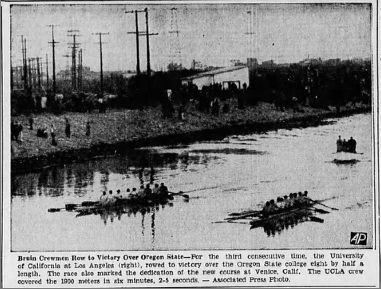
Salem (OR) Capital Journal, 21 March 1940, 3.
On April 5, Sacramento JC swept the Bruin shells on Ballona Creek. The Sacramento varsity (5:59.5) defeating the Bruin varsity by three-quarters of a length, and the Panther JV (6:17.8) defeating the Bruin Frosh by ten feet. The Bruin JV (6:14) was the only winning crew with a two-length victory over Compton Junior College.
“Sacramento J.C. Oarsmen Defeat U.C.L.A. Crew”, Long Beach (CA) Sun, 6 Apr 1940, 9.
Cal swept the Bruin crews on the Oakland Estuary. Though the UCLA varsity took an early lead, Cal’s crew was four lengths ahead at the halfway mark and six lengths ahead at the finish earning a time of 6:28 and 6:56 for the Bruins. In a closer JV race, Cal completed the course in a time of 6:43 to UCLA’s 6:56. “Bear Crew Drubs Bruins by 6 Lengths!”, San Francisco Examiner, 27 Apr 1940, 22.
1941
In December 1940 the Bruins were invited to join Cal and Washington in a three-way regatta in April 1941 at the Oakland Estuary, however the race did not occur with the Bruins. There was fall rowing for the first time. A new shell, named in honor of its donor the “Eugene P. Clark” was added to the Bruin flight. Shell and Oar a co-ed auxiliary was organized to raise funds for the team. The first objective was to raise funds for “the instillation of showers and lockers at the new boathouse. “Crew” UCLA Southern Campus, 1941, 257. Bob Hillen served as the coach of the freshmen. In its three competitions during the season UCLA’s varsity finished in a tie with Sacramento JC, lost to Cal and defeated Stanford. This was the last appearance of Sacramento JC until after the War and the first by Stanford since the program had been extinguished in 1920, and not as active in 1942, but did resurface in 1943.
Prior to the first race of the season the daily changes to the line-ups were reported in the California Daily Bruin along with illness in the second varsity crew. The five shells that UCLA would race or loan to the visiting teams were “Uclan”, “Bruin Clipper”, “Eugene P. Clark”, “Pioneer” and “Southern Bear.” The race was marred by rain, wind and floating debris on Ballona Creek. The Bruin reporter termed the regatta “the biggest fiasco in local rowing history.” In the first race scheduled Compton JC second crew (3:57.5) defeated the second UCLA Frosh crew by eight lengths over the 1000 meter race. The Bruin crew caught a crab right in front of the boathouse. The Bruin first Frosh crew, staying below 32 strokes per minute, even during their sprint, lost to the Sacramento junior varsity (7:22) by one-length, when the visiting Panthers moved ahead after the halfway mark. Conditions worsened for the feature race of Sacramento JC versus UCLA’s varsity. The Bruins hit an ice chest floating down the creek, while rowing the “Eugene P. Clark” that had been christened just an hour prior. Hitting the obstruction caused the Bruins to stop and allowed Sacramento’s first crew to move ahead. The Bruins rowing at a lower stroke rate pulled up and were credited with a tie (in an incredibly slow time of 8:06.8) at the finish, although Sacramento protested the verdict of the finish judge. It was almost dark as the fourth and final race was getting underway. The UCLA JV was racing Compton’s varsity crew. About 100 meters into the race Compton’s bow rower broke his oarlock in the “Pioneer” and just a few seconds later their #7 broke his oar. The Bruin JV was already one-quarter length in the lead and continued to the finish for time, “It was 8:35 they say, although it was really too dark to see the flag” at the finish. Sam Sale, “Opening Race is Dead Heat”, California Daily Bruin, 31 Mar 1941, 3. Certainly a series of calamities!
A few days prior to the race with Cal several Bruin oarsmen contracted measles. With no end in site for mishaps, in the week prior to the Cal race the UCLA JV had an informal rematch with the Compton JC varsity. The Bruins (6:19) finished four lengths ahead. A race between Compton’s junior varsity was planned with UCLA’s third varsity crew, however in warming up for the start of the race the Bruins took a practice start into a bridge abutment, breaking off the bow of the shell and bending the bow outrigger. The damage was not likely repairable before the weekend races. Taking the place of the third varsity crew, the UCLA second Frosh eight raced the Compton JV losing to the visitors by four lengths. Sam Sale, “Jayvee Bests Tartar Crew by Five Lengths”, California Daily Bruin, 22 Apr 1941, 3. A pair of time trials were held preceding the Cal race between the Bruin 3V and second freshman eight to decide which of the crews would face the Compton JC junior varsity during the four race schedule. The 3V won by over twenty seconds. The oarsmen from Cal traveled by train and brought their own shells for the race. Cal had lost to Washington and their trip to Poughkeepsie was on the line in their race with UCLA, to assist their proposal to the ASUC board for $5,400 in trip expenses. “Four Races Slated at Ballona”, California Daily Bruin, 25 Apr 1941, 2. In the first race of the schedule the JVs from Cal (5:49.8) defeated the UCLA JVs (6:06) by over three lengths. In the feature race Cal’s varsity broke the course record by fifteen seconds posting a 5:42 in its four length victory over the Bruins (6:04). The Bears started and sprinted at a rate of 38 with a 36 stroke rating during the body of the race. In the third race on the schedule the UCLA 3V (6:17) defeated Compton JC junior varsity (6:32) by six lengths. The UCLA Frosh then narrowly defeated Compton’s varsity by a deck. The Frosh crew had to replace their #5 rower when he suffered appendicitis two hours prior to the race. Sam Sale, “Bears Win Both Varsity Contests”, California Daily Bruin, 28 Apr 1941, 3. Both Washington and Cal went on to finish in first and second in the varsity event and the reverse order in the JV race at the final Poughkeepsie IRA regatta prior to the cancellation during WW II.
A group of students at Stanford made an effort to revive rowing in 1941, borrowing an old shell from Cal and a past Cal rower to coach them. Stanford had been without rowing since the 1920 season. Their efforts would be short lived. They tried to arrange a single race against Cal in 1942. They rowed again in 1943 but then shut down until after World War II, reestablishing the program in 1947. UCLA, Stanford and Oregon State all competed in rowing without the financial backing from their colleges. Stanford’s only prior race this season had been a two length loss to Oregon State in Oakland. Early in the week it was uncertain if the crew from Stanford would make the scheduled trip south to face the Bruins. At the same time there was discussion about sending a crew north to race Oregon State in May, but the trip lacked funding and was near final exams.
In a series of races without mishaps, the Bruin varsity posted its first victory of the season. They topped Stanford by seven lengths in a time of 5:59 versus Stanford’s time of 6:28. An entry from the San Diego Rowing Club cancelled by phone Friday evening claiming lack of practice and fear of a poor performance, so instead a race of the UCLA JV and Frosh went ahead with the Frosh in the upset win in 6:12.2 compared to the JV’s time of 6:14. The only other race of the day saw the Bruin 3V again defeat the Compton JC junior varsity in 3:08.2 to 3:25.4 in a 1000 meter race. Milt Willner, “Varsity Impressive in Win Over Indian Boat-paddlers”, California Daily Bruin, 5 May 1941, 3.
A Bruin contingent was left on a 36-hour train trip to Corvallis but taking their own Pocock made oars since the Oregon State group makes their own oars and boats, though they were not shells. The Beavers had defeated both Stanford and Sacramento JC previously during the season. UCLA won the race by three-quarters of a length after being down by two lengths at the halfway mark. The Bruins rowing at a higher stroke rate had closed to even with 100 to go. Sam Sale,
“Bruins Row High Stroke to Win”, California Daily Bruin, 12 May 1941, 3.
1942
In February the team took possession of a new shell, “Ferne W” named after the wife of coach Ben Wallis, after two years of construction in Long Beach. It was built by Walt Bush under the direction of Wallis along the lines of the shell used by German at the 1932 Olympics but was longer and deeper. Though pleased with the new shell no more were to be built due to shortages of materials. This brought the Bruin’s fleet to six shells. The “Uclan” had also been repaired with a new bow, and the “Southern Bear” was still being refitted with a new skin. The “Bruin Clipper” was also undergoing repairs after recent damage. “New Shell Reaches Oarsmen for Tryout”, California Daily Bruin, 16 Feb 1942, 3. Early season low tides or wind plagued the Bruin workout schedule on Ballona Creek. The season opener was scheduled with the varsity hosting Oregon State described as big and rangy. The Bruins won in a time of 6:40 with Oregon State finishing in 6:42.4 and the Bruin JV finished in third with a time of about 6:45. The first Bruin crew led up until 1500 meters when the Beaver crew push ten feet into the lead, then the Bruins raised the rating to 44 to finish one-half length ahead.
Crew Week, with an all-school dance honoring the oarsmen and a Crew Queen continued as annual fixtures in the spring season. 1942 was the tenth annual event and featured on page one of the California Daily Bruin. Changes in the line-ups in the crews were almost a daily feature in the sports section.
With three of the first boat ill and the stroke on a geology field trip caused coach Wallis to replace half of his crew with JV rowers to face Sacramento JC’s first crew and the UCLA Frosh would face the Sacramento JV crew. Sacramento (6:15.6) defeated the makeshift UCLA crew (6:25.6) by two lengths. In their premier race of the season the UCLA Frosh (6:38.2) defeated the Sacramento second crew (6:45.4) in a one and three-quarters length victory.
The Bruin oarsmen hiked three shells, the “Pioneer”, the “Eugene P. Clark” and the “Ferne W” a mile to the railway siding to load into a baggage car for the trip north. Three Cal crews swept UCLA on the Oakland Estuary for their annual race, setting records on the wind swept course, as many Cal oarsmen were headed to military service the following week. A log broke loose from its mooring blocking the race at halfway in the varsity race, so the crews were sent back to the start with the Bears (6:08) winning by at least three lengths and the Bruins finishing in 6:28. The Bears raced between stroke rates of 37 and 27, while the Bruins rowed from 35 to as high as 43. In the JV race Cal’s third crew (6:10.3) was victorious over the Bruin JVs (6:23) by two and one-half lengths. The Cal Frosh (6:30) defeated the Bruin crew by two lengths. Art Geen, “Bear Crewmen Sweep U.C.L.A.” Oakland Tribune, 26 Apr 1942, 9, 11. Harry Borba, “Cal Crews Outrow ‘Cousins’”, San Francisco Examiner, 26 Apr 1942, 44.
In their race against the San Diego Rowing Club, most of the UCLA oarsmen studied for finals instead of preparing for competition and sat out the race. The UCLA varsity (6:34) was a combination of all three experienced crews, and finished a length and one-half ahead of the UCLA Frosh (6:41) crew with the San Diego Rowing Club (7:02) in third, described as “businessmen that row for a hobby”, six and one-half lengths behind in the final race of the season. The Frosh had been scheduled to face a separate novice crew from San Diego but an epidemic of measles caused their crew to cancel. “Varsity, Freshmen Mop Up San Diego” California Daily Bruin, 8 May 1942, 3.
1943
Bob Hillen ‘39 was listed as the frosh coach, assisting head coach Wallis. The California Daily Bruin included several calls for participants during February and March, “recruits are still needed here just as they are in all our sports this year.” “Crew Hampered by Adverse Tides at Ballona Creek”, California Daily Bruin, 16 Mar 1943, 3. The Bruins hosted two competitions on its home course in the spring. In both regattas the Bruins provided shells for the visiting crews, though Stanford brought their own oars on the train. Members of the team along with other students were called up for military service during the season. Including team captain Warren Beck and then five more oarsmen between the Stanford and Cal races. “Crew Hopes Fall as Five Boatmen Called to Service”, California Daily Bruin, 5 May 1943, 3. Beck had stepped into the position as team captain when Jim Wallace reported to Fort Benning in February at the time the R.O.T.C. class graduated. “Warren Beck Chosen Bruin Crew Captain”, California Daily Bruin, 10 Mar 1943, 3. The team was plagued with missing practice days due to low tidal water levels at the Ballona Creek boathouse. “Crew Preparation for Stanford Race Hurt by Low Tides”, California Daily Bruin, 29 Mar 1943, 3. The JV lost one of its oarsmen for a week when he stepped on a rake in the tall grass around the boathouse. “Wallis Names Crew Lineups for Distant Stanford Meet”, California Daily Bruin, 2 Apr 1943, 6. In its first competition UCLA (6:43.4) was victorious over Stanford (6:52.0), whose program had been reestablished in 1941, having been shut down since 1920, by three lengths in the varsity race. Stanford’s JV (7:15), coxswained by Ann Ashley, defeated the Bruin JV (7:19) in a close race until the final 500 meters. That a women was coxing a men’s crew was national news.
In advance of Cal’s race with UCLA the Bears had already defeated both Washington and Stanford. The week prior to the meeting with Cal, coach Wallis’ coaching launch was disabled with a bad clutch so Wallis coached from a car driven along Ballona Creek. “Boatmen Show Form in Trial; Wallis Pleased”, California Daily Bruin, 14 May 1943, 3. UCLA’s varsity crew against Cal consisted of three oarsmen from the previous year’s JV, two from the previous Frosh crew and three without previous rowing experience. Cal’s varsity was more experienced containing four varsity veterans, two from the previous JV and one from the previous Frosh crew and only one without prior rowing experience. “Lineup for Bruin-Bear race Revealed”, California Daily Bruin, 19 May 1943, 3. The varsity from Cal (6:00) defeated the Bruins (6:19.1) by three lengths of open water. In the JV race, Cal (6:18.0) defeated UCLA (6:31.0) by a similar margin. Certainly, an underdog the Bruin JV was composed of six freshman oarsman and the Bears weighed in an average of ten pounds heavier than the Bruins. In both races UCLA had the more sheltered side of the course on Ballona Creek. “Bear Crews Score Twice Over Bruins”, Oakland Tribune, 23 May 1943, 21.
There was a call out for experienced oarsmen beginning unofficial practices in early September 1943, however the official announcement that crew be dropped from the UCLA athletic program occurred in early January 1944 when a resolution from the Men’s Athletic Board was passed by the Student Executive Council. “The council decided that the sport would be resumed ‘as soon as practicable.’ … The action believed inevitable, inasmuch as both California and Stanford, the only 1943 foes of the Bruin crewmen , have since dropped the sport.” “Crew Dropped for Duration in Long-Expected Council Move”, California Daily Bruin, 7 Jan 1944, 3.