National Championships:
Intercollegiate Rowing Association IRA,
Cincinnati National Collegiate Championships and
American Collegiate Rowing Association Championships

UCLA at national championships
|
UCLA at national championships |
Intercollegiate Rowing Association (IRA)
The Intercollegiate Rowing Association (IRA) championships began in 1895 and was considered the national collegiate championship for American rowing. Races at the IRA were four-miles (1895-1916, 1925-1941) then three-miles (1921-1924, 1947-1963, 1965-1967) for the varsity eight until finally becoming 2,000-meters (1964 in preparation for the Olympics, 1968 and since). Freshman eights were two-miles and when JV crews were added they were two-miles and then three-miles while on the Hudson River in Poughkeepsie (until 1949). At points during the early portion of the twentieth century, the stewards that represented the five association members (Navy, Cornell, Columbia, Pennsylvania and Syracuse) made decisions about which teams outside their membership would be invited. In 1936 there was a plan to invite the winner of the Mid-American regatta hosted at Marietta, Ohio, “Crew Race Scheduled on June 22”, Santa Barbara (CA) Morning Press, 22 Jan 1936, 10. and in 1942 prior to the cancellation during World War II about restricting the regatta to just the five association members. “Coast Crews May Not Get Regatta Bids”, Sacramento Bee, 10 Jan 1942, 9.
The IRA began in 1895 and experienced a few disruptions:
1917-1919 World War I
1933 The Great Depression, though a six crew “National Inter-Collegiate Crew Regatta” was hosted in Long Beach, California
1942-1946 World War II due to challenges of transportation logistics and crew members enlisted or drafted for military service
2020 Covid-19 pandemic
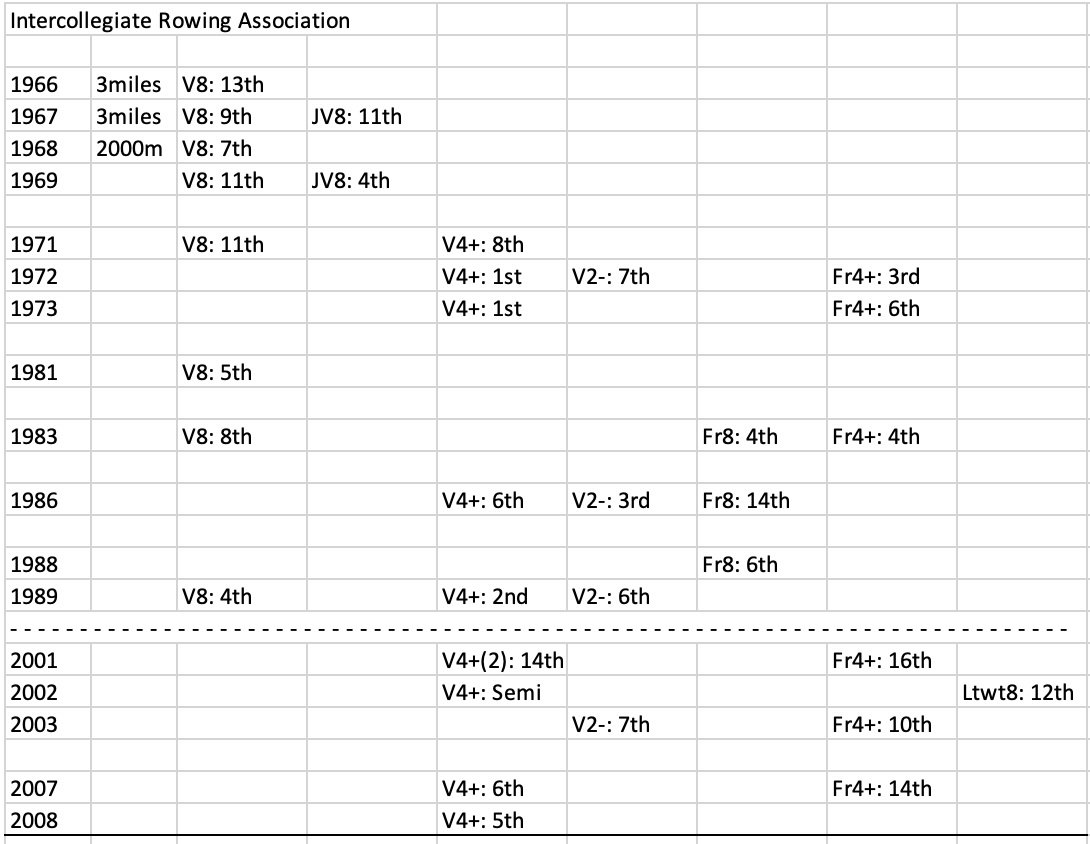
In the absence of and in addition to the IRA there were attempts at other national-level collegiate rowing championships. Though for many years until 2003, the title of “national collegiate” champion was a bit euphemistic since power houses Harvard and Yale did not attend. Following the 2008 the IRA stewards restricted attendance at the IRA to varsity-level teams, thus elimination club-level teams, thus UCLA could no longer attend. The Bruins had sent crews to the IRA in 2001, 2002, 2003, 2007 and 2008 after losing its varsity-program status follow the 1991 season.
UCLA participated in the following years:
National Collegiate Rowing Championship – Cincinnati
1982 – 1996
The purpose of the championship, aside from generating interest in rowing in the Midwest, was to create a national championship bringing together the IRA champion, the PAC-10 champion, the Eastern Sprints champion and the Harvard-Yale winner. During those years Harvard and Yale while attending the Eastern Sprints did not attend the IRA. It was not until 2003 that Harvard and Yale’s men’s varsity 8 ended their long absence from the IRA. The travel to the regatta of those designated invitations was paid by the Cincinnati hosts. As an inducement the winner would receive an expense paid trip to the Henley Royal Regatta. In 1987 athletic directors of schools participating in the National Collegiate Rowing Championship voted to “make it a violation for teams to accept airline tickets from private groups, such as the Cincinnati Regatta Inc., for winning the title.” Matt Solinsky, “Top U.S. Rowers vie in Cincinnati Regatta”, Cincinnati Enquirer, 11 Jun 1989, 37. As a result, the funds passed through a public trust called the Navy Olympic Rowing Fund for a grant to reimburse the expenses for the trip to England.
Other crews were allowed and other events, including women’s events were added. The first added events were the women’s 8 and men’s lightweight 8 added in 1986. The regatta was the creation of local attorney, and former Brown oarsman, Bill Engeman. The East Fork of the Little Miami River had been dammed in 1978, creating a large reservoir outside of Cincinnati in East Fork State Park named for U.S. Representative William H. Harsha, and served as the venue.
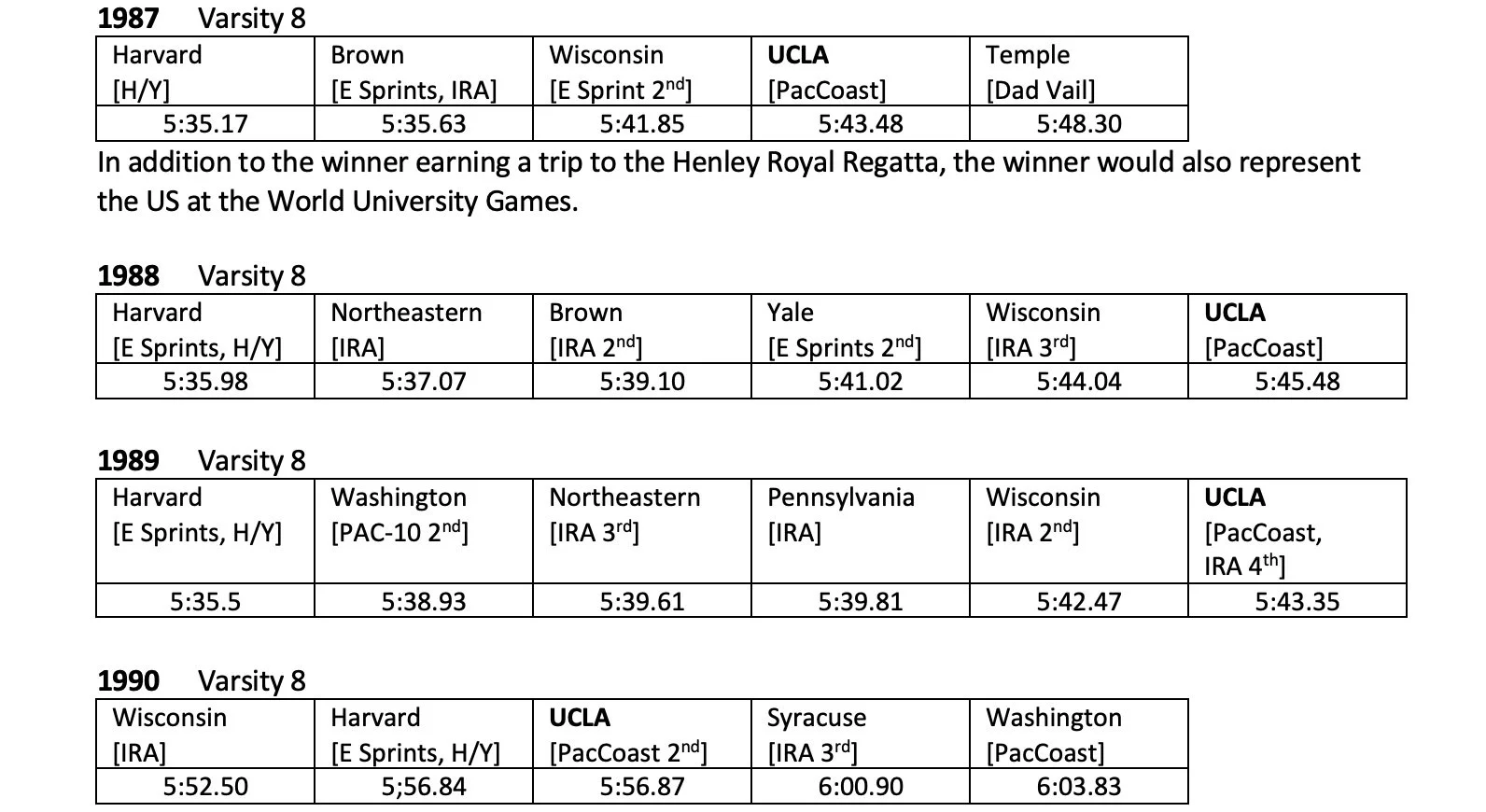
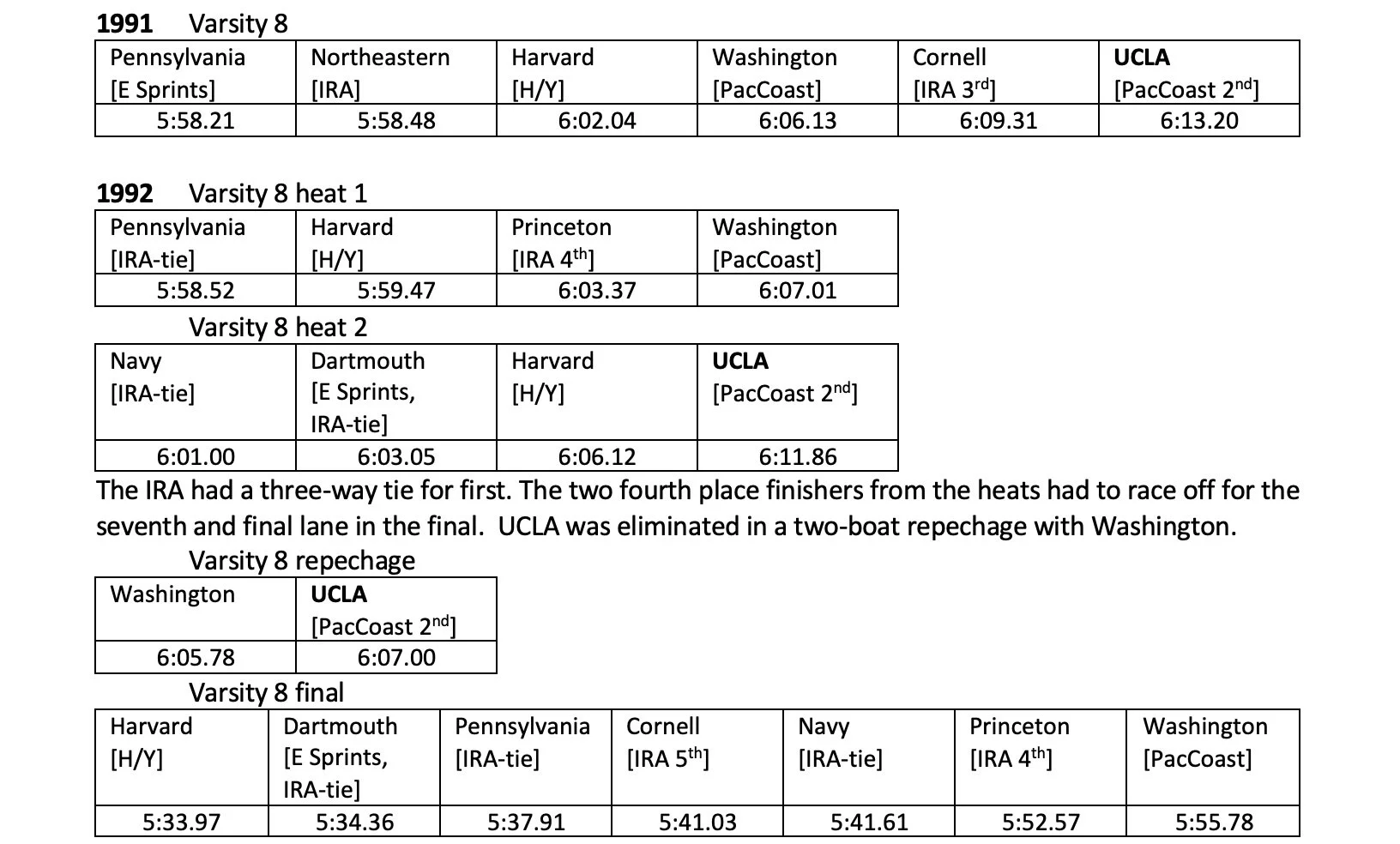
The championship regatta began in 1982 and ran through 1996, ending in advance of the NCAA women’s championship beginning in 1997. Although the women’s championship was moving to a separate NCAA structure the men’s collegiate championship at Cincinnati also ended, along with associated high school races since local sponsorship could not support the regatta with the high school races alone. “Princeton coach Curtis Jordan said he also wants to [continue to] come back [to a National Championship]. ‘What we would like to see is this regatta rotate with the Eastern Sprints and IRA to avoid having to row three 2,000-meter races in four weeks as we did this year.’” Bob Queenan, “Cincinnati Eight is Second as Rowing Event’s Era Ends”, Cincinnati Post, 10 Jun 1996, 19. During ten of its fifteen year existence, the IRA champion did not become the National Collegiate champion. During 1987 thru 1992 UCLA was highly competitive and earned their way to the National Collegiate Championship.
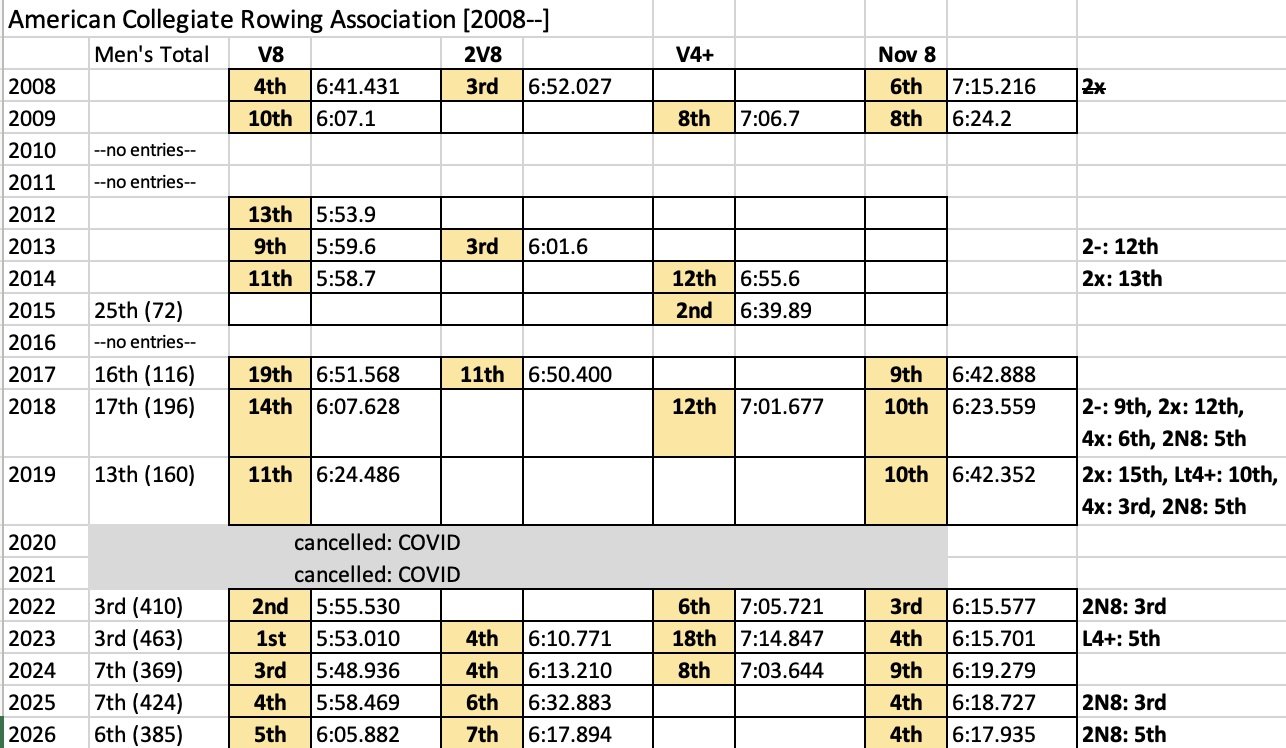
American Collegiate Rowing Association Championships (ACRA)
Before 2006, competitive club rowing programs, which receive little or no funding from their university athletic departments, were able to compete at the IRA Championship. In 2006, Rutgers University eliminated funding by the athletic department from its men's rowing program, reducing it to club-status. Part of Rutgers’s justification for cutting rowing was that clubs could compete equally with funded programs at the IRA Championships. To avoid other members from losing funding, the IRA excluded club-status teams from competing at its championship at the 2009 regatta. The American Collegiate Rowing Association (ACRA) became an alternative championship for these clubs. Established in 2008 by University of Michigan coach Gregg Hartsuff, under the General Not for Profit Association Act of 1986, the ACRA was constituted of club-level collegiate rowing teams, that are not sponsored by an institution’s athletic department as defined by the NCAA. While classified as varsity teams at their schools, both Orange Coast (a two-year college) and Cal Maritime (an NAIA school) were two West Coast teams that could compete at the ACRA. The ACRA was seen by coach Mohka as “the best thing that could happen to our program,” with a season ending championship the whole team could train for.