UCLA did not row from 1944 thru 1946
Collegiate rowing during World War II and its post-War recovery

1947 - 1949
|
1947 - 1949 |
The IRA regatta was not held from 1942 through 1946. Neither was there an Adams Cup race among Harvard-Penn-Navy during 1944 through 1946. Collegiate rowing was essentially shut down during the War in 1944 and 1945. Rowing was cited as the “first and probably hardest hit of any collegiate sport,” during the War years. Chris Kieran, “4 Crews Keep Rowing Alive”, New York Daily News, 29 Apr 1945, 22. Four colleges did continue rowing and competed during both 1944 and 1945. Navy, MIT, Cornell and Columbia raced and met in a four-team end of season regatta during both of those years. Racing involved the host providing shells and equipment for the visiting teams. Cornell’s year-by-year history cites win-loss records of 2-2, 2-4, 2-2 in years 1943, 1944 and 1945, with a 5-1 dual record in 1946 along with a fifth place finish at the (first) EARC.
In the Midwest, Wisconsin continued to row a little, occasionally competing with clubs and schools, but on the Pacific Coast collegiate rowing stopped, with the programs at Sacramento Junior College and Compton Junior College permanently terminated. There were no Cal-Washington dual races during 1944, 1945 or 1946. Washington’s rowing halted following a meager 1943 season. During 1944 and 1945 the program was cancelled but the boathouse was open for intramural rowing and a military (V12) program. The V12 program did row two informal races, a win against crew from the Port Angeles Coast Guard station at and a loss to a crew from the University of British Columbia. Stanley Richard Pocock, Way Enough!: Recollections of a Life in Rowing(Seattle: BLALA Publishing, 2000), 19. The UW varsity program resumed in March 1946. Cal also halted after the 1943 season, but whether it would restart became an uncertainty. “The question of reinstating rowing as an intercollegiate sport became an issue in the ASUC executive committee, just as it had following World War I. The profit-oriented individuals wanted to eliminate rowing before it could start again. Plans were made to sell off the boathouse property and equipment.” Jim Lemmon, The Log of Rowing at the University of California, Berkeley 1870 -1987 (Berkeley, CA: Western Heritage Press, 1989), 36. Don McNary, coxswain of the 1943 freshman crew, had become a member of the ASUC committee and he set in motion a plan including encouraging Cal coach Ebright to return and so successful was the lobbying that the ASUC unanimously voted to reinstate the sport. Ebright set about getting the facilities and equipment back in shape at the beginning of March 1946 with the plan that rowing would resume in the fall but the opportunity to race at the event in Seattle moved the time table ahead.
An action by the Student Executive Council in late May 1946 approved a recommendation “that crew racing be given a place on the budget for [the] next semester.” However, the article cited that coach Wallis had provided his services on a volunteer basis and “frequently met his own expenses whenever the team had regattas scheduled out of town,” and that the Bruin Rowing Club formed among the participants helped defray expenses and that members of the freshman crew paid their own way to the few out-of-town regattas. There were plans announced to reorganize the Shell and Oar (active from 1941 through 1943) that had served as a co-ed auxiliary supporting the team. The team was fortunate to have six shells in its fleet. Those leading the effort as elected officers included Bill Merrill, Phil Baker and Julian Wolf. “Crew Return Given Nod”, California Daily Bruin, 23 May 1946, 3.
1947
UCLA did not row during 1944, 1945 or 1946, though there were still athletic competitions. Extramural competitive sports were celebrated in the UCLA Southern Campus yearbook (football, basketball, baseball, tennis, track, and minor sports: cross country, golf, gym team, cricket [’44, ‘45], water polo, swimming, boxing, rifle [’45, ‘46], pistol [‘46], and wrestling [‘46]). In the spring of 1947, the Bruins were back on the water competing in duals against a reestablished Stanford and Cal along with Sacramento and San Diego State, plus the championship in Seattle in 1947. Although the almost daily reports in past years in the California Daily Bruin were gone, the crew was back in action. The Bruins began with 130 signed up for the team and were practicing when the tide permitted on Ballona Creek. The oarsmen were complaining of the unheated showers and the need for a decent dressing room. Bob Hillen (UCLA coxswain, 1937-39) took over the head coaching responsibility in place of Ben Wallis beginning in late April. Wallis was facing illness in his family and pressures of his business. “Crew Makes Progress Despite Hazards Galore”, California Daily Bruin, 22 Apr 1947, 5. Assisting was Bob Schaeffer (Cal stroke 1943).
The UCLA varsity crew contained six returning Bruin lettermen, one from the 1942 Washington Frosh and one from the 1943 Cal JV. “Crew Races Today”, California Daily Bruin, 2 May 1947, 2. In the inaugural post-War regatta on Ballona Creek UCLA (6:08.1) defeated Sacramento Junior [City] College by three and one-half lengths. The Bruin JV (6:23) and 4V then defeated the Sacramento JV crew. The UCLA JV were six lengths ahead of the 4V who finished one and one-half lengths ahead of the Sacramento JV. In the final race of the day the UCLA 3V faced San Diego State Teachers College varsity, in their first intercollegiate competition. The crews were even through about the first 1000 meters until the #7 in the San Diego crew suffered a broken rigger. The UCLA entry went on to a victory by one and one-half lengths in a winning time of 6:39.4. “Triple Conquest Marks Postwar Crew Inaugural”, California Daily Bruin, 5 May 1947, 5.
Cal was already looking forward to the Olympics scheduled for 1948. Cal’s varsity bow and #7 rowed in the same seats in the 1942 Cal boat, five others including the coxswain were sophomores, the remaining two oarsmen had been in the 1946 Cal varsity. The Bruin varsity held off Cal from moving to an open water lead for the first 1600 meters. Cal (5:57) won by three lengths. Both coaches Hillen and Ebright praised the Bruin crew, with Hillen regarding “the Bruins at least as good, man-for-man, as [the] Cal crew. Limited training facilities [of at times less than even 2000 meter in length on tidal Ballona Creek], he explains, are all that keeps the locals from showing what they are capable of doing.” “Cal Sweeps Crew Meet”, California Daily Bruin, 12 May 1947, 2. The Cal JV finished five and one-half lengths ahead of the Bruin JV. The Cal Frosh defeated the San Diego State varsity by two and on-half lengths. Incredibly all three winning Cal crews were clocked in the identical time of 5:57. Bob Brachman, “Cal Crews Beat UCLA; Frosh Loom Best Eight”, San Francisco Examiner, 11 May 1947, 27.
In the final race of the spring season UCLA’s varsity defeated Stanford by five and one-half lengths, having led from the start. The rowers thought it was their fastest time of the season however the watch timing the race failed. San Diego State’s varsity (6:30.6) defeated the UCLA JV by one and one-half length, having been passed by the San Diego crew at about the 1500 meter mark. The Stanford JV faded fast and were well behind in third place. The UCLA third varsity crew defeated their Stanford opponent by seven lengths in a time of 6:42.8. “Crew Conquers Tribe in No Time”, California Daily Bruin, 26 May 1947, 4.
The Washington-Cal dual resumed with Cal the victor in the varsity race and Washington easily winning the junior varsity and freshman races. After a change in line-up of stroke and # 7 from the JV crew the Washington varsity placed third in the IRA. It was decided that the IRA champion Washington freshman crew, that was strongly competitive with the varsity crew would represent Washington at the second annual Seattle Invitational Sprint Regatta.
In the resumption of the IRA regatta, raced over 3-miles, the eleven varsities concluded with Navy the winner, followed by Cornell, Washington, California, Princeton, Pennsylvania, a 3-way tie for seventh of MIT, Syracuseand Wisconsin, followed by Rutgers and Columbia. Nine of those crews in addition to Harvard, Yale and UCLA attended the sprint race in Seattle. The conditions were idea and Harvard’s winning time was cited as faster than any crew on record, though the course may not have been precisely measured. The second and third place Yale and Washington crews were less than six-feet apart and the decision was based on motion pictures, sighting over the 720 feet of water. The crowd was estimated at 110,000.
Harvard 5:49 | Yale 5:51.8 | Washington 5:51.9 | Syracuse | Cornell | California |
Wisconsin | Princeton - MIT (dead heat) | Pennsylvania | Columbia | UCLA |
Coach Ben Wallis passed away in October 1947, following an illness over two months. He had been the head of the Pacific Automobile Insurance Company and the Bruin’s volunteer coach since 1934.

1948
Bob Hillen
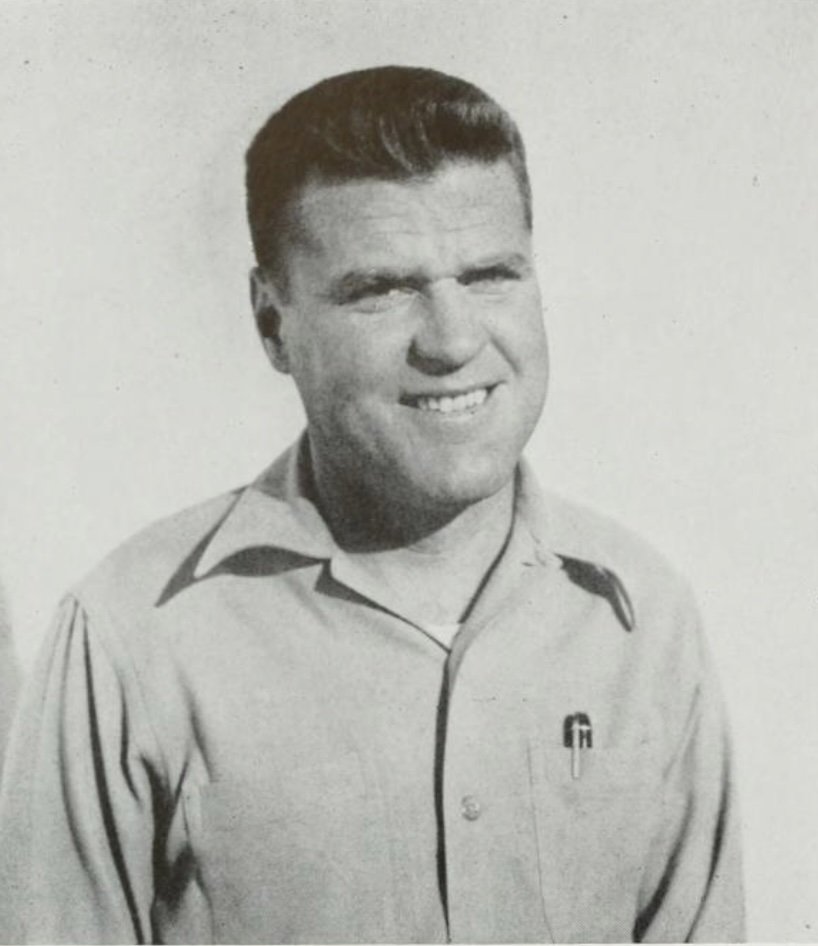
This marked the beginning of the USC rowing program under UCLA alum Julian Wolf ‘47, with the loan of a shell and sharing facilities on Ballona Creek under UCLA coach Bob Hillen. Hillen had gone from being a coxswain at Sacramento Junior College in 1936 to become a coxswain at UCLA from 1937 thru 1939 for Ben Wallis. Hillen started as a freshman coach at UCLA in 1941. After graduating from UCLA, Wolf attended law school at USC. “Wolf, along with Bob Hillen, [who had been Wolf’s freshman] his coach at UCLA [in 1941], started the Trojan men’s crew team in 1948. Hillen, who was interested in establishing a program at USC strictly for competition purposes, offered the use of UCLA’s boathouse at Ballona Creek … and the Bruins’ shells and equipment. UCLA’s athletic department and alumni had a predictable reaction to Hillen’s generosity. ‘They weren’t very happy about it,’ Hillen said by phone recently from his home in Culver City. ‘But I tried to convince [Athletic Director] Wilbur Johns--and he understood the motive--that if rowing was to prosper in this area, there should be more than UCLA rowing.’” Linda Whitmore, “USC Rowing Team Started Because of UCLA’s Generosity”, Los Angeles Times, 19 Jun 1998, web [URL: https://www.latimes.com/archives/la-xpm-1998-jun-19-sp-61644-story.html]. Crew Week culminated in the selection of a crew queen, a dance, the class races (won by ’51) and the christening of two new shells [each costing $1,650], one in honor of Ben Wallis. The UCLA Frosh was coached by Marsh Cleveland. In April the UCLA Daily Bruin carried some remarks by Sandy Weiner the SCOP humor magazine’s Sports Editor with comments regarding the facilities provided to the team, “There is positively no excuse for having the athletes indulge in ice cold showers after a hard workout on the creek, which is a cold ordeal in itself. Are we so indifferent that we can’t even afford a hot water heater for one of our larger sports?” And Weiner also makes the claim, “the students don’t care whether the crew wins, loses, or drops dead.” “Latest Issue of SCOP; Out Thurs.” UCLA Daily Bruin, 7 Apr 1948, 10.
Buffalo (NY) Evening News, 25 Feb 1948, 37.
By Frank Neil-International News Service,
Pittsburgh Sun-Telegraph, 23 Feb 1948, 16.
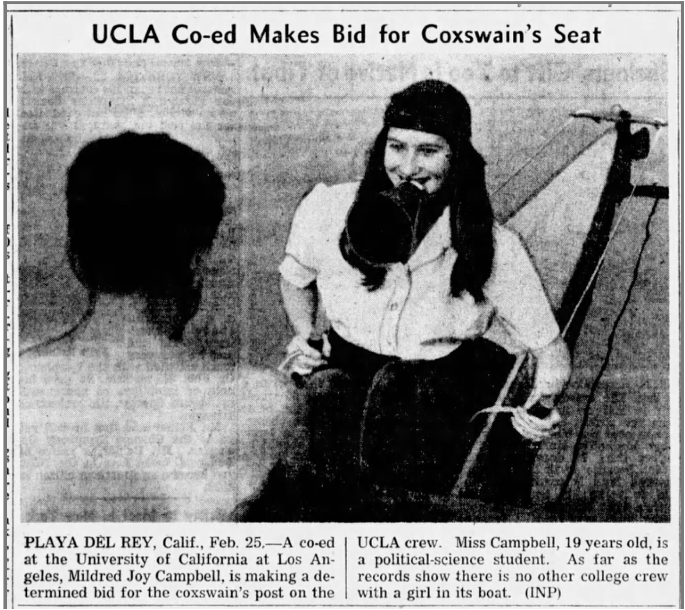
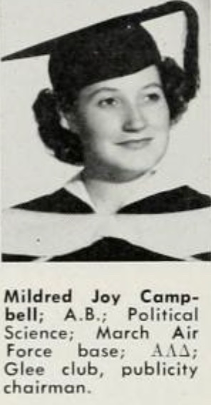
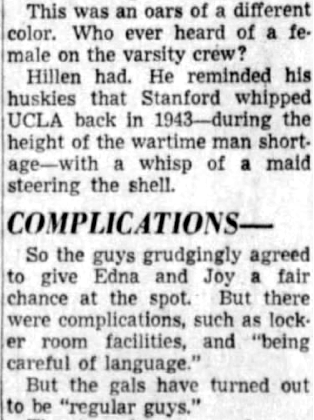
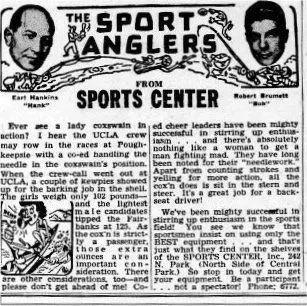
During February of 1948, Mildred Joy Campbell made news across the country and was discussed in a syndicated men’s outdoors columns with several different titles, as she made a bid to become a coxswain on the UCLA men’s crew. She and her roommate Edna Saxton reported to the call out that spring along with 78 male crew aspirants. News articles stated that the rowers were “leery at first” to give the women a try, but were allowed by UCLA’s coach Bob Hillen. At least in news photos, Mildred Campbell was shown actually coxing a shell, often with a header above the photo as “Barking Beauty.” Mildred graduated in 1949 and her yearbook caption did not include mention of the crew, it was mentioned in Edna’s 2008 obituary. A month prior to the first race of the 1948 season both young women were released from the team after an anonymous poison pen letter was sent to coach Hillen and the athletic director claiming that the presence of the two female coxswains was a “detriment to the prestige of the male sex.” UCLA Daily Bruin Reporter Joe Bleeden wrote that the letter went on to say that men were degraded during the last war by having to train under women, and that seemed a shame to have the he-men on the team commanded by girls now. Joe Bleeden, “Girl Coxswains Canned; Hillen Seeks Replacements”, UCLA Daily Bruin, 2 Apr 1948, 6. There was support for the two young women through a letter to the editor. John Johnson, “For Girls and Victories”, UCLA Daily Bruin, 6 Apr 1948, 7.
Decatur (IL) Herald, 2 May 1948, 19.
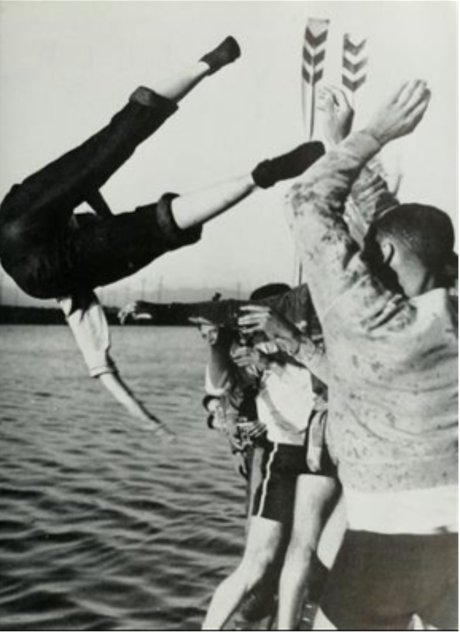
An image of Edna Saxton appeared in several newspapers and in the Southern Campus yearbook, however hers was of her backside as she was airborne. Often printed with a header of “Oops-a-Daisy” and a caption “Girl coxswain Edna Saxton (in air) is tossed into a Los Angeles, Cal., creek by University of California at Los Angeles crew members rehearsing the traditional dunking. Edna is one of UCLA’s two girl coxswains, both were chosen for the job because of their light weight.” “Oops-a-Daisy!”, Santa Cruz (CA) Sentinel, 14 Apr 1948, 5.
Stanford, under Lt. Cmdr. A. A. Clark’s direction this year, swept the three races from the Bruins in the season opening regatta on Ballona Creek on May 1. The first race was the JV eight including four crews. All four crews were even at the 200 meter mark then Stanford’s JV started to move out ahead. The Stanford JV (6:15) finished first, San Diego State’s varsity (6:18) was second, USC varsity in their first competition was third and the UCLA JV finished in fourth.
In the freshman race, Stanford (6:30.5) was two and one-half lengths ahead at the midway point and they stretched that to seven lengths ahead of UCLA (7:04) by the finish. Stanford (6:01.1) won the varsity race, within 7.1 seconds of the course record set by Cal in 1941, with UCLA finishing in a time of 6:27. Joe Bleeden, “Oarsmen Second to Stanford”, UCLA Daily Bruin, 3 May 1948, 5. In a fourth race, UCLA’s Ltwt (3V) was scheduled to race USC’s JV.
Three weeks later, coach Hillen had several athletes suffering from injuries to and again faced USC and San Diego who had both demonstrated successes since the Stanford race. In this race San Diego State (6:20) won by one boat length over USC, with the Bruin varsity two lengths behind the Trojans and the UCLA JV trailed in fourth place. “San Diego Cops Easy Crew Win”, UCLA Daily Bruin, 24 May 1948, 6.
In the final race of the season the Bruins faced the Cal Bears. The visiting Bears were said to make it look easy. In the varsity race the crews stayed close for the first 500 meters with the Bears (6:18.4) keeping their stroke rate low until the final sprint moving to a 34 in their victory over UCLA (6:55) by eight lengths. The Cal JV (6:32) defeated UCLA (6:40) by two lengths. This marked the first presentation by J. Doug Baker, father of UCLA #7 Ken Baker, of the Ben Wallis Memorial Trophy to the winner of the California UCLA race. “Bear Rowers Defeat Bruins by 8 Lengths”, Los Angeles Times, 30 May 1948, 11. The Ben Wallis trophy is a hand carved cherry wood statue depicting an oarsman in a boat. The Cal eight went on to win the gold medal at the 1948 Olympics.
For the third time in its history [fall of 1933 but reinstated by spring of 1934, and suspended during World War II years 1944-1946] following the 1948 season “crew at UCLA was officially dropped by the athletic department as an intercollegiate sport; the recent [October 1947] death of Ben Wallis must have been one of the events which led to the folding of the crew.” Robert Frassetto, UCLA Crew – A Half Century (Los Angeles, 1978), 26. “In 1949, Hillen had a falling out with the UCLA administration over Hillen’s mixed allegiances, and the Bruin crew program was eliminated. That year, Hillen began to provide his services on a volunteer basis to USC. A year later, UCLA revived its crew program, but Hillen never went back.” Linda Whitmore, “USC Rowing Team Started Because of UCLA’s Generosity”, Los Angeles Times, 19 Jun 1998, web [URL: https://www.latimes.com/archives/la-xpm-1998-jun-19-sp-61644-story.html].
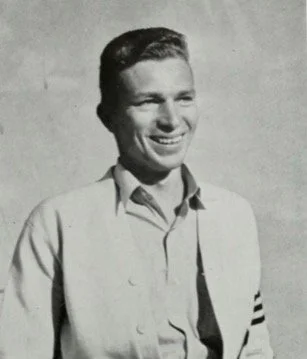
Martin Litton ‘38
As a result, the Bruin Boat Club was formed. “They contacted alumni, enthusiastic supporters, and influential officials, … Largely through the efforts of these unselfish Bruins, presided over by Martin Litton ’38 [three-year letterman: 1936 JV/V stroke, 1937 V stroke, 1938 JV stroke, coach of the 1939 freshmen, lifelong environmentalist, wilderness activist and founder of Grand Canyon Dories], rowing was reinstated in 1949-50 as a major sport.” Robert Frassetto, UCLA Crew – A Half Century (Los Angeles, 1978), 26. 1978 team captain Frassetto cited the 1949 struggle as a valuable future lesson: “Support of the crew by the Department of Intercollegiate Athletics, friends and parents of crew members, and public statements concerning the crew’s proceedings are fundamental to a crew’s viability.” Robert Frassetto, UCLA Crew – A Half Century(Los Angeles, 1978), 26.
1949
In late September 1948 a call-out for those interested in the Bruin Rowing Club appeared in the UCLA Daily Bruin with, “sign-ups for the fall practice sessions of the varsity crew will be taken” and included Bob Hillen cited as “UCLA varsity crew coach” as a featured speaker. “Bruin Rowers Take Sign-ups This Week”, UCLA Daily Bruin, 28 Sep 1948, 6. In the fall, the Bruin Rowing Club “wanted to row as a club in lieu of the suspended varsity competition but this proved financially unfeasible.” Bob Lupo, “Crew Learns Fate at SEC Meeting Tonight”, UCLA Daily Bruin, 24 May 1949, 4. During 1949 while USC and Stanford were active, UCLA was not. There were no races by UCLA in 1949, nor coverage in the Daily Bruin or Southern Campus.
Crew supporters petitioned the Student Executive Council for a favorable recommendation to the Board of Control that controls all the ASUCLA financial matters. The crew proponents were requesting reinstatement as a regular varsity sport with an allotment of $7,000 or $8,000. “Athletic department officials however feel that the only way in which crew can be successfully operated is on a full-time basis, i.e., with a full-time coach, a boat-man and all the necessary adjuncts to a successful athletic program.” Bob Lupo, “Crew Learns Fate at SEC Meeting Tonight”, UCLA Daily Bruin, 24 May 1949, 4. The athletic department placed the annual cost at $20,000 for a first-rate program, which they complained they did not have available; however, the primary concern was that from an engineer’s report that Ballona Creek was not navigable during most of fall training season. While the oarsmen contend that they could condition on land during the fall and “ewhen spring rolls around they would jump into the shells and begin rowing against other crews. But the Bruin crew members would be rowing against teams that have had benefit of actual practice on water during the fall term and defeats would become habitual instead of rare.” “Council to Decide Crew Problem: Facilities Cause Main Controversy”, UCLA Daily Bruin, 20 May 1949, 10. “Director of Athletics Wilbur Johnson is of the opinion that if the creek were to be dredged and a crew racing course were to be provided which would be adequate enough to ensure a representative athletic team, that it would be desirable to reinstate a crew program. Otherwise, he feels that it would be a waste of ASUCLA funds to put on a partial program.” Bob Lupo, “Crew Learns Fate at SEC Meeting Tonight”, UCLA Daily Bruin, 24 May 1949, 4. Dredging would be expensive and the responsibility of the county. Also before the SEC was great contention regarding the slate of the Daily Bruin staff. The SEC passed a resolution recommending crew’s reinstatement as an active UCLA sport with a $5,000 budget for 1950, it still required approval by Board of Control. “SEC Okays Crew”, UCLA Daily Bruin, 27 May 1949, 21.