Duvall Hecht, Olympic Gold Medallist, becomes Head Coach.

1976 - 1979
|
1976 - 1979 |
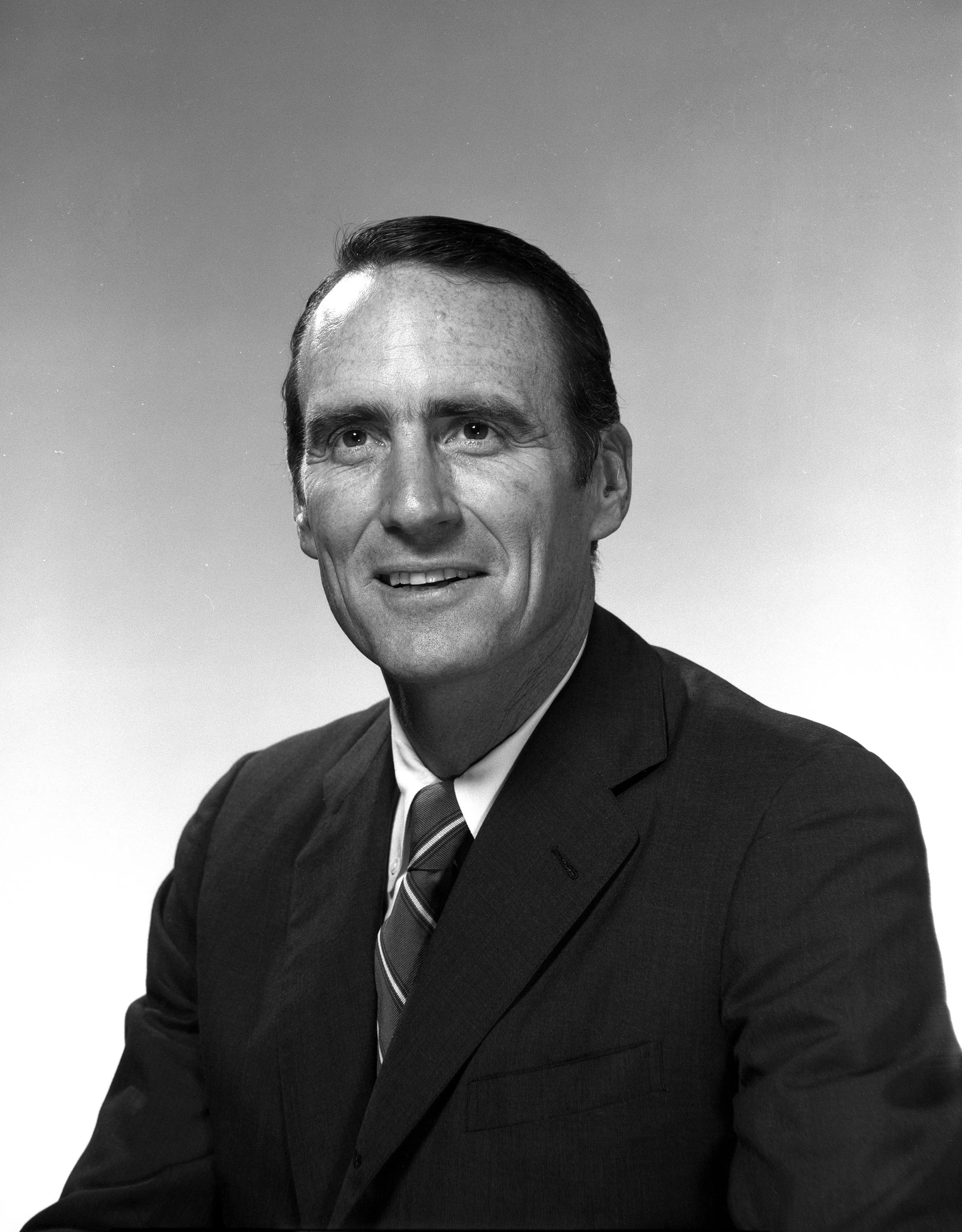
Duvall “Dewey” Hecht
Duvall Hecht (UCLA Head Coach from 1976 to 1979) had attended Menlo College his freshman year to get into Stanford. After rowing at Stanford he represented the United States at the 1952 Olympics in the 2+, but failed to make the finals. He entered the USMC as a fighter pilot. In 1956 he and his partner won the 2- at the Olympics. Hecht served in the USMC for another year and then was a pilot for Pan Am for a year. He taught English at Menlo College and started a team there in 1958 and coached it. In 1959 he took an eight including seven novices and placed second in the varsity eight at Dad Vail Regatta. Hecht started the team at UC Irvine in 1965. He coached the UCLA freshman in 1973/74. Hecht started Books on Tape in 1975 while working for an investment banking firm in Los Angeles, inspired by his daily commute from Newport Beach. He eventually sold Books on Tape to Random House.
At the end of the 1979 season, his fourth year as UCLA’s head coach, Hecht summed up the season saying, “the varsity never quite got things running smoothly,” but not for want of effort. Pat Kennedy, “UCLA Crew Coach Calls it Quits”, UCLA Daily Bruin, 1 Jun 1979, 23. Hecht announced his resignation at the team awards banquet, saying there “is no sense in holding on” longer and that while he was leaving coaching it was expected that he would continue in a supportive role in the “Friends of Bruin Crew.” At the 1979 PAC-10, UCLA finished fifth again defeating Stanford and USC in the finals, after losing to Washington State in the first round.
Among other things, Hecht was lauded in the “Friends of Bruin Crew” for have the team’s equipment in such good condition. Under the watchful direction of Rigger Brown the team had completed sanding and varnishing session of their Pocock shells following Saturday practices with donuts and milk still containing frozen chips provided by coach Hecht. After Hecht’s announcement freshman coach Mike Bennett and Bob Newman, who had been a successful coach at UC Irvine since leaving the freshman position at UCLA, were both cited as potential candidates as Hecht’s replacement. Hecht would return to coaching at UC Irvine in the fall of 1991 until 2001. Duval Hecht passed away in 2022. Richard Sandomir, web, “Duvall Hecht, Founder of Books on Tape, Is Dead at 91”, New York Times, 3 Mar 2022.
1976
Duvall Hecht was named Head Coach of the UCLA Men’s Rowing program. Former Freshman Coach Bob Newman was named as head coach of UC Irvine replacing Duvall Hecht. UCLA graduate Norm Witt became the coach of the UCLA freshmen and assistant coach.
Nine members of the UCLA women’s crew set a Guinness Book of World Record for time and distance in marathon rowing on December 12, immediately after final exams. Their new record was 110.77 miles in 24 hours and 1 minute, replacing a record set by an Australian boy’s high school crew in 1973 of 101.75 miles in 15 hours and 1 minute. “UCLA Women’s Crew Sets Records”, Los Angeles Times, 14 Dec 1975, 60. and Hunter Kaplan, “Row, Row, Row Your Boat – Oarswomen Set Record”, 15 Jan 1976, 23. They were allowed no more than five minutes rest each hour and did that as 15 minute breaks after each 2:45 of continuous rowing. It was hoped that the next year the women would have their own shell and pushing for their own boathouse at the Marina so that they could shower and change clothes. Mike Finegold, “Coxswains Most Ignored Part of Crew Program”, UCLA Daily Bruin, 10 May 1976, 10-11.
That six of the seven coxswains on the UCLA men’s team were female was featured in articles in the Los Angeles Times. They were cited as “generally sensitive to the mood of the men,” and “they’re very good on the psychological aspects of crew,” by coach Hecht and satisfying the weight limit of 120 pounds. Ray Ripton, “Women Pull Weight With UCLA Crew”, Los Angeles Times, 1 Apr 1976, 151. There were two female coxswains for the women’s team.
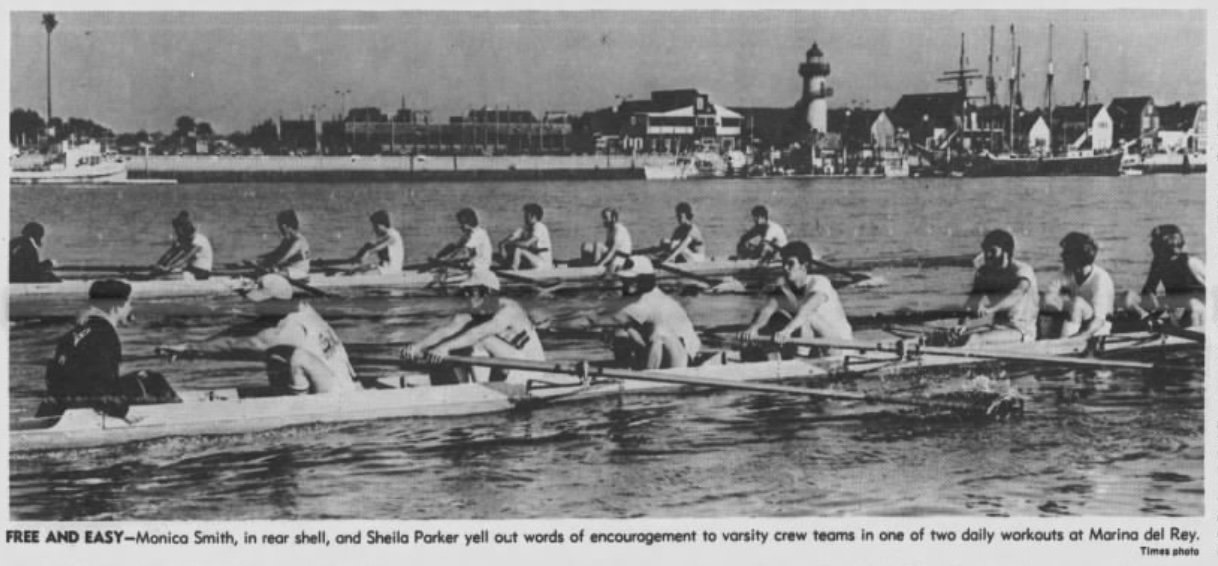
"Women Pull Weight With UCLA Crew", Los Angeles Times, 1 Apr 1976, 154.
The first race of the spring schedule was a race between UCLA and host Orange Coast in Newport on March 20. Host Orange Coast won all three races over the Bruins. Orange Coast won the freshman four in a time of 7:28; the freshman eight (6:33.4) over the Bruins who were described as lacking “the ‘wind up’ at the last 200 meters;” and the Orange Coast first crew (6:29.4) over UCLA’s JV even though Orange Coast had to slow down during the race for a passing yacht. “Bruins Drown as OCC Crew Pulls away in Newport Regatta Opener”, Orange Coast Coast Lines, 24 Mar 1976, 9.
At the April 3 San Diego Crew Classic, UCLA was not included in the grand final of the varsity eight, which was won by Harvard, Cal in third and Washington in sixth. After a fifth place finish defeating Stanford in the preliminary heat, they finished first of the six crews in the petite final. The Bruin JV placed as the varsity with a fifth in their elimination heat and a first place in the petite final. The freshman eight was second in their heat and fifth in the final. UCLA placed seventh in the open 4+. UCLA (6:36.9) was second in the lightweight eight behind Washington (6:26.3), but defeated Santa Clara (6:38.1), Cal (6:43.8), San Diego State (6:48.1) and USC (6:50.4). The Bruins were fourth of five in the men’s lightweight 4+. UCLA placed second in the women’s lightweight eight, behind ZLAC. The women’s eight (3:05.0) finished in third behind Long Beach RA (2:55.6) and Cal (2:58.3) but ahead of Long Beach State (3:08.1), UC Santa Barbara (3:10.0) and San Diego State (3:17.1). Bill Center, “Harvard Crew Champs”, San Diego Union, 4 Apr 1976, H-11.
The Wallis Cup race against Cal resulted in five Cal victories in the six men’s events and one of the two women’s races. The men’s varsity race resulted in a time just one second off of a course record established by Washington. Cal bettered UCLA in a time of 5:43.2 to 5:45. In the JV race Cal (5:50) easily defeated the Bruins by fifteen seconds. Cal also won the freshman race 6:09 to 6:17; Cal turned in a slow time in the novice four but still won in 7:18.1. UCLA’s lightweights (6:22) finished behind the Bears (6:17). The only men’s race that UCLA won was a two-tenths of a second victory in the novice eight. The women defeated Cal in the novice eight by five seconds but lost to the Bears in the varsity eight, both races with freshman Susie McCarty in the stroke seat in both crews, just an hour later. Mike Finegold, “Rowers Have Good Times – But Bears Have Better”, UCLA Daily Bruin, 19 Apr 1976, 18.
On Ballona Creek, UCLA’s lightweights were edged in the eight by Santa Clara, while both UCLA and Loyola protested that Santa Clara had false started. The lightweight four from UCLA defeated Santa Clara and a Loyola JV crew. UCLA’s women raced USC and placed first by 10.5 seconds, and a second UCLA crew in third place only one second behind the Trojan varsity. The UCLA women’s four defeated USC’s four by five seconds. For the men’s Harbach Cup, UCLA won the varsity and JV races, and finished second to USC in the freshman race. The Bruin varsity finished five lengths ahead of Stanford. The next day in Long Beach, the UCLA women’s varsity eight trailed Long Beach State by almost half a length at halfway but pulled ahead to win in a commanding fashion. For UCLA’s (16.17.5) men varsity race in Long Beach, they were 4 seconds ahead at 1500 meters but UC Santa Barbara pulled to within 1.4 seconds by the finish, Long Beach was 16.4 seconds behind UCLA and San Diego state trailed. “UCLA Beats 49er Rowers”, The Forty-Niner, 26 Apr 1976, 5. UCLA won the JV race easily and a thrown together second JV also finished well ahead of UC Santa Barbara and San Diego State. While the UCLA freshman eight finished behind UC Santa Barbara, the freshman four won by ten seconds after a poor start. Mike Finegold, “Rowers Have Good Weekend, Win Cup”, UCLA Daily Bruin, 26 Apr 1976, 19.
1976 marked the first year of the Norman P. Miller Cup, honoring the vice chancellor for Student and Campus Affairs, representing the first trophy race for UCLA women’s crew. The Bruins won the Cup this year based on their victory in the varsity eight. In a two-crew format, UCLA first faced Long Beach State and while falling behind at the start sprinted to a victory in the final 20 meters by .6 of a second. Loyola had defeated USC in their preliminary race. In the final, UCLA led the Lions the whole race. The Bruin women also won the four-oared event over Loyola. Mike Finegold, “UCLA Crews Turning Up For Finales”, UCLA Daily Bruin, 4 May 1976, 19.
On May 2 the UCLA men raced at the Newport Regatta. The Cal varsity came from behind at the halfway mark to finish ahead of UCLA by 1.2 seconds. The first race of the day the Bruins finished behind Cal, Orange Coast and Long Beach State in the freshmen four. The UCLA lightweight eight won their race by less than one-tenth of a second. The Bruins were disappointed in the freshman eight, finishing in fourth place among six crews. UCLA was the winner of the JV 4+ by three seconds with a boat that was arranged the day before. The JV eight finished with UCLA in third place behind Orange Coast and Cal that had made a closing sprint against Orange Coast. The following week would be the interclass regatta. Mike Finegold, “UCLA Crews Turning Up For Finales”, UCLA Daily Bruin, May 4 1976, 19.

1976 heavyweight team
The Western Intercollegiate regatta was raced over 2000m for men and 1000m for women at San Pablo Reservoir, May 14-15. It was the first year that included an expanded schedule for collegiate women. The rustic regatta site was described by California freshman coach Kent Fleming, in the May/June 1976 Oarsman magazine as difficult for spectators to view a race which required almost a four mile drive from the start to the finish. The 63 race schedule with heats and reps on Friday and finals on Saturday was described as “cluttered with too many events.” Although the site was beautiful, it was also primitive without toilets, dressing rooms, running water, telephones, an announcing system, proper shell storage or even a buoy system. The size of the regatta was estimated as over 800 competitors from 30 colleges and clubs.
Washington and California were the favorites in the varsity eight, however both UCLA and Oregon State brought some credentials. Oregon State had finished second at the 1975 Sprints and had finished only 1.6 behind Harvard in their heat at the San Diego Crew Classic. UCLA was led by a new coach Devall Hecht, and had been racing well and finished within a half-length behind California during their several meetings earlier in the season. UCLA had placed first in the petite final at San Diego, ahead of Oregon State [2nd], British Columbia [3rd], Stanford [5th] and UC Irvine [6th]. California had finished [3rd] nine seconds ahead of Washington [6th] in the final of the San Diego Crew Classic and Washington had nosed ahead of California by 4/10th of a second in the final 100m of their dual meet.
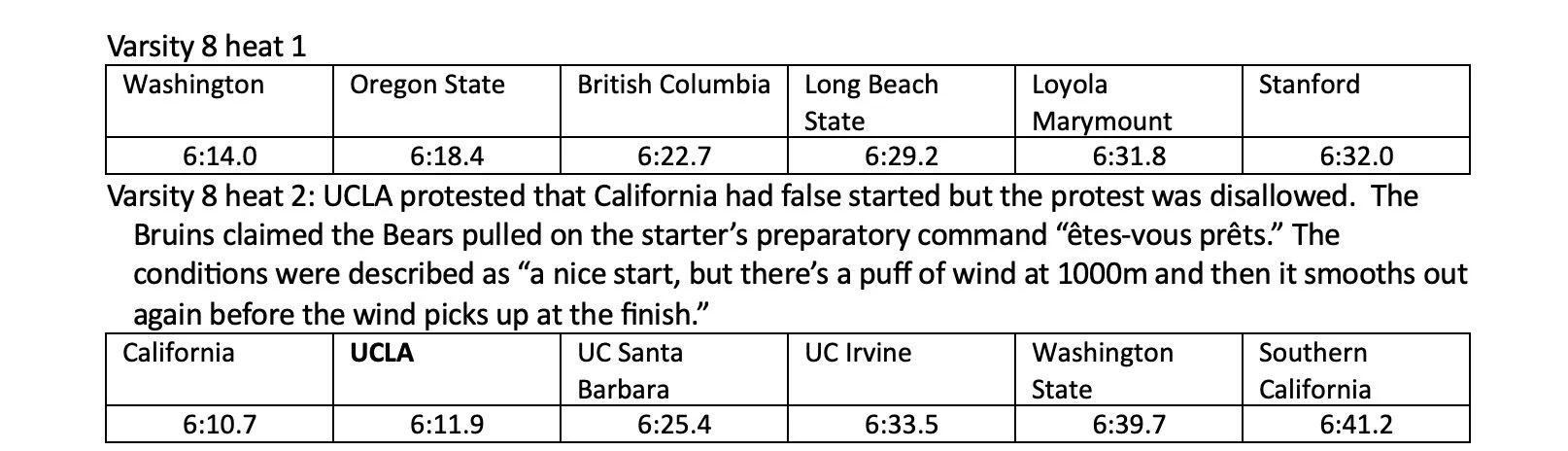
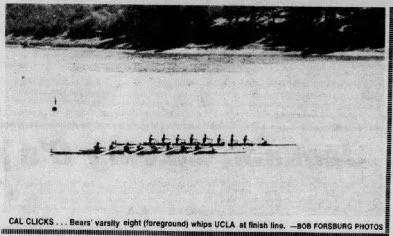
[Heat 2] Bob Forsburg, Berkeley Gazette, 15 May 1976, 5.

“UCLA had an early three-seat lead when Washington caught up at 500 meters, with Cal a seat behind.” “Best in the East Next for Cal Crew”, San Francisco Chronicle, 16 May 1976. California and Washington were even at the 1000m mark with California rowing at 36 spm and moving to a slight lead at 1100m. UW coach Erickson was quoted as saying, “This is the second race this crew rowed up to its ability,… I don’t think we were ever behind … we were jockeying with Cal for the lead, back and forth, by a couple of seats until we moved away” after 1000m and stroked at 34 spm near the stretch. “We put all of our marbles in one basket right here, this ends our season.” “Huskies Outrow Cal in Western Sprints”, San Francisco Examiner, 16 May 1976, 34. The Washington eight contained six seniors. Washington did not attend the IRA because the event was scheduled a week prior to final examinations. California coach Steve Gladstone characterized his crew’s performance as “We were like a runner who didn’t have an easy flow or rhythm. We were moving pretty fast, but we really had to work hard – it was a grunt.” His rowers told him that they just didn’t do it in the third 500m, while they had usually been strong during the middle 1000m or races during the season. Gladstone also stated that “It’s tough to accept because we whomped [Washington] in San Diego at the beginning of the season and virtually won on the Estuary. Today their victory was decisive. You wonder what you have to do to beat those bastards.” Nick Peters “No Excuses for Cal Crew”, Berkely Gazette, 17 May 1976, p. 13.

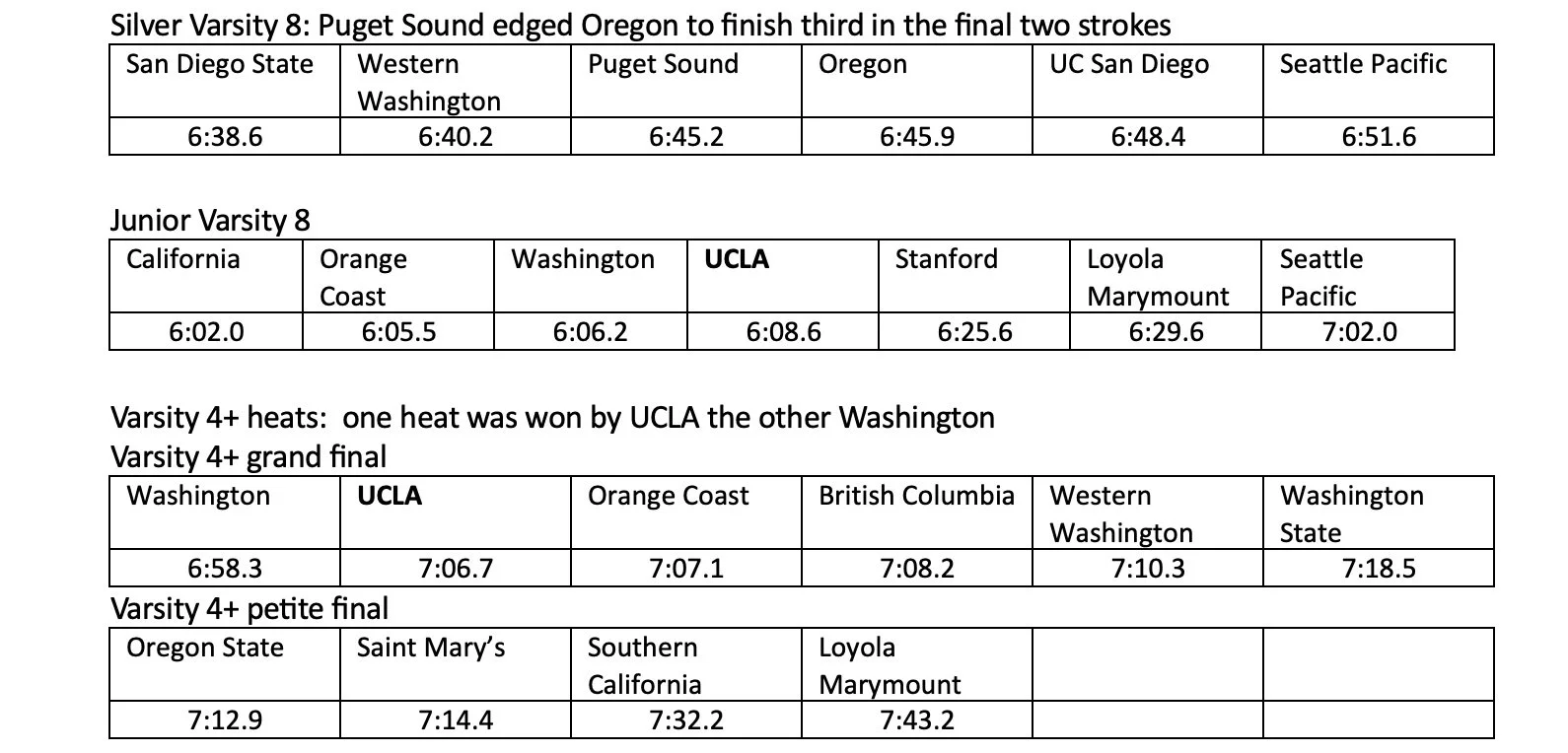
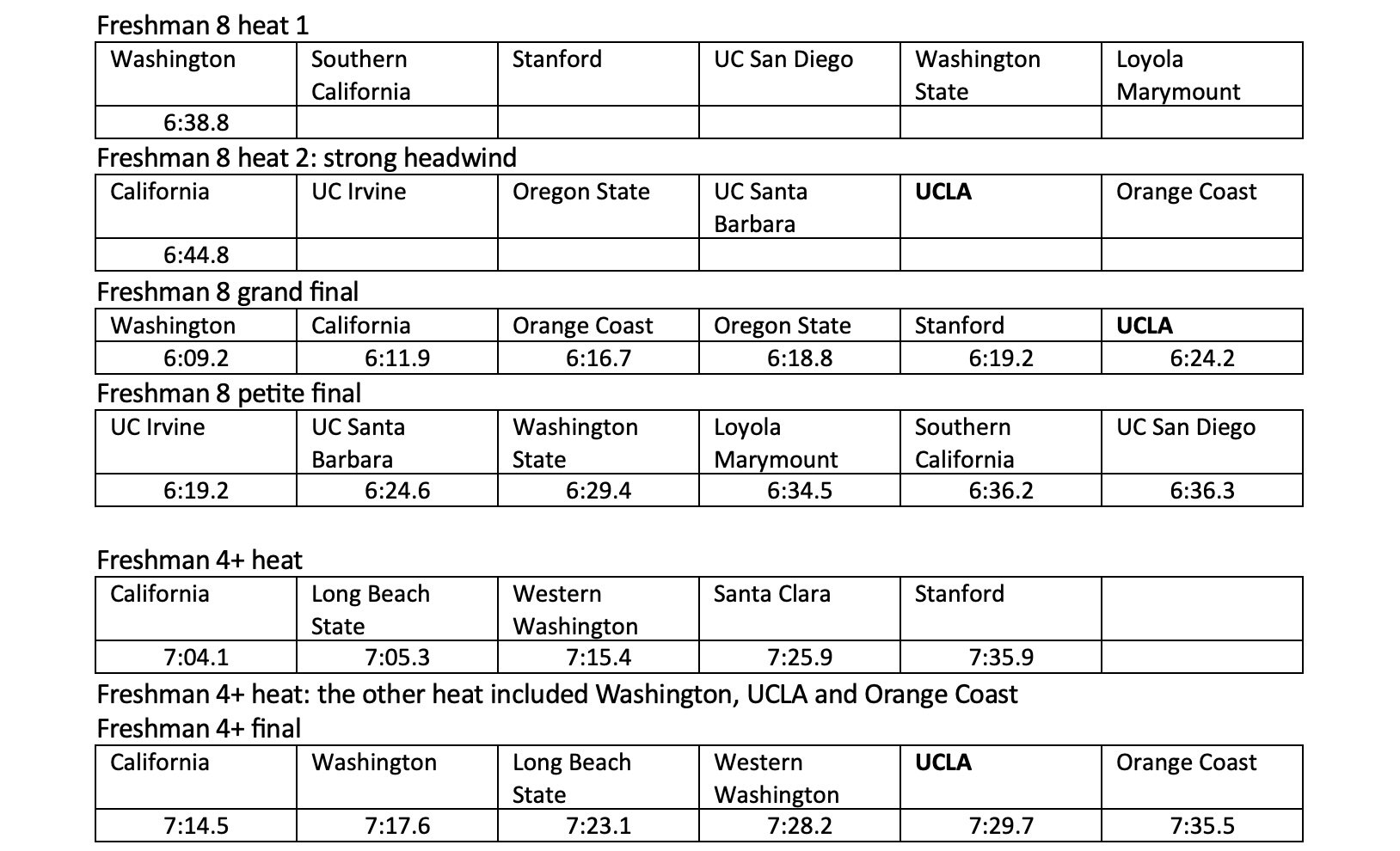
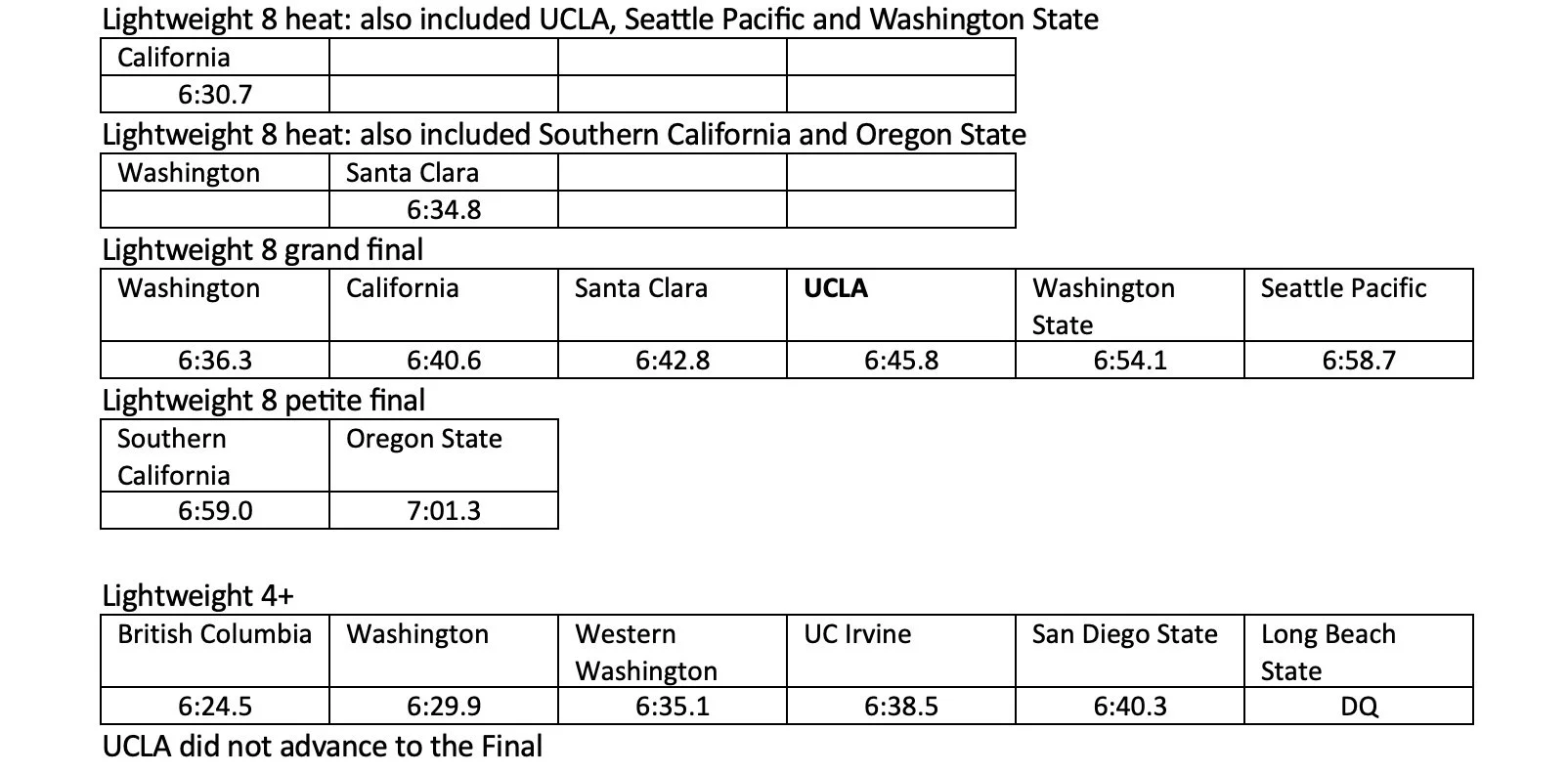
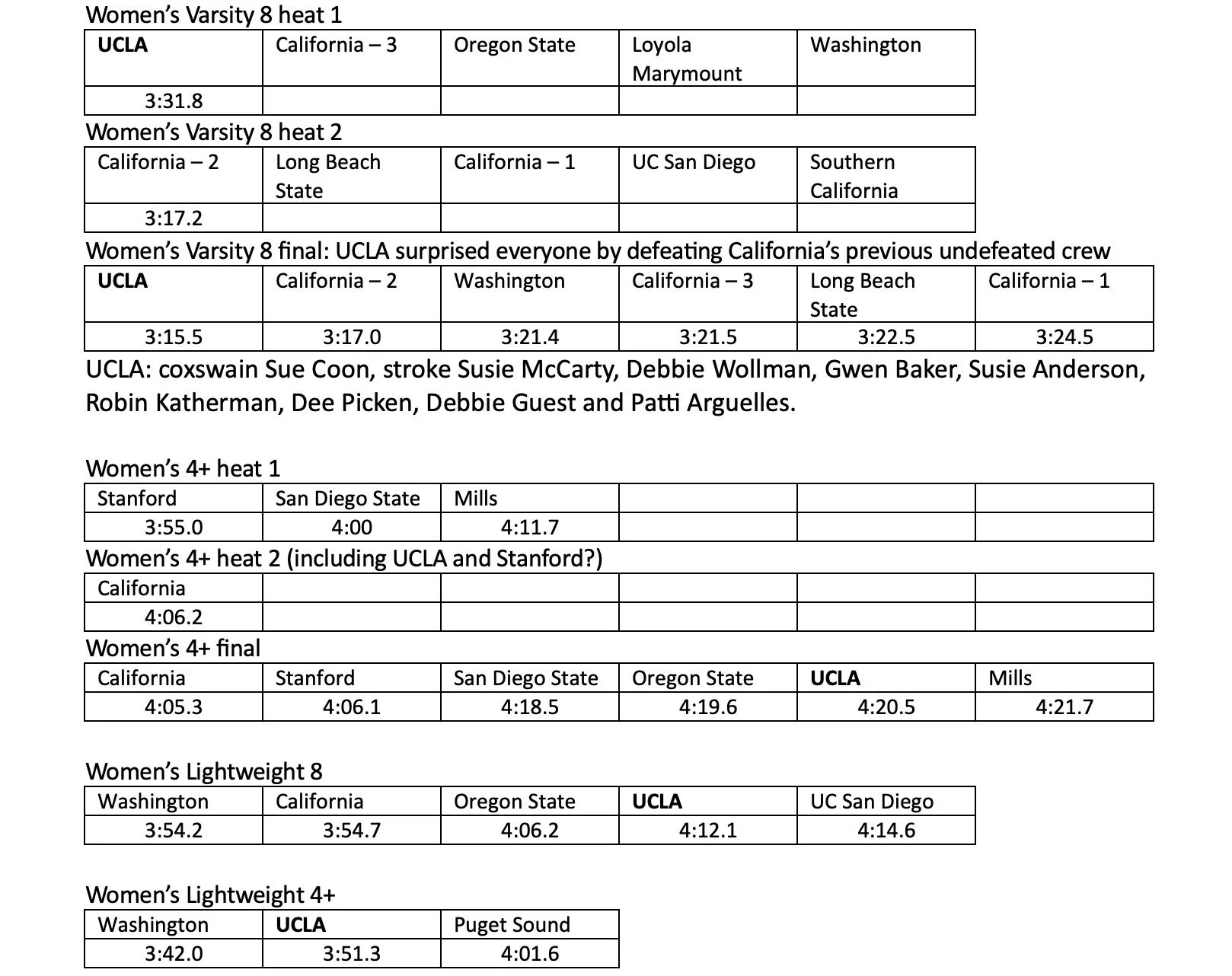
Kent Fleming concluded his summary of the regatta by stating, “The Western Sprints are a great spectacle, but they seem to have grown somewhat out of control and therefore they lack a central focus. The proper focus, of course, would be the original intention of holding the Sprints, i.e., to provide for the championship level rowing.” Kent Fleming, “Western Sprints”, The Oarsman, May/June 1976, pp. 37-38. The 1976 Western Sprints was in fact the last time until 1984 that all but a rare Pac-8/10 school competed with the non-Pac-8/10 schools in the Western Sprints/WIRA championships, instead competing in their own league championship regatta.
In the 1976 IRA championship California was the only team from the West Coast and attended with three entries (second place Varsity 8, first place JV 8 and second place Freshman 8), Washington did not attend.
Freshman eight [12 entries]: California 7th (first in petite)
Freshman four [12]: No West Coast crews
Junior Varsity eight [7]: California 4th
Varsity pair-without coxswain [8]: No West Coast crews
Varsity four-without coxswain: [7]: No West Coast crews
Varsity four-with coxswain [16]: No West Coast crews
Varsity eight [11]: California 1st
UCLA women finished second their heat in the open eight over Dartmouth and Mexico at the NWRA nationals “Rowing Results”, Long Beach Independent, 19 Jun 1976, 13. The NWRA included both club and college crews among their entrants. UCLA also raced in the lightweight 4+ and finished fourth of five in their elimination heat. In the open eight final, UCLA finished fourth behind College Boat Club, Wisconsin and Cal, defeating Dartmouth and Washington. Jim McCormack, “Lind Rows to Two More Wins in Women’s National Finale”, Long Beach Press-Telegram, 21 Jun 1976, 22.
In early June, the Daily Bruin carried an article regarding the conflict between the Sailing Club, overseen by Cultural and Recreational Affairs, and the varsity rowing program for use of the dock and storage space around the boathouse. “Originally the UCLA docks [on Marina del Rey] were built for training and operation of the crew team in 1966. The Sailing Club moved into the facilities a year later with only two boats.” Since that time the number of sailboats has greatly expanded. The sailors were also unhappy about the storage of two 40’x6’ crew training barges, each weighing several thousand pounds, in their storage space. Alan Michael Karbelnig, “On the Waterfront – Sailing Club Battles Crew for Docks”, UCLA Daily Bruin, 4 Jun 1976, 1, 20. New boathouse docks were installed in Marina del Rey in the spring of 1977 and requested that the Department of Small Harbors move a 5-knot speed limit warning buoy 300 feet southwesterly of the UCLA boathouse from a position 800 feet northerly of the boathouse since vessels “traveling 8 knots or faster create wakes which caused damage to the boathouse docks.” “Speed Limit Buoy Placed in Harbor”, Los Angeles Times, 20 Mar 1977, 444.
1977
Coach Duvall Hecht was again assisted by freshman coach Norm Witt.
At the fifth annual Head of the Harbor was growing and “UCLA crews gave an impressive preview of the season despite an oil tanker and a collision.” The collision occurred at the end of the men’s novice eight race. UC Irvine had finished and lingered at the finish line over a minute, so that when UCLA came across the line the Bruin shell ran into the UC Irvine hull, damaging six feet of the shell’s bow. The bow four rowers of the UCLA crew had to exit the shell so that it would not sink. No one was hurt and no protest was filed. UC Irvine (30:53) won the event, the UCLA (31:36) shell that collided was second, and a second UCLA novice crew (32:14) was third. The UCLA men’s freshman crew finished fifth behind a Cal entry. The men’s lightweight eight finished seventh. The last race of the regatta was the men’s open eight. An oil tanker prevented twelve of the twenty-one entries from rowing the entire 4½ mile course so no points were awarded and the race was called a draw. “Nine boats allegedly completed the course in its entirety, but officials felt only five actually rowed 4½ miles. UCLA’s ‘A’ boat, fifth starting out finished with a 26:12 time, good enough to beat the other eight boats which finished as follows: Cal ‘B’, MBRA/ZLAC ‘A’, Cal ‘A’, UCLA ‘B’ (26:59), Motley, OCC, Stanford ‘A’, and Stanford ‘B’.” Washington’s entry posted a time of 26:04 but only rowed 4 miles. The women’s lightweight four (32:14) {Renee Smith at bow, Renee Lux, Jackie Stitt, Sally Huhn, cox Dalynn Scott} finished third behind Mission Bay RA/ZLAC (34:28). In the women’s eight, UCLA (28:10) {Patty Arguelles at bow, Joanne Gold, Dee Picken, Robin Katherman, Susie Anderson, Gwen Baker, Debbie Wallman, Susie McCarty and cox Erin Morey} was fifth with Cal-B (27:07) the winner. Cindy Luis, “Crews Open Impressively”, UCLA Daily Bruin, 18 Nov 1976, 25.
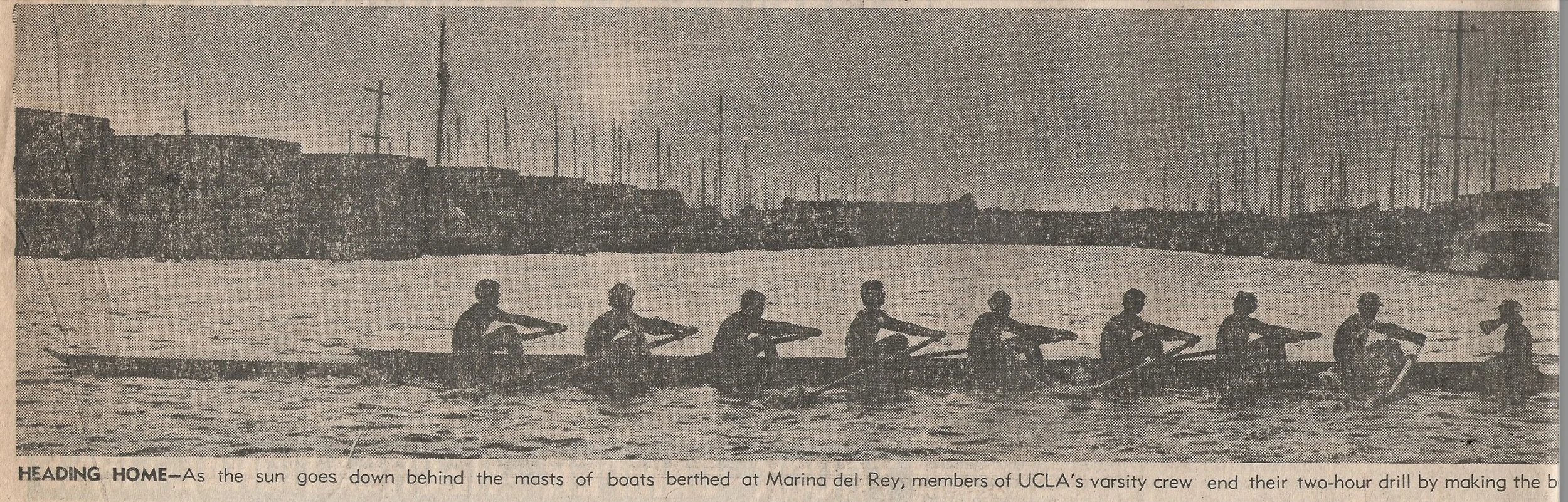
Bill Hodge, Los Angeles Times, 5 Nov 1976, 42.
The lightweight team under Jon Gilwee defeated the fledgling University of San Francisco team in March as the Don’s traveled south for their first intercollegiate contests “Crew Faces USC & UCLA”, USF Foghorn, 11 Mar 1977, 11. against USC then UCLA’s lightweights. The Bruins moved to control the race after the 1500m mark. “Crew Strokes to New Status”, USF Foghorn, 22 Apr 1977, 11.
The difference between the harmonization of men’s and women’s rowing teams at UCLA and USC was presented in the USC Daily Trojan. At USC the men’s and women’s teams were fairly coordinated though the women sought greater attention from the women’s athletic department, on a par with other women’s sports at USC like tennis and track. USC women’s coach Jim Willis said, “the women are a subset of the men’s team. … At UCLA, I don’t think the men and women know each other that well. At Cal they don’t even row out of the same boathouse. I think it’s more fun the way it is here. This is the only true coed team I know of.” Dave Moore, “USC Crew Program: A Marriage of Strenuous Labor on the Water”, Daily Trojan, 25 Mar 1977, 16, 13.
At the fifth annual San Diego Crew Classic, the Bruin men’s varsity eight finished fifth in the consolation final beaten by UC Santa Barbara (10th) for the first time with Loyola behind the Bruins; the women’s varsity eight and men’s lightweight eight each placed sixth in their final after a second place finish in their preliminary heat. In the women’s lightweight eight, the Bruins finished fourth though complained that their coxswain did not hear the starting commands, and that theirs was the only crew that approached the starting line correctly for a running-start race. Both the men’s freshman and JV eights finished sixth in the finals. The men’s lightweight four finished third of four and the men’s open four was second, eleven seconds behind Princeton. Cindy Luis, “Rowers Capsized at Mission Bay”, UCLA Daily Bruin, 5 Apr 1977 17.
Following the Crew Classic coach Hecht claimed “we have an excellent crew this year.” He saw the depth of experienced oarsman as a program strength with as many as twelve oarsmen vying for seats in the varsity eight. Coach Gilwee, however felt that his lightweight squad lacked depth. Neither squad had performed well against Cal crews at the Crew Classic. Hecht called on his rowers to display “more emotional intensity” in addition to their talent, and Gilwee said “We’re nowhere near our peak yet.” Bob Heber, “Crew Prepares for Berkeley Showdown”, UCLA Daily Bruin, 12 Apr 1977, 13.
However, in Oakland, all five of the UCLA heavyweight crews lost to Cal with the two Bruin lightweight crews winning by large margins. Hecht summarized, “We didn’t have the right combination, . . . we rowed better but I didn’t expect us to lose by that much.” The UCLA varsity (5:41.3) was behind at the 1600 meter mark and couldn’t make up the deficit and finished 8.2 seconds behind the Bear varsity (5:33.1). In the JV events, the first Bruin crew lost by 8.5 seconds, 5:41.0 to 5:49.6; the second JV was tied at 1600 meters but the Bears sprinted ahead to win by 2.5 seconds. Both UCLA freshman crews lost to Cal crews by 9 seconds, the first crews timed in 5:52.1 to 6:02.7. The UCLA lightweight four won by 12 seconds and the lightweight eight won by 4.5 seconds both with leads coming past the 1600 meter mark. Varsity coxswain Sheila Parker felt that the course felt short in distance. Bob Heber, “Berkeley Bests Bruin Heavyweight Boats”, UCLA Daily Bruin, 19 Apr 1977, 19. and Ed Schoenfeld, “New Cox Walking Tall for Bears”, Oakland Tribune, 18 Apr 1977, 33.
The UCLA women’s eight lost to Cal by 2.3 seconds in a time of 3:00.2 to Cal’s 2:57.9, making up 5 seconds from their previous meeting at the Crew Classic. In the lightweight race Cal was 3:03.3 to UCLA’s 3:11.1. They prepared for the coming weekend where Bruin varsity and lightweight eights would race USC in Wilmington and the next day race a varsity eight and varsity four, the four drawn from the lightweight eight, against UC Santa Barbara, Long Beach State and USC at Long Beach. Cindy Luis, “Women’s Crew Row Two”, UCLA Daily Bruin, 22 Apr 1977, 19.
The Bruin men’s heavyweight prepared for the Harbach Cup and then a race in Long Beach against UC Santa Barbara, Long Beach State and USC. Hecht pronounced that “This should be the turning point in our season. We should win these races.” By work on improving hull speed Hecht predicted, “We’ll race a hell of a lot better this weekend.” Bob Heber, “Double Regattas For Men”, UCLA Daily Bruin, 22 Apr 1977, 19.
The men’s heavyweight varsity defeated Stanford and USC on Friday and then UC Santa Barbara, Long Beach State and USC a second time on Saturday at the Sievert Cup. “The JV heavyweights also swept their weekend races, with a second boat finishing three seconds behind the first.” For the freshman squad, they posted a loss in the eight at the Harbach Cup regatta; at Long Beach, the freshman four lost but the freshman eight came back to post a victory. The women’s team defeated USC in both of its races on Friday. The varsity crew defeating USC by one boat length, and a predominantly lightweight crew, using two heavyweight rowers, won their race over USC rowing a new shell. On Saturday the varsity eight defeated Long Beach by two-seats, while the Bruin four was defeated by USC. “Rowers Get Weekend Wins”, UCLA Daily Bruin, 26 Apr 1977, 19.
The Bruin Women hosted Washington in a rare trip for them to Southern California, racing heavyweight and lightweight eights and an open four. The Huskies won both the lightweight eight and open four by nine seconds, but the Bruins came through with a three second victory in the varsity eight. Cindy Luis, “Women’s Crew”, UCLA Daily Bruin, 3 May 1977, 19.
While the men were at the Newport Regatta on May 1, UCLA again faced Cal along with UC Irvine, UC Santa Barbara, Loyola and Orange Coast College. It would be the lightweight’s first competition since their win over Cal. The varsity eight (6:15.5) finished third, behind Cal (6:11.7) and UC Irvine (6:15.2) in a very close finish. The Bruin JV (6:29.6) finished third to Cal (6:20.4) and Orange Coast (6:24.7). The freshman eight finished fourth and the freshman four fifth. UCLA’s lightweight eight (6:28.9) while defeating Santa Clara and Loyola, could not replicate its victory over Cal (6:24.8). One of UCLA’s highest finishes of the day was a victory in the varsity 4+ “Rowing Results”, Los Angeles Times, 2 May 1977, III-9. moving out to an early lead and increased it steadily through the race. The lightweight four used a “go-for-broke sprint” to overcome a one-boat length deficit in the last 500 meters and won by 8 seconds. While the Bruins were named the outstanding crew at the regatta, coach Hecht said, “We’d trade it all for winning the varsity eight.” This was the third finish by the varsity eight behind the Bears of the season. Their final sprint had brought them even with UC Irvine with 50 meters remaining, “but it wasn’t good enough” according to varsity coxswain Shelia Parker. Bob Heber, “Rowers Win But Lose at Newport Regatta”, UCLA Daily Bruin, 3 May 1977, 20, 15.
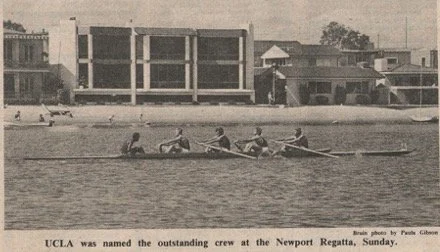
[UCLA varsity 4+ won at Newport Regatta] Paula Gibson, UCLA Daily Bruin, 3 May 1977, 20.
Following Newport, the Bruin men’s team held their interclass regatta. The women’s team hosted the second annual Norman P. Miller Cup, racing a heavyweight eight, a lightweight four and the lightweight eight racing in a JV event. For the second year the Bruin women won the Cup. The Bruin varsity edged out their strongest competition, Long Beach State, in the first round and defeated Loyola in the final. The lightweight four defeated USC for a win by nine seconds, and the lightweight eight racing in the JV event fell to Long Beach State by four seconds. Cindy Luis, “Women Row to Title in Miller Cup”, UCLA Daily Bruin, 16 May 1977, 15.
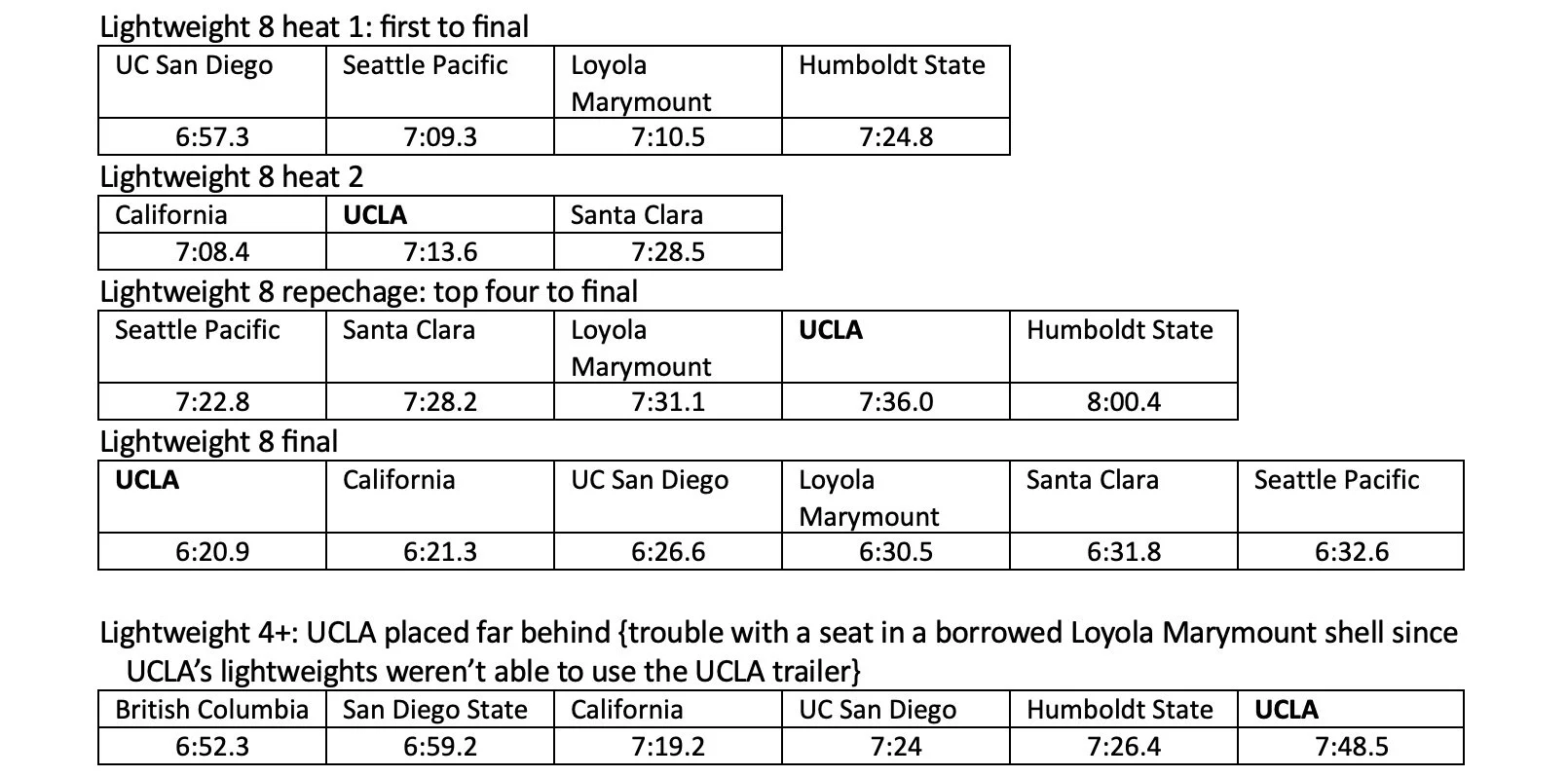
The Western Intercollegiate was raced on the North Lido Channel in Newport Beach, May 13-14. This was the first year of the separate PAC-8 championship the following weekend, leaving the remaining crews to race the Western Sprints. Fifteen crews were scheduled to compete in twenty-six races over the Friday-Saturday regatta. UCLA heavyweights chose the PAC-8 regatta over the Western Sprints, however UCLA’s Lightweight team was given a choice of attending only one of the championships and attended the Sprints instead. Since the UCLA athletic department would only pay for one championship lightweight coach Gilwee declared that they would rather race at the Sprints. UCLA Varsity coach Hecht was quoted as saying, “The Pac-8s supersede the Sprints. The Western Sprints were getting out of control. There used to be only five schools on the coast that rowed, but now there’s over 22.” “Men’s Crew”, UCLA Daily Bruin, 12 May 1977, 19. The UCLA Lightweights had to transport their eight-oared shell on Loyola Marymount’s trailer, since they were not allowed to use the UCLA team trailer, and borrowed a four-oared shell from Loyola Marymount that developed problems during the final of the Lightweight 4+. The Bruin lightweight four had twice defeated Cal. “The trouble started when Matt Barbato’s seat popped off its track. Barbato tried to fix it, but as he did, UCLA plodded along six lengths behind British Columbia. At one point, Barbato nearly fell out of the boat.” “’It was terrible’, said Barbaato. ‘This wouldn’t have happened if we had our own boat.’” Bob Heber, “Oarsmen Make Beeline to western Rowing Title”, UCLA Daily Bruin, 16 May 1977, 15. Five PAC-8 schools participated in the Lightweight 8 at the PAC-8 championship (Southern California, Oregon State, Washington, California and Washington State)
Western Sprints (selected results, no women’s races):
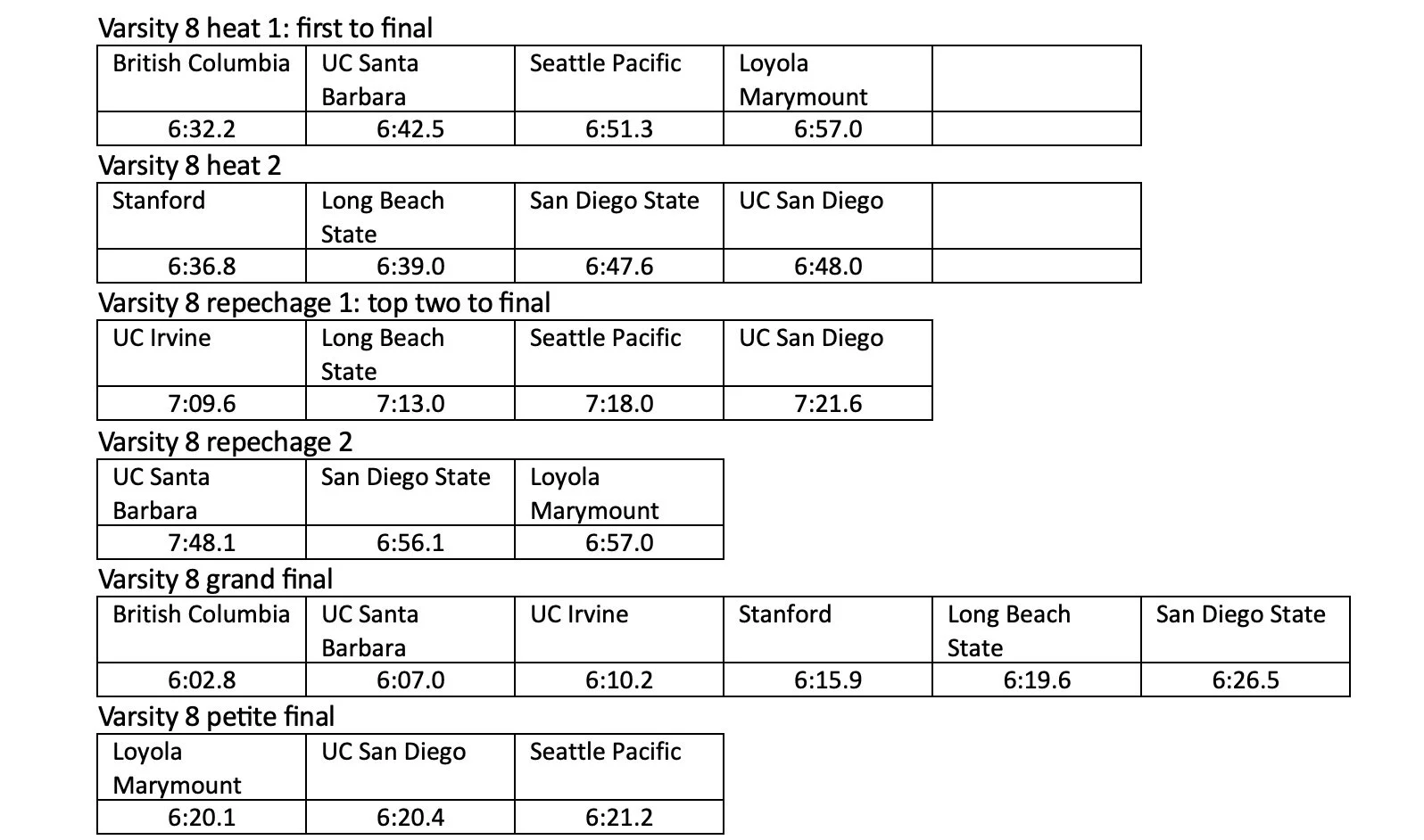
The first PAC-8 championship for men, was held at Redwood Shores, on May 20-22. The Western Invitational Women’s Rowing Championship on the same course (not official Pac-8 basis) during the same weekend. The race format was a bracket with match races. The women’s distance remained 1,000 meters while men raced 2,000 meters
Conditions included cloudy skies and headwinds. Stanford, considered a club sport, had difficulties proving athlete eligibility due to insufficient units completed since the last season to comply with NCAA requirements. Most of the other schools present felt Stanford should be allowed to stay. Ed Jacoubowsky, “Cardinal Crew Ineligible” Palo Alto Times, 21 May 1977, 23.
While disappointing for the Bruin varsity, in its first round loss to Washington State, the Cougars saw it as a breakthrough and earned respect for their club program that had first raced in the spring of 1972. David Arnold, Pull Hard! Finding Grit and Purpose on Cougar Crew, 1970-2020 (Washington State University Press: Pullman, WA, 2021), 57. That WSU crew included future 1984 Olympic gold medalist Paul Enquist.
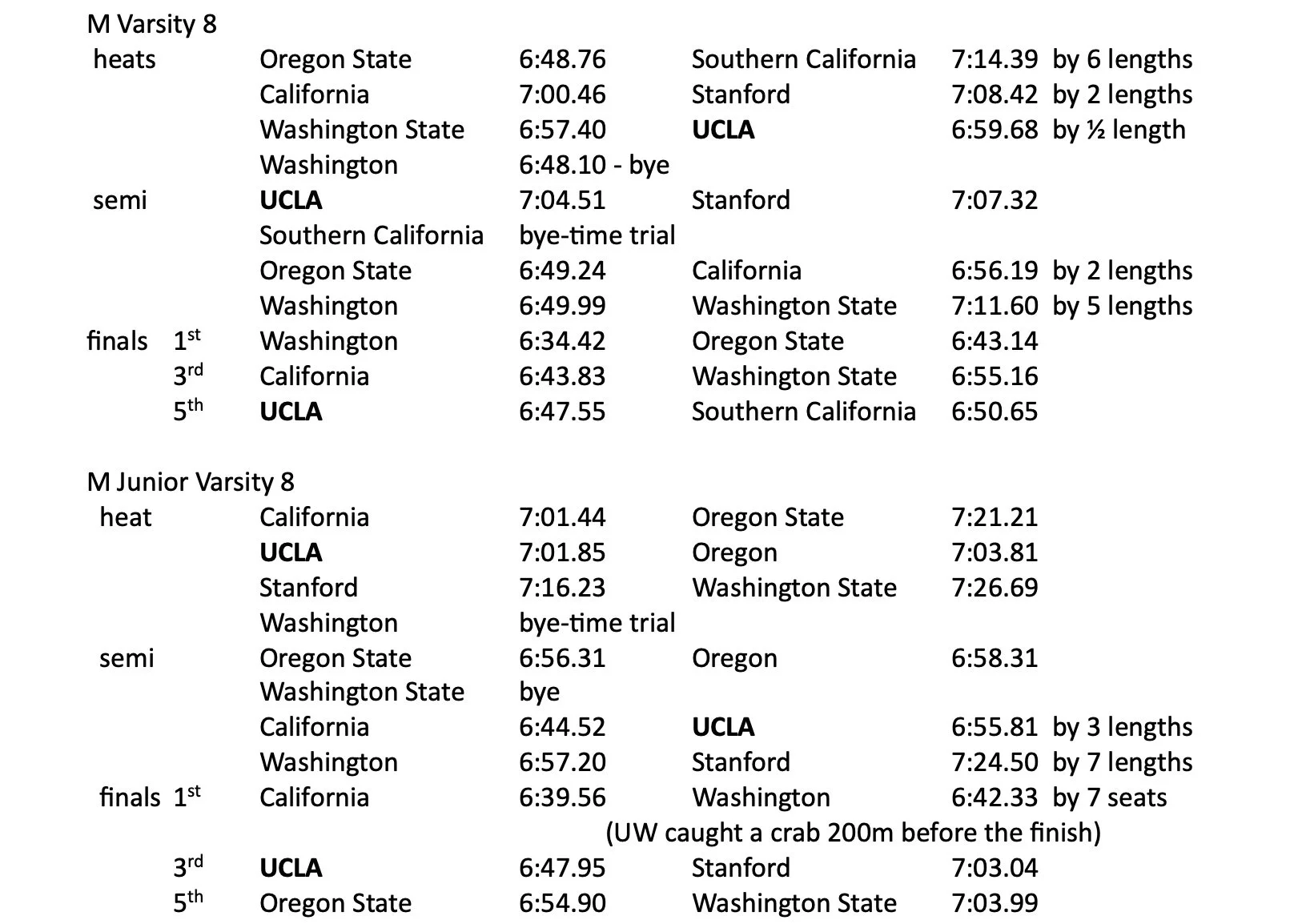
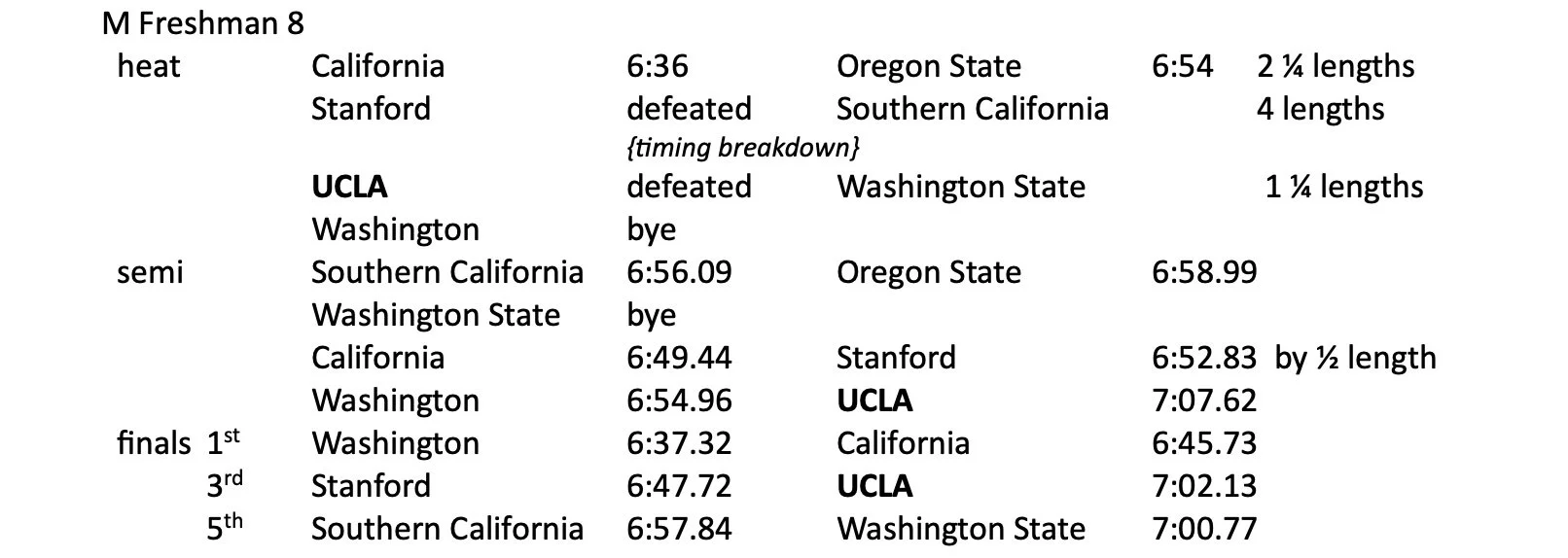
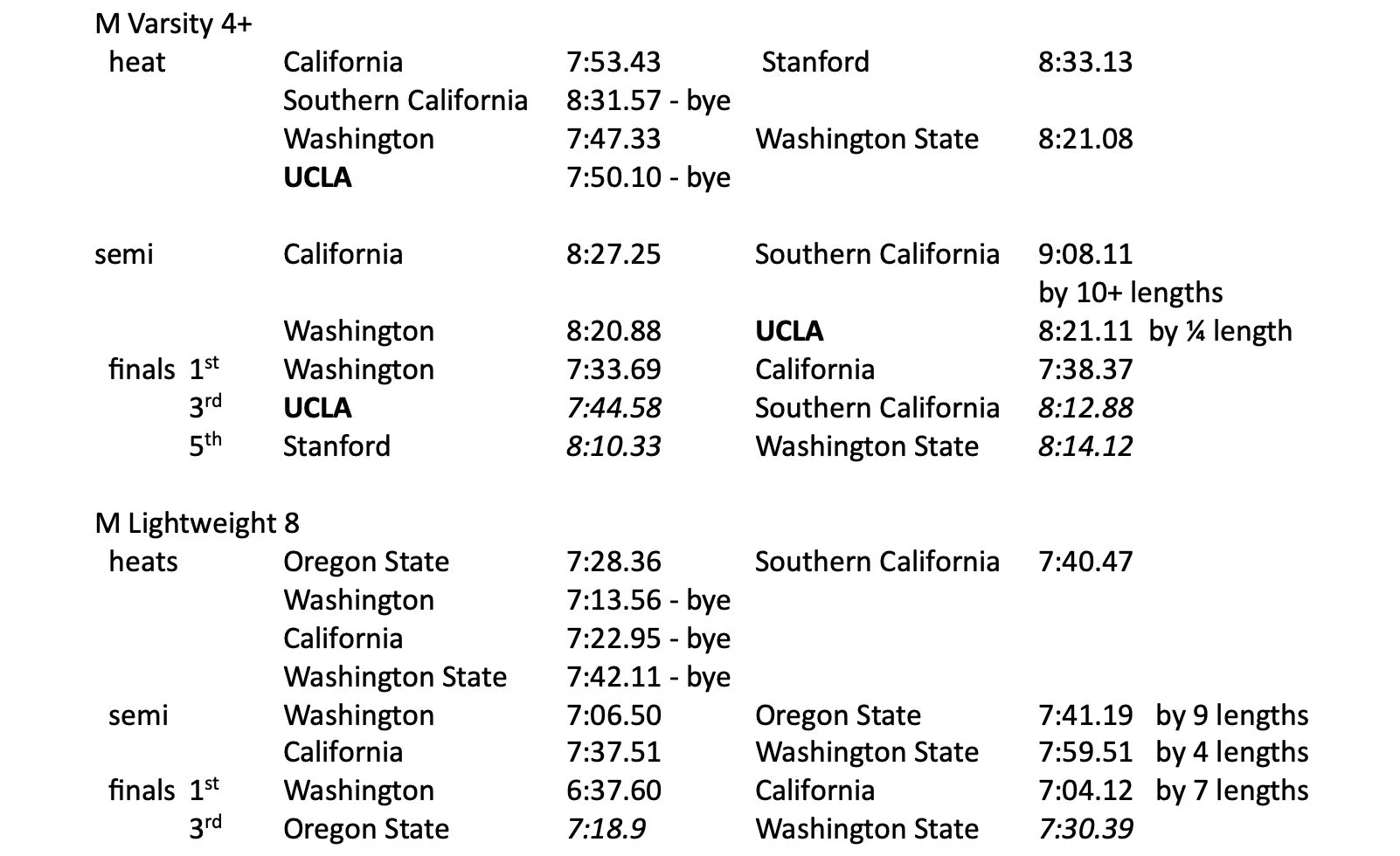
Western Invitational Women’s Rowing Championship on the same course (not official Pac-8 basis) bracket with match races, and included a few non-Pac-8 schools.
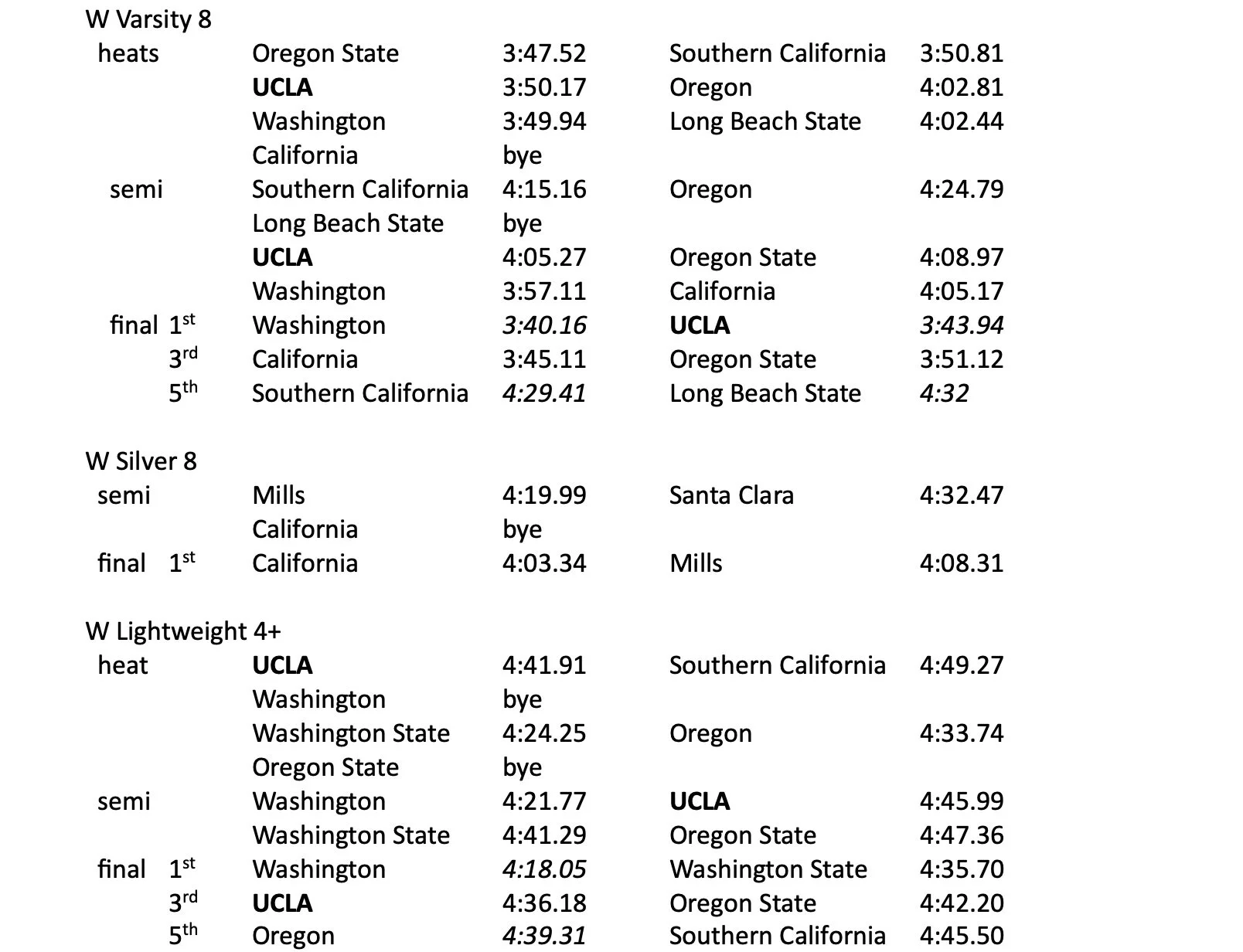
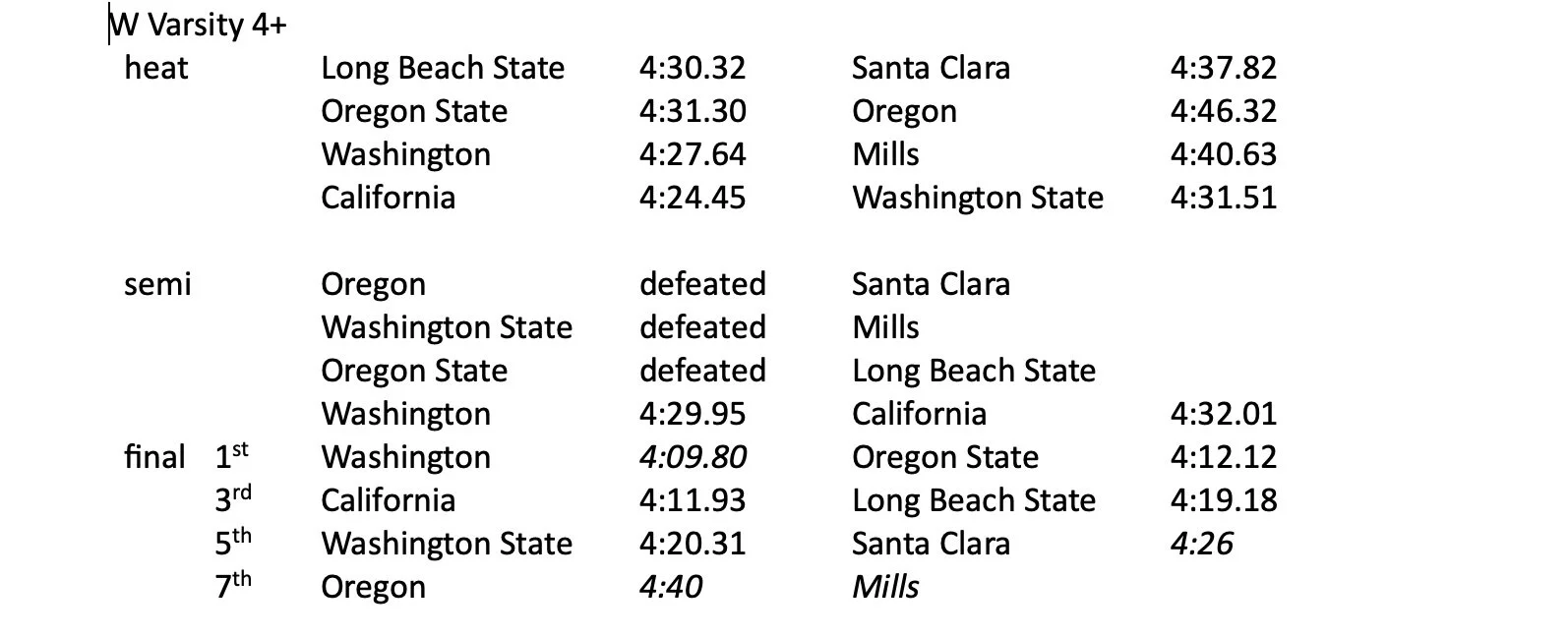
Following their participation in the Western Invitational, the Bruin women won two medals at the Southwest Regionals. They won the heavyweight eight, topping rival Cal. In the lightweight eight, with four crews finishing within two seconds of each other, the Bruin women powered through the last 250 meters to finish third in 3:37 to Mission Bay RA (3:35) and Lake Merritt (3:36.5). The lightweight four finished last in its four-crew race. Cindy Luis, “Women’s Crew”, UCLA Daily Bruin, 1 Jun 1977, 23. The UCLA women’s team advanced their entry to the semifinals of open four final of the NWRA nationals following a third place in an opening heat. “Cal Women Crews Advance”, Oakland Tribune, 17 Jun 1977, 48.
Washington did not plan to attend the IRA (expenses and exams the reason) but planned for a month-long European tour including Henley Royal regatta (winning the Grand Challenge Cup), Nottingham and Lucerne. Oregon State was lacking funds ($6,000 – 7,000). California coach Gladstone hoped to convince athletic director Maggard to send V8 and JV8 to IRA, after having placed second to Washington at the 1976 West Coast championship and then winning the IRA.
In the 1977 IRA championship, all six West Coast entries advanced to the finals with none of the West Coast entries relegated to the petite finals.
Freshman eight [11 entries]: No West Coast entries
Freshman four with [13]: Long Beach State - 6th
Junior Varsity eight [11]: California - 2nd
Varsity pair with [8]: San Diego State - 2nd
Varsity pair without [8]: No West Coast entries
Varsity four without [11]: No West Coast entries
Varsity four with [11]: UC Santa Barbara - 2nd
Varsity eight: California - 3rd, Oregon State - 5th
1978
Mike Bennett was appointed as the new freshman and assistant coach, replacing Norm Witt. Bennett had rowed for Cal 1971-75, and had been the varsity coach at Saint Mary’s College 1975-76 and coached at Berkeley High School. “UCLA Freshman Crew Coach”, Los Angeles Times, 11 Aug 1977, 135.
Due to poor weather, several of the events of the Head of the Harbor were scratched. The Bruins saw competition in only four events. UCLA placed first and fifth in the varsity four; the varsity eight placed ninth with Cal placing first and second; the lightweight eight finished second to Loyola; and in the pair-without-coxswain placed third behind the pair from Cal. Marcy Garber, “Men’s Crew Gets Under Way”, UCLA Daily Bruin, 10 Nov 1977, 29.
The lightweight team coached by Jon Gilwee, again defeated the University of San Francisco on March 18.
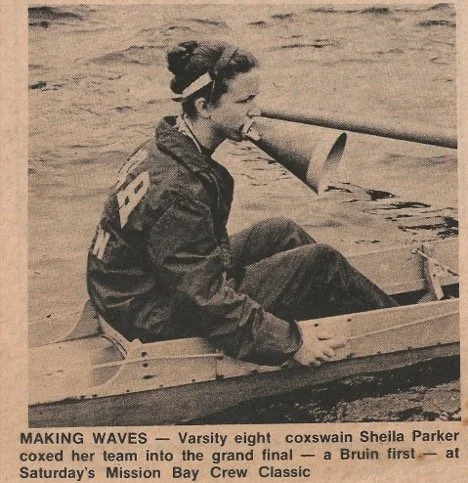
UCLA Daily Bruin, 3 Apr 1978, 53.
The men’s varsity eight lost to UC Irvine in their season opener though beat them handily at the San Diego Crew Classic. The results at the San Diego Crew Classic saw little for the Bruins to be happy about. In the men’s varsity eight, UCLA (6:03.85) finished in a near-dead heat with Oregon State (6:03.8) with both advancing to the grand final. In the heat, Penn (5:57.4) and Cal (6:01.6) were first and second, with Cornell (6:07.5) and Wisconsin (6:12.9) finishing in fifth and sixth. Washington (5:52.2), Harvard (5:54.7) and Brown (5:57.2) advanced from the other heat. Although an accomplishment advancing to the grand final of the Copley Cup, the Bruins finished in seventh place, 2.5 seconds behind sixth place Brown, with Washington (6:03.1) in first and Cal (6:05.5) in third. One of the members of the crew recalled, “This was one of the potentially best races that season. Kerry [Turner] was in the seven seat. We were in lane seven due to a dead heat in the heat. Unfortunately, in the final, we were waked by the announcer’s launch and lost our chance to see where we could really finish!” Stroke Mark Dolan noted improvement, “every time we row, we row better. We’ll be ready for Cal.” Leslie O’Neal, “Crew Classic: One Stroke For the West Coast”, UCLA Daily Bruin, 3 Apr 1978, 54. Four West Coast crews made the seven-boat final from among the twelve entries, leaving Cornell and Wisconsin, and three others to the consolation final.
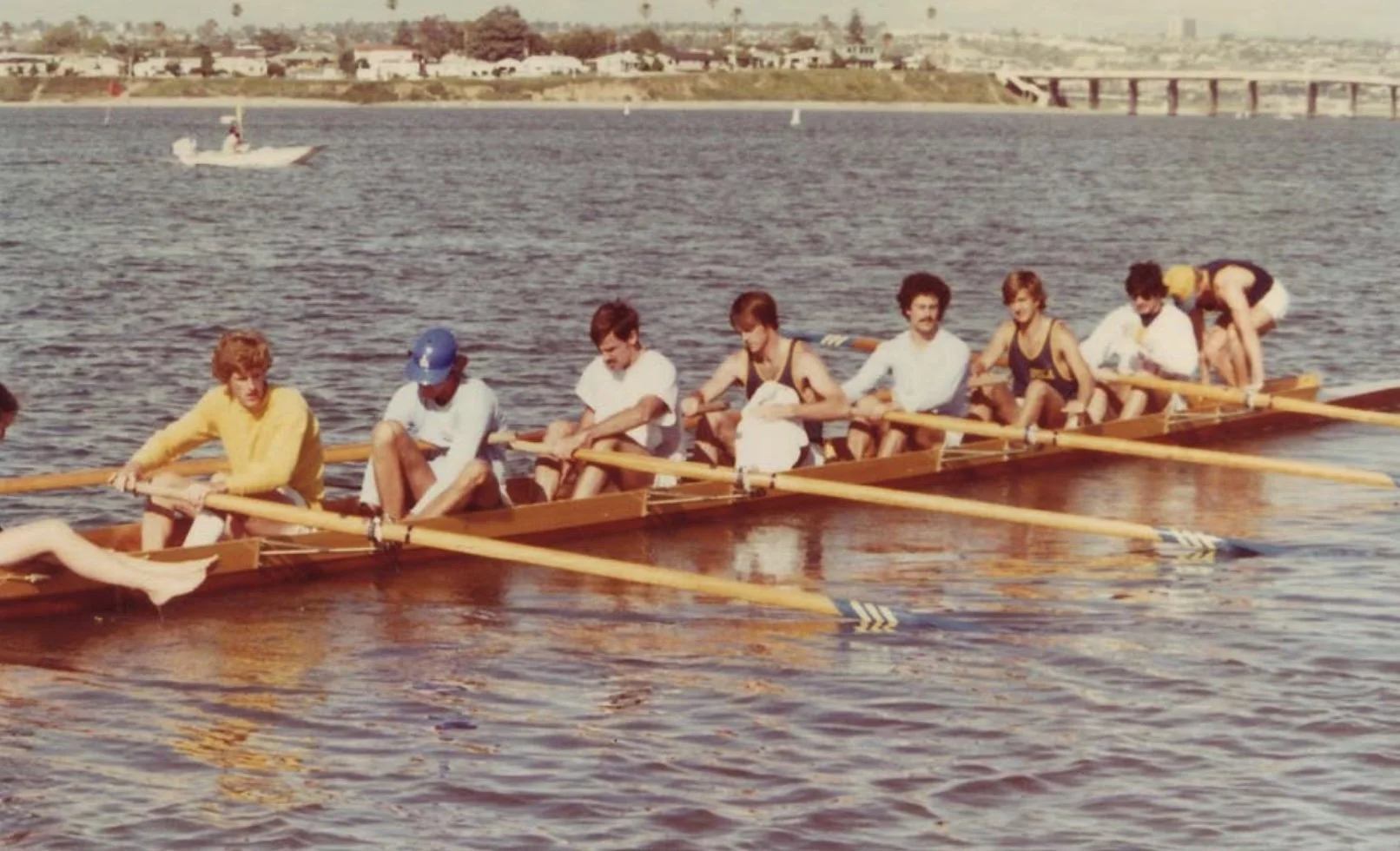
Varsity 8: Cox: Sheila Parker, Stroke: Dolan, Turner, Fitzmorris, Lovely, Frassetto, Smith, Izeman, Lachmar.
The Bruin JV eight finished last in their five crew heat but rallied to win the consolation final. UCLA entered two open fours, but they finished fourth and fifth in their heat and did not advance. In their heat the UCLA lightweight eight was disqualified due to lane violation and colliding with UC San Diego. As the JV crew, the lightweight eight also rallied to win the consolation final and defeated Cal by 3.4 seconds. The Bruin freshman eight placed second in their heat defeating Cal by a slim .05 seconds. However, in the grand final they placed last in seventh place, 23.7 seconds behind third placing Cal. The men’s novice eight placed fifth in a field of six crews defeating only University of San Diego. Entering two eight-oared crews the UCLA (2:40.1) women placed second in the consolation final to USC (2:39.0) in the women’s open eight, and second to Cal in the women’s novice eight in times of 3:15.1 and 3:17.7, after winning their heat. “Crew Classic Results”, San Diego Union, 2 Apr 1978, H-6.
UCLA hosted Cal for the Wallis Cup awarded for the varsity eight race, with seven men’s races and two women’s races on April 15. The racing was mostly during a rain storm as water and debris flowed down Ballona Creek. The Bruin varsity eight never caught site of the Bears after the start as they finished 23 seconds behind Cal. Rowing in the worst of the storm the Bruin JV gave Cal a scare and finished only two seconds behind. The lightweight eight and four, and freshmen eight defeated their northern opponents as the only UCLA victors. The UCLA women lost both the varsity eight and novice eight races. The Bruin women were only four seconds behind in the varsity race. “The women’s novice race was a disaster for the Bruins. A swell caught the boat, sending the bow under water and the stern and rudder in the air. With no steering control, the boat spun off course and took on four inches of water, causing the Bruins to fall too far behind to catch up.”Leslie O’Neal, “Growling Weather, Bears Reign in Crew”, UCLA Daily Bruin, 17 Apr 1978, 31.
The water and weather conditions improved greatly for the next regatta at Marina del Rey. UCLA continued its domination of the Harbach Cup, raced on Ballona Creek for the first time. UCLA swept the events, winning the varsity eight by a boat length, the JV was 20 seconds ahead, and the freshman finished 28 seconds ahead of Stanford, USC was lacking a freshman entry. The UCLA women’s team defeated USC in both the varsity eight and four by two and eight seconds. Traveling to face UC San Diego the men’s lightweight eight lost by .2 seconds. The Bruins held a comfortable lead until the 1500 meter mark, when their “coxswain called the sprint earlier than the guys are used to and they burned out before the finish,” explained Gilwee. The Bruin lightweight four defeated UC San Diego’s crew by one and one-half lengths of open water. Leslie O’Neal, “Bruin Rower Down Stanford to Keep Harbach Cup”, UCLA Daily Bruin, 2 May 1978, 20.
The UCLA men raced at the 13th Newport Regatta, and the women hosted the Miller Cup against Long Beach State, Loyola Marymount and USC. At Newport, although UC Irvine and UCLA tied in the points competition the Anteaters were given the Palmer Cup based on their two first place compared to none for UCLA. Cal was the dominant crew but the Bruins were closing the gap. Cal won the varsity eight, with UC Irvine second, UCLA in third, Long Beach State, UC San Diego and Loyola-Marymount in last. The Bruins narrowed the gap behind the Bears from 23 seconds at the Wallis race to 7.4 seconds in Newport, but UC Irvine still finished 4 seconds ahead of the Bruins. The JV eight was won by UC Irvine, only two seconds ahead of UCLA, who finished .6 seconds ahead of Cal, with Orange Coast and Long Beach State behind them. The varsity four finished in last place in the five-crew event won by UC Irvine. The freshmen had a disappointing third place finish behind Orange Coast and Cal in second place, although they finished ahead of UC Irvine, Loyola Marymount and Santa Clara. The men’s lightweight eight finished third behind Santa Clara and UC San Diego, but finished ahead of Cal. For the first time, Long Beach State won the Miller Cup. The 49ers defeated the UCLA in the heat by .1 second, and Loyola Marymount defeated USC in the other heat. The 49ers had no difficulty defeated the Lions in the final, while UCLA defeated USC by 3.6 seconds in the consolation race. In the varsity four Long Beach defeated UCLA in the final, USC having scratched and Loyola not entering a crew. Leslie O’Neal, “Irvine Rowers Edge Bruins for Palmers Cup”, UCLA Daily Bruin, 8 May 1978, 31.
The Western Intercollegiate was held at the Lexington Reservoir near Los Gatos on May 13-14. Most PAC-8 schools, including Washington and California did not attend, instead they raced at the next weekend’s PAC-8 championship in Seattle. Seventeen schools attended the Western Sprints, including several Stanford entries, and California and UCLA’s lightweight crews. This was another case of choose-one for the UCLA lightweights, since there was a lightweight eight, but not four, at the PAC-8 championship. The Bruins were slowed by scattered cases of pneumonia, bronchitis and hay fever. Coach Gilwee “was not even sure all his rowers would make the event. But all did.” Leslie O’Neal “Crew: A Bad Day by the Bay”, UCLA Daily Bruin, 17 May 1978, 21. Prior to the start of the Sunday finals officials had to chase runaway lane markers caused by strong headwinds, delaying the start of racing.
Western Sprints (selected results, included a women’s 8 and 4+ races):

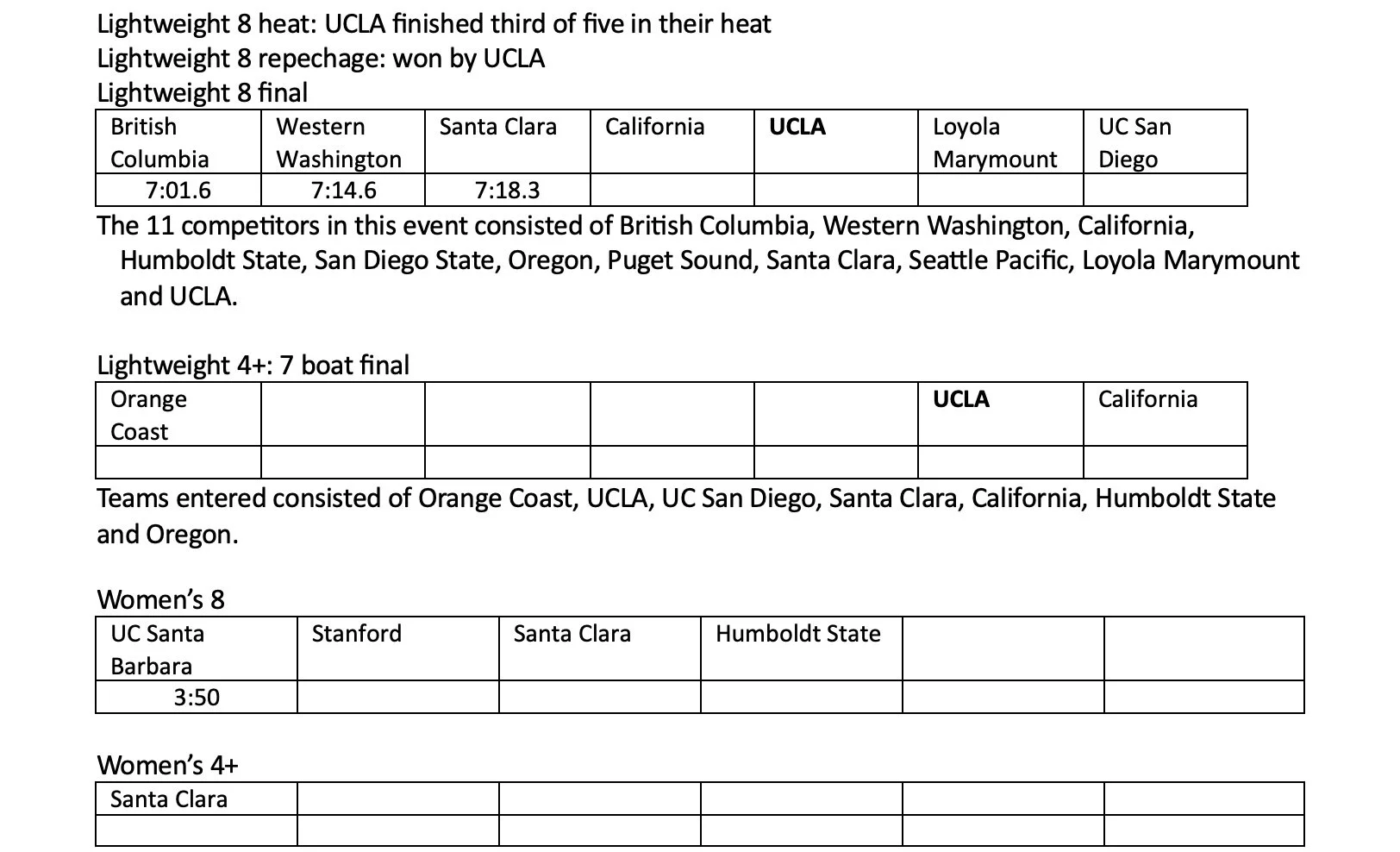
The PAC-8 (men-2000 meters, finals only on Saturday, May 20) and Western Intercollegiate Crew Championship (women-1000 meters, heats on Friday to produce four-crew finals on Saturday) were held in Seattle. The format returned to side-by-side racing with as many as five crews, though that created a tight situation, instead of the match races in within a bracket in 1977.
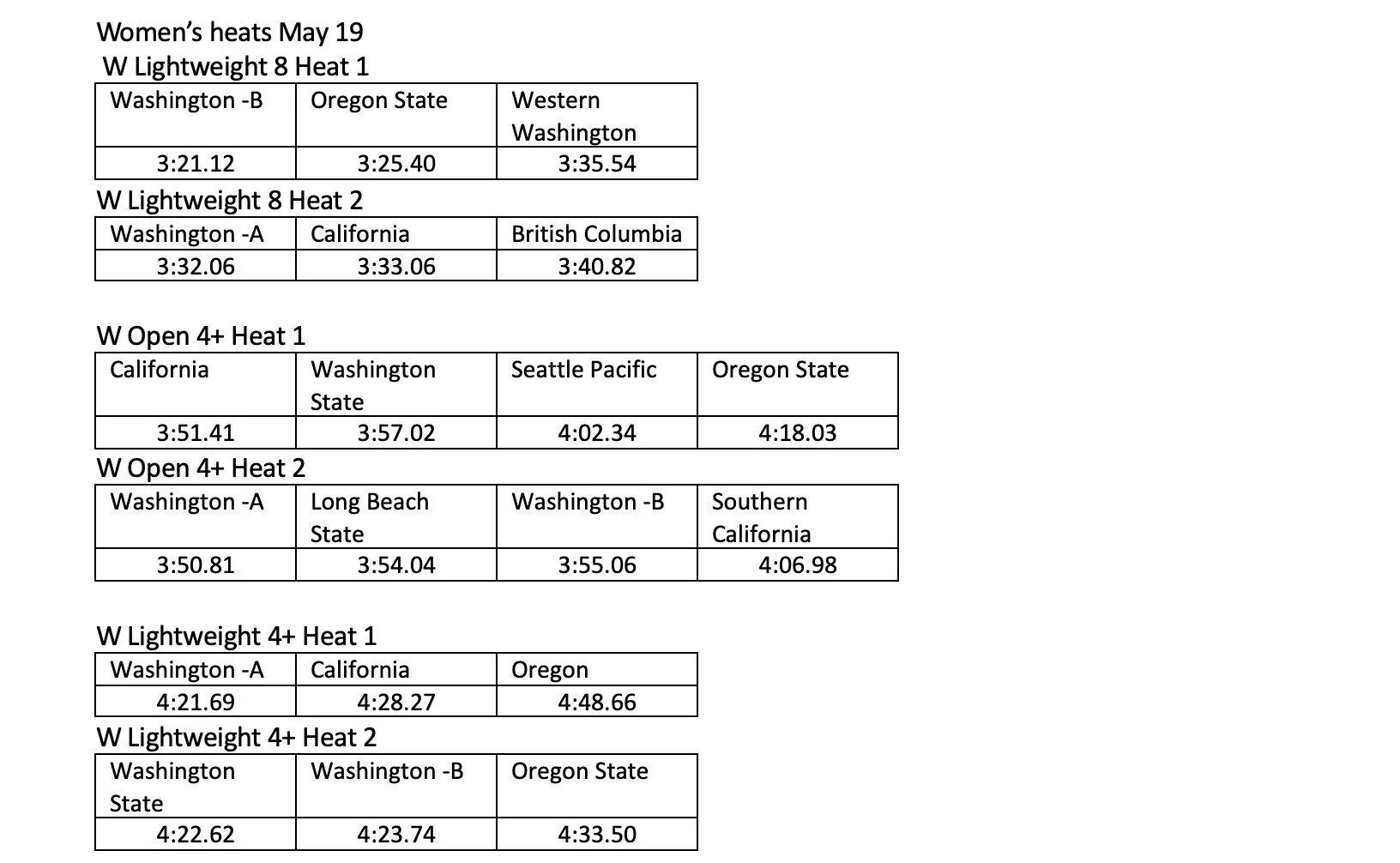
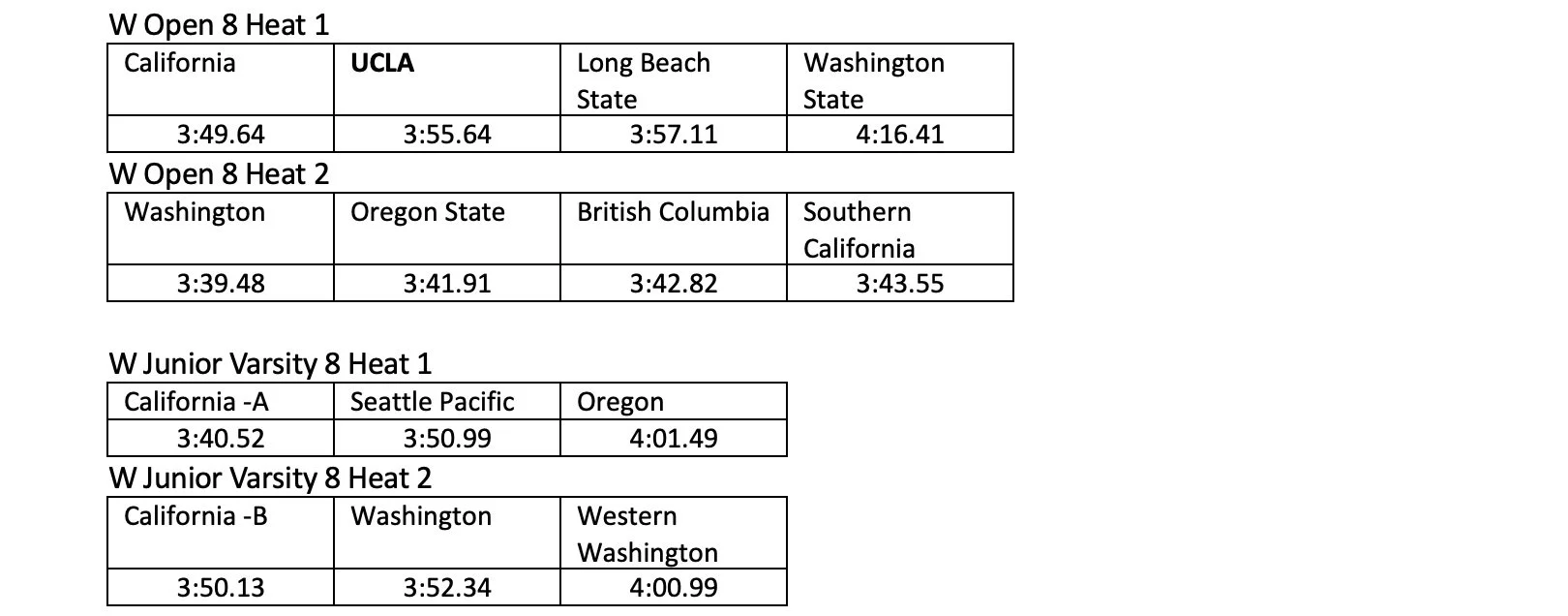
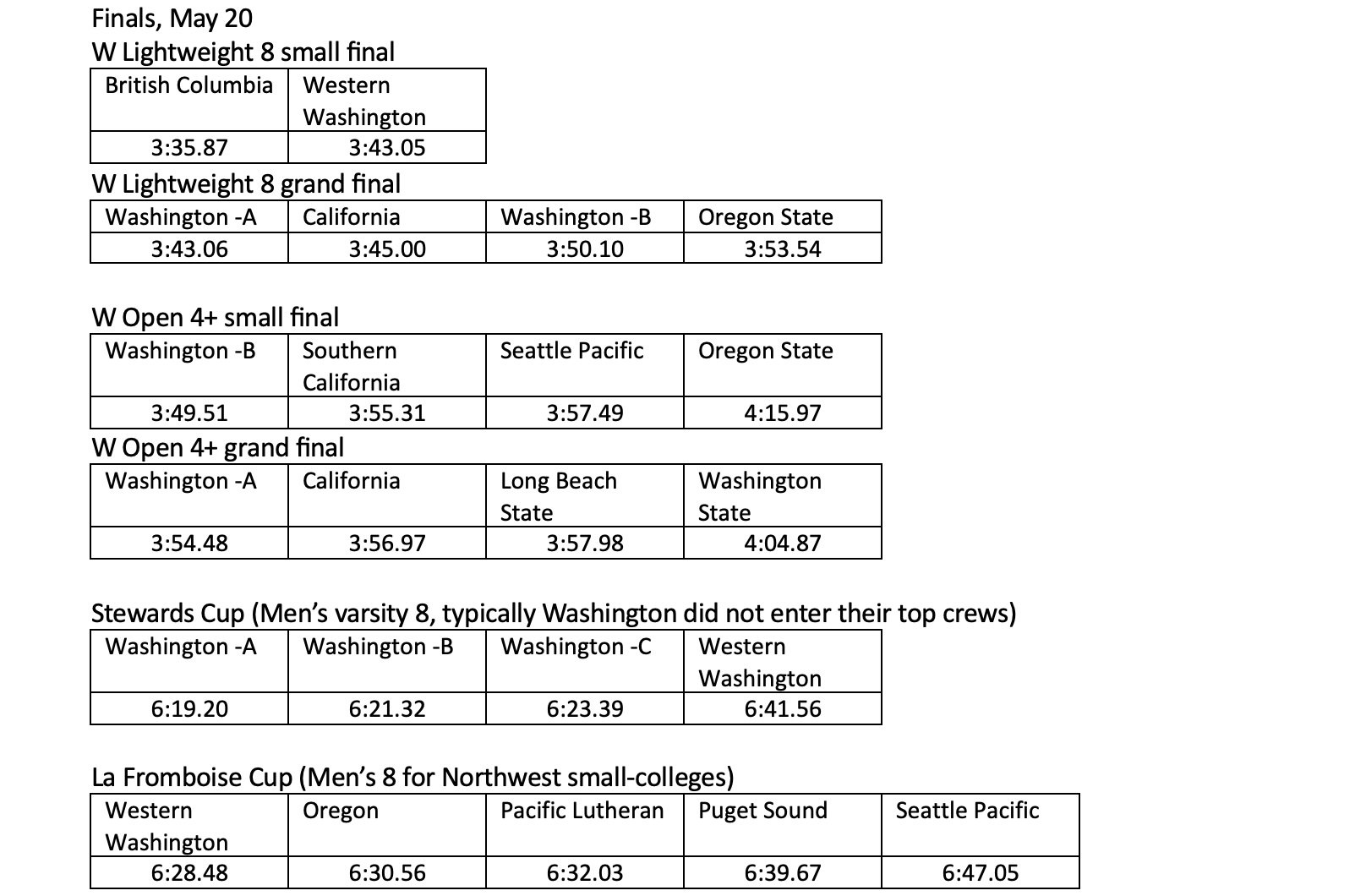
M Freshman 8: “The Bruin frosh rowed one of their best races of the year and went home with the belief that they had finished second to Washington and in front of Cal, OSU and WSU – which they actually did. But on Sunday morning, a phone call from Seattle awarded Cal the second place and put the Bruins in third. The story goes as follows: The Bruins and the Cougars were placed in outside lanes, due to poor finishes in the Pac-8’s last year. The 2,000 meter course narrows radically at 1,000 meters as it goes under a bridge. In theory, the two outside boats are expected to be far enough behind to allow the three middle boats clear passage. UCLA did not adhere to theory and was keeping up with Cal and Washington. As all went for the bridge, Washington and Cal shoved UCLA toward a cement wall. To avoid collision with the wall, the Bruins steered close to Cal until oars clashed and the Bruin bowman lost his oar. After 30 strokes UCLA regained control and went on to beat Cal but finished behind Washington. Then on Sunday came the news that Cal’s coxswain had filed a complaint of lane violation and UCLA was stripped of second place. But officials didn’t bother to mention any problems to UCLA until the Bruins were home in Los Angeles, Sunday.” Leslie O’Neal, “Varsity Eight Finishes Fourth in Pac-8 Crew”, UCLA Daily Bruin, May 22, 1978, 26.
At the Southwest Women’s Regional Championship, UCLA earned three second places and one championship. UCLA placed second by four seconds to Cal in the novice eight, followed by UC Santa Barbara and Long Beach State/Loyola. The Bruin open pair-without-coxswain, Carol Bower and Gwen Baker, surprised onlookers by their close finish of 3:52.3 to the first place boat of ex-Olympians that clocked a 3:51.5. The finish assured them of going to the NWRA nationals and also set their sights on the Olympic Training Camp. The UCLA lightweight four defeated Cal and Lake Merritt for their championship. The UCLA open eight finished in second, two seconds behind Cal. The Bruin crew fell apart at the start and were in last place. By halfway they had moved to fourth place, after that they poured in on to pass the other crews, all except Cal. They finished in second place ahead of Cal-B, Long Beach State, Lake Merritt, Cal-A in sixth and Stanford last. Improving on several losses during the season. Leslie O’Neal, “Bruin Women Rowers Take National Eight Title”, UCLA Daily Bruin, 31 May 1978, 38.
Carol Bower
Carol Bower was inducted into the UCLA Athletics Hall of Fame in 2006 and is a two-time U.S. National Rowing Hall of Fame inductee. Bower has been called the greatest all-around women's crew athlete in UCLA history (1978-79). A bronze medalist in the 1979 World Championships, Bower joined the U.S. National Women's Rowing team in 1980. She was a three-time World Champion Silver Medalist (1981–83) and took home the gold medal in the eights during the 1984 Summer Olympics. Carol was selected Oarswoman of the Year in 1982 by the United States Olympic Committee and was inducted in the Rowing Hall of Fame in 1984. Bower graduated from UCLA in 1979 and served as the head coach of the University of Pennsylvania's Women's Rowing program from 1987- 1996. She then served as the head crew coach at Bryn Mawr College. “Carol Bower”, UCLA Hall of Fame web, https://uclabruins.com/honors/hall-of-fame/carol-bower/125 Carol became a coach at Bryn Mawr in 1996 and she became the first full-time rowing coach at Division III Bryn Mawr in 2002 and led the program until 2022. Carol coached the US Women's Olympic 4+ in 1988. More recently she has been an Associate Director of Craftsbury Outdoor Center.
1979
At the end of his fourth year as UCLA’s head coach Duval Hecht summed up the season saying, “the varsity never quite got things running smoothly,” but not for want of effort. Pat Kennedy, “UCLA Crew Coach Calls it Quits”, UCLA Daily Bruin, 1 Jun 1979, 23. In the first two early season dual races UCLA had lost to UC Irvine and Long Beach State, the second and third place varsity’s from the 1978 WIRA. UCLA’s varsity finished fifth in the petite final at the San Diego Crew Classic with UC Irvine ahead in fourth. This after the Bruins placed sixth in their qualification heat. Coach Hecht characterized the crews performance as ‘average’ and “We still have to row our best race.” “Crew Rows to Fifth in Classic”, UCLA Daily Bruin, 9 Apr 1979, 27. In their annual dual, California had almost swept UCLA winning all the races except the second freshman eight. UCLA swept the Harbach Cup over Stanford and USC at Marina del Rey. At the Newport Invitational, UCLA’s first crew finished in third, again defeated by Long Beach State (6:09) and UC Irvine.
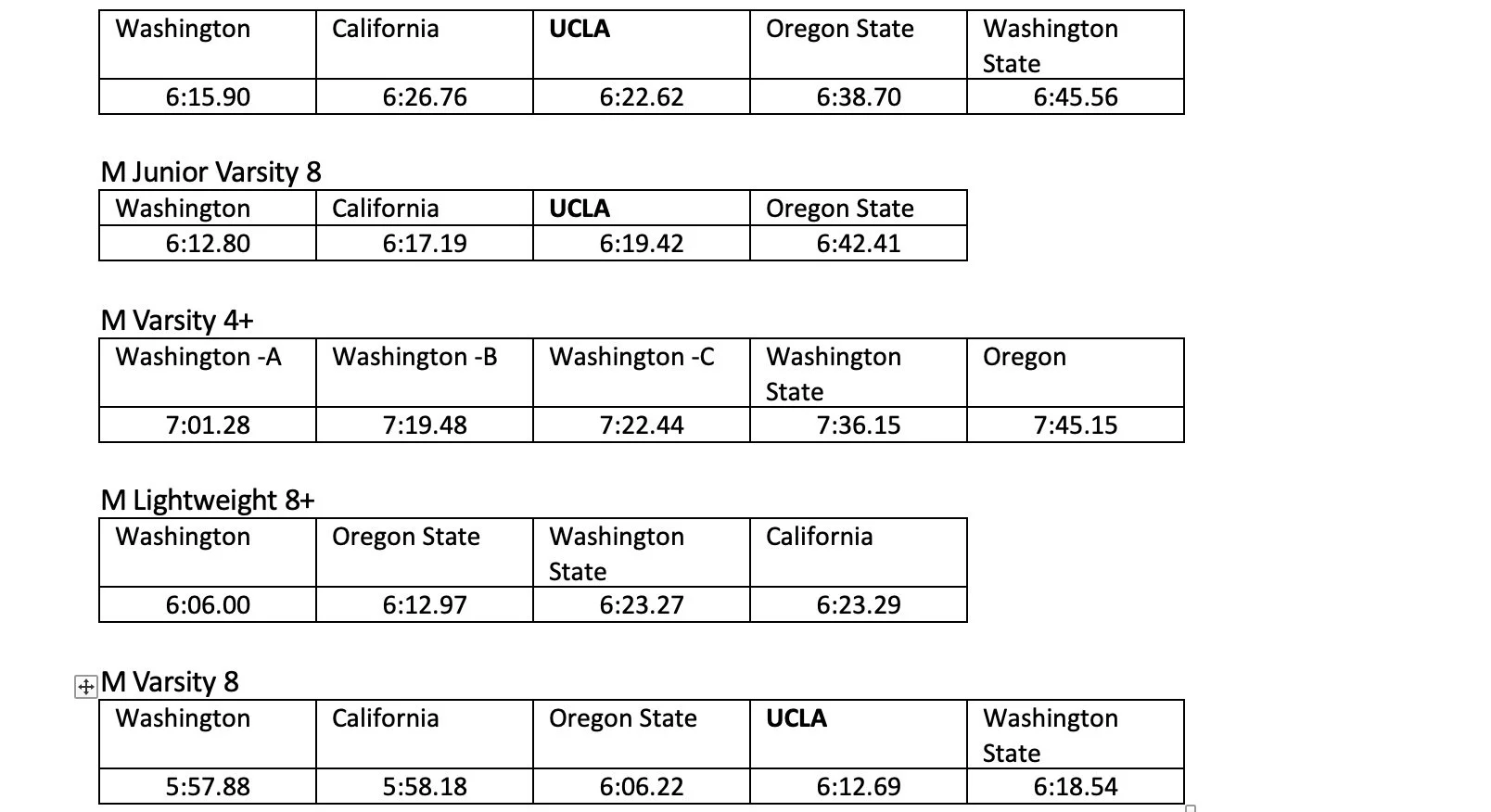
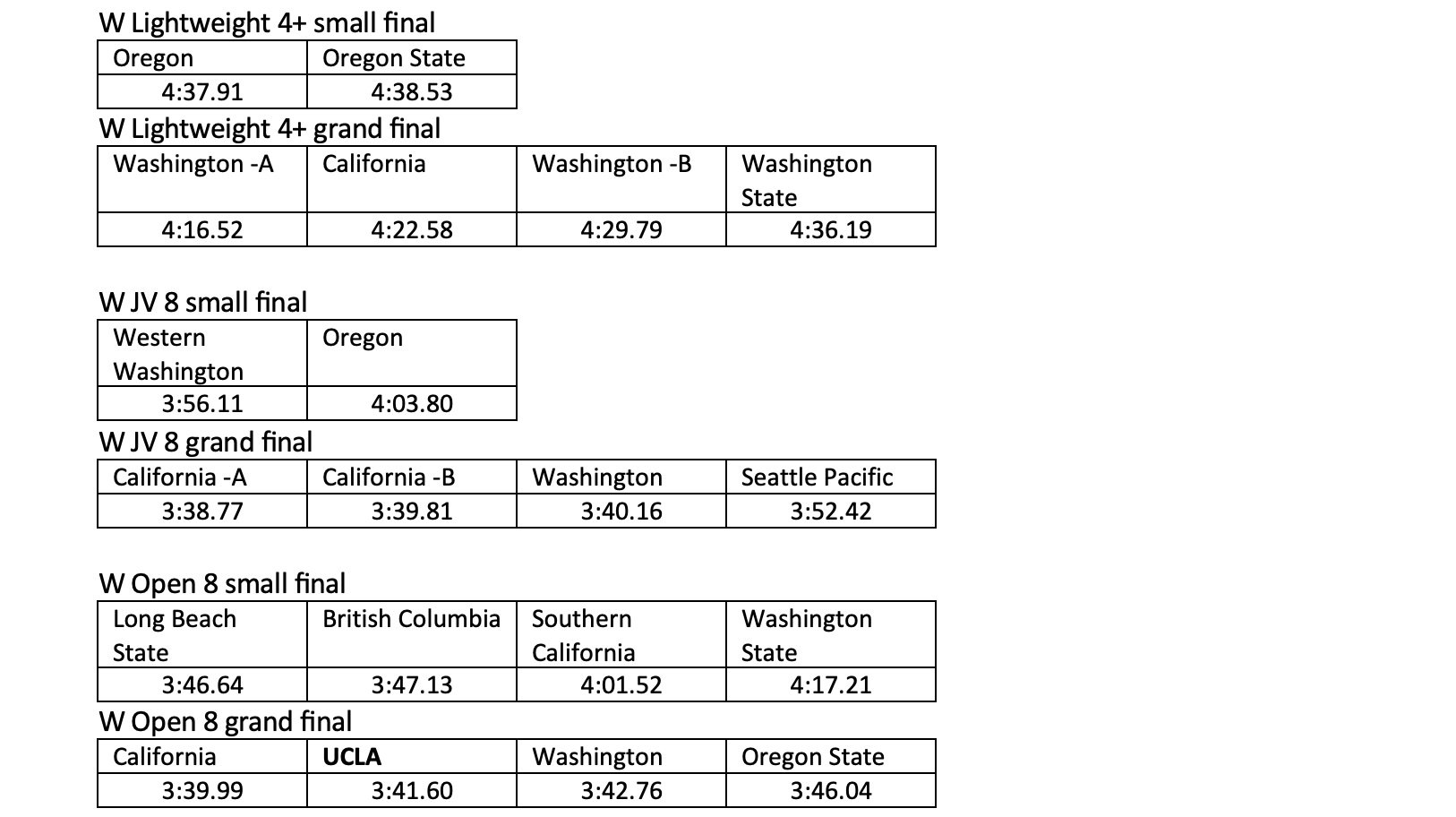
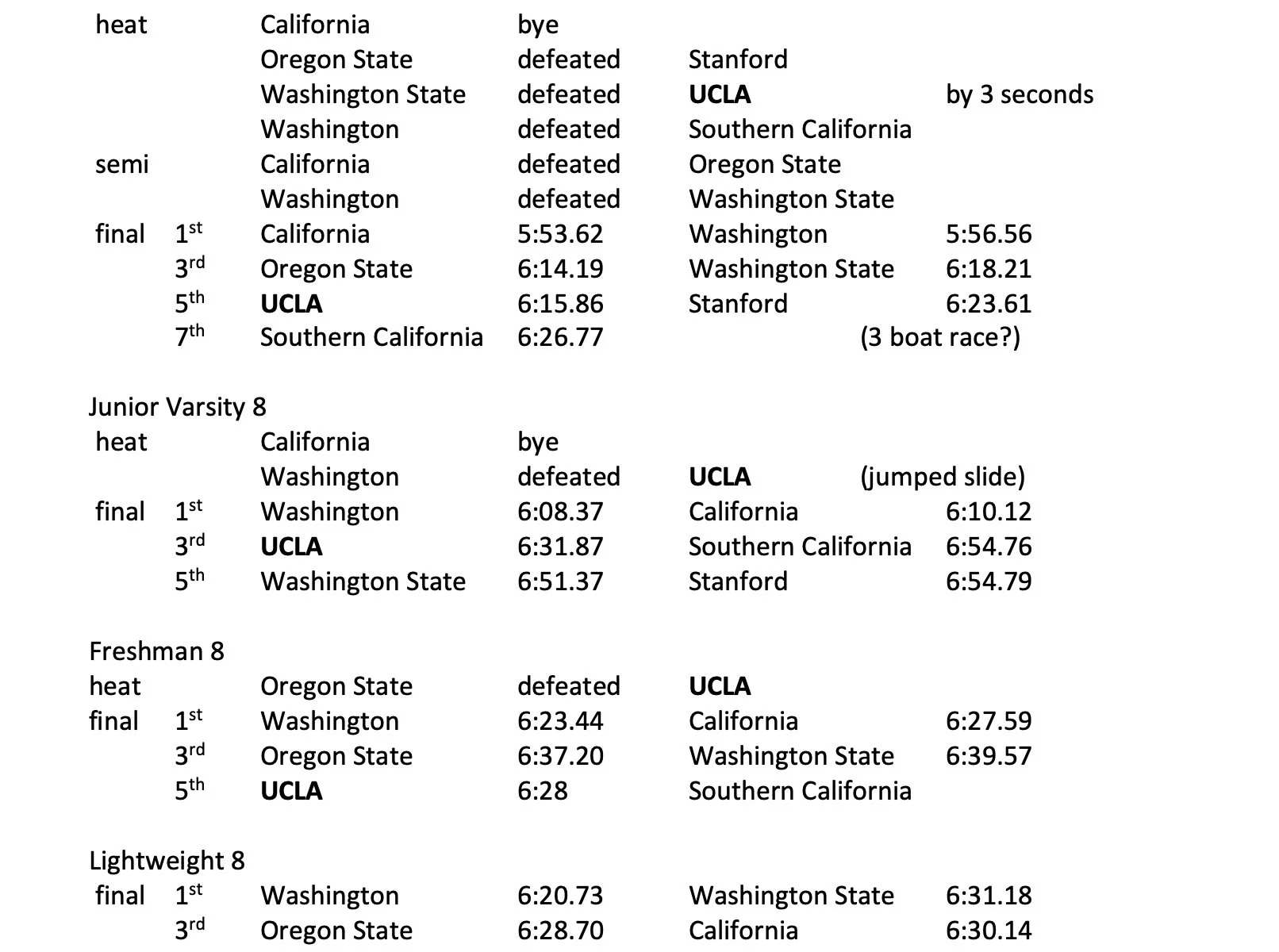
At the one-on-one PAC-10 bracket, third ranked UCLA finished fifth again defeating Stanford and USC in the final rounds, after losing to Washington State in the first round. The Daily Bruin reported, “The Pac-10s were the last races of the year for the Bruin oarsmen, and varsity coach Duvall Hecht offered no excuses for the team’s showing either at the regatta or during the year. ‘This year we never reached our potential.’ He said ‘We were not concentrated enough. We will do better next year.’” Pat Kennedy, “UCLA Takes Consolation: PAC-10 a Mixed Bag for Rowers”, UCLA Daily Bruin, 21 May, 1979, 27.
Varsity 8: Cal had a shaky start (five strokes in their stroke caught a slight crab) but lead Washington most of the way ending with a ¾ length lead at the finish. Cal was headed to the Henley Royal Regatta and had begun the season with a second place finish to Harvard at San Diego, and defeated Washington twice earlier in the season. Neither Harvard nor Yale were planning to race at the IRA and so California wasn’t going to race there either.
Hecht announced his resignation at the team awards banquet, saying there “is no sense in holding on” longer and that while he was leaving coaching it was expected that he would continue in a supportive role in the “Friends of Bruin Crew.” Among other things, Hecht was lauded in the “Friends of Bruin Crew” newsletter for have the team’s equipment in such good condition. Under the watchful direction of Rigger Brown the team had completed sanding and varnishing session of their Pocock shells following Saturday practices with donuts and ice cold milk containing frozen chips provided by coach Hecht.
After Hecht’s announcement freshman coach Mike Bennett and Bob Newman, who had been a successful coach at UC Irvine since leaving the freshman position at UCLA, were both cited as potential candidates as Hecht’s replacement. Hecht would return to coaching at UC Irvine in the fall of 1991.
At the San Diego Crew Classic the women’s team placed second in the lightweight eight petite final containing four novice rowers, and third in the five-crew novice eight final. Pat Kennedy, Crew Rows to Fifth in Classic”, UCLA Daily Bruin, 9 Apr 1979, 27. In the Miller Cup UCLA placed last, defeated by USC in the qualifying heat, who was defeated by Loyola in the grand final. UCLA was then defeated by Long Beach State in the petite final. In two other races, the Bruins defeated Long Beach State in the JV race and Gwen Baker and Carol Bower defeated a pair from Long Beach. “An Up-and-Down Affair for Rowers”, UCLA Daily Bruin, 7 May 1979, 23.
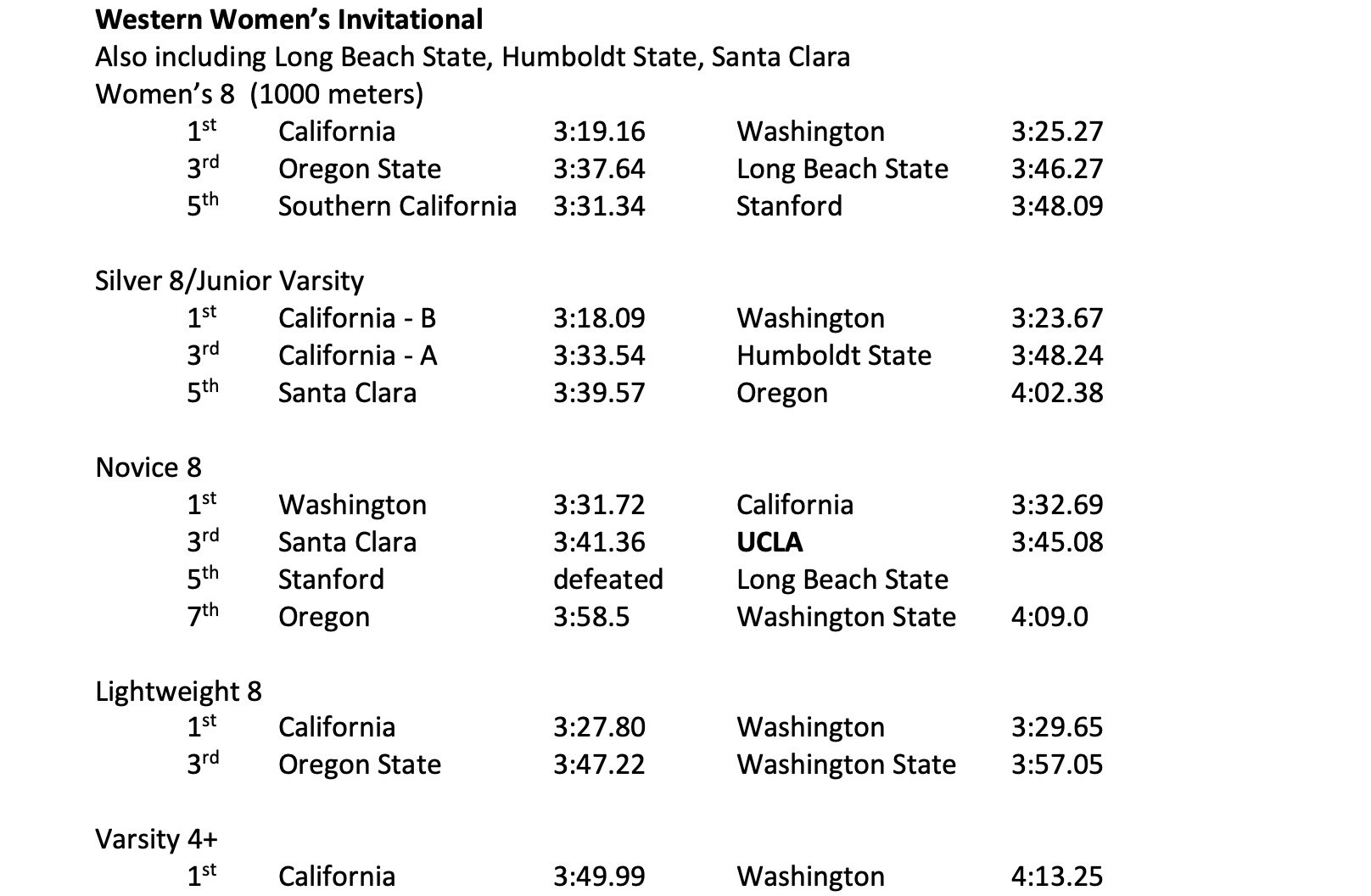
The women’s teams of the PAC-10 attended the Western Women’s Invitational also held at Redwood Shores in conjunction with the PAC-10 championship, also using a one-on-one bracket format. The Women’s Western Invitational also including the women’s teams from Long Beach State, Humboldt State and Santa Clara. UCLA placed fourth in the novice eight, defeated by Santa Clara in the final round for third place. The novice championship saw Washington victorious over Cal.
At the NWRA Southwest Regional Championship, UCLA’s women won three of the four events they entered. The Bruins won the novice eight, defeating the favored Cal crew that had defeated the Bruins earlier in the season, by 1.3 seconds with St. Mary’s and Long Beach State finishing in third and fourth. The pair composed of Gwen Baker and Carol Bower won over San Diego State by 7.5 seconds. The third champion was the lightweight four (Tia Graves-stroke, April Dean-#3, Cathy Murphy-#2, Jennifer McCleery-bow, and Carin Fujisaki-coxswain). UCLA’s open four finished third behind two Cal crews. Pat Kennedy, “Women’s Crew Team Wins Three of Four”, UCLA Daily Bruin, 30 May 1979, 40. Strength training for women’s teams at UCLA was cited in the August 16, 1979 issue of the Daily Bruin. “’Your well-rounded and well-trained athlete will excel,’ says Larry Daugherty, women’s crew coach, stressing the importance of weight training to rowing. ‘When you get to the top crews, technique will be the same, but strength will be the difference. It has so much to do with speed in our sport.’ His team does a ‘circuit workout’ including 14 different exercises done as fast as they can for cardio-vascular improvement.” Leslie Hurwitz, “Training Goes to Weights: Body Building Leads to Strength, Not Strain for Women”, UCLA Daily Bruin, 16 Aug 1979, 20. Women’s rowing was not included in the 1979 Southern Campus.