The Bob Newman Years

1980 - 1986
|
1980 - 1986 |
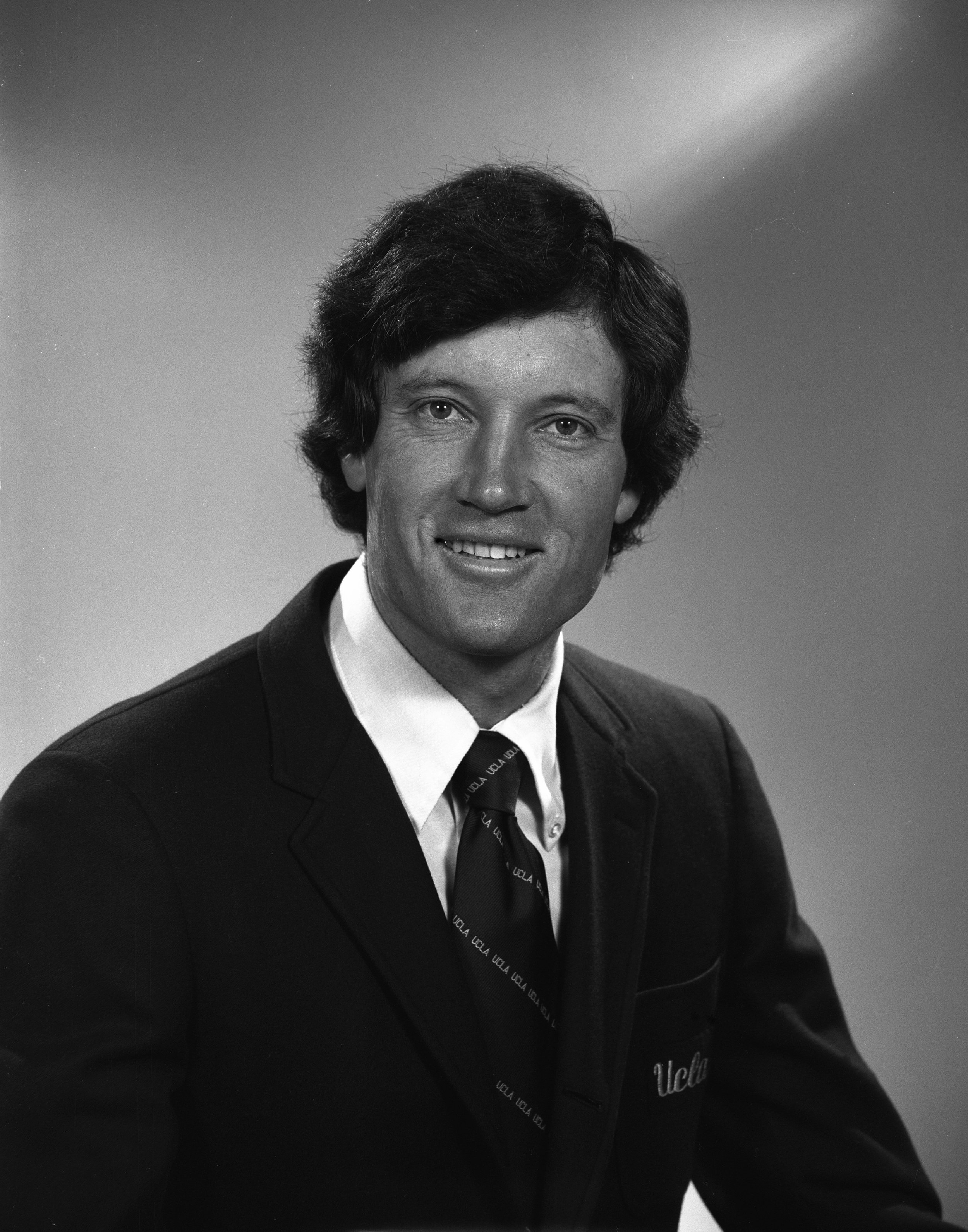
Bob Newman, UCLA Head Coach
Bob Newman was no stranger to UCLA rowing, having been a varsity letter winner in 1967 and 1968 and the Freshman coach during 1974/75. Newman began his rowing career as a freshman rower at Orange Coast College and transferred to UCLA where he became a member of the undefeated 1967 Varsity eight that won UCLA’s first Western Sprint championship defeating Washington by one length in a dramatic final. A sailboat crossed in the path of UCLA at the 1,000 meter mark, the Bruins maintained their composure, circled around the sailboat, caught Washington and opened up a lead. After graduation, Bob and Butch Pope, ‘69, teamed up to earn UCLA rowers' first berths on a U.S. National Team in a 2+, and represented the U.S.A. at a world championship competition in Copenhagen in 1971 [20 crew field, still called “European championship” at the time]. Newman was out of coaching during the 1972 thru 1974 seasons, instead selling real estate and involved in property management, but that did not provide him as much enjoyment as coaching. As a result, he “didn’t think about it more than two seconds” when the UCLA freshman position became available. Milan Lazich, “Newman’s Helped Make UCLA Crew a Winner – twice” UCLA Daily Bruin, 21 Apr 1983, 32, 30, 29. After Newman had coached the UCLA freshman for one year, when Jerry Johnsen departed, Duvall Hecht was selected over him largely because of his experience as a head coach. Newman became the head coach at UC Irvine developing a very competitive program for four years culminating in his UC Irvine crew winning the varsity eight event at the 1979 Western Sprints. When Newman was selected to head the UCLA program he said, “suddenly I was in coaching heaven.” Newman’s goal in addition to improving the Bruin’s competitive position was to increase the team’s profile on campus and he wanted his athletes to be able to look back and say “Damn, I’m glad I did that. That was fun.” Milan Lazich, “Newman’s Helped Make UCLA Crew a Winner – Twice” UCLA Daily Bruin, 21 Apr 1983, 29. Following his six years as head coach of UCLA’s program he maintained his close relationship of support for the program including a $2.5 million gift from Bob and Mary Jo Newman. “Bob Newman, ’68, Gifts 2.5 Million to UCLA Men’s Rowing”
1980
Bob Newman’s first year as head coach was successful. The 1980 “Varsity Eight won six of nine races. The wins were over UC Irvine, Long Beach, U. of San Diego, USC and Stanford in the Harbach Cup, and the Newport Regatta and Western Sprints Championships. The losses were to Cal, to Washington at the Opening Day Regatta in Seattle by 1.7 seconds, and a fourth place finish at the PAC-10 Championships. The Varsity Four won the PAC-10 Championships.” “Friends of Bruin Crew” Newsletter, 26 Feb 1981. The San Diego Crew Classic was canceled because of sewage contamination from broken pipes caused by winter rainstorms.
The Western Intercollegiate was scheduled in Newport Beach on Monday and Tuesday of the week preceding the PAC-10 championship. UCLA took advantage of the opportunity to compete and won the Varsity eight and Freshman four at the WIRA along with a second place finish in the Junior Varsity eight, third place in the Freshman eight and sixth place in the Varsity four.
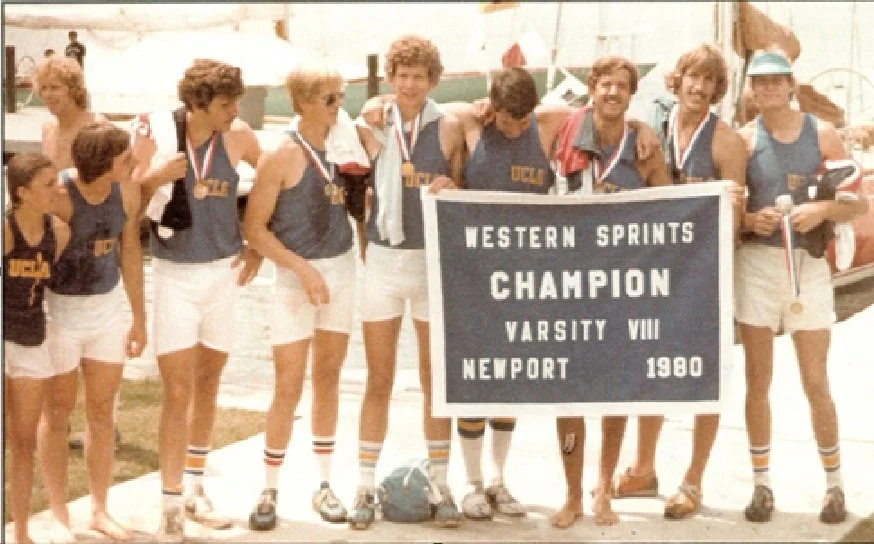
At the PAC-10’s single elimination format UCLA (Sarah Hantley-cox, Frank Kovac-stroke, David Nelson-#7, Matt Smith-#6, Joe Carlson-#5, Joe Fahrner-#4, John Nelson-#3, Scott Case-#2, Tom Orsley-bow) defeated Washington State in first round and ended up placing fourth, the Junior Varsity placed third, the Freshman eight third and the Varsity four winning their event.
An end of season article by Milan Mueller praised the team and their coach. “A group of inexperienced walk-ons combined with a dedicated coach have produced the most successful crew season in the last decade. The UCLA crew team, who could stroke out only one victory last year, turned around to accomplish that feat six times this season and establish themselves as the best crew in Southern California. The last time a Bruin crew achieved any notoriety was in 1970 when they only lost one race. For head coach Bob Newman, who has been responsible for rebuilding the program, it has been a very rewarding experience. The coach praised the team’s determination as the oarsmen never lost faith in themselves when they were losing all their races a year ago. Newman said that these kids are ‘responsible for establishing the foundation for a good program.’ And with only two people graduating, captain Frank Kovac and Rich Maire, the Crew has a ‘bright future ahead.’” Milan Mueller, “Oarsmen Turn Program Around”, UCLA Daily Bruin, 28 May 1980, 38.
The UCLA women posted a first place in the novice four over San Diego State, Mission Bay Rowing Association and UC San Diego at the San Diego Crew Classic, while the varsity eight (3:11.5) placed second to Cal-A (3:03.4) though overcoming Cal-B and Stanford in their final. “Women’s Crew Team”, UCLA Daily Bruin, 11 Apr 1980, 18. In their dual race with Cal the UCLA women (3:08.5) posted its first victory over the Bears (3:12.0). The Bruins gained a two-seat lead off the start, but the crews were even at the 250 meter mark. UCLA took a power-10 at 500 meters securing a three-seat advantage which they lengthened to eight-seats by 750. The Bears took a final sprint but only moved up two-seats, giving the Bruins a six-seat win. “Women’s Crew Beats Cal For First Time”, UCLA Daily Bruin, 24 Apr 1980, 29. The team defeated USC in a combined regatta with the men’s team. The varsity eight won the Miller Cup with preliminary heat victories over Long Beach State and USC. In the final, coxswain Carin Fujisaki, described how after gaining a boat length on Loyola after the first 20 strokes “we just ate them up.” The Miller Cup was also an occasion when the team christened the “Norman P. Miller” honoring Vice Chancellor Miller for his support and dedication to the establishment of the women’s program. The Bruins also won the novice 4+, open 4+ and lightweight divisions. Jean Reilly, “Crew Squad Christens the Miller Shell”, UCLA Daily Bruin, 5 May 1980, 26. At the PAC-10 championship, UCLA’s varsity lost to Oregon State in the semifinal by .09 seconds in the final strokes and then lost to the University of British Columbia (3:15.54 to 3:20.51) in the final for third place. The Bruin team performance at the NWRA Southwest regional was even better. The varsity eight (April Dean, Cathy Schauerman, Julie Nelson, Kelly Burnette, Beth Holasek, Wendy Larson, Cecelia Radeski, Tia Graves and coxswain Carin Fujisaki) upset Cal by .2 seconds, won the lightweight 4+ (April Dean for the third time and Sue Berman for a second time, along with Gigi Evans, Cathy Schauerman and Tessie Castelo) for the third consecutive year, and won the novice 4+ (Page Messerly, Lisa Swallow, Beth Holasek, Linda Wheat and Tessie Castelo) completed their season unbeaten. In the open 4+ race UCLA finished second to Cal, only .3 seconds behind. “Women’s Crew Finish Second”, UCLA Daily Bruin, 28 May 1980, 35. The varsity eight went on to finish sixth in the semifinal with British Columbia, Cal and University of Victoria in third through fifth place at the National Women’s Rowing Association (NWRA) national championship in the senior eight, their second best finish in school history. “8-women Crew Sixth in the U.S.” UCLA Daily Bruin, 24 Jun 1980, 18. In an article comparing total women’s athletic budgets at selected universities UCLA, sponsoring 12 teams, was cited as having a $750,000 budget and USC at $1,000,000 sponsoring 8 teams, though the University of Texas sponsoring 7 sports was the highest listed at $1,200,000 during 1979/80. Mike Siroky, “UT Women Seek Top-Shelf Budget for 1st-Rate Sports”, Knoxville [TN] News-Sentinel, 22 Jun 1980, 35.
The UCLA wrestling program, that predated the UCLA rowing team by almost ten years, was being congratulated in the April 1, 1980 Daily Bruin for its fifteenth place finish at the NCAA championship that included two All-American finishes (fourth and sixth in their weight divisions). However just a few days later, the Daily Bruin carried the announcement that the wrestling program would be terminated immediately, citing lack of space as the main reason (their training area was to be redesigned into office space in MAC-B’s lower level and a new wrestling space would cost approximately $750,000 and there were higher priorities). An additional reason cited was the allocation of scholarships, eleven of which were split between men’s soccer and wrestling and a desire to place UCLA in the top five of sports nationally.
Obviously, there was the potential for other non-revenue varsity sports to be dropped.

1981
There was an investment in equipment with UCLA armed with new carbon fiber oars {$175/oar} and two new Carbocraft eight-oared shells [“J.D. Morgan” and “Rigger Brown”] each costing $10,000. There was also a stronger outreach toward supporters. Coach Newman in a February 1981 newsletter outlined “making a concerted effort to involve all the alumni, parents and friends who have ever had a connection or interest in this program.” Newman further stated, “We want you to be proud of the program and welcome your support, be it morally, physically, and/or financially.” There was an Alumni Day scheduled to start off the spring.
It was a very successful season highlighted by a victory over Cal and a second place Varsity finish in the PAC-10 championship. Prior to those events, UCLA built a strong record with dual race sweeps of UC Irvine and Long Beach State, a victory over the University of San Diego and a sixth place finish in the San Diego Crew Classic after beating Oregon State, Brown and Wisconsin in their heat. Coach Newman stated, “This is the first time UCLA has been within firing distance of the top crews in the country in a month of Sundays.” Christine Dzllvelis, “Crew Works Toward The Conference Meet”, UCLA Daily Bruin, 8 Apr 1981, 35. Other UCLA crews experienced success in placing in the Crew Classic finals, the Novice eight was second, the Freshman eight fourth and the Varsity four sixth, while the Junior Varsity was edged out of advancing to the final by Yale. The newly reinstated lightweight crew placed fifth in the elimination heat bettering only USC and did not advance to the final.
At the meet hosting the University of San Diego, UCLA christened two of new lightweight Carbocraft shells in honor of the late athletic director that had done so much to support the rowing program “J.D. Morgan” and the other honoring “Rigger Brown”. The Bruin varsity defeated the University of San Diego by 16.8 seconds, in times of 5:45.7 and 6:02.5. Newman was pleased with the performance and the Bruins nearly swept their opponent, except in the varsity 4+. The UCLA lightweights race two crews that defeated the UC San Diego lightweight crew. Christine Dzilvelis, “Rowers Honor J.D., Beat USD and UCSD”, UCLA Daily Bruin, 14 Apr,1981, 32.
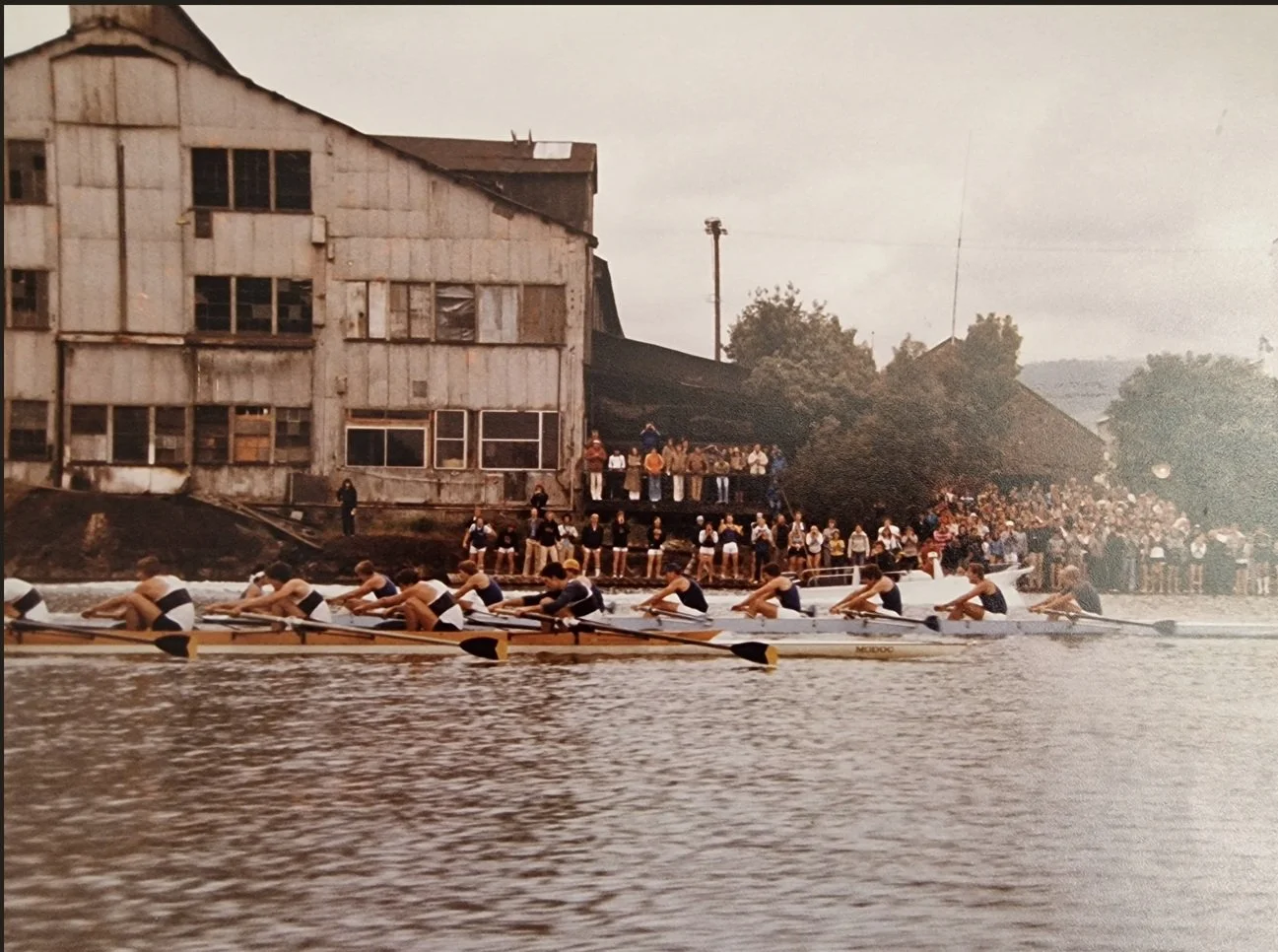
UCLA Varsity wins by 5 seconds over Cal at the Oakland Estuary
For the first time since 1970 the Bruin varsity defeated Cal. Of UCLA’s five second victory over Cal Coach Newman was quoted as saying, “Cal may have looked ahead to Washington and if they were they made a big mistake. We were the underdog but we were prepared.” Christine Dzllvelis, “After Decade, Crew Beats Cal”, UCLA Daily Bruin, 21 Apr. 1981, 32. The Bruins then swept the Harbach Cup against Stanford and USC in five races even with a wake in the varsity eight dumping two to three inches of water into the shell and during the lightweight eight race the rigger of the #5-man breaking but the Bruins persevered with only seven rowing finishing in 6:54.2 to USC’s 6:58.6. “Crew Wins Harbach Cup Again”, UCLA Daily Bruin, 28 Apr 1981, 22. UCLA won the Varsity eight event at the Newport Regatta and also earned the regatta’s Palmer Cup. At the PAC-10 championship the Varsity eight placed second being defeated by only 5 seconds by Washington in the championship-round, the Junior Varsity finished third, the Freshman eight placed second, the Varsity four first and the Lightweight eight finished in fourth. Over all for the season the crews of the varsity squad compiled a 47-20 record. After the silver medal performance by the Bruins at the PAC-10 Championships, Newman was named PAC-10 Coach of the Year with the best showing since the start of the PAC-8/10 championship in 1977. Three Bruins were named to the All-conference team: Joe Carlson, Scott Case and Matt Smith. The season continued for the varsity eight with a fifth place finish at the IRA. The varsity squad compiled a 47-20 record. This was the first time at the IRA for the Bruins since 1973 and the first return in the varsity eight since 1971. The IRA was open to any school but the cost of the trip to travel was a challenge for West Coast crews. The Bruins were the only West Coast team sending a varsity eight and would not be facing Washington or Cal, though would potentially face Northeastern who had placed 2.2 seconds in front of the Bruins in the San Diego Crew Classic, and defending IRA champion Navy. Mark Hazelwood, “Rowers in Syracuse Tournament”, UCLA Daily Bruin, 5 Jun 1981, 29, 30.
The women’s program began their season with a third place finish in the petite final (9th place) of the varsity eight, and a third place finish in the novice eight at the San Diego Crew Classic. Their success continued with a win over Long Beach State, USC and Loyola to capture the Miller Cup. At the NWRA Southwest Regional championship, UCLA won the open 4+ (Tessie Castelo, Wendy Larsen, Cathy Busnell, Tia Graves and Cecelia Radeski) and placed second in the open eight to Lake Merritt Boat Club defeating all the other collegiate entries. At the Women’s Western Invitational held in conjunction to the men’s PAC-10 championship, UCLA placed fourth in the one-on-one bracket and fifth in the novice eight.
Tia Graves and her younger sister were transfers from Wisconsin where their father Robert, brother Ross and older sister Carrie had all rowed to national prominence. Tia came to UCLA during 1979, and 1981 was her final year. Tia Graves had come to UCLA for “a change in the weather and my boyfriend.” Tia said, “although I liked my rowing experience at Wisconsin, I left school for half a year and when I came to UCLA, rowing wasn’t a priority. Allison and I decided that it would be fun rowing together and she wanted an experience away from Wisconsin so later she came out. Christine Dzilvelis, “Graves Family, All In a Row, is a Crew In Itself”, UCLA Daily Bruin, 13 May 1981, 36. Coxswain Carin Fujisaki was awarded the team’s most-valuable-player award.
1982
Following early season dual victories over UC Irvine and Long Beach State, UCLA’s Varsity placed fourth at the San Diego Crew Classic, finishing thirteen seconds behind winner Cal, but three seconds ahead of Harvard and six seconds ahead of Cornell in the final. Though the Bruins lost their dual to Cal by twelve seconds (5:37.0 to 5:49.0) the Cal crew with an incredibly quick start, UCLA swept the Harbach Cup including novice and lightweight divisions, and finished only four seconds behind a “darn fast” Cal but twenty seconds ahead of UC Irvine at the Newport Regatta. This was apparently the last of the Harbach Cup races between UCLA, USC and Stanford.
As in 1980, due to scheduling, the Western Intercollegiate was in Long Beach on the Monday prior to the PAC-10. Given that opportunity, UCLA won the WIRA Varsity eight and Varsity four, placed second in the Junior Varsity eight and third in the lightweight four. In the PAC-10 the third-seeded UCLA Varsity eight faced Washington in the semifinal. The Bruins had a 2-seat advantage by 500m and were dead even at 1000m. “A Power-20 put the Bruins up by 3 or 4 seats at 1250 meters. This race was to come down to the sprint at the very end to determine the victor. As they crossed the line it was the Huskies winning by two seats [1.4 sec]. … As the crews returned to the beach… the Huskies returned apparently physically spent and emotionally defeated. As UCLA stroke Russ Rowell described the experience, they had learned ‘what it was all about: giving your all over 2000 meters with nothing left.’ UCLA had achieved the satisfaction of giving it their best against the best regardless of the result.” UCLA Bruin Oarsmen, 28 Sep 1982. In the final round UCLA placed third in the Varsity eight, Junior Varsity eight, Varsity four, Freshman eight and Lightweight eight. Senior Russell Rowell, a transfer from Orange Coast, was a two-sport athlete competing as a snapper on UCLA’s football team and as an oarsman on UCLA’s crew. UCLA did not attend the IRA this year.
The mid-May newsletter pointed out that men’s heavyweight and women’s programs were “primarily funded by the Dept. of Intercollegiate Athletics. The Men’s Lightweight program is not funded. As per the accompanying letter, our help is now needed to continue the program at UCLA. It is no secret that minor sports are being cut at many major universities. For our program to continue to climb, success as witnessed in the past two year’s accomplishments, UCLA rowing needs our help and now is the time.” Matt Smith, May 1982 newsletter. There was a greater push to raise supporting funds. In a letter on May 6, 1982, Coach Newman announced a goal of raising $50,000 by December 31, 1982, with the intent of implementing at least 50% of what is raised into an endowment fund with up to 50% used for current needs.
1982 marked the final year of several UCLA coaches. Freshman coach Mike Bennett (1977-1982), head Women’s coach Larry Daugherty and Lightweight coach Kirk Hansen.
The UCLA women placed first in the varsity eight petite final (7th place) at the San Diego Crew Classic. UCLA’s varsity (3:19 to Cal’s 3:06) and novice (3:24 to Cal’s 3:20) crews lost to Cal when the Bruins hosted the Bears on Ballona Creek later in April. The Bruins repeated as winners of the Miller Cup with a varsity victory (3:16.1) over Loyola-Marymount (3:20.2) and Long Beach State and a novice victory over Long Beach State. “Women’s Crew Wins Miller Cup”, UCLA Daily Bruin, 29 Apr 1982, 28. UCLA’s women also lost to Washington in the semifinal round of the Women’s Western Invitational, racing a similar bracketed format as the men. The women’s varsity eight finished in fourth place in the finals round and the novice eight was seventh. Continuing their season at the NWRA Southwest Regional, UCLA won the varsity eight and novice eight categories and finished second in the elite eight and third in the elite four. “Women’s Crew Wins Regionals”, UCLA Daily Bruin, 24 May 1982, 24.
1983
During the 1982/83 season the “Bruin Oarsman” changed its name to “Friends of UCLA Rowing (F.O.U.R.)”
With the objectives of:
· Sponsor social events which will act as focal points to reunite the UCLA rowing community.
· Re-establish communication with UCLA crew program alumni.
· Develop a long-term base for support to complement the activities which are historically sponsored by the University.
The unification of the interests of all the UCLA rowing programs, both men’s and women’s, was hoped to that the support of the program continued and even an expansion of the boathouse to include a women’s bay and locker room and an alumni lounge. The centerpiece of the 50th anniversary would be a race against Harvard, dubbed the UCLA Classic, with a bare bones budget of $14,245.
The varsity posted comfortable early season victories over UC Irvine, San Diego State and Long Beach State prior to the San Diego Crew Classic. Success continued for the Varsity eight as it placed fourth (6:04.16), behind Washington (5:58.10), University of Victoria {the Canadian National team} (6:00.73), and Yale (6:03.67) while placing ahead of Cal (6:05.98) and Purdue (6:06.64), with a tremendous move in the middle 1000m. The final was restarted after one of Washington’s oars hit a buoy and broke a rigger after they had strayed into Victoria’s lane. The ruling was Washington was not to be disqualified since referees had not warned Washington of the lane infraction. Tim Gillman, “OCC Oarsmen Help Washington Capture the Copley Cup”, Los Angeles Times, 3 Apr 1983, 53. The Lightweight eight placed second in the Crew Classic. Next the varsity raced duals with Cal where they went from “an open water disadvantage with 600 meters to go to a two seat advantage with 20 strokes to go. Unfortunately, they came up a little short and lost by five feet. The next day the Bruins easily defeated Stanford at Redwood Shores.” Bob Newman, “Men’s Heavyweight Varsity”, UCLA F.O.U.R. newsletter, Spring 1983.
Celebrating 50th anniversary of UCLA Crew the team hosted Harvard. In the Varsity eight Harvard [who later won the Eastern Sprints] won by one and one-half length over the Bruins before some 12,000 spectators. Members of the 1933 UCLA crew were special guests, and included UCLA’s first coach Major Goodsell. Maury Grossman from that first crew donated medals and a trophy for the event. Newman and F.O.U.R. raised over $14,000 from the event.
This was the last time that the WIRA and the PAC-10 championships were held on different weekends. UCLA’s Freshman four won their WIRA event and the Lightweight eight raced in their final. At the PAC-10 UCLA placed third in the varsity eight, second in the varsity four fourth in the junior varsity eight, lightweight eight and freshman eight. The freshman eight had been seeded first but in their semifinal against Washington State an oarlock broke 300 meters into the race, leaving only seven oarsmen to finish the remainder of the race. Then in the third place final the Bruins rowed a fast time (5:46.8) to lose to Cal that finished three-tenths of a second faster, both times being markedly faster than the crews in the first place final.
In was reported that F.O.U.R. raised $39,326.29 in the 1983 fiscal year – unprecedent in the history of the program. With the help of the Athletic Department, UCLA purchased a new carbon fiber shell for the Freshmen replacing the damaged “Noella”. The conclusion of the anniversary season was punctuated by a trip to the IRA for the varsity eight, the freshman eight and freshman four. The Bruins placed fourth in both of the freshman events and second (eighth-place) in the varsity petite final – the only West Coast crew in the varsity eight competition. UCLA’s freshmen eight was the only West Coast crew in the grand final, with both Cal and Stanford relegated to the petite final. Oregon State won the freshman four grand final.


UCLA oarsman Kevin Still, ’83, raced as a member of the 1983 U.S. team in the four-without-coxswain at the World Championships where they finished sixth. Still had transferred to UCLA in 1980 after two years at Humboldt State. He had been planning to not do any athletics except intramurals but decided to try rowing with the thought “I’ll try it for a week” but occupied the #5-seat in the Bruin eight for much of the 1982 and 1983 seasons, after his 1981 season in the novice boat. Kevin posted the highest ergometer score among the 1982 pre-elites not only on the West Coast but nationally. He was a member of the U.S. pre-elite crew that won the Thames Challenge Cup at the Henley Royal Regatta in 1982. Milan Lazich, “Bypassing IMs, Rower Kevin Still Looks Toward Olympics”, UCLA Daily Bruin, 5 May 1983, 32. Still was the first UCLA male oarsman to represent the U.S. in the Olympics earning a bronze medal in the pair-with-coxswain in 1984. In 1985 as a member of the U.S. eight his crew earned a bronze medal at the World Championships, and another bronze medal in the eight at the 1986 World Championships.
Dave Cowell was the head women’s coach after the departure of Larry Daugherty. The team was disadvantaged by a lack of depth since they were thirteen athletes that did not return from the previous season. Milan Lazich, “Crew Hopes Its Rematch With Washington Has a New Ending”, UCLA Daily Bruin, 20 May 1983, 18. Not for the first time, in a letter to the editor in the Daily Bruin, team member Rachele Nyssen complained of the lack of coverage of the UCLA women’s crew at the San Diego Crew Classic. “Women’s Crew”, UCLA Daily Bruin, 26 Apr 1983, 12-13. Though there was a brief mention at the end of an earlier article that the varsity eight had lost to Pac-10 rivals Washington, Stanford, Oregon State and Cal at the Crew Classic finishing in seventh/last place in the Whittier Cup, and that the novice eight placed fourth. Two weeks later the Bruin varsity lost to Cal by 8.4 seconds and the next day by 10 seconds to Stanford. “Women Are Second to Cal, Stanford”, UCLA Daily Bruin, 18 Apr 1983, 35. The Bruins continued their hold on the Miller Cup defeating Loyola and Long Beach State in both the varsity and novice eights, only falling to Loyola in the novice four by 11 seconds. A new Women’s Southern California Championship was hosted in Oxnard. UCLA won the varsity eight defeating UC San Diego 3:39 to 3:43. San Diego State won the novice eight and Loyola won the lightweight eight. UCLA defeated Long Beach State by two-lengths to also win the novice 4+. “Crew Racing”, Los Angeles Times, 9 May 1983, 33.
At the Western Women’s Invitational the UCLA women lost to Stanford in the semifinal and then lost to Cal 3:15.2 to 3:21.1 in the third-place final “Bruins 4th in Women’s Crew Meet”, UCLA Daily Bruin, 23 May 1983, 28. The novice eight finished in fifth place with a victory over Loyola-Marymount. UCLA sent 20 athletes, after having as few as 9 athletes earlier in the year, to the NWRA Southwest Regional and earned 27 medals. Their victories included the varsity eight, splitting the eight into two 4+s won the open 4+, also the wherry, the novice eight and part of a composite lightweight eight. Coach Cowell called it ”a great capper to the year.” Milan Lazich, “Women’s Crew is Hit of Regionals”, UCLA Daily Bruin, 2 Jun 1983, 32.
1984
Jim Sims, ’67, a teammate of Bob Newman, coached the men’s freshman/novice team. In the fall Matt Smith, ’81, became the new lightweight coach and was active in fundraising for the lightweight team as a subset of F.O.U.R. with a goal to fund an $18,000 budget. There was a four race fall schedule. The F.O.U.R. Board faced challenges in addition to fund raising needed to amend its bylaws that allowed it to reallocate funds raised for the benefit of specific teams, to act in the best interest of the rowing program as a whole. The yield from the 1983 Freshman eight was only one rower and the coxswain. With four returning oarsmen from the 1983 Varsity eight. Coach Newman’s expectation for the season, “We look forward to a competitive season but, at this point, very unknown future. UC Irvine and Long Beach have picked up speed and Stanford will host their best crew in the last 20 or more years. The competition will be tough – all of it.” Bob Newman, “The Heavyweight Varsity”, UCLA Bruin Strokewatch, March 1984.
UCLA’s varsity and lightweight crews defeated Long Beach State to win the Major Sievert Cup for a fifth consecutive time. Coming off a week without practice due to final exams the Bruin varsity notched a 2 second victory over Long Beach State. Coach Newman felt that they didn’t take the race seriously and only “put together just enough effort in the race to win.” Steve Barra, “Crews Kept Themselves Busy During Spring Break”, UCLA Daily Bruin, 5 Apr 1984, 34. The varsity lightweights won their race by a margin of 25 seconds. At the San Diego Crew Classic UCLA’s varsity finished fifth in its heat of the Copley Cup defeating Stanford, and then third in the petite final behind Wisconsin and Northeastern but defeating San Diego State, Stanford and UC Irvine. The freshman eight placed fourth and the lightweight eight third including a 6.8 second margin over fourth place Cal.
In a dual race with Orange Coast the Bruin crews showed improvement but were defeated by Orange Coast. The UCLA freshmen finished .6 seconds behind in their race. The JV were 29.5 seconds behind and Coach Newman concluded that the Bruins “weren’t aggressive and didn’t row hard” feeling that even though Orange Coast was a fast crew that his Bruins should have been closer. In the novice eight event UCLA never really got into the race after a poor start where oars clashed between the competitors finishing 5.8 seconds back. Steve Barra, “OCC Gets By Bruin Rowers”, UCLA Daily Bruin, 16 Apr 1984, 38. On April 21 host UCLA lost to Cal (5:52.3) by four seconds in choppy conditions. In other men’s races the Bruin freshman and JV lost by 12 and 28 seconds, while the UCLA novice eight won by 22 seconds and both lightweight crews, by 8 and 28 seconds, defeated Cal. “Crew’s Best Not Enough to Top Cal”, UCLA Daily Bruin, 23 Apr 1984, 35.
The second UCLA Classic grew to include three visiting crews, and UCLA finished behind them all. The Maury Grossman Cup was at stake, and a dual race in other categories between UCLA and Stanford was also scheduled. The order of finish for the Grossman Cup was Cornell (5:42.9), Stanford (5:48.2), Princeton (5:51.8) and UCLA (5:55.0). Though all the crews were tight at the beginning, Cornell broke loose and went on to win. Coach Newman felt his Bruins had not performed up to their ability. In other races UCLA’s lightweight crew overcame Stanford. The next day UCLA’s varsity and JV defeated neighbor Loyola-Marymount by 13 and 22 seconds. Steve Barra, “Crews Encounter Mixed Results in Weekend Races”, UCLA Daily Bruin, 30 Apr 1984, 32, 28.
The next weekend at the Newport Regatta Cal (6:10.8) again defeated UCLA (6:13.5) with Long Beach State (6:23) finishing third. UCLA finished third in the Junior Varsity and Freshman eights falling to Cal and Orange Coast in both events. UCLA ended their dual race season with a sweep of UC San Diego in the varsity eight, varsity lightweight eight and JV lightweight eight by margins of 4.7, 9.0 and 12.3 seconds. “Crew Ends Dual meet Season on a High Note”, UCLA Daily Bruin, 14 May 1984, 21.
1984 marked the combination of WIRA and PAC-10 on the same weekend at the same venue in Sacramento without the two-boat progression for the PAC-10 since there was a desire for more lanes. On Sunday the top three PAC-10 finishers raced the top three WIRA finishers in the grand finals of a new event titled the Pacific Coast Championship. UCLA’s varsity eight placed third in both the PAC-10 and then the Pacific Coast. The junior varsity eight was not in the grand finals. The freshman eight placed fourth in the PAC-10 and the Varsity four won their PAC-10 event. UCLA’s novice eight finished third in the Pacific Coast Championship. The lightweight eight finished second in the PAC-10 and the lightweight four was third in the Pacific Coast.
The women’s lightweight 4+ was credited with fall wins at the Head of the Harbor and the Christmas Regatta along with a dual meet win over Mills College. “Lightweight Crew Second in San Diego Classic”, UCLA Daily Bruin, 10 Apr 1984, 29. The UCLA women’s varsity opened their spring season with a trip to Oregon. At the Corvallis Invitational, Oregon State swept all the events, with University of Victoria and British Columbia also attending, UCLA finished third in the lightweight 4+ event, 8 seconds behind first place Oregon State, and the heavyweight four finished last in their event. The next day the Bruins faced Oregon and University of Victoria finishing second the heavyweight four and not placing in the lightweight four. Back at Marina del Rey the UCLA novice crew lost by 2 seconds to Long Beach State. Steve Barra, “Crews Kept Themselves Busy During Spring Break”, UCLA Daily Bruin, 5 Apr 1984, 34.
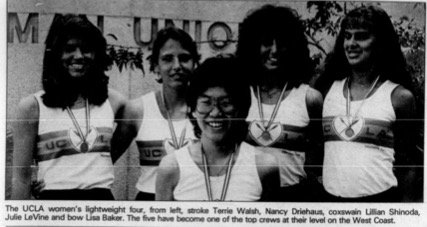
UCLA Daily Bruin, 19 Apr 1984, 33.
At the San Diego Crew Classic the lightweight four (Lilian Shinoda-cox, Lisa Baker-bow, Julia Lavine, Nancy Driehaus and Terrie Walsh-stroke) web [URL: https://github.com/crewclassic/results/blob/master/1973_through_2003.xls] made a come-from-behind move to capture first place 4:37.3, with the non-collegiate entry from Lake Merritt Rowing Club (4:39.5) in second. The varsity eight repeated their 1983 finish in seventh/last place in the Whittier Cup. This year behind Washington, Wisconsin, Yale, Cal, Stanford and Oregon State. The novice eight was fourth in their final “Lightweight Crew Second in San Diego Classic”, UCLA Daily Bruin, 10 Apr 1984, 29. behind Cal, Stanford and Long Beach State. The team suffered from some flu that had hampered training. Steve Berra, “Tough Cal Crews Get Second Shot at Bruins”, UCLA Daily Bruin, 20 Apr 1984, 18.
The lightweight four set their sights on having an undefeated season and racing at the national championship in Seattle. “It’s just the matter of getting the money and thinking that we’re good enough to go,” stated Driehaus since qualifying for the event wasn’t difficult. Steve Berra, “Women’s Lightweight Four Endures Harsh Training”, UCLA Daily Bruin, 19 Apr 1984, 33. During their dual against Stanford that was part of the UCLA Classic Regatta, UCLA’s eight had led until halfway through the race after a poor start by Stanford, then Stanford pushed ahead in a time of 3:13.4 to the Bruin’s 3:16.6 however in Coach Cowell’s estimation this was their best race so far in the season. The women’s novice crew had a similar race where they led until the 500 meter mark, though an improvement over their performance against Stanford from San Diego. The Bruins came back from that defeat the to win the Miller Cup the next day against Loyola-Marymount and Long Beach State. The UCLA varsity won, powering over the other two eights by margins of 8 and 11 seconds. In the novice eight, coached by Jean Reilley, the Bruins overcame a six-seat deficient to win in a sprint. The freshman crew, coached by Sarah Lopez, also defeated their two competitors. Steve Barra, “Crews Encounter Mixed Results in Weekend Races”, UCLA Daily Bruin, 30 Apr 1984, 28. This marked the first year of the Wyatt Cup for the Southern California Women’s Collegiate Championship in Oxnard. The varsity eight defeated UC San Diego by 3 seconds, the novice eight squeaked by Long Beach State by a slim .1 second margin and also defeated Long Beach State in the novice four by 4.6. UCLA won the Cup as the overall champion. “Women’s Crew Shines in Oxnard”, UCLA Daily Bruin, 7 May 1984, 23. The Bruin women’s crew entered two coxswained fours and an eight in the 1984 Pacific Coast Championship championship, both fours were the favorite. Both the WIRA and PAC-10 were still men only. Women’s preliminary races were held Saturday and event finals were raced on Sunday as part of the first Pacific Coast Championships. Temperatures were described as sweltering reaching over 90 degrees. This was the final year that the women’s racing distance was 1000m. UCLA finished fourth, ahead of fifth-place Cal, in the varsity eight, and third in the women’s freshman eight behind Cal and Oregon State. UCLA won both the open 4+ and lightweight 4+. Following the Pacific Coast Championship UCLA entered crews in the National Women’s Collegiate Rowing Championship, winning the both the lightweight 4+ and Freshman 8 and placing fourth in the novice eight behind Cal, Yale and Stanford, with Washington and Wisconsin in fifth and sixth. “Rowing”, The Olympian (WA), 4 Jun 1984, 23.
1985
After easy early season victories over UC Irvine and Long Beach State the Bruins prepared for the San Diego Crew Classic. With a crew average of 6’4” and 210 pounds coach Newman was hopeful that his team’s size and strength would make up for their lack of experience, consisting mostly of second year oarsmen. John Sullaway, “Oarsmen to Face Stiff Challenge in San Diego Classic”, UCLA Daily Bruin, 5 Apr 1985, 24. The regatta was relocated due to a sewage spill a shorter 1500 meter course and plagued with a quartering tailwind. The Varsity eight finished fourth in their heat behind Cal, Navy [this year’s only East Coast crew] and British Columbia. The Bruins failed to settle during the heat but did win the petite final. In the other men’s events the Freshman and Novice eights finished third, the Lightweight eight placed fourth and the Junior Varsity finished sixth. John Sullaway, “San Diego Crew Classic Big Letdown for Bruins”, UCLA Daily Bruin, 8 Apr 1985, 31. In their visit to the Bay Area to race two duals versus Cal and Stanford, both the varsity and JV lost to Cal, however the varsity was only .9 behind. The following day both Bruin crews defeated Stanford. The next week at the Newport Regatta UCLA had “blossomed” and entered the race with a different strategy according to coach Newman, “Instead of going all-out at the start, we paced ourselves through the body of the race so that we could have a stronger finish at the end.” The strategy worked for UCLA with the Bruins erasing almost a ten-seat advantage by Cal in the last 500 meters to finish only six-tenths of a second behind. This was a further improvement to the previous week’s dual race against Cal when UCLA came within nine-tenths of a second of Cal. The Bruin Junior Varsity finished in third behind Cal and Orange Coast. John Sullaway, “Cal Nips Heavyweight Crew at Newport Race”, UCLA Daily Bruin, 30 Apr 1985, 23. In the Newport lightweight event the Bruins finished fourth behind San Diego State, Cal and a surprising Cal Maritime Academy. Bruin varsity entered the Pacific Coast Championship with a positive feeling because they were improving and felt like they were jelling.
Beginning in 1985 and through 1994, the WIRA and PAC-10 teams were combined in a single Pacific Coast championship regatta. UCLA placed third in the Varsity eight and in team points placed seventh tied with Stanford and California Maritime Academy. Newman thought that the Bruins “raced much better at the Newport Regatta, … I think that the pressure of the high expectations that other people have of them and their inexperience really worked against them.” Senior #6 oar Robert Salonitas said “we had a good first 500 meters and they outpulled us for the rest of the race.” John Sullaway, “Huskie Crew Tops Cal, UCLA in Coast Finals”, UCLA Daily Bruin, 21 May 1985, 27. The rest of the varsity finalists were Stanford in fourth place followed by UC Irvine and close behind them was Long Beach State. UCLA placed fifth in the freshman eight, seventh in the novice eight, seventh in the lightweight four and second in the lightweight JV eight.
The UCLA lightweight squad raced at the Eastern Sprints, finishing third in the Lightweight Freshman eight behind Harvard and Princeton, and the Lightweight Varsity eight finished third in their event’s petite final (9th) ahead of Pennsylvania and MIT. The same Lightweight Freshman eight finished in second place in the Lightweight Junior Varsity race at the Pacific Coast Championships.
The Stanford Quad reported that the Stanford team was granted varsity status, after many years of being a club, and boated three varsity and five novice crews. For decades the Stanford men’s crew had been referred to as the “orphan crew” since they were not funded by the athletic department. In an article in March 1983 in the Stanford Daily that the 29 club sports serving 1300 athletes were organized and run by the student-athletes including fundraising and administrative chores. The men’s and women’s rowing club teams raised funds through row-a-thons and clean the stadium after football games, with the athletic department and Associated Students of Stanford University providing some funding. The women’s team captain Margi Fetter cited their financial challenge with club-status, “Our main problem is just financial. we’ve got enough money to get by, but we’re constantly in need of equipment.” The men’s crew captain Steve Debenham stated that they prefer to remain a club, even though last year’s budget was on $25,000, “We’ve outgrown the limits of what Club Sports has to offer in funds, but we prefer to remain student run.” Sid Atkins, “Club Sports Emphasize Competition, Management”, Stanford Daily, 2 Mar 1983, 5. That changed in the 1984/85 season. In December 1983 the Stanford Board of Trustees decided on a three-tiered system for funding the University’s 24 intercollegiate teams that would cut a $1 million athletic budget deficit due to shortfalls in expected television and gate receipts from the 1-10 football team.
Of the 24 teams, 16 [MEN: baseball, basketball, cross country, golf, football, swimming, tennis, track and field; WOMEN: basketball, cross country, golf, gymnastics, swimming, tennis, track and field, volleyball] would be in the top tier, Varsity I, and not receive any major funding cuts.
The Varsity II teams would have “part-time coaching, no recruiting or scholarships and will compete on a local level” [MEN: crew, gymnastics, sailing, soccer, volleyball, wrestling, water polo; WOMEN: crew, field hockey, sailing, soccer, softball]. Varsity III [fencing] would operate on a “self-help basis similar to Stanford’s current club sport program.” The plan required raising $300,000 to keep the Varsity II sports from falling to the Varsity III (club level). Mark Zeigler, “University Reviews Athletic Budget”, Stanford Daily, 9 Jan 1984, 1, 10. This provide more support, but less than full support for the rowing teams. Ken Dreyfuss was hired as the head men’s coach and the team received 25% of its budget from the athletic department. Mark Beyreis, “‘Coach of the Year’ Goes to Crew Coach”, Stanford Daily, 15 August 1986, 2.
Jean Reilly assumed the position of head women’s coach after beginning her coaching career last year guiding the novices. Reilly had been the team captain in 1977. In addition to her coaching responsibilities Reilly works as a corporate paralegal/securities specialist with a law firm. It was a successful year due to increased depth with the team size swelling from 25 to 50 athletes during the season. This spring the women’s team had prepared for the change to the 2000 meter distance at San Diego and had already defeated Long Beach State at that distance two weeks prior. At the 1985 San Diego Crew Classic all races for men and women were shortened to 1500 meters. UCLA’s varsity women’s eight placed sixth in the grand final of the Whittier Cup of the San Diego Crew Classic, fourth/last in the JV eight in the second year the event was offered, and won the novice eight (Yracy Sorano, Kerry Kanela, Kathy Grunderson, Shawna Reisewet, Lynn Perkins, Kristen Mueller, Stephanie Wurach, Kristy Seidel and Janoe LaBrie) in a time of 5:03.0. web [URL: https://github.com/crewclassic/results/blob/master/1973_through_2003.xls] UCLA’s varsity lost to both Cal and Stanford, while the novice crew successful, defeating Cal by two-lengths and Stanford by one-half length.
There next opponents of the season were San Diego State, Loyola and UC Santa Barbara for the Miller Cup. The Bruins swept their opponents with the most exciting race a victory in the varsity eight coming from behind in the last 250 meters to defeat Long Beach State by six inches. John Sullaway, “Cal Nips Heavyweight Crew at Newport Race”, UCLA Daily Bruin, 30 Apr 1985, 23. UCLA continued its domination of the Wyatt Cup. UCLA’s women tied for fifth in team points at the Pacific Coast Championship, including second place in the novice 4+, third in the lightweight 4+, both the Freshman 8 and eight finished in the bottom half of the crews in the grand finals and the novice eight finished in second place. At the National Women’s Collegiate Championship UCLA won the Freshman 8 and placed seventh in the novice eight. The novice eight was composed of Kathy Gundersen, Kerry Kaneda, Jenae Labrio, Kristin Mueller, Lynn Perkins, Shana Reisewitz, Kristy Seidel, Tracy Soriano and Stephanie Wunsch and we coached by Elana Lawles. Three of the members of the varsity four secured or hoped to be invited to tryout for the national team: Kelly Martz, Carlene Salonites and Melanie Hoffman. The other two members of the crew were sophomore Emily Roske and coxswain Mina Norona. Andrea Tetrick, “Women’s Crew Nab National Title”, UCLA Daily Bruin, 6 Jun 1985, 66.
Jim Sims becomes Head Coach for the 1985-1986 Season
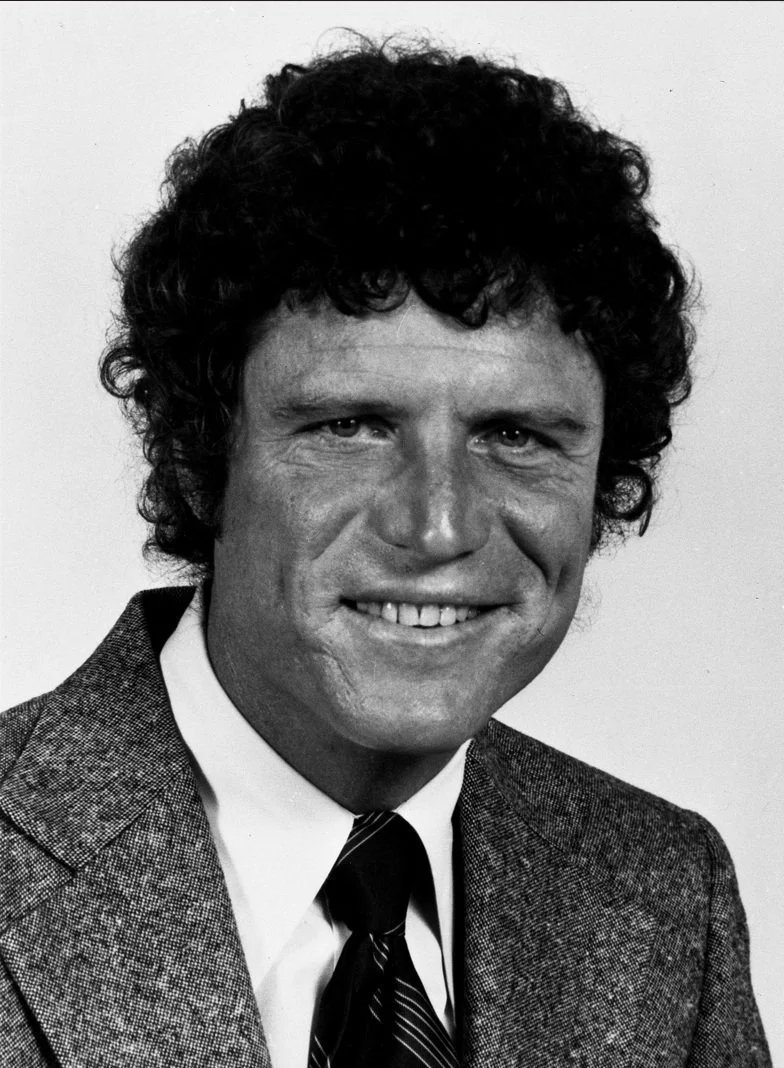
Jim Sims was a 1967 UCLA graduate and had been the stroke of the 1967 Western Sprints champion. He coached the UCLA Freshman during the 1968/69 and 1969/70 seasons and then the 1973 USC Freshman. Jim earned his law degree from Loyola and had been practicing law in Ashland, Oregon. Jim and his partner moved back to Los Angeles to set up a practice and he became the Freshman coach for three years beginning in the fall of 1982, succeeding Mike Bennett. UCLA Bruin Oarsmen, 28 Sep 1982. Newman's contract was not renewed and his successor was the Freshman coach Jim Sims. Sims became the head coach for the 1985/86 season. Following the season he returned to Ashland, Oregon to continue his law practice there.
In 2020, Jim Sims donated $100,000 to start the FOUR endowment fund.
1986
The alumni were notified in a letter entitled “URGENT SAVE THE UCLA CREW PROGRAMS” stating that the coaching staff had been informed in June 1985 that the “rowing programs at UCLA would be sharply curtailed effective September 1985. As of June 1986, the Administration may withdraw its entire financial support.” The letter outlined an immediate goal of raising $100,000 by December 31, 1985 and an ultimate goal of three million dollar endowment, along with a letter writing campaign to the UCLA Chancellor. In the words of coach Sims, “the threat of program termination hung over the heads of this year’s crew.” Jim Sims, “Heavyweight Crew Report”, Bruin Strokewatch, Sep 1986.
Ed Buckley became the freshman/novice coach as Jim Sims became the varsity coach. The spring season began with a home opener on March 29 and clean sweep against USC (as a substitute for the Harbach race). The following weekend at the San Diego Crew Classic, UCLA’s Varsity eight was edged out of the grand final by one-half a length by Navy and then finished second in the petite final (8th) behind Long Beach State. UCLA placed fifth in the open eight and the lightweight eight was sixth. Next up in the schedule was the UCLA Classic on April 12 with UCLA hosting Cal and Oxford University. Actor and 1937-39 Cal oarsman was Gregory Peck as Grand Marshal and the emcee was film star Dudley Moore.
“The university’s authorities, who closed down their journalism school a few years ago as an economy measure, have been threatening crew, too, reducing its annual budget to $75,000.” Bob Oates “A Jolly Good Show, Old Sport”, Los Angeles Times, 13 Apr 1986, 79. First year head coach Jim Sims shared that the UCLA administration was evaluating whether to terminate the team because it was non-income generating. A goal was set to raise a multi-million dollar endowment to generate a $300,000 yearly budget. Following the example of the 1983 50th anniversary event against Harvard, the 1986 UCLA Classic would feature Oxford University and Cal against the host Bruins. “Coach Jim Sims said the event also would be his eight’s statement against recent athletic department reviews questioning the financing of crew and its continuance as a university activity.” Paul Dean, “UCLA Crew, Out to Improve Image, Meets Oxford at the Marina April 12”, Los Angeles Times, 7 Mar 1986, 51.
Oxford had come after their loss to Cambridge in The Boat Race to perform public relations for Augusta, Georgia and lost by a few feet to Temple University, then to Marina del Rey to face California and host UCLA. UCLA experienced a bobble on the third stroke that placed them six seats behind. Though Oxford got out to a quick lead, they were passed by California after about 600 meters and failed to hold UCLA at the end. The last event of the Classic on April 12 ended with California the victor in 5:43 and finishing UCLA two inches ahead of Oxford both in 5:50. Oxford coach Topolski shared in his book that rowing a shorter distance than their training for The Boat Race and “with a new stroke, a substitute 6 man” Oxford was at a disadvantage but “a big crowd had turned up and everyone was happy – rowing looked secure on the Creek for another year at least.” Daniel Topolski with Patrick Robinson, True Blue: The Oxford Boat Race Mutiny, 1989, 57.
Although the UCLA rowing team received a reprieve, it was only temporary.
At the Stanford Classic, both Stanford and UCLA lost both their morning and afternoon races. The six crew field also included Cal, Washington, Brown and Wisconsin. UCLA’s losses were to Washington and then to Cal. Separately, the JV, freshman, novice and lightweight crews raced UC Santa Barbara. The Newport Invitational was won by UC Irvine, Long Beach State placed second and UCLA was third. The UCLA Freshman 8 challenged the eventual winner Orange Coast but bobbled at the 1500 meter mark resulting in their second place finish. Prior to the Pacific Coast Championship, UCLA hosted Orange Coast and the University of San Diego. Orange Coast won all the men’s races they competed in and UCLA defeated San Diego in the Varsity eight. The lightweight freshman race was exciting since it included a UCLA rower breaking his oarlock at the 200 meter mark and one of the University of San Diego oarsmen ejected from his shell while catching a crab. Those two crews participated in a re-row that the UCLA crew won. Dave Marble, “OCC Men’s Crew Beats UCLA: Women Win at Southern Cal Championship”, UCLA Daily Bruin, 5 May 1986, 23. The lightweight varsity attended the Opening Day regatta in Seattle but their stroke disappointingly developed a broken foot stretcher early in the race. At the Pacific Coast Championships both the Varsity eight and Junior Varsity eight finished fourth, and the Freshman eight was fifth though only one length out of second place.
“Following the Pacific Coast Championships, UCLA received an invitation to compete at the Intercollegiate Rowing Association Championships in Syracuse. Because the frosh eight had made a dramatic 38 second improvement through the season and it was decided they should also go to the IRA. Two of the oarsmen the varsity eight decided they didn’t want to go, so the varsity organized a four and a pair.” Jim Sims, “Heavyweight Crew Report”, Bruin Strokewatch, Sep 1986. The Freshman eight finished in fourteenth place (last in the third level final). The crew was composed of Mark Batchelder, Mark Curzan, Mark Hogan, Jeff Kaltreider, Steve Peterson, Mike Stralka, Craig Webster, Brad Weiners and coxswain David Watt. The Varsity four-with-coxswain finished sixth and the Varsity pair-without-coxswain (Simon Outwaite and Richard Sax) finished third after winning its heat.

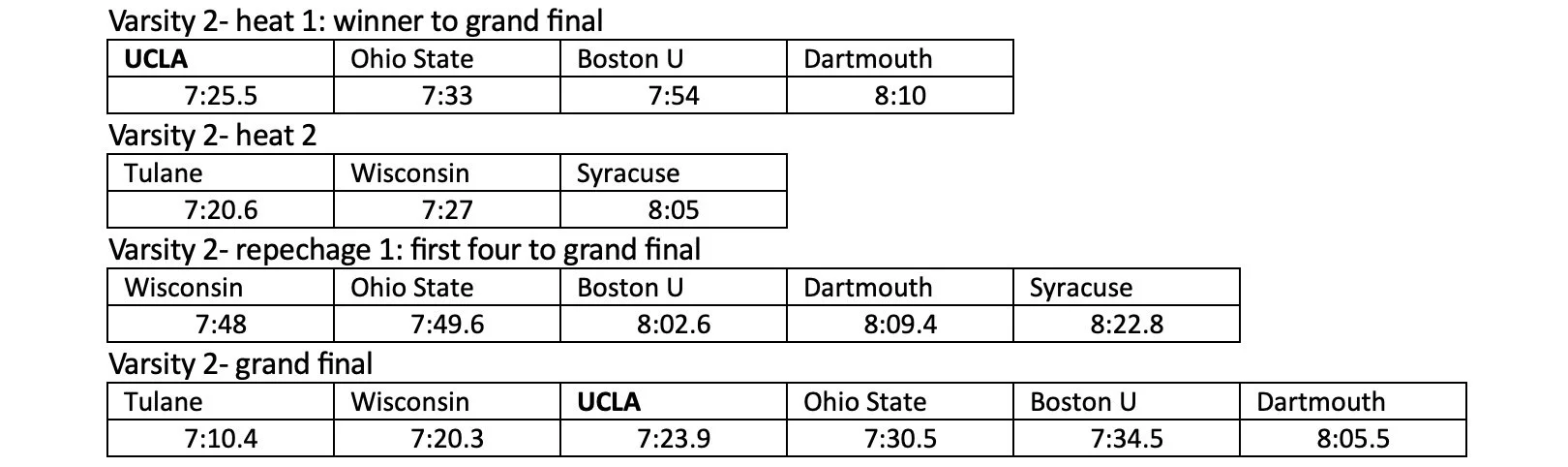
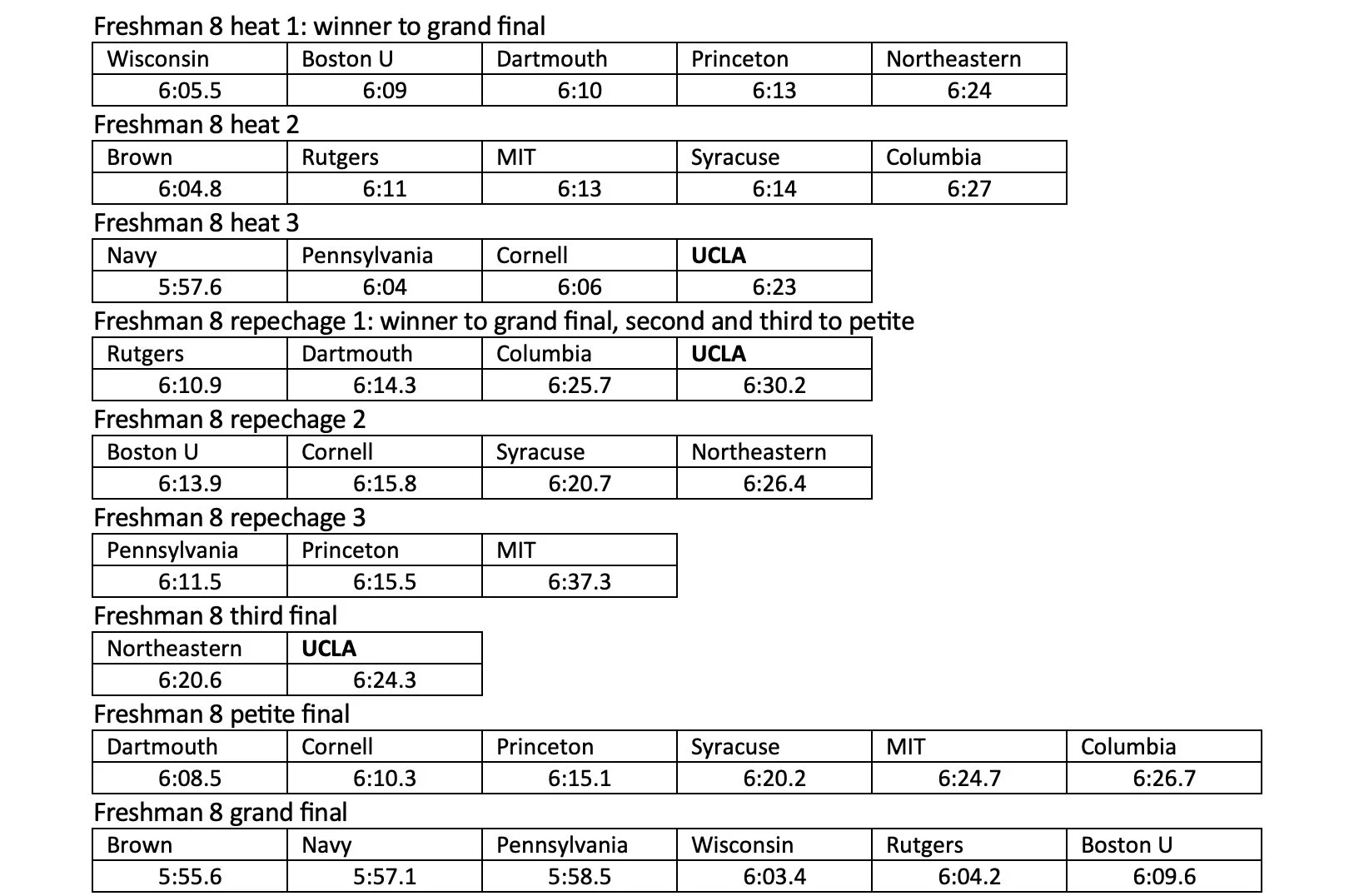
Lightweight coach Kevin Sherwood reported the expansion of the squad to varsity, junior varsity and freshman crews and that the “lightweight fund raising efforts were successful, and exceeded $43,000; which added a used shell and boat trailer, and helping send the team to Washington’s ‘Opening Day’ [placed third] and the ‘Eastern Sprints’.” Kevin Sherwood, “The Lightweight Crew”, Bruin Strokewatch, Sep 1986.
For the first time women raced 2000 meters at the San Diego Crew Classic. The UCLA women’s varsity eight placed second in the petite final (8th place) .2 seconds behind Cal, fifth place in the lightweight eight and third in the novice eight. web [URL: https://github.com/crewclassic/results/blob/master/1973_through_2003.xls] During the UCLA Crew Classic UCLA’s and Cal’s women faced off in four races. Cal won the women’s varsity (6:46.5 to UCLA’s 6:49.5) and JV race by 37 seconds, while UCLA won the novice eight and novice four races. Dave Marble, “Women Rowers Split Four Races With Cal”, UCLA Daily Bruin, 15 Apr 1986, 34. During the Newport Regatta weekend most of UCLA’s women raced the Southern California Championship in Oxnard. The Bruins won each of their heats and finals. The competition for the Wyatt Cup in 1000 meter races included UC San Diego, the University of San Diego, San Diego State, Loyola-Marymount, Cal Poly San Luis Obispo and UC Santa Barbara. The UCLA varsity eight was racing the University of Washington in Seattle and was soundly beaten. At the Pacific Coast Championship UCLA’s novice 4+ was second, the novice eight third and the varsity eight placed in the bottom half of the grand final that concluded with Washington, Stanford and Cal in the first three places.
A reminder of one of the challenges of a club trying to survive on a shoestring was a fatal accident that occurred after the Pacific Coast Championships. While returning home from the regatta, a 15-passenger van carrying twelve men from the San Diego State team and one women from UC San Diego was involved in a rollover accident on Interstate 5. At about 8 p.m. with a 19-year old athlete driving, a tire blew as the van was traveling at an estimated 85 miles per hour. Three athletes were killed and the others injured. “Athletes Killed in Accident”, Oroville (CA) Mercury Register, 12 May 1986, 1.