The Erinn McMahan Years
Erinn McMahan completed nine years as head coach of the men’s rowing program. He was credited with redirecting the trajectory of the team and expanding the number of participants.

1998 - 2006
|
1998 - 2006 |
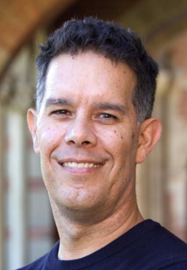
Erinn McMahan assumed the duties of head coach, in the fall and entered the UC Irvine Graduate School of Management while continuing his duties as head coach. Doug Miller split the coaching duties of the men’s team with McMahan. Miller had rowed in high school at Washington-Lee in Virginia and the lightweight crew at Princeton University. His past coaching positions were with the junior program at Potomac Boat Club and the novice girl’s program at Washington-Lee High School. He was beginning work on a graduate degree in urban planning at UCLA.
1998
Persistent heavy rain storms kept crews training indoors during the first six week of 1998. Instead of the Berg Cup at Newport March 21, UCLA attended the Southern California Challenge Cup on Mission Bay. The Bruins finished last behind Long Beach, Newport Aquatic and the San Diego Rowing Club. In the varsity four events UCLA placed third in the “A” event and fourth in the “B” event. The novice squad fared better finishing first and fourth in the four and third in the eight. The limited water time strongly affected the performance at the San Diego Crew Classic, where neither a novice eight nor open eight advanced to finals. The women’s Miller Cup was cancelled due to large waves in Ballona Creek. At the Newport Regatta UCLA placed fifth in the men’s varsity four and the B-level Novice eight, but did not enter a varsity eight. UCLA’s only finalists at the April 18 California Collegiate Rowing Championship was a first-place in the varsity four and third-place in the lightweight four.
Beginning in 1997, the PAC-10 became a one-day event; the WIRA was under the name “Pacific Coast Championship” on the day preceding the separate PAC-10 that included non-conference colleges, both at Lake Natoma. The WIRA/Pacific Coast Championship was held on a Saturday and included lightweight events that some PAC-10 schools competed in and the PAC-10 Championship was held on Sunday and included nineteen non-conference schools. UCLA entered five events at the Pacific Coast Championships/PAC-10: women’s varsity four (fifth/last in petite final PAC-10) and novice fours, men’s varsity four (second place in the third final PAC-10), men’s freshman/novice eight (second place in the third final PAC-10) and men’s lightweight four (second place at Pacific Coast, a scrappy crew). Heavy chop at Lake Natoma caused the men’s varsity four to swamp during a practice the day prior to their race.
The June Strokewatch newsletter announced that the UCLA Foundation Office threatened to dissolve F.O.U.R. “due to the lack of viable leadership for over two years.” It was reported that the last few years F.O.U.R. had dwindled to four active board members and they had not come up with new ideas to motivate alumni participation nor fundraising. Dissolution would cause the loss of 501(c)(3) status and while the endowment would still exist there would be little ability to organize solicitations and provide future alumni support. It was a call to action to the eight hundred UCLA Crew alumni.

1999
Some of UCLA’s racing included the San Diego Crew Classic. Both the two women’s novice eights and men’s freshman eights finished well back in the heats. An April triangular race with Loyola and Chapman left UCLA’s men behind in all three events. UCLA entered eight events at the California Collegiate Championship where both UCLA men’s and women’s varsity eights finished in eleventh place. The other events UCLA entered were mostly in lightweight and novice events, with one of the higher placing a fifth place in the women’s varsity four. At the Pacific Coast Championships, that mostly featured lightweight and novice events the day in advance of the PAC-10, UCLA finished seventh in the men’s lightweight eight and eighteen in the men’s novice eight and women’s novice four, and the women’s novice lightweight four finished ninth, which was last. At the next day’s PAC-10 championship UCLA was also at the bottom of the finishers taking a twelfth in the men’s freshman/novice eight, seventeen in the women’s novice eight, eighteenth from 21 entries in the women’s varsity eight, and elimination in the heats from a field of twenty-one in the men’s varsity eight.
For the first time since 1995 UCLA had entries in the varsity eights. As a result, Jon Goss was honored as a member of the PAC-10 All-Conference roster, and Michael Hendricks as a member of the PAC-10 All-Academic roster for the first time since 1994. On the women’s side, Bobbie Seminoff earned a place on the PAC-10 All Conference rooster, the first Bruin since 1996, and Amy Chen on the PAC-10 All-Academic roster for the first time since 1997.
The season concluded with a total of more than fifty male and female athletes. The team updated their fleet with three Hudson eight-oared shells and a Vespoli ultralight bow-coxswained four-oared shell. One of the eights was from a trade with Long Beach State. The other three shells were purchased with a donation from alumni supporter Julian Wolf and a grant from the registration fees committee. There was still a need for rowing ergometers, oars and Cox Box sound amplification systems.
2000
In August 1999 Loyola Marymount’s floating boathouse came unmoored and sank in Marina del Rey, totaling all their rowing equipment. Though the school dropped the program for the year students carried on and received equipment assistance from Marina neighbor UCLA. Bill Plaschke, “Rising from the Depths”, Los Angeles Times, 7 May 1999, D-1, D-7.
The coaching staff for the men’s squad consisted of head coach Erinn McMahan, assistant Doug Miller and novice coach Steve Scott. After three years of focusing on building the size of the team and “creating an atmosphere conducive to athlete retention,” Coach McMahan said, “the focus has shifted to identifying individuals with the talent and determination to propel the team to the next level. This process represents the next stage in restoring the program to its historical standing in the rowing world.” Erinn McMahan, “Coach’s Corner”, Strokewatch, December 1999, 1.
The year’s schedule listed planned participation in three fall events. During the spring UCLA’s women raced a varsity eight and a novice eight, and occasionally a novice four. The men’s team did not race a varsity-level eight, but consistently raced a novice eight and a varying mix of lightweight, varsity and novice fours. The teams’ collective victories prior to the championships were few, with a women’s varsity win over Chapman, a men’s varsity four win over Chapman and a men’s novice four victory over first-year program Pepperdine. Both novice eights had also defeated UC Santa Barbara’s second novice crews while losing to UCSB’s first novice eights.
During the years 2000 to 2004 the WIRA and PAC-10 were typically held two weeks apart with a “Pacific Coast Championship” held the day prior to the PAC-10. UCLA did not attend the WIRA and instead entered crews in the Pacific Coast Championships that featured small boat categories, novices and lightweight events, and entered five crews in the PAC-10 Championship regatta. UCLA earned two medals at the Pacific Coast Championship. The victory in the men’s novice four was a highlight of the season and the past several seasons. In the final they had established a lead and were not forced to sprint at the end. The men’s lightweight four finished in third place of four crews, securing a second medal, however that same crew had their better race on Saturday and finished fifth in the petite final in the open weight men’s varsity four at Sunday’s PAC-10. The remaining UCLA crews entered at the PAC-10 all finished in last place in the third finals, in the men’s novice eight, women’s novice eight and women’s varsity eight. The third final of the men’s novice eight experienced excitement as one of the Bruin rowers broke his oar within the first half of the race and elected to jump out of the shell to lighten the load, leaving seven rowers to finish the race. “UCLA Wins West Coast Championship”, Strokewatch, Fall Quarter 2000, 1.
2001
The F.O.U.R. president Lin Werner suggested in a November 2000 appeal that alumni sponsor the unmet costs of the athletes at $60 per month per athlete, $480 per athlete per year [$24,000 for the team]. Based on 50 athletes participating the annual cost per athlete was budgeted at $1122 [about $56,100 total], with $162 income to the program per athlete, student participation dues of $60 for each of eight months. In the past the per athlete dues of $480 for eight months also required an additional $200 in fundraising that the athlete became responsible for if they had not reached that amount. President Werner targeted F.O.U.R.s fund raising to offset the fundraising requirement to prevent the fundraising requirement from causing team members from quitting. F.O.U.R. raised more than their $17,000 goal set at the beginning of the year. Erinn McMahan, “Fundraising Campaign a Success”, Strokewatch, Summer 2001, 2. Werner reported that there was close to $37,000 in total was raised plus gifts-in-kind valued approximately at $10,000. Lin Werner, “A Letter From the President of FOUR”, Strokewatch, Summer 2001, 2.
Erinn McMahan completed his fourth year as head men’s coach, his fifth year after beginning as a coach with the program, and also coached the novice men’s group. During his tenure as a coach the team, “the size of the team [increased] from 20 rowers in 1996/97 to over 60 in 2000/01, increasing the team’s budget from $20,000 to $60,000, and helping to raise funds necessary to purchase five eights and two fours for team use.” “Men’s Coach Will return for Sixth Year With Team”, Strokewatch, Summer 2001, 7.
Replacement of the aging fleet of shells was noted as an important goal. Both the increasing number of oarsmen along with physically larger rowers, the team hoped to add a larger shell, a Vespoli DXL instead of the DL (size range 175-190 pounds) purchased the last year. Allen D. Bailey, UCLA rower from 1955 through 1957, contributed $12,000 that helped purchased a new Vespoli Millennium eight-oared shell and $8,000 to purchase a 2000 Vespoli Ultralight purchased from Loyola Marymount. Bailey had also played on the UCLA basketball team for Coach John Wooden along with working a full-time job. Other equipment contributions included two sets of Concept2 oars, from Julian Wolf and Adora Chan combined with several other alumni, and a discount on the purchase of a pickup truck to tow the shell trailer. There were only four shells in the boathouse for the expanding women’s team. A Vespoli Millennium shell purchased the last year, the “Ms. Lin” for F.O.U.R. president Lin Werner, was to be used primarily for lightweight women. “Bruin Alum Donates $21,000 to Men’s Team” and “Do You Want to Name a New Racing Eight?”, Strokewatch, Summer 2001, 7.
The year’s schedule listed planned participation in four fall events. Since the men’s squad was both young and inexperienced they “struggled to find consistent speed” during the 2001 season. The Bruin varsity eight was composed of five novice rowers and three second year rowers. They finished last in the third final of the PAC-10 Championship. The Bruins did sweep USC in their dual on Ballona Creek. The team raced men’s novice eights, sometimes as many as three crews, often including a varsity eight, and occasionally a lightweight eight and varsity four. One of the racing highlights of the season was a silver medal, from a field of seven entries, at the Pacific Coast Championships in the men’s novice lightweight four.
The varsity women were cited as making steady improvement during the season however were still without any victories by the end of the season. The novice women ended the season with two crews. The novice eight was undefeated in dual races, though the San Diego Crew Classic plagued by a disruption caused by high winds and heavy rains on Saturday at and they also had to cancel their hosted Miller Cup. They won the Pacific Coast Championship but placed eleventh at the next day’s PAC-10. The victory in the Pacific Coast event was made more noteworthy since their shell’s fin had broken off during the warm-up. “Coxswain, Melissa Fong, had to retrieve the skeg by diving into the water. They then rowed to the starting dock where race officials had them remove their shell from the water to fix the damage. That the nine women in the boat had the composure to win their race with the skeg affixed by only tape, and no warmup, is testament to their maturity and concentration.” “Bruins Golden at PCRC/PCVC”, Strokewatch, Summer 2001, 1. Six members of the women’s Pacific Coast lightweight eight (second of four entries) and the IRA lightweight entry were from the second novice eight.
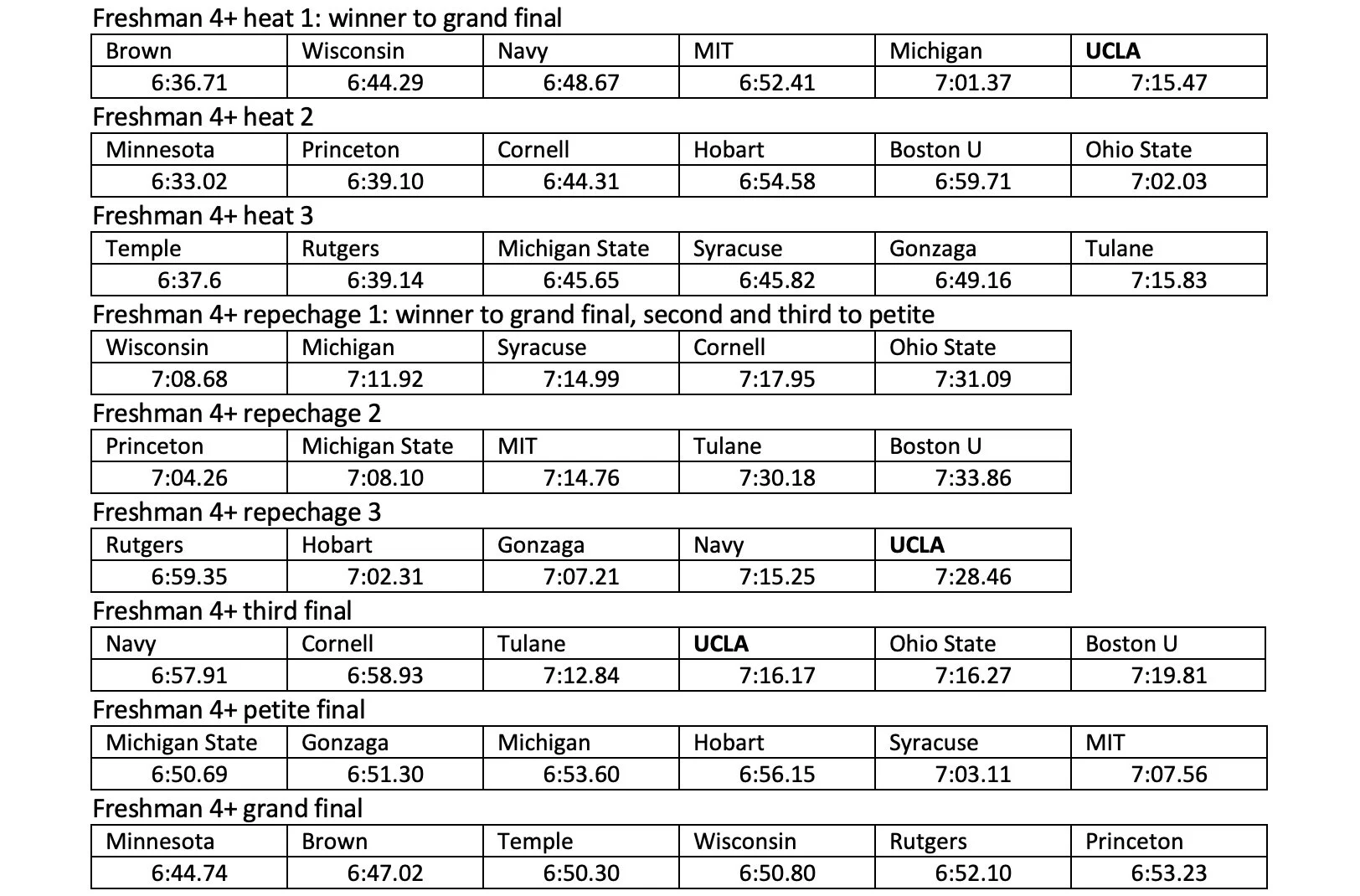
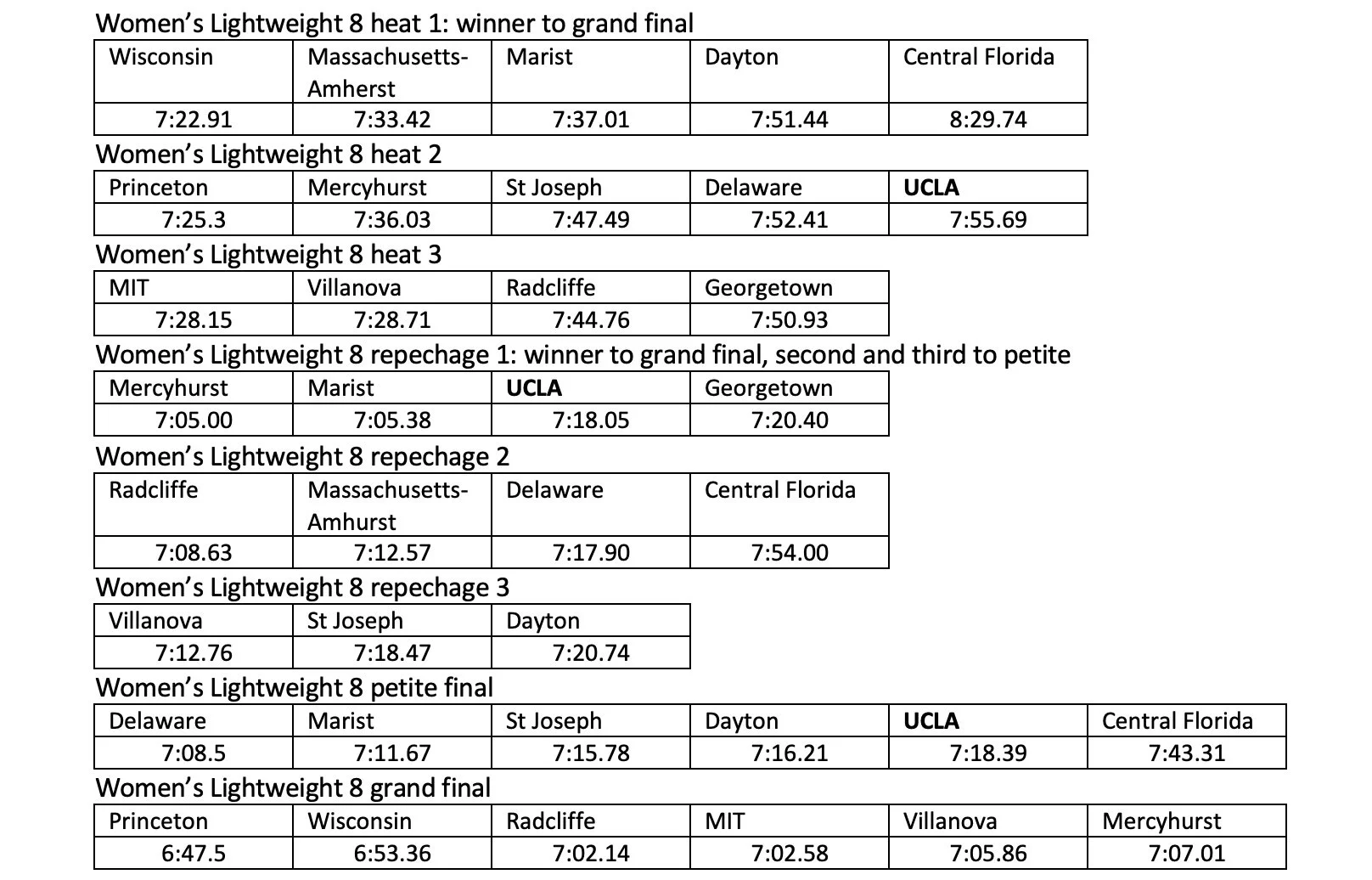
Twenty-seven members of the UCLA team attended the Intercollegiate Rowing Association (IRA) championship, the first such trip since 1989. Their travel was aided by ASUCLA, alumni, parents and friends, with the rowers paying for their own daily meals and airline ticket. The IRA was the national collegiate championship for heavyweight and lightweight men and for lightweight women. UCLA entered two crews in the varsity four-with-coxswain, a freshman four and a women’s lightweight eight. The IRA having added the women’s lightweight eight in 1997. The women’s lightweight eight, consisting of six novice rowers and a novice coxswain, emerged in eleventh (fifth in the petite final) place. Of the men’s varsity fours, the second crew composed of lightweights was eliminated in the repechages and the first crew, consisting of three second-year rowers and one first-year rower, placed fourteenth (second in the third level final). The freshman four was sixteenth (fourth in the third level final).
From 2001 through 2005 a revived USC men’s club crew shared the waters of the Marina, rowing out of the Loyola Marymount boathouse.
On February 8, 2001 it was announced that the UCLA women’s rowing team would regain varsity status for the 2001/02 academic year and be fully operational for the 2002/03 school year to meet Title IX compliance, while the men’s team would remain under the Club Sports Program in the UCLA Recreation Department. The process had begun in 1998 with a complaint filed by the California Chapter of the National Association of Women that UCLA was not in compliance with providing opportunities for female students. After an analysis of the entire UCLA athletic program the Region IX Office for Civil Rights found that the university treated athletes of both genders similarly but the ratio of male/female athletes was out of line with the ratio of student enrollment. “Women’s Crew to Gain Varsity Status”, Strokewatch, Winter 2001, 1. Amy Fuller was hired to coach the varsity women, with Guillermo Lemus who had been the varsity coach for the last two seasons as an assistant. After several years as an emerging sport, the NCAA had offered its first sponsored national rowing championship for women in 1997, and many colleges had moved to offer women’s rowing to help with their Title IX compliance, especially since rowing required a large team size. UCLA already had some of the basics for women’s rowing, including a venue with some equipment along with some athletes, and did not have to start from zero.
2002
The UCLA women’s team was again in transition as it regained its status as a varsity sport. In a joint message in the fall, both coaches shared that even with the status change “we are still one united Bruin team.” It also noted that “the men will require substantial outside support to achieve long term success,” surviving on dues and outside donations. However, donating to F.O.U.R and its endowment was now supporting just the men and donations to support the women’s team would go through the department of intercollegiate athletics. While funded by the athletic department, the women’s program would also rely on outside donations since much of their projected budget would cover operations and recruiting expenses. Ten new rowing ergometers purchased by the women and the truck and trailer owned by the men would be mutually shared. Amy Fuller and Erinn McMahan, “The Direction of UCLA Rowing” Strokewatch, Fall 2001, 1.
There were larger numbers on both the men’s (the men’s team growing to 65 athletes from 32 the previous year) and women’s teams, along with higher expectations of work, boat speed and success. There were rowing ergometer standards for both teams. For women, all were to be below 7:30 for a 2k distance and for varsity and novice men below 6:25 and 6:35 to race in their respective eights.
The F.O.U.R. president Steve Richardson suggested a similar funding plan as the previous year in a December 2001 appeal. Alumni were asked to sponsor the unmet costs of the athletes at $480 per athlete per year [$24,000 for the team]. Based on 50 athletes participating the annual cost per athlete was budgeted at $1135 [about $56,750 total] without equipment costs, with $175 endowment income to the program per athlete, student participation dues of $60 for each of eight months. Tom and Louise Jones endowed the first scholarship for the women’s team and christened a new eight “Craig E. Dial” (12 Aug 1958 – 14 Dec 2001) in memory of their son-in-law, a former UCLA oarsman. The received funds to increase their fleet of shells and had enough left over to refurbish the Creekside boat bay with new paint and boat racks to the benefit of both teams. Erinn McMahan, “Donations Help Bruins Succeed in ‘02”, Strokewatch, Summer 2002, 5.
The women’s varsity team received coverage in the Daily Bruin but not the men’s club. The women’s staff considered the novice eight a priority boat for the season. That crew placed sixth in the final at the San Diego Crew Classic, won at the Miller Cup and placed fifth in the PAC-10 Championship. The varsity eight included seven second-year rowers and placed third in the third final of the Cal Cup at the San Diego Crew Classic and twelfth at the PAC-10. The junior varsity eight consisted of three experienced rowers and five novices. That crew placed tenth at the PAC-10. The team’s goals for the season had been “to set the standard of hard work, focus, respect, and academic excellence for years to come,” and was “less about medal count and color.” Amy Fuller, “Women’s Crew Has Strong Year”, Strokewatch, Summer 2002, 4.
The coaching staff considered the men’s team up and coming as it had increased its numbers and was fielding more crews at regattas. The Bruins notched a 3-1 dual race record with their one loss to Stanford. All three of the Bruin eights placed in the petite finals of the San Diego Crew Classic. UCLA’s men’s team entered six events in the Pacific Coast Championships and three crews in the next day’s PAC-10 Championship. The lightweight and novice events featured in the Pacific Coast yielded more UCLA success in the men’s lightweight events. UCLA earned two second places. One in the lightweight eight (of three entries but defeating UC Santa Barbara that had earlier won the WIRA) and the other in the novice lightweight four. UCLA also raced in the second novice eight, the novice four, open four and lightweight four. Their three eights at the PAC-10, freshman/novice, junior varsity and varsity, all finished in the petite finals with the freshman/novice crew placing seventh overall. As a team the men placed fifth in the PAC-10 points standing.
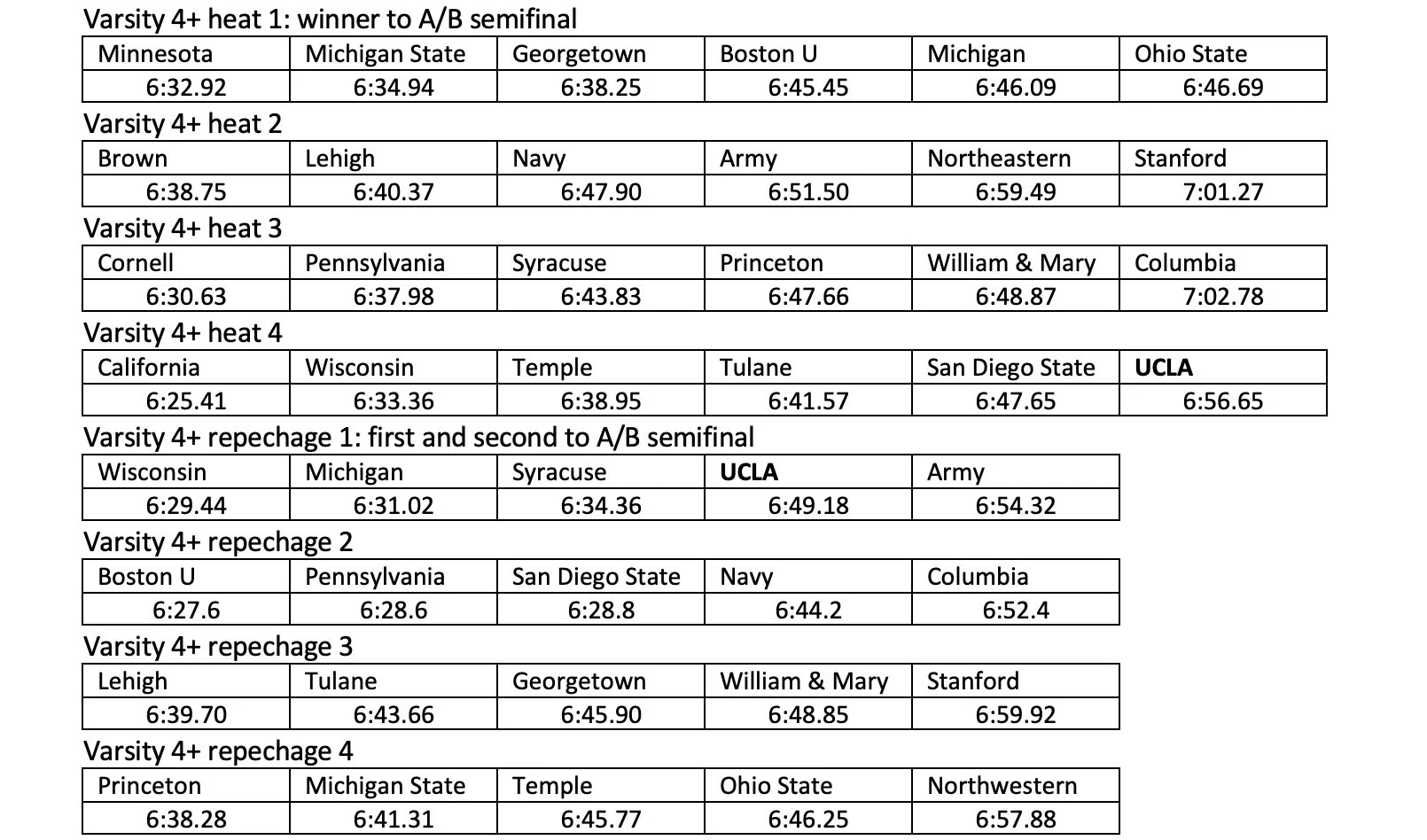
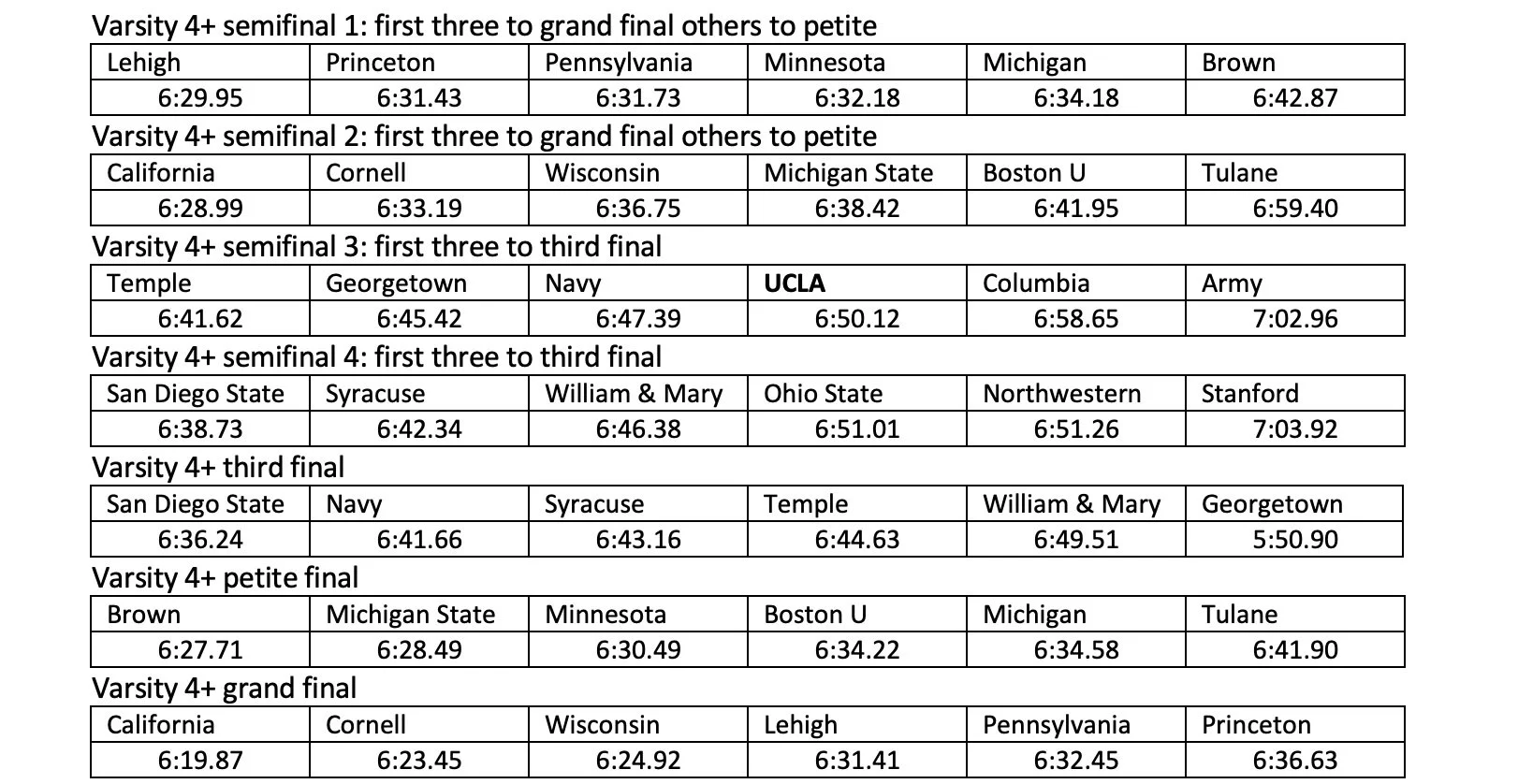
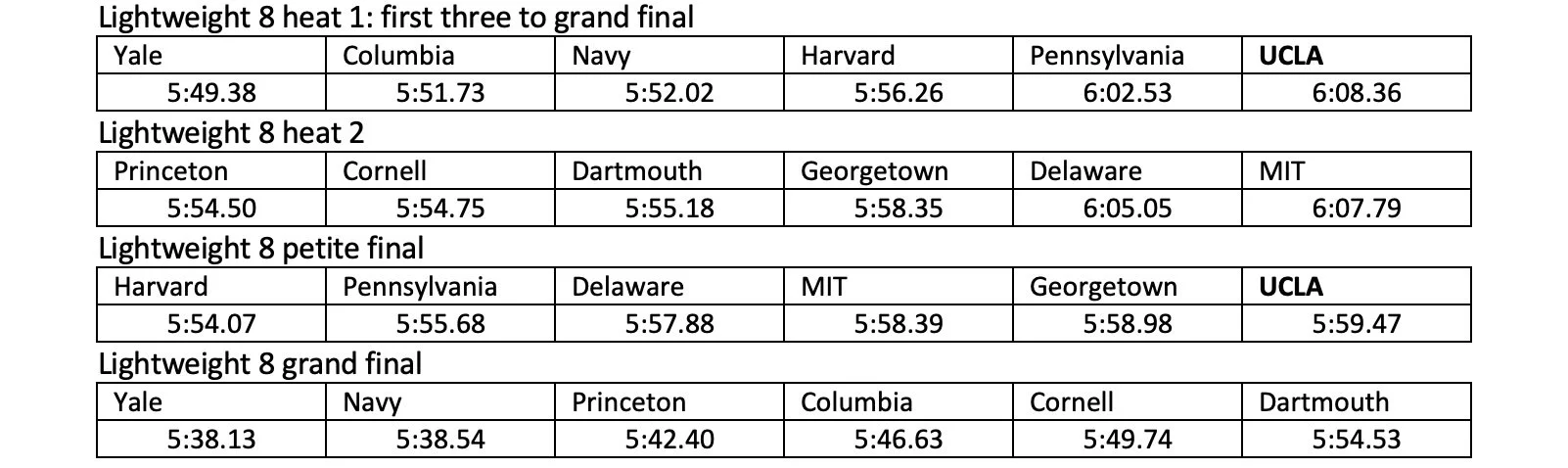
UCLA’s men returned to the IRA in the varsity four and the lightweight eight. The lightweight eight, composed of athletes from the varsity and novice eights, finished last in its heat and last in the petite final of the twelve crews entered in the event. The crew was described by coach McMahan as “long on power but short on experience.” The varsity four competition had 24 entrants and the progression consisted of heats, repechages, and semifinals to three levels of finals. UCLA’s entry finish fourth in a semifinal for the third level final, overall having beaten the U.S. Military Academy twice and Columbia once.
2003
Bill Zack, after seven seasons as head coach at Sacramento State, joined the women’s coaching staff as another full-time assistant.
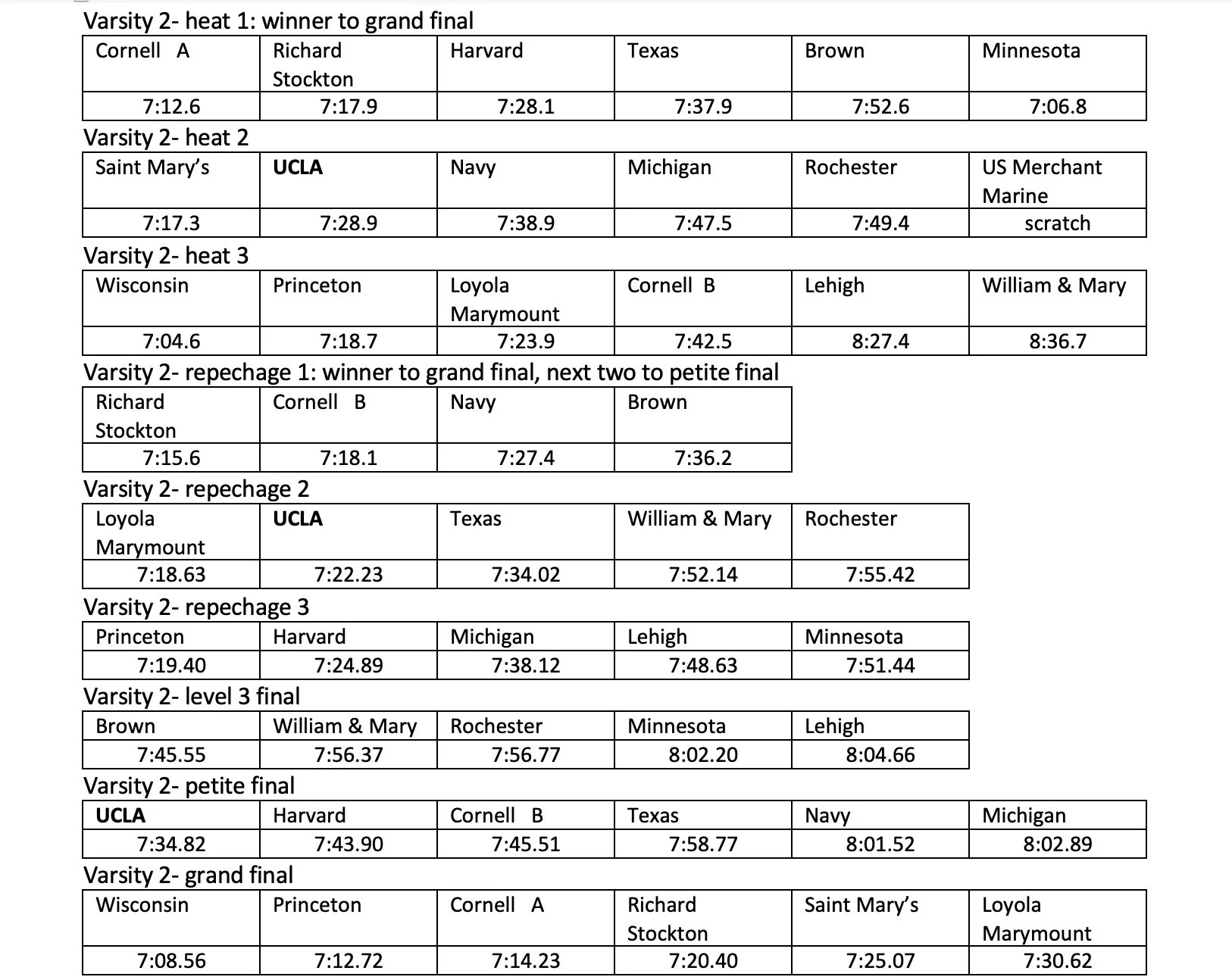
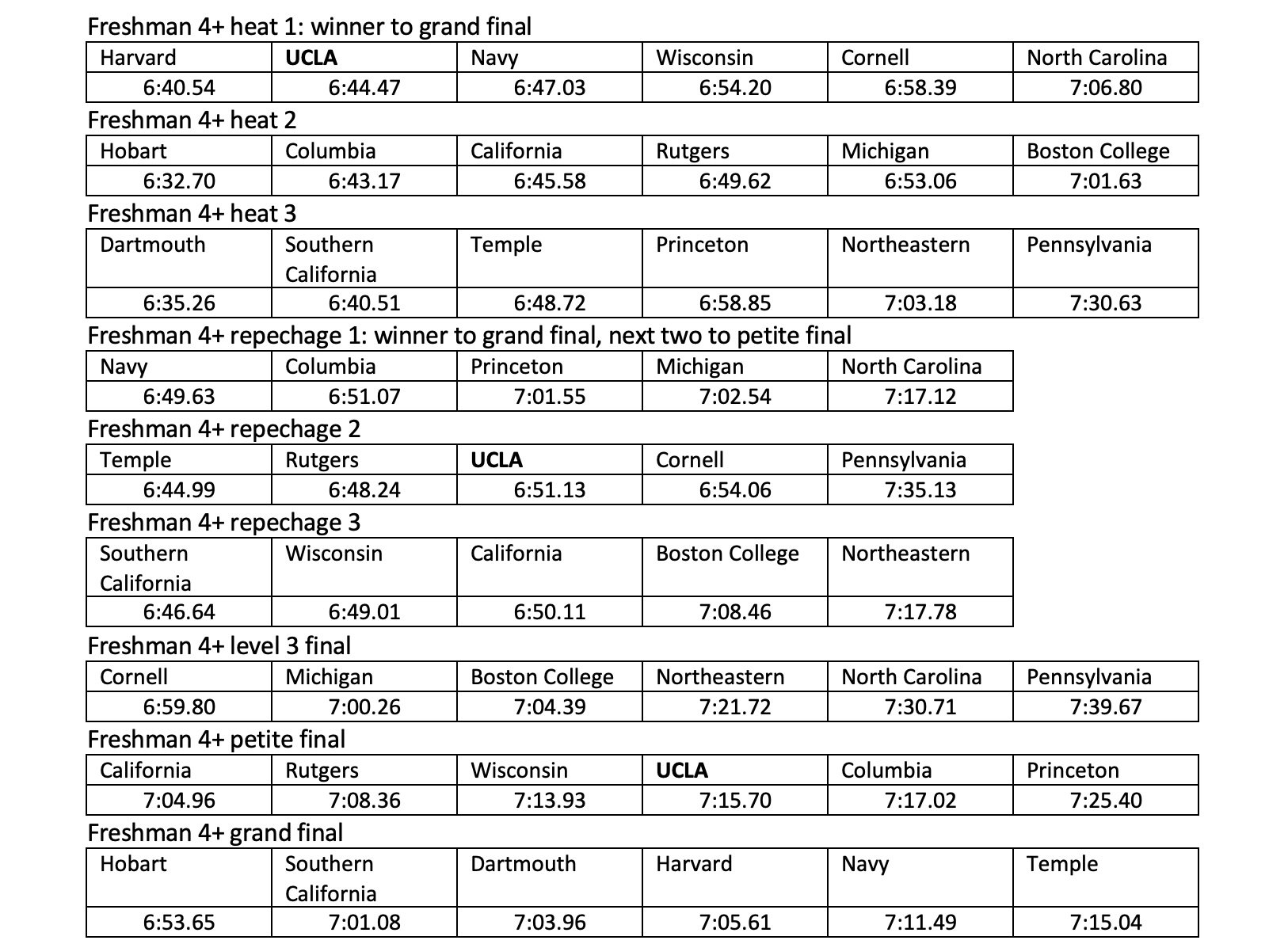
Still not attending the WIRA, UCLA placed second and fourth in the Pacific Coast Championship in the men’s novice four and novice lightweight four. At the PAC-10 the freshman/novice eight, junior varsity and varsity all placed in the petite finals, in eighth or ninth place overall, with the freshman/novice and junior varsity only placing ahead of a single crew each. As a team, they placed sixth of seven PAC-10 schools. The women placed sixth of eight schools and were moving up in their placements at the PAC-10 Championship with the varsity eight, junior varsity eight and varsity four still in the petite finals, but placing either seventh or eighth overall. The novice women won the championship in their event at the PAC-10. UCLA’s men’s crew sent entries to the IRA for the third consecutive year. The Bruins placed seventh in the varsity pair-without-coxswain and tenth in the freshman four. They both began with second place showings in their heats. The regatta being scheduled the week following final exams prevented coach McMahan from additionally bringing a varsity four and open four to the regatta.
2004
Rigger Brown (Paul Herrick) passed away on June 8, 2004. Although retiring in 1984 he never really left the program and continued visits back to the boathouse until the final months of his life.
The men’s coaching staff expanded and former Bruin rower Lyndsey Wells was hired to plan events, manage the database and fundraise. Part of her task was to track down 500 missing address contacts. Lyndsey had been a volunteer the year before after a knee injury cut her rowing season short. Will Nguyen, (2002 Texas, four year team member as a coxswain) was to coach the freshman/novice squad after serving as a volunteer assistant with the UCLA women the previous year; Arthur Lee (2003 UCLA) was to assist with the novice men and had been the 2002 stroke of the UCLA varsity eight and lightweight eight and raced at the IRA in both 2001 and 2002, and had worked with the learn-to-row program the previous year after completing his athletic eligibility; also scheduled to assist with the novice men was Erik Krogh-Jespersen (2001 Rutgers). Erik had rowed since his junior year at Rutgers as a lightweight and had one more year of eligibility when he arrived at UCLA as graduate student, he rowed on the UCLA 2001/02 varsity squad and in the lightweight eight.
Early season victories were earned over Saint Mary’s, UC Irvine and Loyola Marymount [Guy Lundberg Cup, UCLA extended the series victories to 3-1]. In the Pacific Coast Championships, that featured small boats lightweights and novices, the Bruins entered five crews and earned a first in the two boat lightweight four event, a second place in the four boat novice lightweight four. At the next day’s PAC-10 Championship among UCLA’s four entries they placed eighth in the varsity eight, seventh/last place in the junior varsity eight, fifth/last in the varsity four and tenth in the freshman/novice eight. In team points they placed fifth of eight PAC-10 schools participating. There were no UCLA entries sent to the IRA.
Lindsey Wells reported that over $40,000 was raised in the alumni supported Support-A-Rower Campaign and the family and friend supported Erg-A-Thon (almost $6,000 in its first year). The funds supplemented the expenses of team travel to both the San Diego Crew Classic and the PAC-10 Championships, paid the coaching salaries and were used to purchase a new eight-oared racing shell (“1967 Pac-8 Champions”). The women’s team honored donor Tom Bengaard and longtime supporter Lin Win naming two of their new shells, the “Big Tom” and “Ms. Lin”. John Nelson, UCLA ’81, was stepping forward to help in the purchase of a new shell in the fall of 2004.
2005
UCLA attended the Head of the Charles regatta in Boston for the first time since 1991, but this time in the Collegiate instead of the Championship eight. The Bruins finished in twenty-fifth place among the forty-five entrants on the wind shortened 4,000 meter course. A total of forty-eight oarsmen and six coxswains completed in a four regatta fall season for the Bruins.
A new shell, the “Rigger Brown II”, was purchased through a gift by John Nelson ’81, was slated for christening during the Alumni Day in March. Athlete contributions had grown to $540 per year representing half the cost of budget for equipment, travel, coaching salaries and uniforms.
The Bruins swept Loyola Marymount and UC Irvine in all events during the first race of the season on Ballona Creek. The next weekend the Bruin varsity and junior varsity eights defeated Orange Coast, even when in the JV race the Bruins fought a crosswind and several crabs, after early morning rains changed the venue from Ballona Creek to Newport Beach. Riding a wave of strong showings, the men’s team looked forward to even greater success at the San Diego Crew Classic. Although leading early on in a challenging field in the Cal Cup , they dropped back to third by halfway and then Washington State sprinted past them at the end. In the petite final the Bruins placed third. The novice and junior varsity eights also raced in the petite finals of their events, with the novice finishing first and the JV third. They followed that with a successful sweep of UC Santa Barbara. The Bruins traveled to the Stanford Invitational and faced Stanford and Oregon State in separate races. They were defeated by Stanford’s superior size and then fatigue after racing Stanford when they faced Oregon State just two hours later. The Bruins finished four and five lengths back in the two races though they had put forward aggressive starts in both races. The UCLA freshman eight was the brightest spot in the trip as they defeated Stanford but could not replicate that against a fresher and more experienced OSU crew. The last race before PAC-10 was against USC that shared the Loyola Marymount boathouse. After the two past years, the Bruins reclaimed the Bob Hillen Cup and swept the Trojans, even after a replacement in the varsity eight due to illness the day of the race and still bested the Trojans by two lengths.
From 2005 through 2009, while still on separate weekends with the WIRA usually two weeks prior, the PAC-10 included fewer, between three and eight non-conference teams for women’s events, as did men’s events in 2005 and 2006. The PAC-10 was a one-day event that still allowed the non-varsity-status teams from the conference schools to attend and compete, but it was an extreme challenge for them financially and competitively. A smaller Pacific Coast Championship continued through 2013 as a one-day event prior to Sunday’s PAC-10 Championship. The 2005 Pacific Coast offered the lightweight and novice options UCLA had entered in the past. At the PAC-10 UCLA’s men advanced to the grand finals and placed sixth in both the varsity and junior varsity eights and fifth in the freshman/novice event. Ranking fifth of the seven men’s PAC-10 teams.
2006
The men’s spring season kicked off with a dual against Loyola Marymount with the Lions besting the Bruins in the varsity and novice eights but with the Bruins victorious in the varsity four. The next weekend UCLA hosted UC Irvine. The Anteaters won both novice eight events and the Bruins the varsity eight and four. The fours featured the top four athletes from each school. For the Bruins, four of their athletes rowed in both the varsity eight and doubled in the novice eight.
At the San Diego Crew Classic, the top three Bruin seniors raced as part of a third place Open eight that included three oarsmen from the New York Athletic Club. UCLA entered two crews in the men’s novice eight and they finished second in the third final and third of three in the fourth final. The men’s team again traveled to the Stanford Invitational where they were defeated in both the varsity eight and freshman/novice eight by host Stanford but were victorious over crews from Santa Clara. The Bruin varsity eight in that regatta included five novices. USC’s men’s crew had returned to rowing at the Los Angeles harbor. In the Bob Hillen Cup UCLA won the freshman/novice eight and novice four races but were defeated by the Trojans in the varsity eight (including three first-year rowers) and four. The varsity four had built a 3-0 record prior to facing USC but had a rough race and lost by seven seconds. The Bruins won a gold medal at the Pacific Coast Championships in the novice lightweight four, and that crew was the same lineup that had defeated USC’s open weight novice four two weeks prior. At the next day’s PAC-10 Championships UCLA earned seventh place among the eight PAC-10 teams attending. The highlight was a third place finish in the varsity four. That crew consisted of three seniors and one freshman rower. The Bruins also placed fifth in the freshman/novice eight. UCLA did not enter a varsity or junior varsity eight in the competition.
Erinn McMahan concluded nine years as head coach of the men’s rowing program. He was credited with redirecting the trajectory of the team and expanding the number of participants. McMahan took on the position as Director of the UCLA Marina Aquatic Center at the end of the season. There were hopes that the apartment building behind the boathouse might be demolished and rebuilt with the potential for an expansion of the boathouse, and there was a hope that a Title IX ruling might provide an opportunity for the men’s team to regain varsity status. Neither of those came to fruition. F.O.U.R. was still looking to find addresses or emails to almost 300 past UCLA rowers along with continuing to build the endowment fund.