The Mokha and Jurowski years and the beginning of the American Collegiate Rowing Association (ACRA) championship in 2008.

2007 - 2010
|
2007 - 2010 |
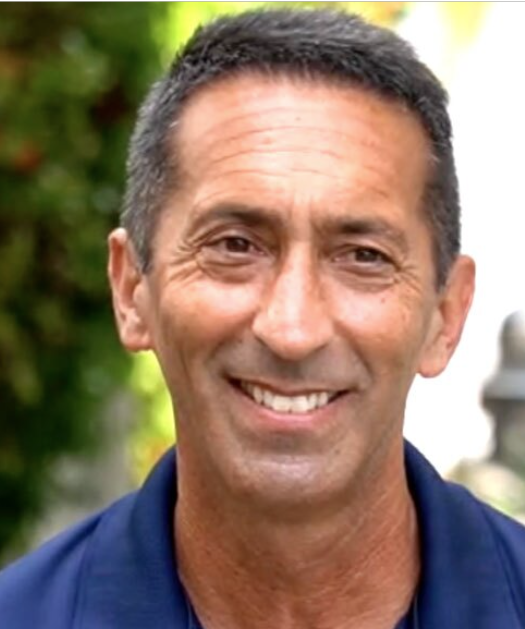
Paul Mokha
Paul Mokha became the UCLA men’s head coach in the fall of 2006 and served through the 2009 season. His most recent coaching position had been as head women’s coach at D-2 Barry University in Miami for eight years, 1998-2006, including an NCAA second place team finish in 2006. Prior to that he had been the women’s varsity coach at the University of Miami from 1994 through 1997. In college he had been a varsity coxswain at Temple University, graduating in 1989. He was a US National team member at the 1990, 1994 and 1995 World Championships. He was an Olympic coach at the Rio Olympic Games in 2016. In the summer 2021 he became the director at Vero Beach Rowing in Florida. In 2023/24 he is listed as an assistant coach at the University of Miami.
2007
The fall season began with a “large returning group of oarsmen from last year’s squad with the addition of a few transfers and high school recruits.” Coach Mokha described them as “motivated, eager to learn and highly athletic.” There were four eights of novices at the end of the fall season. There were three goals for the spring season: “1) have four eights rowing and developing, 2) beat all our non Pac-10 West Coast competition, and 3) be competitive in all four events at the Pac-10 championships.” The Bruins planned two additions to the regular schedule: a trip to the Southern Intercollegiate Rowing Association [SIRA] championship in Oak Ridge, Tennessee during April and returning to the IRA. Paul Mokha, “Coach’s Corner”, Strokewatch, January 2007, 1.
UCLA began the spring season with victories in the varsity eight and freshman/novice eight over Marina neighbor Loyola Marymount, as LMU placed first in the two four-oared events, the varsity and freshman/novice. UCLA continued their success the next weekend against UC Irvine and San Diego State in the varsity eight, novice eight and the novice four, though behind UC Irvine in the JV eight. In one of the strongest performance in years by UCLA placing second in the Cal Cup at the San Diego Crew Classic. In its other entries the Bruin novice eight placed thirteen and the second novice eight third of six. In the next weeks leading up to the PAC-10 championship, UCLA’s varsity won the Newport Regatta, placed fourth at the SIRA Regatta (behind Virginia, Temple and Purdue, and ahead of Marietta and Florida Tech), and defeated USC in their dual race. UCLA continued to by-pass the WIRA championship. At the Pacific Coast Championships UCLA won the novice second eight event in a field of three crews, placed sixth in the novice four and fifth in the open four. The next day at the PAC-10 the team placed sixth of the seven men’s teams by earning a fifth place in both the varsity eight and freshman/novice eight and did not enter either the JV eight nor the varsity four.
UCLA raced in the freshman four (fourteenth) and varsity four-with-coxswain (sixth) at the IRA. The progression for the freshman 4+ with 24 entrants included heats, repechages, semifinals and finals. UCLA’s freshman placed third in their heat, and advanced to the third level final through a third place finish in the repechage and first place finish in their semifinal. In the third level final they finished second behind Wisconsin.

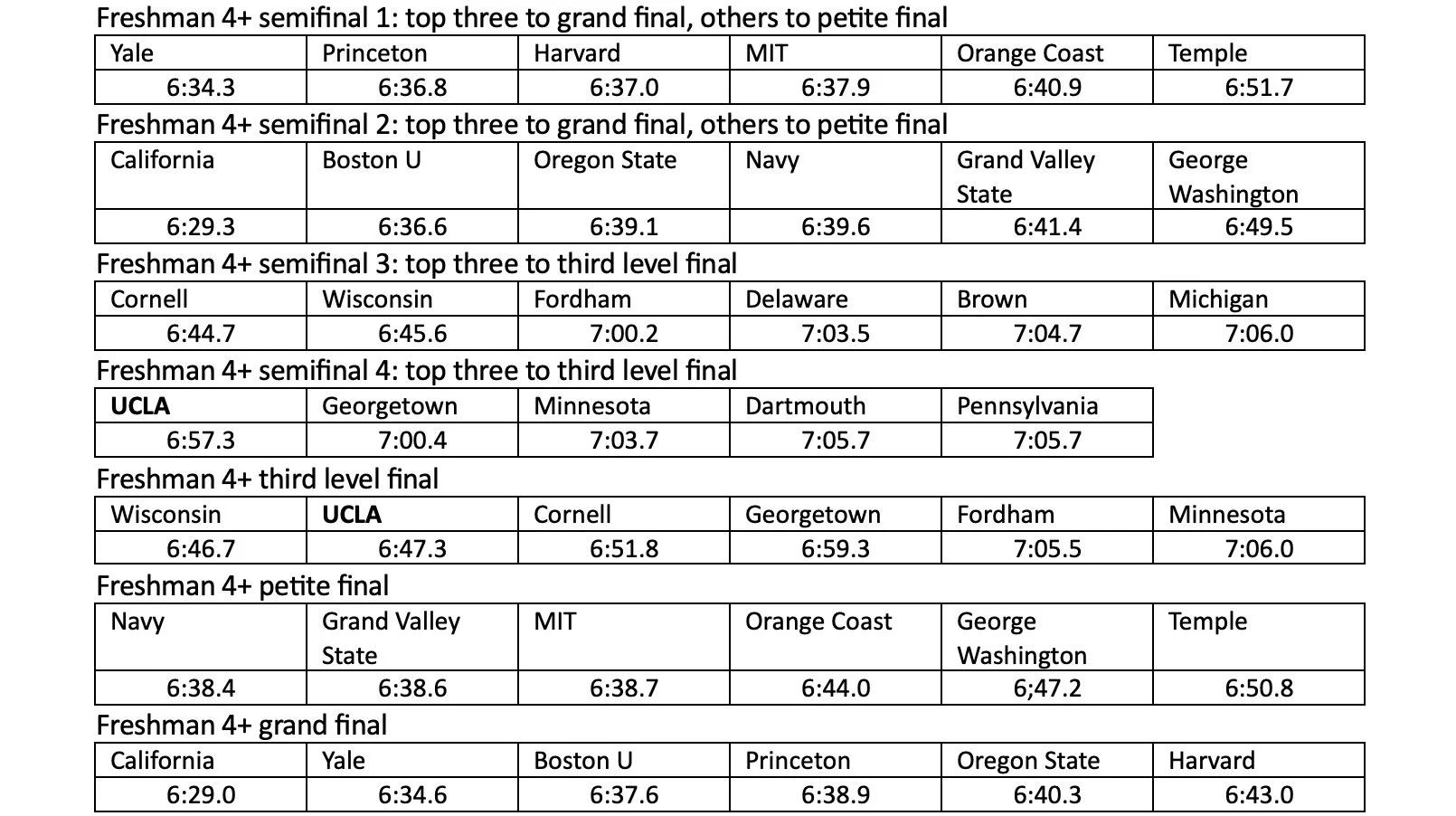
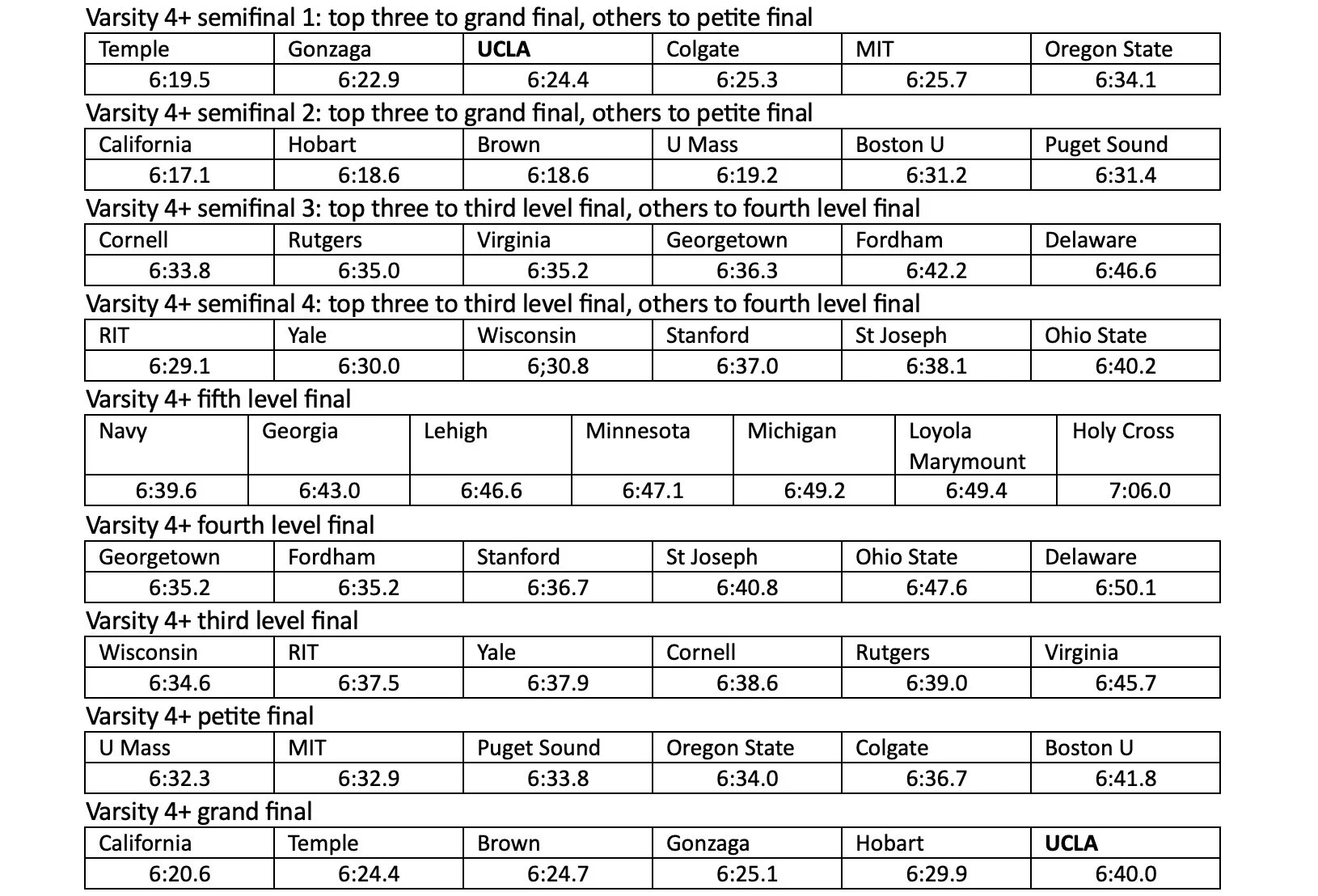
However with 31 entries the varsity 4+ was the only event at the championship that used a time trial to a semifinal to finals. UCLA placed eighth in the time trial: Temple 5:30.1; Brown 5:31.6; Puget Sound 5:32.5; MIT 5:33.5; Gonzaga 5:34.8; U Mass 5:35.4; California 5:35.7; UCLA 5:35.8. The 12 fastest from the time trial advanced to the A/B semifinals, the next 12 to the C/D semifinals, the remainder to the E final.
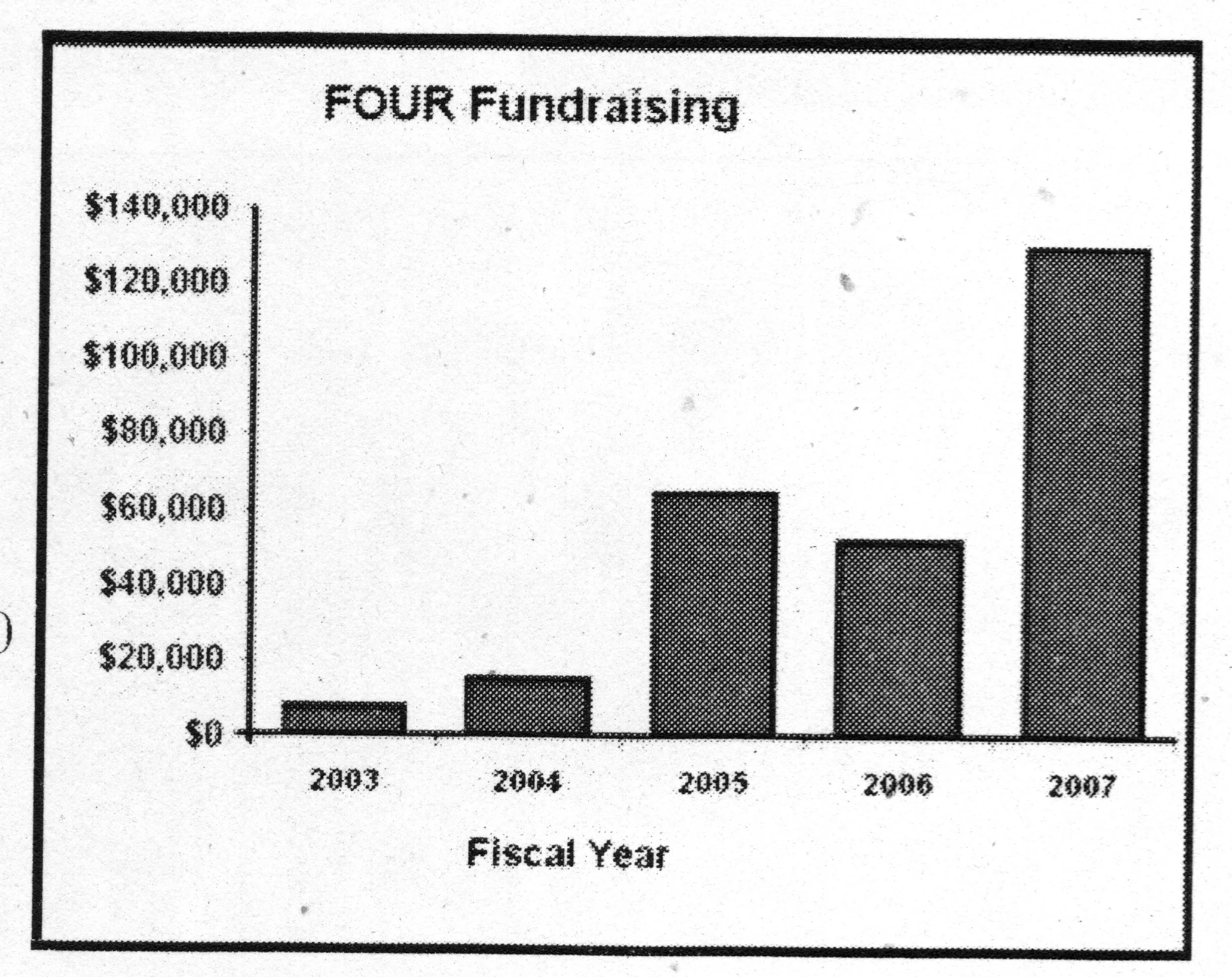
It was announced that F.O.U.R. needed to annually raise the $125,000 for annual operations. There was $270,000 in the endowment with a goal of building to $4,000,000. This year a UCLA oarsmen paid approximately $600 for the year, covering equipment, travel expenses, coaching salaries and uniforms, while the other half of the team expenses were made up by fundraising. Alumni were asked to sponsor an oarsman for the $600 athlete cost so that “the young men who want to row have the possibility of having the rich rowing experience that we had.” There was additionally a push for contributions to the endowment, called the UCLA Men’s Crew Forever Fund. Many parents were stepping forward to feed the team at the various regattas. The Alumni/Parent banquet, including a silent auction, raising more than $20,000. A “Row to Sacramento” (15,000 meters by each of 44 rowers) using 15 ergometers set-up in front of Pauley Pavilion was expected to raise $5,000 from pledges. The number of donors was increasing.
2003 2004 2005 2006 2007
Gifts $8,000 $15,000 $65,000 $52,000 $130,000
Donors 26 48 100 73 164

2008
Before 2006, competitive club rowing programs, which receive little or no funding from their university athletic departments, were able to compete at the IRA Championship. In 2006, Rutgers University eliminated funding by the athletic department from its men's rowing program, reducing it to club-status. Part of Rutgers’s justification for cutting rowing was that clubs could compete equally with funded programs at the IRA Championships. To avoid other members from losing funding, the IRA excluded club-status teams from competing at its championship at the 2009 regatta. The American Collegiate Rowing Association (ACRA) became an alternative championship for these clubs. Established in 2008 by University of Michigan coach Gregg Hartsuff, under the General Not for Profit Association Act of 1986, the ACRA was constituted of club-level collegiate rowing teams, that are not sponsored by an institution’s athletic department as defined by the NCAA. While classified as varsity teams at their schools, both Orange Coast (a two-year college) and Cal Maritime (an NAIA school) were two West Coast teams that could compete at the ACRA. The ACRA was seen by coach Mohka as “the best thing that could happen to our program,” with a season ending championship the whole team could train for.
In the fall, with a larger number of participants, groups were divided for training. The twenty-five varsity oarsmen were training nine times per week. The novice group of over seventy-five were coming to the boathouse in thirty-man shifts five days per week and using rowing ergometers on campus two days a week.
The team began the spring season with four eight-oared crews. According to coach Mokha, there was “tight competition for seats in the Varsity 8 (something that was new for these guys).” The crew was “stronger and faster than last year’s but struggled to find that natural rhythm.” The “2nd Varsity was the definition of synergy. They had a lot of fun, great attitudes and went fast.” The team graduated four seniors, and novice coach for the last two seasons Gregg Everett departed. Paul Mokha, “Coach’s Corner”, Strokewatch, July 2008, 1. At the start of the season UCLA defeated Loyola Marymount in both the varsity and freshman/novice eights, with a second UCLA entry finishing third in both events. At the PAC-10 Rowing Challenge the UCLA varsity defeated UC San Diego and Gonzaga, but lost to Cornell. The freshman eight and JV eight struggled in their races at the event. It was a successful San Diego Crew Classic for the Bruins as the varsity eight finished in second place to Orange Coast in the Cal Cup. The JV eight finished seventh and the novice eight placed twelfth. UCLA placed fifth in the varsity eight at the PAC-10, fourth of four in the JV eight, they did not entered in the varsity four and placed fifth in the freshman/novice eight. While successfully racing at the first ACRA regatta, placing fourth in the varsity eight, third in the JV eight and sixth in the men’s novice eight, UCLA oarsmen also made their last appearance at the IRA before the event being closed to only varsity-level crews.
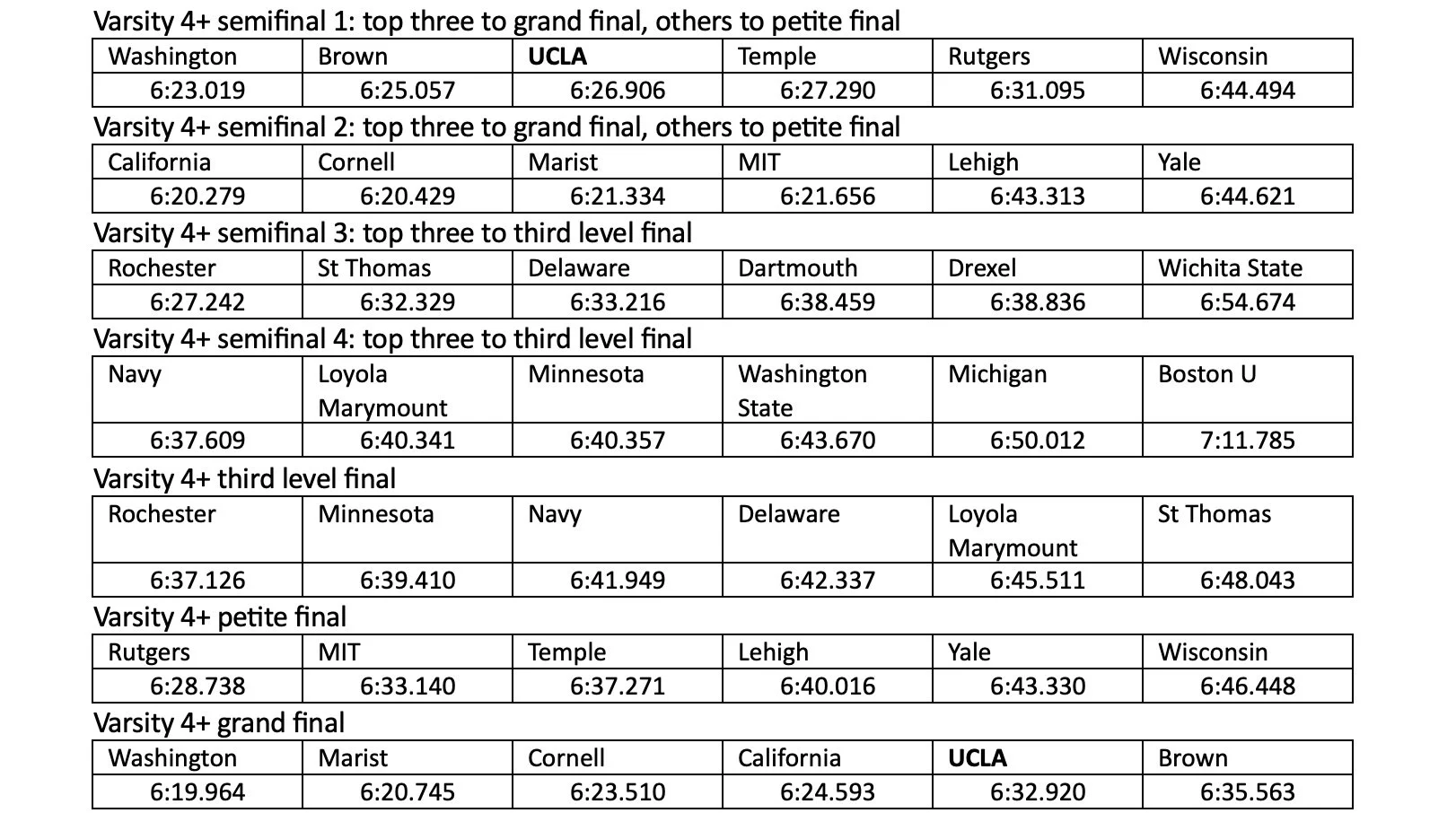
At the IRA the first round of the varsity 4+ was a time trial for the 24 entrants. UCLA was fourth among the contestants. Washington 5:37.9; Marist 5:39.4; Cornell 5:40.2; UCLA 5:41.0; Temple and MIT tied at 5:41.7. From there the fastest 12 teams advanced to two A-B semi-finals, and the slower 12 from the time trial to two semi-finals for the third-level final. UCLA placed third I its semi-final to reach the grand final and finished fifth.
Under F.O.U.R. president Alex Frasco the group had organized cohort leaders for fund raising. Charlie Jackson, ’73, had put together a DVD celebrating 75 Years of Tradition UCLA for the banquet that hosted 180 guests plus the men’s varsity and novice squads, and featured past UCLA coach Jerry Johnsen. The wine tasting and silent auction raised $19,000. Fund raising reached a five year high of $130,000 with a much larger group of donors participating. One of the major donations was $40,000 from the Bacas Family Foundation. Fund raising continued to be successful with the 2008 total $168,000 involving 335 donors. The endowment increased from $50,000 to $320,000.
2009
Even with the economic upheaval during 2008 F.O.U.R. had a successful fundraising year. Alumni events including the banquet’s wine tasting and silent auction were avenues to raise monies for the team’s operating expenses and the endowment. From January 16, 2008 through January 15, 2009 215 donors contributed cash gifts totaling $125,000. “During the last 5 fiscal years the new FOUR has averaged almost $96,000/year in fundraising. For the fiscal year ending June 30, 2009 we raised nearly $65,000 of which $16,000 went into the endowment.” The short term goal was to increase the endowment to $500,000 with a long-term goal of a program sustaining $5,000,000. “Endowment Five-Year Plan”, Strokewatch, October 2008, 4. The endowment at $300,000 was yielding approximately $15,000 annually to support the team. A raffle of LA Clippers VIP seats, donated by Big Valley Dodge, brought in $5,300. The 65 km erg-a-thon was scheduled for February 19 with a goal of raising $15,000. Each oarsman was responsible for raising $300 in sponsorships. Only three of the over 20 clubs at UCLA were reported as having a support group and neither of the others were providing the level of support that F.O.U.R. was. Outside the basic fundraising, donors could contribute funds for racing shells. The Department of Cultural and Recreational Affairs [CRA] and the coach were responsible for directing the spending of the $40,000 in annual contribution from F.O.U.R. which was over and above the $15,000 per year yielded by the endowment. F.O.U.R. had three non-negotiable requests:
a) there are three home races on Ballona creek each year,
b) the equipment money is spent every year on maintaining the shells and oars, and
c) the recruiting money is spent to recruit as many men as possible.
”We Often Get Asked”, Strokewatch, February 2009, 4.
Expense Items
Travel
· Newport Autumn Rowing Festival $1,000
· San Diego Crew Classic. 5,500
· Pac-10 Rowing Challenge/
Windermere (Varsity) 2,000
· Newport Regatta 500
· ACRA Championship (Varsity) 6,500 $15,500
Home Races (a minimum of three
_Per year at Ballona Creek) $2,000 $2,000
Frosh/Novice Coach $10,000 $10,000
_____________________________________________________________________
Other
· Equipment/Spare parts $2,500
· Uniforms 5,000
· Recruiting 1,000
· Truck fees, fuel, service 4,000 $12,500
Total $40,000
Robert Hermann was the new novice coach. He had been a member of the bronze medal US lightweight eight at the 1991 World Championships and had experience coaching at Tufts University and Boston’s Community Rowing. He recruited a new rower turnout of over 100 in the fall that boiled down to almost three eights by the spring. The varsity squad was described by Coach Mokha as young, being comprised of ten oarsmen that were either second-year rowers or freshman with high school rowing experience. Paul Mokha, “Coach’s Corner” Strokewatch, February 2009, 1. At the start of the spring season UCLA split in their regatta with Loyola Marymount, with the Bruins first and third in the varsity eight, but second and third in the freshman/novice eight. In a tree-team regatta with the University of San Diego and UC Irvine fielded a first and second varsity eight, and first and second novice eight, placing second in three of the races and third in the JV eight. At the PAC-10 Challenge/Windermere regatta the varsity eight lost its three dual races to UC San Diego , Stanford and Gonzaga. The JV eight and freshman/novice eight were also winless at the competition. The Bruins placed sixth in the Cal Cup at the San Diego Crew Classic. The other Bruin entries placed tenth in the JV eight, second of two entrants in the second novice eight, and the first novice eight was eliminated in the heats. Choosing to attend the Newport Regatta instead of returning to the Stanford Invitational, the varsity eight placed third, the varsity four second of three, the novice eight placed fifth and the second novice eight earned a second place. The last dual of the season resulted in a sweep over USC in both the varsity and freshman/novice eights. The Bruin varsity eight traveled to Seattle’s Opening Day Regatta and placed second behind Washington’s JV eight in the Erickson Cascade Cup. At the Pacific Coast Championships, UCLA finished fifth and sixth of six crews in the men’s collegiate novice four. At the next day’s PAC-10 Championships the Bruins placed fifth of eight among the PAC-10 men’s teams, having entered three of the four men’s events. The Bruins placed fifth in the varsity eight, did not enter the JV eight, placed third of three in the varsity four and earned sixth place in the freshman/novice eight. Attending the second year of the ACRA Championship UCLA’s three entries all placed in the petite finals. The varsity eight placed tenth and both the varsity four and novice eight earned eighth place.
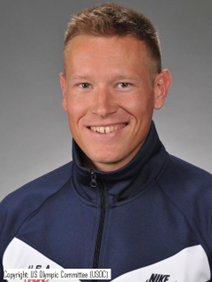
Ken Jurkowski
Ken Jurkowski was a 2003 graduate of Cornell and had earned a bronze medal as part of the US eight at the 2006 World Rowing Championships, and finished eleventh at the 2008 Olympics in the men’s single. During 2005 and 2006 he had been a volunteer coach with the University of Texas. In 2011, after leaving his position at UCLA, Jurkowski was racing internationally and he later raced in the 2012 Olympics finishing 24th in the single. He last raced in the single at the 2016 World Rowing Cup II.
2010
During the spring season only a varsity eight represented the men’s team. In March the Bruins lost dual races to Loyola Marymount and University of San Diego. At the San Diego Crew Classic, the Bruins raced in the Cal Cup and placed fifth of five in the heat and raced to third place in the third level final, defeating the club teams from Arizona State and San Diego State. The season continued with last place performances as the Bruins raced a three-team regatta with Orange Coast and UC Irvine, then duals with UC Santa Barbara and USC (losing the Hillen Cup). UCLA attended neither the WIRA nor the Pacific Coast Championships. At the PAC-10 championship, UCLA entered only in the varsity eight, the Bruins placed last of seven in the race. UCLA did not attend the ACRA Championships in 2010 nor 2011.
Financially, the budget was balanced and even resulted in a small surplus and the endowment had grown. The equipment was reputed to have been in the best shape in the last several years. In addition to an improving relationship with Cultural and Recreational Affairs Department and the University administration, several alumni produced the Strokewatch, provided legal assistance, maintained the mailing list and provided input in the development of FOUR.
“On July 16, Ken Jurkowski informed the Crew that he would not be returning as head coach of the program. Ken indicated that he was moving to Ithaca to continue his training and the decision hinged on his girlfriend’s choice not to pursue her PhD this fall at UCLA.” Nic Smith, “Message From the Team”, Strokewatch, October 2010, 2.