Oars

from spruce to carbon
|
from spruce to carbon |
The Pocock near monopoly in shells was linked to a similar near monopoly in oars with the Needle/Pencil blade shape for a “proper fit” to those shells. This was especially the case since the Pocock fixed rigging had a narrower spread.[1]

In Pocock’s laminated wooden oars, there was a hollow channel of 1 to 1¼ inches in diameter between the two pieces of West Coast Engelmann spruce forming the shaft of the oar. A procedure used in the manufacture of Pocock oars was a technique discovered in the shop by Hilmar Lee to rip the spruce plank used for the shaft down the middle flip one piece longitudinally before gluing the halves together. This prevented the oar from later twisting which was common to earlier manufacturers’ oars due an invisible spiral grain that may exist in the wood.[2] Engelmann spruce from Montana is, “a wood strong in tension, weak in compression,” and the hollow core between the pieces in the loom decreased weight and give the shaft flex. There was then a one-eighth inch (4mm) external layer of Australian ironwood as a backing for strength. The layer of Australian ironwood was said by Pocock, “imparts spring and compressive strength to the [back of the] oar.” [3] Pocock sweep oars included a copper protective strip at the end of the blade. Pocock oars in the 1930s included a leather sleeve attached to the shaft with brass tacks and a fixed position collar formed by wrapped strips of leather held in place by a wood block and screws on the back of the shaft. There were thin strips of copper wrapped around the edges of the sleeve and outer edges of the collar.
There was change coming though in the shape of the oar blade and the inboard/outboard setting, it was the Karlish “Spoon” or “Tulip” blades.[4] These were later called “Macons” because they first appeared on the world stage at the 1959 as the West Germans won the European Championships in Mâcon, France using an oar with a wider blade and shorter overall oar.[5] Later Pocock oars featuring a Tulip/Macon blade included a clear plastic sleeve that was heat shrunk to the shaft. The collar was a blue rigid plastic and its position was adjustable.

Pocock Macon blades 1974
The next dramatic change in oars began in 1975. The Dreissigacker brothers, Peter and Dick, created the first known pair of non-wooden oars.[6] The idea of using materials other than wood was to increase or maintain strength but also lowering weight. The Concept2 design utilized a component system (handle, shaft, sleeve, collar and blade) that could produce different oar options and be retrofitted at a later time. The new design and more efficient features made them appealing to many.
As Pocock before them, manufactured oars to fit their shells, in 1989 Concept2 began producing oarlocks with pitch bushings to better fit their oar sleeves. By 1990 the majority of rowing programs were using Concept2 oars with Macon blades. The “Big Blade” or hatchets, an asymmetric hatchet-shaped blade, was introduced in 1991 and there was a mixture of Concept2 Macon and Big Blade oars at the 1992 Olympics.
Prior to 1996 oars were still produced at a fixed length with the only option being sawing off a few inches of the handle to produce a shorter oar. Concept2 began including a “Clip-on Load Adjusting Mechanism” (CLAM, for short) with their oars that provided a 1 cm increase in the inboard without moving the oar collar.[7] This allowed the sharing oars between an eight and a four, adjusting to different wind conditions along with a wear surface between collar and oarlock. Also in 1996, “Concept2 introduces an adjustable length system for oars,” with two screws holding a clamp inside the shaft with a removable handle insert.[8] Concept2 progressed with oar shaft materials toward lighter materials of varying flex and with less wind drag.
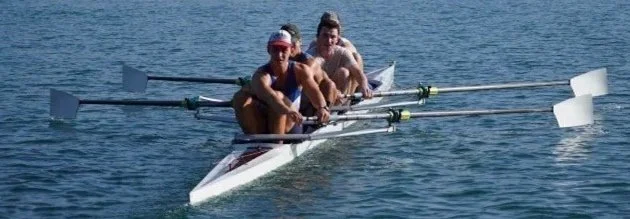
Concept2 carbon fiber shaft with Smoothie2 Plain Edge blade
There are several other oar manufacturers that have market share smaller than Concept2. Derher’s Apex and Big Blades made by Durham Boat Company (New Hampshire), Croker (Australia), Empacher (Germany) and Braca Sport (Lithuania, Hungary). Each has their distinctive features and following. Many times, customers purchase equipment geographically, or look to see what National Team programs are currently using for blade design. Blade surface area is important relative to the total weight of the crew and shell, and the resistance loading of the oar. A heavier crew or a crew desiring a heavier load would use an oar with a larger blade area. A crew smaller in stature would be more effective with a smaller blade area.[9]
Oar makers continue to adjust blade shape and area looking for optimal shape given the crew and their technical style.
[1] Strickler, Rowable Classics: Wooden Single Sculling Boats and Oars, 121.
[2] Pocock, Way Enough! Recollections of a Life in Rowing, 104.
[3] Newell, Ready All! George Yeoman Pocock and Crew Racing, 149.
[4] Darryl J. Strickler, Rowable Classics, email, 18 October 2014.
[5] Filter, “Design and Materials in Rowing”, 291.
[6] Concept2, web, “Time Line”.
[7] Concept2, web, Oars, “Clams”.
[8] Concept2, web, “Time Line”.
[9] Purcer, Notes on Rowing - Chapter 3 Rigging, 141.