
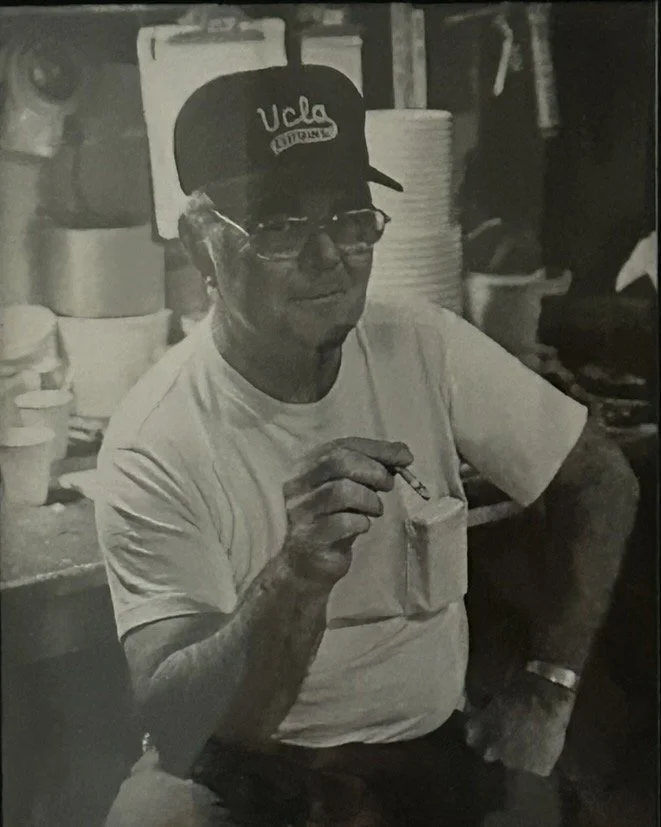
Paul “Rigger Brown” Herrick
UCLA boatman from 1963 to 1984, but he never really left the program. Master woodworker, healer of shells and generations of rowers.
“Flubadub” a common exclamation that he would share. It could mean “it is what it is,” “don’t worry”, anything you needed it to mean. It always made me feel better.

Paul Herrick – alias Rigger Brown
|
Paul Herrick – alias Rigger Brown |
PORTRAIT OF A RIGGER
by Leslie O’Neal
Riggers are a necessity to a boathouse. They are stable fixtures who watch coaches and crews come and go. Their jobs vary from rigging boats to mending broken feelings.
Rigger Brown of UCLA is no exception. Since 1963 he has seen three coaches and uncountable young men and women pull shells in and out of the boathouse racks. He has mended shells nearly as many times as crews have used them. He has also mended personnel clashes and what Rigger refers to as “loser’s blues.”
At 57, Paul Herrick – alias Rigger Brown – remembers Ballona Creek as being his playground in youth. Where the boathouse now stands was once a duck club. “It’s pretty ironic that I ended up here in the same spot. I remember seeing UCLA row on the creek before I was ever affiliated with the university,” said Rigger.
In 1960 he began working for the carpenter shop at UCLA. One of the numerous jobs he was assigned sent him to Marina Del Rey to transport racks from the old boathouse to the new one.
After toying with a number of miscellaneous errands, on behalf of the crew, Rigger was approached by coach John Bissett – the first of the three coaches Rigger has dealt with. Bissett asked if Rigger had ever worked on boats, to which Rigger replied, “No, but they’re wood aren’t they? Well, I’m a cabinet maker so it just takes some imagination.”
Rigger had some quick imagining to do the first season as the ’63 crew did their share to keep him busy. The repair of a split stern was his first task in early November and, by the third week, he was trying to make a second shell float. His resourceful handicraft pleased Bissett who requested a six-month lease of Rigger’s talents. UCLA gladly complied and Rigger headed west.
By February 1964, Bissett needed a full time rigger and Paul Herrick had a job. But the name ‘Rigger Herrick’ did not sound good and, “I liked Charlie Brown so we put them together and got ‘Rigger Brown’ which sounds more like it,” laughs Rigger.
Rigger recalls the early years as being the most fun. “We started out brand new in 1963 when J.D. Morgan (UCLA Athletic Director) officially bolstered our status. In ’66 we beat Cal for the first time and in ’67 we won the Western Sprints in Long Beach,” says Rigger.
After five years Bissett moved on and Jerry Johnsen took the reins. The boathouse atmosphere eventually slowed its pace. Johnson remained there until 1976 when Duvall Hecht took over and is still out there every afternoon. Rigger has done his share of coaching – on and off the water. He drove the launch for eight years until the mid-70’s. “I look at a boat and know what’s happening, but I don’t always tell the coaches anymore,” said Rigger.
Each coach has had his impact on the performance of the rowers. You have to be a psychoanalyst as a coach,” said Rigger. “The guys mimic a coach if he’s fast and quick or slow and relaxed. It’s hard to get them (the rowers) to do what you want unless you’re a good example. A large number of coaches don’t get that point. Bissett always got everyone’s respect right off and with respect you can do anything.”
Rigger also has a talent for gaining respect. “I can stand by the bench and spot people with things on their mind and I go over and make some kind of remark to help them unwind and talk,” said Rigger. “It works pretty doggone good. I enjoy young people because they keep my mind sharp.”
Rigger now stays away from coaching and leaves all that to Hecht. But he never has a lax moment between equipment repairs during the season and off-season restoration. It is a seven-day-a-week during racing season that requires traveling from San Diego to Vancouver with both the men and women. “I have equal responsibilities to the men and women, and try to be one big family during the season,” said Rigger.
Not that it always works, but if anyone can keep pace among the ranks, Rigger can. “You have to take them aside and give them an idea of why they are here and what they should do to stay here. Crew is one of the best things in the world and they shouldn’t drop crew for school,” advised Rigger. “If they clean up problems one at a time they will have a clean mind and everything will go right. There is a 500% change for the better after four years because they’ve learned to regiment themselves and mature.”
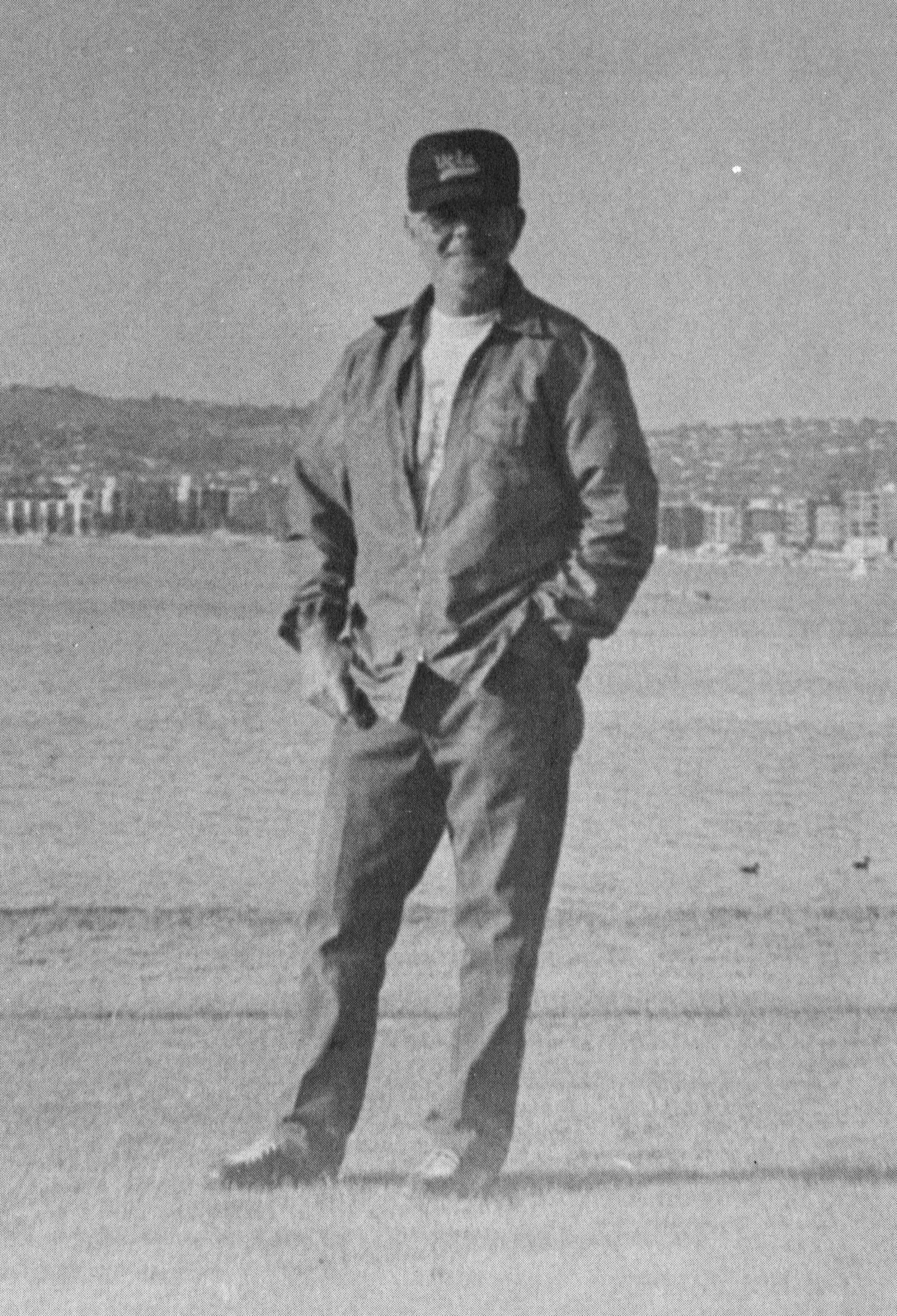
Rigger has his own restrictions, too. He tries to stay on top of an ever-increasing workload of broken gadgets. “If you have equipment that looks good, everyone will pay more attention to it,” said Rigger.
Rigger is presently at the majority of social functions that involve crew members. “The main thing about crew is that there is nothing more valuable than friends. Y ou can go anyplace in the world and find crew people and you are automatic friends,” said Rigger. At the rate he is going, Rigger will have a multitude of friends as the years progress. He was a personal acquaintance of George Pocock and has the utmost admiration for his wooden shells. “His fiberglass boats are not up to par with Schoenbrod, but there is nothing prettier than a Pocock varnished wooden boat,” said Rigger. Then he adds, “But you have to remember that it isn’t the boat that is fast. It’s the muscles in it.”
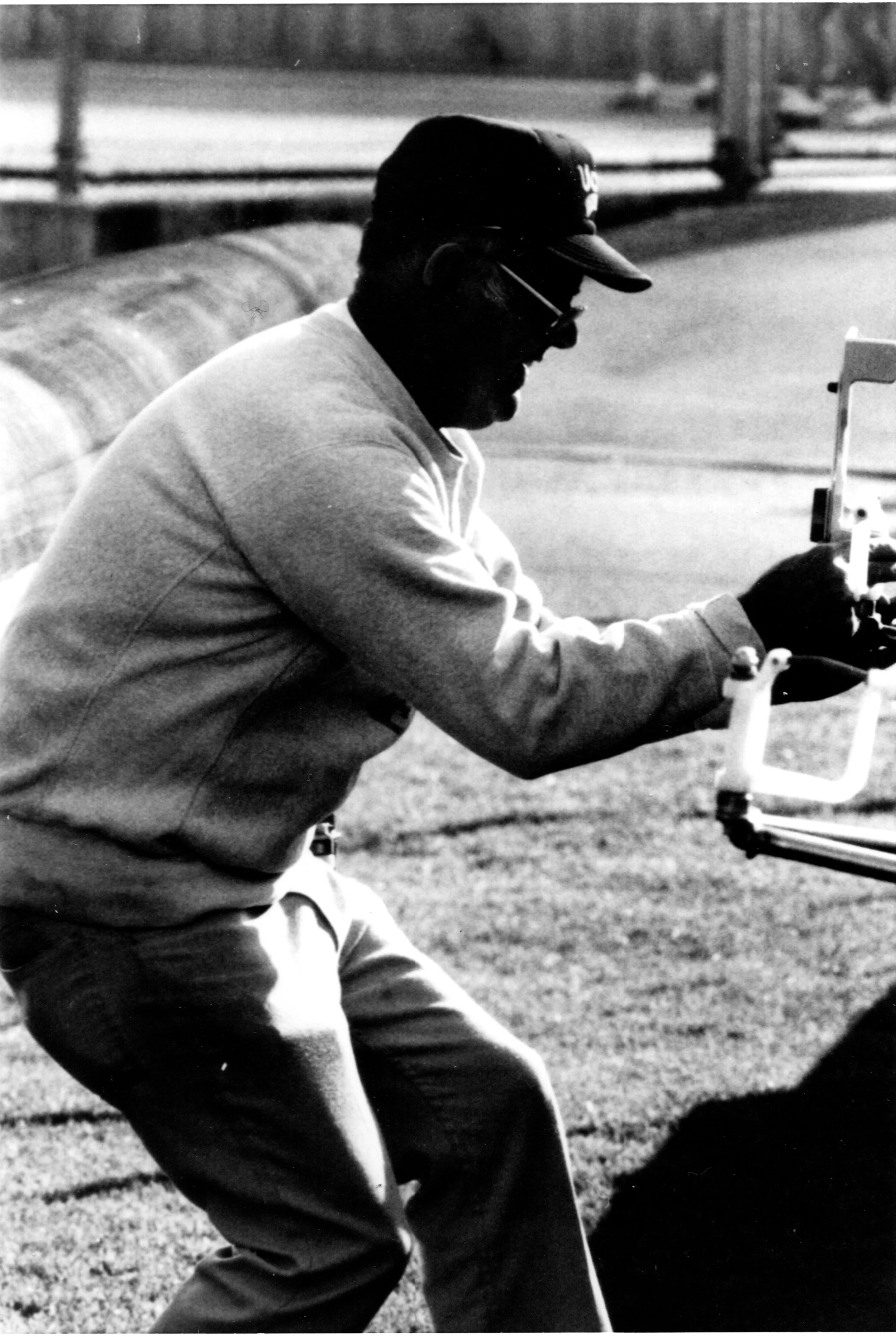
His future plans are to remain right where he is and keep a watchful eye on the boathouse. After all, the rigger has to keep in time with cracked oars, weekly regattas, and a handful of rowers who need a good ear and a little varnishing.
Published in UCLA Crew – A Half Century by Robert Frassetto (Los Angeles, 1978), 68-72.
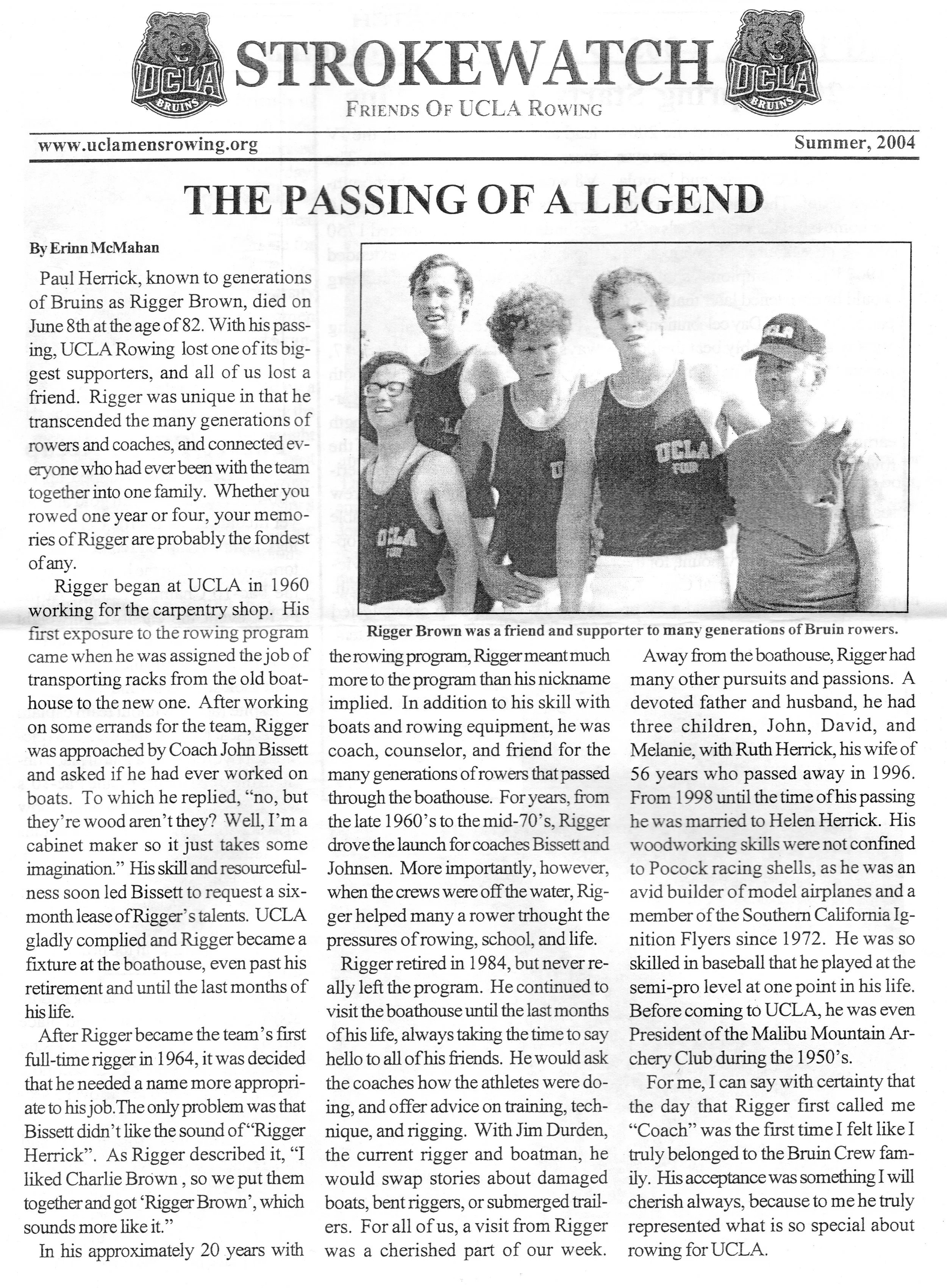
UCLA Strokewatch, Summer 2004, 1.
