The John Bisset Years
Greater support of the program by Athletic Director J.D. Morgan with the hiring of John Bisset and the completion of the boathouse at Marina del Rey.
UCLA first attends the Intercollegiate Rowing Association championship and first victory over Cal in 1966; wins Western Sprints in 1967 defeating Washington.

1964 - 1968
|
1964 - 1968 |
John Bisset Takes the Reins
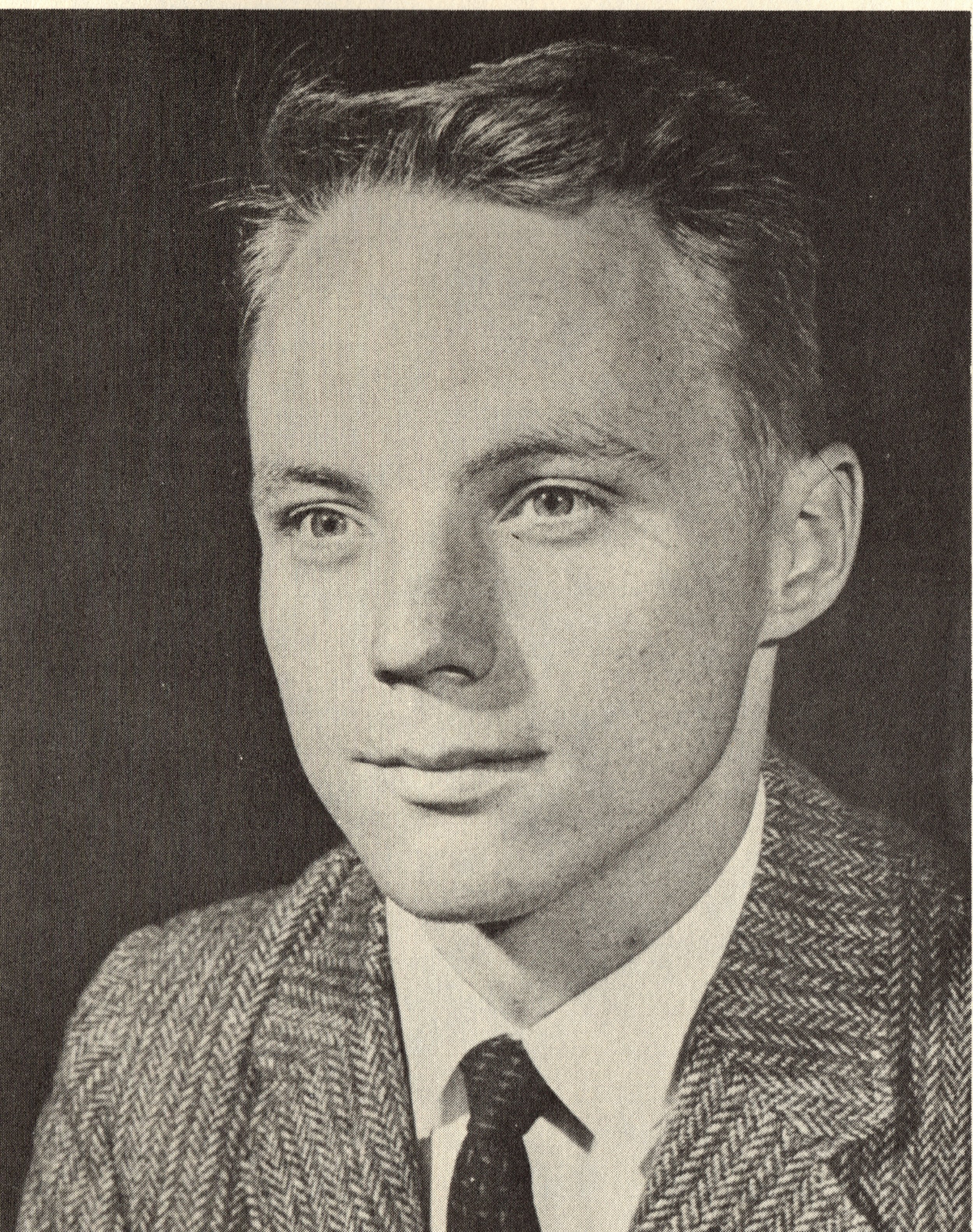
John Bisset
John Bisset was signed as a full-time rowing coach at UCLA in August of 1963. Bisset had been a varsity coxswain at Washington including during their win over the Soviet Union in 1958, his senior year, and the previous five years as the Washington freshman coach. Later Bisset became the Acting Business Manager in the UCLA Athletic Department and then in 1968 left to became the Alumni Director at the University of Washington. The hiring of Bisset as a full-time coach and the new boathouse on Marina del Rey under construction in 1964 and completed in 1965 were steps in elevating the crew program to be a major varsity sport at UCLA by athletic director J. D. Morgan. Morgan also hired Bob Horn as the UCLA swim and water polo coach. Bisset commented about having greater interest in the program and a more rowing water on Marina del Rey, “We don’t expect to be an overnight success, but we hope to be right up there within a few years.” Doug Mauldin, “National Prominence Sought by UCLA for Swimmers and Crew”, Los Angeles Times, 10 Nov 1963, 329. While the Bruin varsity placed fifth at the Western Sprints in 1964 and 1965, they progressed to fourth in 1966, and were champions in 1967, and second place to Washington in 1968 and 1969. Also performing in IRA appearances, from thirteenth in 1966, ninth in 1967, seventh (winning the consolation final) in 1968, and eleventh (fifth in consolation final) in 1969 with the JV placing fourth. UCLA was now a contender!
Marina Del Rey becomes a reality
A 1941 UCLA graduate and winning tennis coach J. D. Morgan was selected to take over as the Athletic Director beginning July 1, 1963. He continued to serve as head tennis coach until 1966 and athletic director through 1979. Among Morgan’s goals were to rekindle interest and excitement in the athletic program. “I have been greatly disturbed by the student apathy, the dwindling interest shown in athletics the last few years. I will try to revitalize student interest as well as that of the faculty, alumni and close friends of UCLA.”

Aerial view of Marina and Ballona Creek.
The New UCLA Boathouse becomes reality
In regards to a new boathouse for crew, Morgan planned to let out bids on August 8, 1963 with construction beginning immediately after. “Our new boathouse at Marina Del Rey … will house all the water activities. In the near future we will start building a major crew to meet California and Washington on their level. We hope to compete with excellent crews in the IRA regattas.” “Visions of Tomorrow”, Hollywood Citizen-News, 24 Jul 1963, 13. The boathouse was designed by Leslie Eaby and James Silcott of the UCLA architectural and engineering office. The plan was that the construction was to be financed by a combination of student funds and private loans. Details of the building included an observation deck on top of the one-story stucco and redwood structure. “The building will be L-shaped. Its longer arm will contain storage, work and repair facilities. The other section will provide locker space for 150, showers, rest rooms, the coach’s office and a boiler room.” “UCLA Boathouse Nearing Reality”, Los Angeles Times, 4 Aug 1963, 261. It was now planned that until the breakwater was completed protecting the Marina that the oarsmen would still use docks on Ballona Creek. Morgan expected that the boathouse would “spur interest in rowing to the point where within two or three years, UCLA could become a national power.” “UCLA Boathouse Nearing Reality”, Los Angeles Times, 4 Aug 1963, 261.
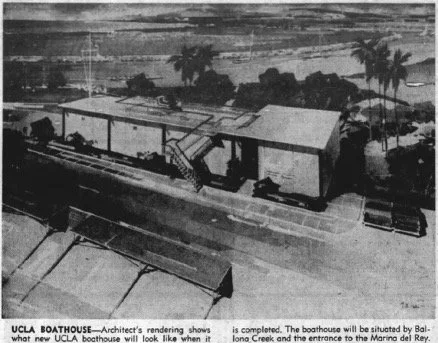
“UCLA Boathouse Nearing Reality”, Los Angeles Ties, 4 August 1963, 261.
1964
Bissett’s plan was to start with a five regatta schedule his first season supported by ten returning lettermen. In addition to the new boathouse the Southern Campus cited that Bisset “emphasized more conditioning and running for his rowers, in an effort to put Crew in the major sport category.” “Crew”, UCLA Southern Campus, 343. Their first race of the season on April 18 the Bruins hosted Cal and USC. Cal had defeated Long Beach State, and USC owned a 2-2 record in advance of this triangular meet. In the Cal-Long Beach race on April 11, Long Beach had gotten off to a poor start and as they approached the final sprint, while trailing about one length behind at the 1500 meter mark, “all four oars on the 49er starboard side crashed into a wooden box. The seventh man on the crew lost his oar and dived overboard,” finishing in times of 6:18.6 and 6:38.5. “LBSC Crew Suffers Mishap, Falls to Cal”, Long Beach Independent, 12 Apr 1964, 29. UCLA boated five returning lettermen and four sophomores in Bissett’s UCLA debut. Howard Bronstein, “Crew Hosts Cal, USC in Opener”, UCLA Daily Bruin, 17 Apr 1964, 5. With a record number of about 1,000 spectators the Cal Bears swept UCLA. Cal clocked a time of 5:52 on the tide and wind-aided course on Ballona Creek. Cal was said to have “effortlessly” pulled ahead of the other two teams in the varsity race who dropped back in order, with UCLA (6:06) finishing four lengths behind Cal and USC (6:22) two lengths farther back. The order of finish was the same in the junior varsity race, Cal 6:03, UCLA 6:14 and USC 6:34. The UCLA freshman (6:26) were a close third to USC (6:24) though both finished far behind the Cal freshman (6:14) crew. Howard Bronstein, “UCLA’s Crew Tops Trojans, Loses to Cal”, UCLA Daily Bruin, 21 Apr 1964, 4. and “Cal Boats Sweep the Bruins, USC”, Oakland Tribune 19 Apr 1964, 54.
On May 2 Stanford hosted UCLA for a race at Redwood City Harbor. Stanford won on the choppy, wind-swept water in a time of 7:25.0 with UCLA behind in 7:29.5. Neither crew sprinted at the end. In the junior varsity race, Stanford won by a margin of four boat lengths, with finish times of 7:39 and 7:54.6. Stanford’s coach Findlay raced his “second” freshman (7:45.5) boat against UCLA’s freshman (7:45.0) with the Bruins the victor by inches. “Indians Beat UCLA Crew In Slow Time”, Oakland Tribune, 3 May 1964, 59.
On May 8 Long Beach (6:38.6) had defeated Stanford (6:44.0) by two-lengths along with Loyola (6:58). “Indians Bow to 49er Crew by 2 Lengths”, Long Beach Independent, 9 May 1964, 11. The Harbach Cup was raced on the Wilmington Inner Harbor on May 9. Stanford was tabbed as the likely winner this year after UCLA’s first cup victory in 1963. Stanford had opened their season on April 11 with a sizable margin of three and one-half lengths in the varsity race over USC, with Oregon State finishing in third. “Indians Dunk USC, Beavers”, Oakland Tribune, 12 Apr 1964, 47. Windy conditions were forecast and coach Bisset felt that the lower stroke rate rowed by the Bruins would be an advantage. “Troy, Tribe Test Crew”, UCLA Daily Bruin, 8 May 1964, 10. UCLA defeated the Stanford varsity by one-half of a length, USC followed in third. Stanford placed first in the freshman race, followed by UCLA with USC in third. “Stanford Crew Suffers Upset in Regatta Race”, Palo Alto Times, 11 May 1964, 22. USC won the junior varsity race with UCLA second and Stanford third. As a result, of one first place and two second place finishes UCLA retained the Harbach Cup for a second consecutive year. “Bruins Top Cards For Harbach Cup”, Stanford Daily, 11 May 1964, 11.
May 16 the Bruins traveled to face Long Beach State at the Long Beach Marine Stadium. Bisset gave the advantage to Cal State Long Beach since the Bruins “started slowly, but we’re improving every week,” and that Long Beach has “a boatfull of big men,” that had beaten Stanford by one and one-half boat lengths earlier in the season. Howard Bronstein, “Bruin Crews Hosted By Cal St. (LB)”, UCLA Daily Bruin, 15 May 1964, 7. As predicted, Long Beach State (6:09.8) did overcome the Bruins (6:11.8) in the race. Long Beach also won the freshman race by two and one-half lengths with times of 6:21.5 and 6:29.5. The Bruin junior varsity (6:24) was victorious by one-half a length as the 49ers finished in 6:26. “UCLA Crew Pushes 49ers to New Mark” Long Beach Independent, 17 May 1964, 34.
At the conclusion of the regular season, the Bruins owned a 3-3 varsity record. As Bisset summarized the season, “We have made great progress this year in our planned program. From now on we’ll keep getting good hard-working kids. The ones we have had this year have done a good job. We’re only losing four seniors from the varsity shell.” Howard Bronstein, “Crewmen to Tiff Eight Colleges In Coast Meet”, UCLA Daily Bruin, 22 May 1964, 15. Bisset saw Cal and Washington ahead of the other West Coast crews, but UCLA in a tight next tier with Stanford and Long Beach State. USC, San Diego State, Orange Coast and Loyola in the third tier.
The Western Sprints were held on Mission Bay in San Diego, May 23. Crosswind created rough water and they were rowing against an incoming tide in the afternoon finals that slowed the times.
California had already earned victories over Washington, Stanford, UCLA, Southern California (twice) and Long Beach State.
Varsity 8 heat 1: first three advanced to grand final
California 6:05.7 | British Columbia 6:13.0 | Stanford 6:15.8 | Southern California | Oregon State
Varsity 8 heat 2
Washington 6:01.6 | Long Beach State 6:12 | UCLA 6:13.2 | San Diego State | Loyola
Varsity 8 consolation final
San Diego State 6:44.1 | Loyola 6:49.7 | Oregon State 6:50.0 | Southern California 6:52.0
Varsity 8 grand final
California 6:11.7 | Washington 6:12.0 | Long Beach State 6:15.5 | British Columbia 6:29.8 | UCLA 6:31.5 | Stanford NTT
Junior Varsity 8 consolation final
UCLA 6:48.6 | Oregon State 6:51.0
Junior Varsity 8 grand final: California took an early lead and pulled farther ahead when Washington hit a buoy near the midway point. Washington turned on a furious drive, pulled even, and swept ahead in the final 500 meters, winning by one-half a length.
Washington 6:25.6 | California 6:27.5 | British Columbia 6:44.2 | Long Beach State 6:47.3 | Orange Coast 6:51.3 | San Diego State 6:52.4
Freshman 8 consolation final
Loyola 6:47.0 | Orange Coast 6:52.3
Freshman 8 grand final
Long Beach State 6:24.6 | Oregon State 6:31.0 | UCLA 6:43.9 | Southern California 6:50.0
Since 1964 was an Olympic year, the collegiate rowing community made an agreement that all races, throughout the season, would be at the 2000-meter distance, including the IRA. For the first time at the IRA there were heats to advance to the finals and consolation finals. In the varsity eight California was first with Washington second. In the junior varsity Washington was first and California second. Washington placed fourth in the freshman eight as their coach described them as dying in the final 500 meters.
Both California and Washington’s varsity eights raced in the Olympic trials. Washington advanced into a semi-final but was eliminated. California finished in third, behind the Vesper Boat Club and second place Harvard in the final. “1964”, Husky Crew, web http://www.huskycrew.com/1960.htm

1965
Marina del Rey was formally dedicated on April 10 at a cost of $36.2 million in public funds. “County to dedicate Its $36.2 Million Marina”, Los Angeles Times, 4 Apr 1965, 173. UCLA opened to season versus Loyola on April 24. In a combined varsity race with UCLA’s first varsity (6:09), third varsity (6:14) and junior varsity (6:16) crews finishing in front of Loyola (6:25) who was described as “strictly along for the practice.” The greatest surprise was that the UCLA 3V had a great start and kept up with the 1V for the first 500 meters and held off a surge by the JV in the final sprint. The Bruin freshmen (6:28) were victorious over the Loyola freshmen (6:38). “Bruin Crew Tips Lions”, UCLA Daily Bruin, 26 Apr 1965, 6. Loyola had already defeated USC.
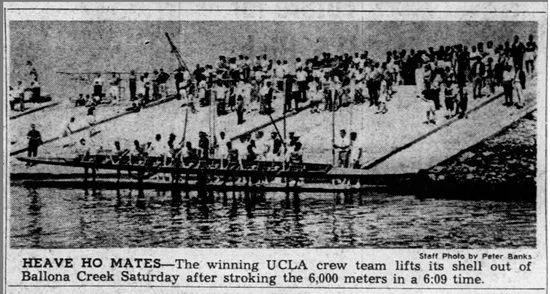
Hollywood Citizen News, 26 April 1965, 15.
The next weekend, on May 1, the Bruins hosted Long Beach State. In 1964, Long Beach had been the undisputed fastest crew in Southern California and placed third at the Western Sprints. So far in the 1965 season Long Beach’s record included a win over San Diego State (6:34.6 versus 6:46.2) on April 24, after a third place finish behind Cal and San Diego State beating only USC on April 10, and had lost to Oregon State (6:19) by 6.2 seconds on April 3. This meeting was a sweep by the Bruins of all five races. The Bruins won the varsity race by four lengths to win the Major Seivert trophy by a large margin 6:10.1 to 6:28.0 by Long Beach, with UCLA’s 3V (6:23) over Long Beach’s 6:49.5. The UCLA freshmen (6:30.5) conquered the 49er freshmen (6:38.0) by two-lengths. The JV race was the closest of the day with UCLA (6:14.5) only :02.6 seconds ahead. In the fourth race of the morning, UCLA’s second freshman eight defeated Long Beach in 6:48 to 6:52.5. Lorraine Eisner, “Crew Thumps CSLB”, UCLA Daily Bruin, 3 May 1965, 7.
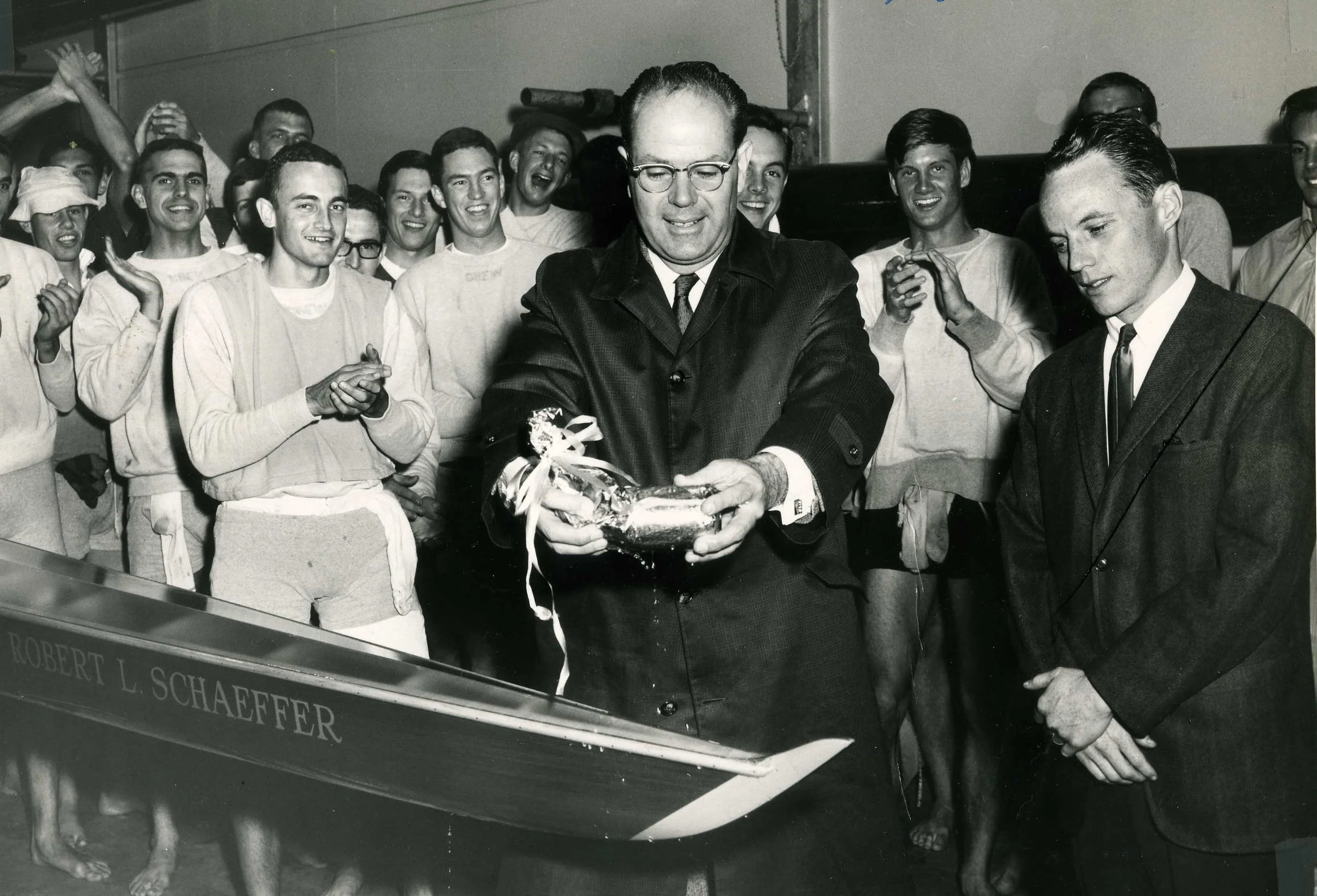
Christening of “Robert L Schaeffer”
UCLA won its third consecutive Harbach Cup. UCLA’s varsity crew remained undefeated winning in a time of 6:04.5 in San Pedro, followed by Stanford (6:10) and USC (6:15). USC (6:11.4) was followed by Stanford (6:15) and then UCLA (6:15.1) in the junior varsity race. Mirroring the varsity order of finish, UCLA (6:14) won the freshman race, followed by Stanford (6:19) and then USC (6:30). UCLA compiled 18 team points, Stanford 17 and 16 for USC. Lorraine Eisner, “Crew Wins”, UCLA Daily Bruin, 10 May 1965, 8.
On May 15 Cal hosted the Bruins on the Mare Island Channel in Vallejo, that would be the 1966 Western Sprints site. Cal’s coach Lemon was experimenting with line-ups and selected six of his sophomores from the successful junior varsity crew to represent Cal in the varsity race, after its successful sweep of Washington. The line-ups for Cal and UCLA were similar in average weight, 186.5 to UCLA’s 186, and 6-3 ¼ to 6-2 ¾ for UCLA. UCLA’s #7, Jeff Brennan, had rowed for Cal’s first freshman crew in 1963. Dave Newhouse, “Cal Boosts Sophs for UCLA Row”, Oakland Tribune, 14 May 1965, 56. The Bruin varsity lost their previously undefeated run when they faced Cal. The Bears swept the Bruins. Racing with a strong favorable tide Cal’s varsity understroked the visiting Bruins at a rating of 30 winning by about one length in a time of 5:28.8. In the JV and frosh races Cal’s crews won by two and three lengths, posting times of 5:58.0 and 5:36. “California Crews Bop Bruins”, Daily Californian, 17 May 1965, 4.
The Western Sprints were held on Seattle’s Lake Washington, on May 23. Headwind with swells prevailed in the afternoon. The top seeds entering the regatta were undefeated Cal, UCLA, Washington and the University of British Columbia. California had swept Washington during their dual two weeks earlier. UCLA’s Bisset decided to only take his varsity crew to the competition, leaving the JV and frosh at home. In the end, Washington swept the three finals.
Varsity 8 heat 1: top three advance to grand final
California 6:22.4 | British Columbia 6:25.6 | Oregon State 6:28.1 | …
Varsity 8 heat 2
Washington 6:18.8 | Stanford 6:21.6 | UCLA 6:23.4 | …
Varsity 8 consolation final
Long Beach State 6:56.0 | San Diego State 6:58.0 | Southern California 7:00.4
Varsity 8 grand final: by one-quarter length, after the top three crews were racing near even with 200 meters to go
Washington 6:34.2 | British Columbia 6:35.1 | California 6:37.3 | Stanford 6:45.6 | UCLA 6:51.1 | Oregon State 7:01.2
Junior Varsity 8 heat 1
California 6:31.6 | | | Saint Mary’s | …
Junior Varsity 8 heat 2
Washington 6:24.9 | …
Junior Varsity 8 consolation final
Long Beach State 6:56.0 | Saint Mary’s 7:15.7 | Puget Sound 7:17.2
Junior Varsity 8 grand final
Washington 6:26.0 | California 6:32.1 | Oregon State 6:43.0 | British Columbia 6:43.3 | Orange Coast 6:45.1 | Southern California 6:51.9
Freshmen 8
Washington 6:52.6 | Long Beach State 7:01.2 | Oregon State 7:17.8 | …
Women’s 4+ (1000 meters) – the Lake Merritt manned by students from Mills College ran afoul of one another appearing to collide, then caught several crabs
Lake Washington Hvywt 4:23.4 | Green Lake RC 4:32.7 | Lake Merritt Hvywt 4:38.4 | Lake Merritt Ltwt 4:44.8
During 1965 through 1967 the IRA returned to the 3-mile varsity distance after racing 2000 meters in 1964. Washington placed third, California seventh and Stanford ninth in the varsity eight. In the junior varsity eight Washington placed fourth with California sixth. Washington was third in the 2-mile freshman eight race.
1966
At the beginning of February, UCLA’s team numbered 55 among the freshman and varsity squads. April 16 UCLA open their spring season against Cal and USC. Coach Bisset was optimistic facing Cal though the Bruins had never defeated the Bears since the beginning of the program in 1933. “Physically speaking we’re capable of rowing Cal right down to the wire. This is the first year that we can match them muscle for muscle which is 90 per cent of the game,” said Bissett, and noted that Cal’s biggest advantage was experience with five returning from last year’s varsity and three from the 1965 JV crew. In comparison UCLA only had Jeff Brennan returning from the 1965 varsity eight and three from the last JV crew (Mike Harris, Tom De Marchi and Randy Grittman). Larry Robin, “UCLA Crew Out to Rule Waves”, UCLA Daily Bruin, 15 Apr 1966, 8. The Bruins took a lead at the beginning of the race, with Cal in third behind USC. By the 1000 meter mark the Bruins and Trojans were side-by-side with Cal one length back. In the final 500 meters of the race on Ballona Creek, USC faded and Cal sprinted, though UCLA (6:07.0) ended with a one and one-quarter length advantage at the finish over Cal (6:12.5) with USC (6:19.0) in third. “UCLA Crew Squad Cracks Cal Jinx”, San Bernardino Sun-Telegram, 17 Apr 1966, D-5. In his history of Cal rowing coach Lemon recounted,
“I tried the same tactic Ky had employed in 1940, switching the varsity and JV completely – the JV had been kicking the varsity in every run for the two days prior to the trip south. What they lacked in experience and strength, they made up for in drive. The result of my experiment was that UCLA posted its first-ever win against a Berkeley varsity. UCLA was on the rise at long last, and it was hard for the Bears to take.” Jim Lemon, The Log of Rowing at the University of California Berkeley 1870-1987 (Western Heritage Press. 1989), 58.
Cal won both the freshman and junior varsity races, both rowed earlier in the afternoon, prior to the wind growing stronger. The freshman race ended with Cal in a time 6:12.1, UCLA in 6:13.0 after the stroke caught a crab a few lengths from the finish, and USC in 6:18. In the junior varsity race the order of finish was the same, Cal (6:01.5), UCLA (6:08.5) and USC (6:31.5). “UCLA Crew Squad Cracks Cal Jinx”, San Bernardino Sun-Telegram, 17 Apr 1966, D-5.
UCLA’s freshman team lost a pair of races to UC Irvine, rowing for their first season. In the second freshman race UC Irvine finished in 6:34.0 to UCLA’s 6:36.0. In the first freshman race UCLA had built up a lead in the first half of the race but had fallen behind by 1500 meters, at the finish UC Irvine recorded a time of 6:29.0 to UCLA’s 6:33.0. “Brubabe Oarsmen Take Lickin’ From Anteaters”, UCLA Daily Bruin, 25 Apr 1966, 8.
In a pair of races, on Friday April 29, Orange Coast College faced UCLA in JV and freshman races. The crews from Orange Coast bettered both Bruin crews; 6:05.0 to 6:15.0 in the JV race and 6:12.0 to 6:17.0 in the freshman race. “Orange Coast Crews Triumph Over UCLA”, Los Angeles Times, 30 Apr 1966, 28. The next day UCLA took on California State Long Beach and Loyola. Following their victory over Cal the Bruin varsity suffered a letdown. Two weeks later, prior to the race against Long Beach State and Loyola Bisset commented, “The varsity has not regained its pre-California form. Some just lived and died with that race. And now, they are not in the right mental frame of mind.” In addition, two of the varsity crew and four in the JV crew were battling the flu. Larry Rubin, “Crew Goes Up Creek With Letdown Fears”, UCLA Daily Bruin, 29 Apr 1966, 6-7. Despite the concern prior to the race, UCLA swept the races against Loyola and Long Beach State, winning the Major Sievert trophy. In the varsity win the Bruins recorded a fast time of 5:53.5 aided by both wind and tide, having led from the start. Although the 49ers crept up to within two seats of the lead at the 1500 meter mark, the Bruins pulled ahead. Long Beach State (5:59.5) finished one and one-half lengths to the rear with Loyola (6:14.7) in third. “Although the Bruins never trailed Saturday, Bisset was not pleased with the rowing and warned that they would have to row a lot better if they hoped to beat Stanford in next week’s Harbach Cup.” “Oarsmen Zip to School mark in Triangular Win”, UCLA Daily Bruin, 2 May 1966, 12. UCLA won the junior varsity (6:10.0) race over Long Beach (6:28.0) and the freshman race by a large margin in a time of 6:02.5, ahead of Loyola (6:23.0) and Long Beach State (6:26.0).
Earlier in the season Stanford had defeated Santa Clara and USC. The 1966 Harbach Cup was a Stanford sweep, with them winning all three races in San Pedro on May 7. The order of finish of the frosh race was Stanford, USC then UCLA. The JV race was Stanford, UCLA and USC third. The real story was the varsity race. UCLA and Stanford were about even going into the final 500 meters when “a lumber barge as big as our Athletic Department Building blocked our entire course and Stanford cut in front of us,” as Bisset described it. “We had four choices. We could have run into Stanford, into the dock, into the barge or just quit rowing. On the basis of my previous directions (coxswain Bob) Swartz stopped rowing and turned the boat around.” USC placed in second. “Tribe ‘Barges’ to Cup”, UCLA Daily Bruin, 9 May 1966, 12. Bisset concluded that, “the Stanford race didn’t tell us anything except that our boat should be doing better.” Larry Rubin, “Home for Bisset is Trouble For Crew”, UCLA Daily Bruin, 13 May 1966, 10-11.
UCLA traveled north to Seattle to face the 1965 first and second place Western Intercollegiate teams from Washington and the University of British Columbia. After the race Bisset characterized the crew from Washington as very fast, “we couldn’t have caught those guys with an outboard motor boat.” Bisset thought that Washington was “better than I’ve ever seen,” and that the Bruins “have a good boat but we couldn’t touch them.” Larry Rubin, “Bruins No Match for Husky Crew”, UCLA Daily Bruin, 17 May 1966, 9. The Huskies (5:51.4) led from the start and finished three lengths ahead of UCLA (6:04.8), who was one length ahead of British Columbia (6:08.3). The race was shortened to about 1830 meters due to swells caused by gusting winds. At the start, UCLA had two seats on Washington and one-half a length on UBC, “but then the three boats hit a big swell. Washington went right through it but we stopped short along with British Columbia.” UCLA finished second in the frosh race and third in the JV race, with Washington the winner in all three races. Larry Rubin, “Bruins No Match for Husky Crew”, UCLA Daily Bruin, 17 May 1966, 9.
The Western Intercollegiate regatta was held at the Mare Island Channel, Vallejo, May 19-20. The afternoon was with 20-knot cross wind. There were eleven entries in the varsity eight (Loyola did not race), twelve in the junior varsity (UC Santa Barbara did not race), seven in the freshmen event and three lightweight eights. Washington and Stanford entered the regatta undefeated, and California had lost to Washington and UCLA. Coach Bisset expected UCLA to place higher that the two previous years when they finished in fifth place. Prior to the regatta UCLA athletic director Morgan announced that the Bruins had been invited to compete in the IRA regatta, for the first time.
Varsity 8 heat 1: top three advance to grand final
Washington 6:18.0 | UCLA 6:24.8 | Santa Clara 6:26.9 | Oregon State 6:31.8 | British Columbia 6:38.7
Varsity 8 heat 2
Stanford 6:20.0 | California 6:20.6 | Long Beach State 6:27.0 | Southern California 6:10.8 | San Diego State 6:13.7
Varsity 8 consolation final
British Columbia 6:37.6 | Oregon State 6:45.4 | Southern California 6:53.4 | San Diego State 6:58.0
Varsity 8 grand final: California’s #4 caught a crab in the last 200 meters as the top three crews were bow-to-bow. California pulled back to two-seats behind Stanford.
Washington 6:51.0 | Stanford 6:54.3 | California 6:55.6 | UCLA 7:06.0 | Santa Clara 7:07.5 | Long Beach State 7:11.0
Junior Varsity 8 heat 1: top three advance to grand final
Washington 7:05.2 | British Columbia 7:22.1 | Stanford 7:29.2 | Long Beach State 7:33.5 | Oregon State 7:45.2 | Santa Clara 7:55.7
Junior Varsity 8 heat 2
Orange Coast 7:11.5 | California 7:17.9 | San Diego State 7:18.8 | Southern California 7:24.0 | UCLA 7:34.4
Junior Varsity 8 consolation final
UCLA 6:04.0 | Long Beach State 6:07.6 | Southern California 6:10.5 | Santa Clara 6:14.0 | Oregon State 6:23.5
Junior Varsity 8 grand final
Washington 5:59.6 | Orange Coast 6:03.9 | British Columbia 6:06.4 | Stanford 6:10.8 | San Diego State 6:13.7 | California 6:15.2
Freshman 8
Orange Coast 5:26.1 | California 5:26.7 | Stanford 5:27.3 | UC Irvine 5:30.6 | Oregon State 5:34.0 | Santa Clara 5:45.9 | Saint Mary’s 5:50.9
Lightweight 8+
Oregon State 5:38.0 | Santa Clara 5:48.8 | Saint Mary’s 5:49.2
Senior 4+
Stanford Crew 7:17.0 | Dolphin RC 7:25.3 | Oregon State 7:27.7 | Vancouver RC 7:34.3 | Lake Merritt RC 7:40.5
Senior 1x: G Connelly: Dolphin RC swamped prior to the race. K Drlica: Lake Merritt RC 9:09.0
Boy’s 4+: Skyline HS Heavyweight overturned on the course: Skyline HS ltwt 8:44.5
Women’s 4+ (1000 meters)
Lake Washington RC - A 4:08.0 | California 4:09.6 | Mills - A 4:11.5 | (Green Lake) Lake Washington RC - B 4:22.8 | Mills - B 4:28.4
During 1965 through 1967 the IRA returned to the 3-mile varsity distance after racing 2000 meters in 1964. Four west coast crews raced among the fifteen varsity eights. Stanford placed seventh, California eighth, Washington eleventh and UCLA (16:48.2) thirteenth. In the junior varsity 3-mile race Washington and Stanford finished fourth and fifth. Washington’s freshman eight was ninth of the eleven entrants.
1967
The UCLA team numbered about thirty men, and were cited as picking up four oarsmen from Orange Coast College. For the second year in a row UCLA (6:08) defeated the Cal Bears (6:13) by two lengths on the Oakland Estuary in their meeting April 15. The race was not without excitement. At the 1000 meter mark, the Bruin shell lost its tiller, as the Bruins led by one and one-half lengths. “The Bruin shell careened in front of the Cal boat. [UCLA coxswain Robert] Swartz got it back in line, then had a crewman on each side exert pressure by changing position for steering purposes while the other six rowed.” “Bruins Lose Tiller, Still Beat Cal”, San Francisco Examiner, 16 Apr 1967, 47. UCLA won the junior varsity race 6:25.5 to 6:34.5, and Cal won the freshman race 6:55 to 6:57. The junior varsity and freshman races had been rowed during a rainstorm, but the rain had stopped for the varsity contest.
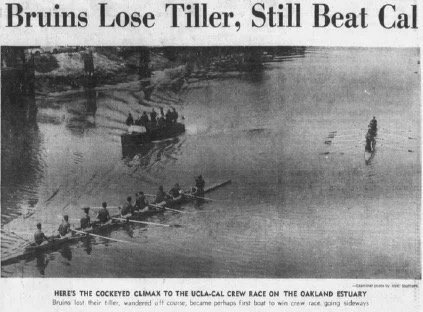
“Bruins Lose Tiller, Still Beat Cal:, San Francisco Examiner, 15 April 1967, 47.
UCLA swept Loyola and UC Irvine on April 22. The Bruin varsity (6:22.0) crew defeated Loyola (6:35.0) by three lengths with UC Irvine (6:38.1) three-quarters of a length farther back. The junior varsity race was won by UCLA and UC Irvine’s crew was coxswained by a female, Karen Shoemaker. “Bruin Oarsmen Capture Race”, Los Angeles Times, 23 Apr 1967, 44.
The annual Harbach Cup was won by UCLA earning 19 points, Stanford had 18 and USC 14. UCLA won the varsity and junior varsity races while Stanford captured the freshman race. In the varsity contest, UCLA (6:12) scored a two length victory over Stanford, with USC third during a driving rain. The order of finish in the junior varsity race was a duplicate with UCLA (6:15) followed by Stanford, and then USC. Stanford (6:35) prevailed in the freshman race, with UCLA finishing in second, and USC in third. “UCLA Crew Wins Ed Harbach Regatta”, Los Angeles Times, 29 Apr 1967, 24.
On May 13 UCLA hosted Long Beach State and UC Santa Barbara competing in the freshman race. It was a UCLA sweep as the Bruins broke the course record. In the varsity race UCLA finished in 5:53 to Long Beach’s 6:08.7. In the JV race UCLA (6:11.6) posted a sizable victory over Long Beach (6:44.2). In the freshman race, UCLA (6:15) finished well ahead as Long Beach State (6:35.5) who narrowly defeated UC Santa Barbara (6:36). “Bruin Crew Stays Unbeaten”, Los Angeles Times, 14 May 1967, 49.
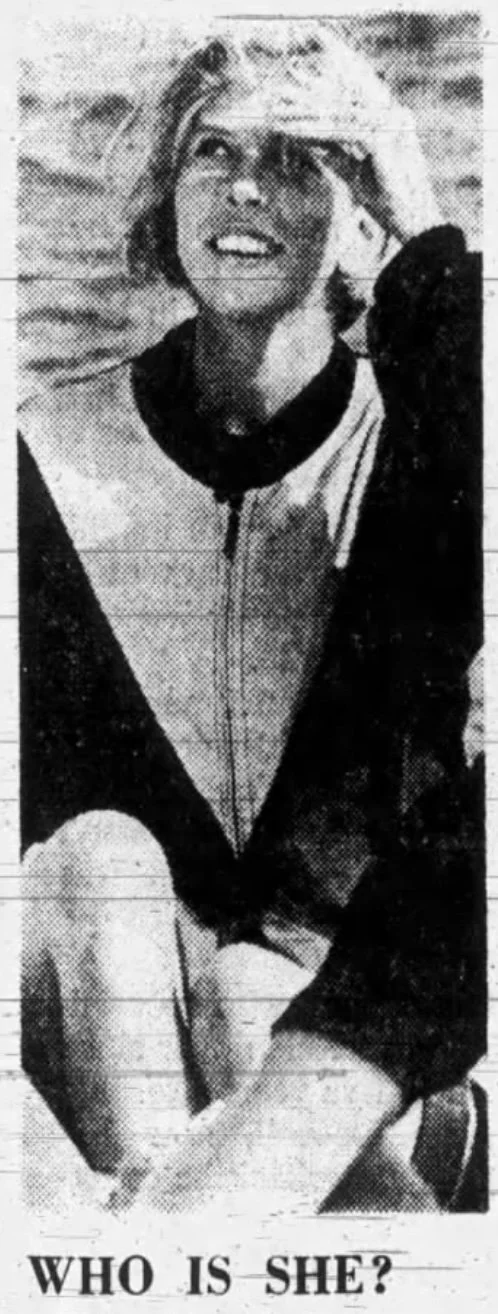
Karen Shoemaker, UC Irvine female coxswain
Long Beach Independent, 21 May 1967, 47
The Western Intercollegiate as held at the Long Beach Marine Stadium, May 19-20. Heats were on Friday, with repechages and finals Saturday where they raced against a strong current and 15-mph winds. UCLA’s varsity eight entered the regatta unbeaten. UCLA’s junior varsity had also been unbeaten and was ranked first on the west coast. UC Irvine’s junior varsity eight included a female coxswain (Karen Shoemaker), the first female to cox in the men’s events. In addition to the three usual collegiate races, there were two lightweight events, a college four and five men’s open events, and perhaps a women’s four scheduled [no results]. The Western Intercollegiate Crew Coaches Association had adopted a rule prohibiting females in male competition on August 26, 1967 after UC Irvine showed up with female coxswain Shoemaker.
Oregon State coach Drlica recounted that there was an incident during the racing, “She was a coxswain for UC at Irvine and got the race all fouled up. The men got mad and the coaches said no more girls.” “Girls: Row, Row, Row Your Boat”, Albany (OR) Democrat-Herald, 22 Apr 1973, 14.
Varsity 8 heat 1: first to grand final, second and third to repechage, others to consolation
UCLA 6:14.5 | Long Beach State 6:26.1 | California 6:29.4 | UC Irvine 6:30.0 | Santa Clara 6:40.9
Varsity 8 heat 2
Washington 6:16.3 | Stanford 6:16.8 | Loyola 6:43.8
Varsity 8 heat 3
San Diego State 6:24.1 | Oregon State 6:25.4 | Southern California 6:37.3 | Saint Mary’s 6:41.3
Varsity 8 repechage: top three to grand final, others to consolation
Stanford 6:22.0 | California 6:25.3 | Loyola 6:27.3 | …
Varsity 8 consolation final: photo finish
UC Irvine 6:30.2 | Long Beach State 6:30.4 | Oregon State 6:38.6 | Santa Clara 6:45.5 | Southern California 6:45.7 | Saint Mary’s 6:50.6
Varsity 8 grand final: by one boat length; a sailboat crossed in the path of UCLA at the 1,000 meter mark, the Bruins maintained their composure, circled around the sailboat, caught Washington and opened up a lead.
UCLA 6:15.2 | Washington 6:19.8 | Stanford 6:22.5 | California 6:30.3 | San Diego State 6:31.8 | Loyola 6:38.4
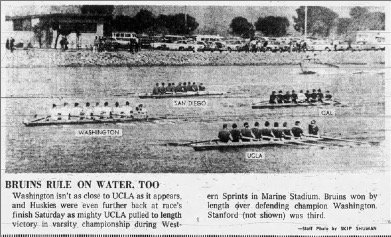
Skip Shuman, Long Beach Indepenent, 21 May 1967, 47.
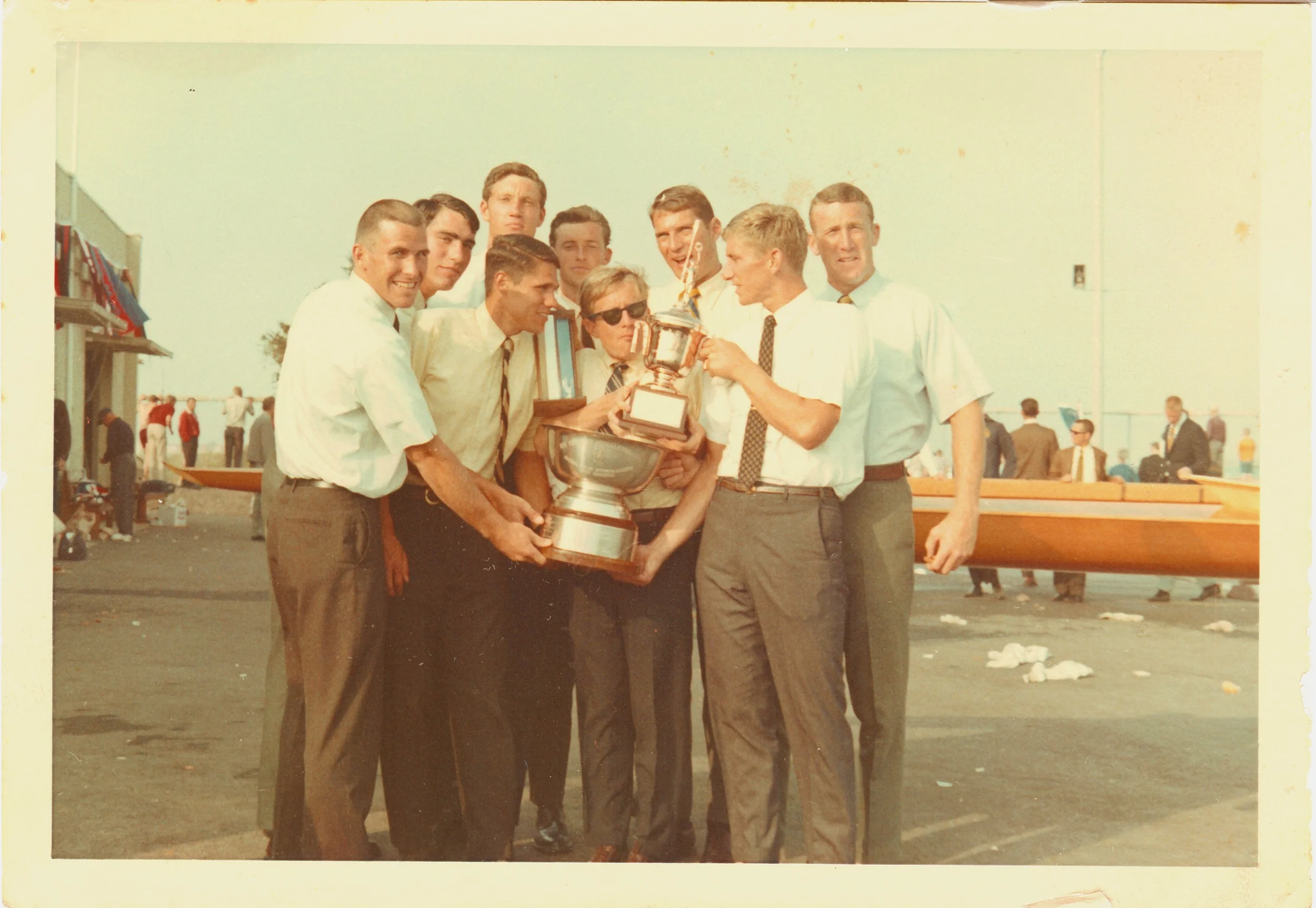
1967 UCLA Varsity Men’s Eight
Junior Varsity 8 heat 1: first to grand final, second and third to repechage, fourth to consolation
UCLA 6:34.0 | UC Irvine 6:35.5 | Stanford 6:37.4 | Seattle 6:47.2 | Oregon State 7:03.0
Junior Varsity 8 heat 2
California 6:35.4 | Washington 6:37.3 | Victoria 6:48.7 | Loyola 6:49.6 | Santa Clara 6:55.9
Junior Varsity 8 heat 3
Orange Coast 6:42.6 | San Diego State 6:54.4 | Southern California 6:56.6 | UC Santa Barbara 6:59.7 | Long Beach State 7:09.0
Junior Varsity 8 repechage: top three to grand final, others to consolation
Stanford 6:27.0 | Washington 6:29.8 | UC Irvine 6:31.3 | …
Junior Varsity 8 consolation final
Loyola 6:40.0 | Victoria 6:47.4 | Seattle 6:55.2 | Southern California 6:56.7 | San Diego State 6:57.2 | UC Santa Barbara ? 7:00.2
Junior Varsity 8 grand final: Stanford narrowly edged California but both boats clocked at 6:27.3
Stanford 6:27.3 | California 6:27.3 | Orange Coast 6:28.3 | UCLA 6:30.5 | UC Irvine 6:33.9 | Washington 6:46.3
Freshman 8 heat 1: first to grand final, second and third to repechage, others to consolation
UC Irvine 6:28.5 | UCLA 6:30.5 | Southern California 6:51.4 | UC Santa Barbara 6:53.2
Freshman 8 heat 2
Stanford 6:28.3 | Loyola 6:35.1 | Oregon State 6:37.4
Freshman 8 heat 3
Orange Coast 6:29.5 | Long Beach State 6:34.7 | San Diego State 6:39.8 | Saint Mary’s 6:42.0
Freshman 8 repechage: top three to grand final, others to consolation
Loyola 6:27.1 | Oregon State 6:29.1 | UCLA 6:32.2 | …
Freshman 8 consolation final
San Diego State 6:44.8 | Long Beach State 6:54.8 | Southern California 6:56.9 | Saint Mary’s 6:58.5 | UC Santa Barbara 7:00.6
Freshman 8 grand final
Stanford 6:30.9 | UC Irvine 6:37.1 | UCLA 6:37.2 | Orange Coast 6:38.7 | Oregon State 6:40.9 | Loyola 6:43.7
Lightweight Varsity 8
Oregon State 6:56.7 | San Diego State 6:57.1 | Southern California 7:03.2 | Santa Clara 7:14.4 | Saint Mary’s 7:26.5
Lightweight Freshman 8
Santa Clara 7:07.8 | UC Santa Barbara 7:30.9
College 4+
Saint Mary’s 7:21.0 | Stanford 7:27.7 | Victoria 8:02.0
Senior 1x won by Van Bloom: Long Beach RA 7:47.3
Senior 2x won by Van Bloom/Nunn: Long Beach RA 7:40.8
Senior 4+ won by Lake Washington RC 7:12.2
150-pound 1x won by P Lickess: Lake Merritt RC 8:44.2
Men’s 2- won by McKenzie/Johnson: Lake Washington RC - A 7:37.0
1967 was the final year that the IRA regatta was 3-miles with all the entrants side-by-side. The same four West Coast crews attended as in 1966. California’s first-year coach Marty McNair stated that he was not planning to attend the IRA after the Western Sprints results, “The kids put their heart and soul into this one, but I couldn’t justify sending back a fourth place crew.” UCLA coach Bisset bemoaned that he only had 2 ½ miles of water to practice on to prepare for the three-mile IRA. Poor weather beset the regatta including a storm occurring with one mile to go in the junior varsity race. In the junior varsity eight Washington was fifth, California seventh, Stanford ninth and UCLA eleventh among the fourteen crews. Pennsylvania (16:13.9) won, Washington placed seventh, Stanford eighth, UCLA (16:47.4) ninth and California eleventh among the sixteen varsity eights. In the freshman 2-mile Washington placed third.
1968
There were 32 coaches listed for the 18 sports at UCLA in the fall of 1967. Coach Bisset was optimistic about the upcoming year, “I think we can finish in the top four or five in the nation.” UCLA Southern Campus, 1968, 206. The UCLA crew staff was listed as Bisset as head coach and Jerry Johnsen as Frosh coach. In March it was announced that Washington had lured Bisset away following this season. First offering the position as head rowing coach for the Huskies in January, after Bisset rejected that he was offered a position as the Executive Director of the UW Alumni Association in February. Bisset decided that after a 15 year involvement with rowing between competition and coaching, “it’s been my life. There was nothing else I wanted to be besides a coach and it’s very hard to give it up. This is particularly so at UCLA because we have done so well overall athletically and because everyone has been so kind to me.” Larry Rubin, “Bruin Oar Coach Bisset ‘Stolen’ by Washington”, UCLA Daily Bruin, 28 Mar 1968, 29, 34. In addition to being the head rowing coach, Bisset had also been serving as the UCLA Athletic Business Manager, handling campus athletic events, team travel planning and athletic grants in aid.
In approaching the first competition of the season Bisset said that the team was “no faster than they were last year at this time,” while they were a lot stronger than the 1967 team. However, he did not anticipate having any difficulty with Long Beach State, UC Irvine, Oregon State and Loyola on April 6 at Long Beach. He admitted that he did not know what to expect from these four opponents, and felt that they might have a chance against the Bruins if his crews “scramble or lose our poise.” Bisset was training his crews for the 2000 meter distance that would be raced at the 1968 IRA in preparation for the Olympic distance. Larry Rubin, “Bruin Oarsmen in Long Beach Opener”, UCLA Daily Bruin, 5 Apr 1968, 15. Bisset judged the varsity race as not “much of a performance. I thought we would do better than we did, although I have to congratulate Loyola.” The Lions of Loyola (6:02.3), coached by John Lind, were only two seconds behind the Bruins (6:00.0) with Long Beach State (6:11.3), UC Irvine (6:11.7) and Oregon State (6:12.3) tightly grouped behind the two leaders. UCLA’s winning time was good considering a quartering headwind and choppy water. In the junior varsity race, Orange Coast (6:00.3) led the Bruins (6:10.3) who were followed by UC Irvine (6:14.5), Loyola (6:23.1), Oregon State (6:23.7) and Long Beach (6:32.0). Larry Rubin, “Loyola Pushes UCLA to Regatta Crew Win”, UCLA Daily Bruin, 8 Apr 1968, 20. Bisset was still considering options in his stroke/coxswain selection Butch Pope [power] or Eric Johnson [finesse] (1967 IRA lineup) as stroke and Guy Lochhead, Orange Coast transfer Randy Rolfe or Jeff McKenna at coxswain. In the freshman race UCLA (6:14.0) were considered “excellent” defeating Orange Coast (6:19.3) by one and one-quarter lengths, followed by UC Irvine (6:24.0), and Loyola (6:27.5) finishing fourth. Looking ahead to facing Cal, by comparing times and finishes of San Diego State and UC Irvine, UCLA was tabbed as 22.7 seconds faster than San Diego State and Cal 21.9 seconds faster than San Diego State. Larry Rubin, “Loyola Pushes UCLA to Regatta Crew Win”, UCLA Daily Bruin, 8 Apr 1968, 18.
In their home opener UCLA would host Loyola an UC Irvine in a rematch. The races were scheduled early in the morning to take advantage of an incoming tide. Loyola’s varsity (6:06.5) prevail over UCLA (6:09.3) by three-quarters of a length, with UC Irvine (6:28.6) trailing behind. Thus, ending UCLA undefeated streak. Bisset had changed the style a bit from a slight pause approaching the catch, to a slight pause at the release, the style that Harvard was currently rowing, though the Bruins, except stroke Pope, were not adapting too well. Larry Rubin, “Loyola Crew Stops Bruin Win Streak”, UCLA Daily Bruin, 15 Apr 1968, 12. Bisset was left to make the decision to return to the style from 1967 or continue to work to make the new style successful for the crew. In the JV and frosh races the order of finish was UCLA, Loyola and UC Irvine following in third. The JV times were UCLA 6:16.0, Loyola 6:23.3 and UC Irvine in 6:40.8. In the freshman race UCLA was 6:27.7, Loyola 6:35.9 and UC Irvine 6:39.9. Larry Rubin, “Loyola Crew Stops Bruin Win Streak”, UCLA Daily Bruin, 15 Apr 1968, 10.
The Bruin varsity was able to rebound by the next weekend to defeat Cal by a three length margin, stretching their lead from the beginning to finish in a time of 6:09.0 to Cal’s 6:20.0. The technique was better after being hurried at the catch during the first two races of the season. Stoke Johnson described the race, “We had the boat really swinging and we were rowing low (30 ½ strokes per minute). There was a lot of pressure because of the change in style and everybody was thinking about that.” With a different outcome than the previous races of the season, UCLA’s JV and freshman crews were judged to be narrowly defeated by the Cal crews. The JV times were 6:01.4 and 6:03.0. In the Cal freshman victory the margin was two-thirds of a length with Cal in a time of 6:17.4 and UCLA in 6:20.2. Larry Rubin, “Crew Rebounds to Beat Cal”, UCLA Daily Bruin, 22 Apr 1968, 14, 16. Cal Coach McNair described his Cal freshman crew as “simply more efficient than the bigger UCLA frosh.” “Cal Crew Dumped by Bruins”, Oakland Tribune, 21 Apr 1968, 52. In advance of the racing, starter Robert Schaeffer had removed two large pieces of driftwood, several glass bottles, a half-dozen beer cans and ten pounds of seaweed from the course. Larry Rubin, “Crew Rebounds to Beat Cal”, UCLA Daily Bruin, 22 Apr 1968, 14, 16. The Bruins had become news. The race was filmed by KTLA from three vantage points on the shore and one from the air, an interview by and sports commentator Dick Enberg, an interview by KMPC and attendance by a photographer from West magazine shooting pictures for the Los Angeles Times. The same weekend, Stanford had pulled an upset victory over a Washington crew on the Willamette River in Corvallis, Oregon, 5:34.0 to 5:34.9
April 27 Long Beach State hosted the Bruins. Two member of the UCLA crew that defeated Cal were out of the lineup, stroke Eric Johnson with poison oak and #6 Carl Marcellas had rowed against Cal with a rib fracture that was now bothering him. That was in addition to some injuries affecting the JV crew also. Larry Rubin, “CSLB Shoots For Bruin Crew Tomorrow”, UCLA Daily Bruin, 26 Apr 1968, 14. UCLA won the two races in varsity, timed at 6:13.8 to 6:27.1, and JV the event over Cal State Long Beach, there being no freshman race.
In advance of the annual Harbach Cup, Bisset rated USC’s chances of victory as very low [“The only way USC would win would be if UCLA and Stanford broke a seat or caught a crab. It’s just one of those years for SC. It’s unfortunate; it’s too bad, but we’ve all had them.” Larry Rubin, “Oarsmen Face Stanford, SC Tomorrow”, UCLA Daily Bruin, 2 May 1968, 16.] while he saw Stanford on the same competitive level as Loyola. In the freshman race Stanford (6:17.0) finished first followed by UCLA (6:25.0) and USC (7:15). The UCLA JV (6:19.0) won, followed by Stanford (6:26.0) and USC (6:54.0). Bisset felt that the JV crew had “run the gauntlet this year, from top to the bottom.” In the premiere race, UCLA (5:55.0) was two seconds faster than Stanford (5:57.0) and USC (6:21.0) finished a distant third. Larry Rubin, “Oarsmen Take Break After Beating Stanford, Trojans”, UCLA Daily Bruin, 7 May 1968, 16. UCLA retained the cup earning 19 points (first in the varsity and JV and second in the frosh), to Standford’s 18 points and USC’s 14. “Bruins Top Tribe In Regatta”, Oakland Tribune, 4 May 1968, 13.
In the Big Row between Stanford and Cal, Cal’s varsity shell swamped in rough water, leading to a Stanford being awarded a contentious victory. Cal’s eight filled with water 200 meters after the start. Though Stanford continued they finished the race with “four men rowing and four men plus the coxswain bailing water out of the shell.” “Varsity ‘Swamps’ Cal, But Bears Grab Cup”, Stanford Daily, 15 May 1968, 7. The two weeks following the Harbach Cup victory and the Western Sprints gave the Bruin varsity time to get healthy but not get stale. The JV and freshman had a race scheduled in Newport Beach against Orange Coast College on the weekend in between, May 11. Orange Coast defeated the vising UCLA JV crew setting a new course record of 6:11.5 to UCLA’s 6:17. Orange Coast coach Dave Grant cited two reasons for the race, “a change in UCLA’s attitude towards the community college” with athletic director J.D. Morgan, and that “five of the eight members of the UCLA crew are former members of the Pirate Crew.” “Win Big Race Against UCLA; Travel to Seattle on Friday”, Orange Coast College Barnacle, 15 May 1968, 4.
The Western Intercollegiate was raced on Seattle’s Lake Washington, on May 17-18.
Varsity 8 heat 1: first to grand final, others to repechage
Stanford 6:30.5 | Long Beach State 6:36.5 | Seattle 6:39.7 | Puget Sound 6:59.0
Varsity 8 heat 2: UCLA lead by a deck at 1000 meters, then Washington hit a big 10 and won going away. Santa Clara protested that that their shell was crowded of their lane by Loyola, but the protest was disallowed.
Washington 6:13.4. | UCLA 6:18.9 | Loyola 6:23.4 | Southern California 6:45.5 | Santa Clara 6:42.4
Varsity 8 heat 3
California 6:24.0 | Oregon State 6:27.6 | British Columbia 6:28.1 | Pacific Lutheran 6:39.6
Varsity 8 repechage 1: first to grand final, second and third to consolation final
Loyola 6:30.2 | Long Beach State 6:30.4 | Pacific Lutheran 6:38.6
Varsity 8 repechage 2
UCLA 6:17.4 | British Columbia 6:23.4 | Santa Clara 6:33.8 | Puget Sound 6:47.9
Varsity 8 repechage 3
Oregon State 6:21.0 | Seattle 6:26.2 | Southern California 6:29.0
Varsity 8 consolation final
British Columbia 6:11.9 | Long Beach State 6:17.5 | Santa Clara 6:20.6 | Pacific Lutheran 6:21.0 | Southern California 6:24.4 | Seattle 6:28.5
Varsity 8 grand final: UCLA and Stanford tied for second over a length behind Washington
Washington 5:56.7 | UCLA 6:00.4 -tie- Stanford 6:00.4 | California 6:09.1 | Loyola 6:09.5 | Oregon State 6:13.8
Junior Varsity 8 heat 1: first to final, others to repechage
California 6:26.3 | Stanford 6:30.2 | British Columbia 6:37.5 | Pacific Lutheran 6:58.3
Junior Varsity 8 heat 2
UCLA 6:20.0 | Washington 6:25.8 | Long Beach State 6:42.0
Junior Varsity 8 heat 3
Orange Coast 6:24.9 | Oregon State 6:37.5 | Oregon 6:40.7 | Victoria 6:50.9
Junior Varsity 8 repechage 1: first to grand final, others to consolation
Washington 6:19.3 | Oregon 6:31.7 | Pacific Lutheran 6:43.3
Junior Varsity 8 repechage 2
British Columbia 6:20.6 | Oregon State 6:26.8
Junior Varsity 8 repechage 3
Stanford 6:23.9 | Long Beach State 6:32.0 | Victoria 6:41.3
Junior Varsity 8 consolation final
Long Beach State 6:26.4 | Oregon 6:27.3 | Victoria 6:32.7 | Oregon State 6:35.9 | Pacific Lutheran 6:43.2
Junior Varsity 8 grand final: Orange Coast moved into the lead immediately, was never threatened and capped an undefeated season.
Orange Coast 6:07.2 | Washington 6:11.9 | California 6:12.5 | Stanford 6:16.5 | UCLA 6:17.4 | British Columbia 6:21.8
Freshman 8
Washington 6:10.8 | Stanford 6:11.7 | Oregon State 6:25.2 | Santa Clara 6:38.8
College 4+
Washington 7:04.6 | California 7:12.6 | Santa Clara 7:13.7 | Pacific Lutheran 7:38.4
Lightweight 8: San Diego State disqualified for wandering out of their lane
Oregon State 6:24.7 | Pacific Lutheran 6:26.5 | Long Beach State 6:32.4 | Santa Clara 6:39.7
From the 1968 IRA to the present the distance became 2000 meters with heats. After review California decided not to enter the IRA nor the Olympic Trials. In the six-boat finals Washington finished second in the varsity eight, UCLA won the petite final (7th place) and Stanford was fifth in the petite final (11th place); Orange Coast was second and Stanford sixth in the junior varsity; and Washington finished fifth in the freshman eight. This was the first year for the varsity four-with-coxswain.
IRA
Varsity 8 heat 1: winner to grand final, others to repechage
Pennsylvania 6:33.9 | Georgetown 6:43.9 | Wisconsin 6:48.1 | Stanford 6:51.6 | Syracuse 6:57.8 | Columbia 6:57.9
Varsity 8 heat 2
Northeastern 6:39.9 | Princeton 6:40.8 | UCLA 6:51.4 | Brown 6:55.0 | Boston U 7:04.1
Varsity 8 heat 3
Washington 6:41.0 | Rutgers 6:48.9 | Dartmouth 6:52.6 | Cornell 6:54.6 | Navy 6:59.2
Varsity 8 repechage 1: winner to grand final, second and third to petite final
Brown 5:53.4 | Georgetown 5:55.6 | Boston U 6:04.3 | Dartmouth 6:07.0
Varsity 8 repechage 2
Princeton 5:45.6 | Cornell 5:53.6 | Wisconsin 5:54.0 | Navy 6:00.5 | Columbia 6:12.8
Varsity 8 repechage 3
Rutgers 5:57.2 | UCLA 6:00.2 | Stanford 6:04.6 | Syracuse 6:08.8
Varsity 8 3rd level final
Dartmouth 6:38.2 | Navy 6:41.3 | Syracuse 6:43.0 | Columbia 6:56.9
Varsity 8 2nd level final
UCLA 6:30 | Wisconsin 6:30.2 | Cornell 6:30.4 | Georgetown 6:31.9 | Stanford 6:38.5 | Boston U 6:43.7
Varsity 8 grand final
Pennsylvania 6:15.6 | Washington 6:20.7 | Princeton 6:21.6 | Northeastern 6:26.0 | Rutgers 6:31.1 | Brown 6:33.2
In the 1968 Olympic trials at the Long Beach Marine Stadium, Harvard [1967 Pan Am Games winner] defeated Pennsylvania [1967 and 1968 IRA champion] by less than a foot, earning the right to represent the United States in Mexico City. Vesper BC was third and Washington finished a close fourth. Other crews that competed were two crews from Stanford, Orange Coast, two crews from Long Beach State, and the Western National Development Clinic of Seattle. Due to altitude and illness Harvard finished in 6th place at the 1968 Mexico City Olympics.