The Jerry Johnsen Years
String of victories over Cal from 1966 through 1971.
IRA champions in the Varsity 4+ in 1972 and 1973, bronze in 1972 Freshman 4+

1969 - 1975
|
1969 - 1975 |
Jerry Johnsen
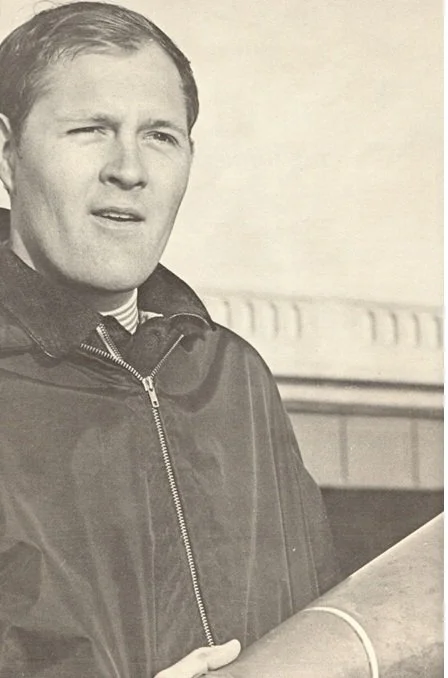
Jerry Johnsen (1969-1975) had been the freshman coach at UCLA in 1966 and again in 1968, with a year in the army in between, and would take over for Bissett following the IRA and take over for a potential try at the 1968 Olympic Trials in Long Beach. Johnsen was stroke of the undefeated 1961 Washington national champion freshman crew, rowing for Bisset, and the Husky’s national champion junior varsity crew in 1964. He had stroked Washington crews to victories during four years at the Western Sprints. “Assistant to be Head Crew Coach at UCLA”, Los Angeles Times, 16 Jun 1968, 269. Bisset commented “I am extremely pleased that Jerry was hired as my replacement. There isn’t anybody around that I would rather see get the job. I think he’ll be a fine coach. He’s a great recruiter, number one. He’s a real student of the game, number two. It is evident by the type of kids he has had this year (coaching the freshmen) that there is a good coach-athlete rapport. And number four, he is a dedicated and hard worker. The crew is going to be in awfully good hands.” Larry Rubin, “Johnsen new Crew Coach”, Daily Bruin, 23 May 1968, 19. Jim Sims, past UCLA stroke, became the new freshman coach as Johnsen moved up.
After the 1975 Western Sprints, Johnsen announced his retirement in order to complete his doctorate in counseling and guidance. ‘”I’ve been at UCLA for ten years.’ Johnsen said, ‘and I’ve loved every minute of it. I wanted to retire at the beginning of this year but the program needed another year to put together a crew that could win the Western Sprints.”’ The varsity finished sixth in the final and the team finished third in the Founders Cup points, behind Washington (129.9 points) and California (117.3) with UCLA third (105.4) and Oregon State fourth (97.6), Orange Coast fifth and Stanford sixth. The Bruins were hit by rolling waves in an outside lane at the 800 meter mark and lost ground that they could not recover during the varsity final. Joe Yogerst, “Crew Finishes Third; Johnsen Retires”, UCLA Daily Bruin, 19 May 1975, 24.
1969
The team had 10 shells [each worth $2,500] in the boathouse and had hired Paul Herrick as a full-time rigger to care for the equipment. First year head coach Johnsen was seen as “an evangelist, whose gospel is crew.” Dwight Chapin, “Devotion to Duty Makes Bruins a Top Crew”, Los Angeles Times, 16 May 1969, 55. Even after losing six of the men in the first eight to graduation in from the 1968 crew Coach Johnsen judged his varsity crew to be “smaller, but a lot scrappier” than the 1968 line-up, with a mean height of 6’3” and weight of 190 pounds. “Bruin Oarsmen Open Season Tomorrow vs. Loyola”, UCLA Daily Bruin, 4 Apr, 1969, 13. Johnsen landed three transfers from Orange Coast College: Dean Hanson, Jim Jorgensen and Geoff Strand. Johnsen was looking for athletes that were at least 6 feet tall and “who has competitiveness, someone who wants to be first.” Burt Wuttken, “Crew Dept Buoys Bruin Coach”, Los Angeles Times, 3 Apr 1969, 189. The first race of the season was against Loyola on April 5. The regatta was a UCLA sweep. The closest race of the day was in the JV event where the UCLA JV (6:38.9) was seven seconds ahead of the UCLA second freshmen with Loyola’s JV :22 seconds back. The varsity race was held with a brisk wind and against the tide UCLA (7:02) finished 9 seconds ahead of Loyola. The Bruins rowed at 31-32 strokes per minute with the Lions two strokes higher and went up to 38 at 1750 meters. The Bruins finished at a rating of 37. The Bruin freshmen moved steadily ahead finishing in 7:05.5 with Loyola 13 seconds back. Saul Shapiro, “Crew Sweeps 3 Over Loyola”, UCLA Daily Bruin, 7 Apr 1969, 13.
On April 12 UCLA hosted Long Beach State. The Bruins (7:02.5) defeated the 49ers (7:17.5) in the varsity and JV (7:21.5) races by 15 and 23 seconds. The UCLA freshmen raced the Long Beach State lightweight crew since the 49ers only had seven freshmen. The Bruins (7;27.5) won by three lengths. The UCLA second freshmen raced the UCLA 3V and a crew national team hopefuls from Long Beach Rowing Association, with the narrow decision going to the LBRA crew. Saul Shapiro, “Johnsen Pleased With Crew Sweep: Face Cal on Saturday”, UCLA Daily Bruin, 16 Apr 1969, 14. That weekend, UC Irvine had defeated Cal’s varsity by .3 seconds.
UCLA defeated Cal in the varsity and junior varsity races on the Oakland Estuary on April 19. UCLA (6:13.2) led the varsity race from the start and was only challenged by Cal (6:21.2) at the 500 meter mark as the Bears pulled to within two seats behind the Bruins before falling back. Cal’s coach McNair said his varsity had “been having problems lately,” and was unhappy with their performance. The Bruin JV (6:14.6) finished with a one boat length lead over the Cal JV (6:19.8) even though the Bears bettered the time of their varsity. The Frosh race was a nail bitter with the lead changing five times, but Cal overcame a one-half boat length disadvantage in the final 250 meters to win in a time of 6:34.1 to UCLA’s 6:35.2 “Bruin Crew Rips Cal”, San Francisco Examiner, 20 Apr 1969, 51. when 10 strokes from the finish a crab shook the UCLA boat after having a four seat lead. Saul Shapiro, “Bruins Sink Cal Crew”, UCLA Daily Bruin, 21 Apr 1969, 16.
UCLA’s JV and frosh crews broke the season’s undefeated record held by crews from Orange Coast College. The Bruin JV (6:13) established an “insurmountable lead” controlling the race from the start and finished 10 seconds and two and one-half lengths ahead. Although the Bruin freshmen (6:23) were behind Orange Coast at the 1000 meter mark, they began pulling ahead to a two length advantage only to have Orange Coast (6:25) reduce that to only a one boat length advantage at the finish. Saul Shapiro, “Jayvee, Frosh Boats Top OCC”, UCLA Daily Bruin, 28 Apr 1969, 12.
UCLA swept the Harbach Cup earning 20 team points, followed by Stanford with 17 and USC with 10. UCLA was timed in 6:09.4 for the varsity race, 6:17 in the JV race and 6:04.5 in the freshman race. Stanford finished second to the Bruins in all three races; USC did not enter the JV event. “UCLA Crew Sweeps Harbach Regatta”, Long Beach Independent, 3 May 1969, 15. On May 10 Stanford (6:19.6) defeated Cal (6:24.6) by over a boat length in the Big Row.
The Western Sprints were held on Mission Bay in San Diego. Twenty schools entered in the two-day regatta, May 16-17. Both UCLA and Washington were undefeated entering the regatta.
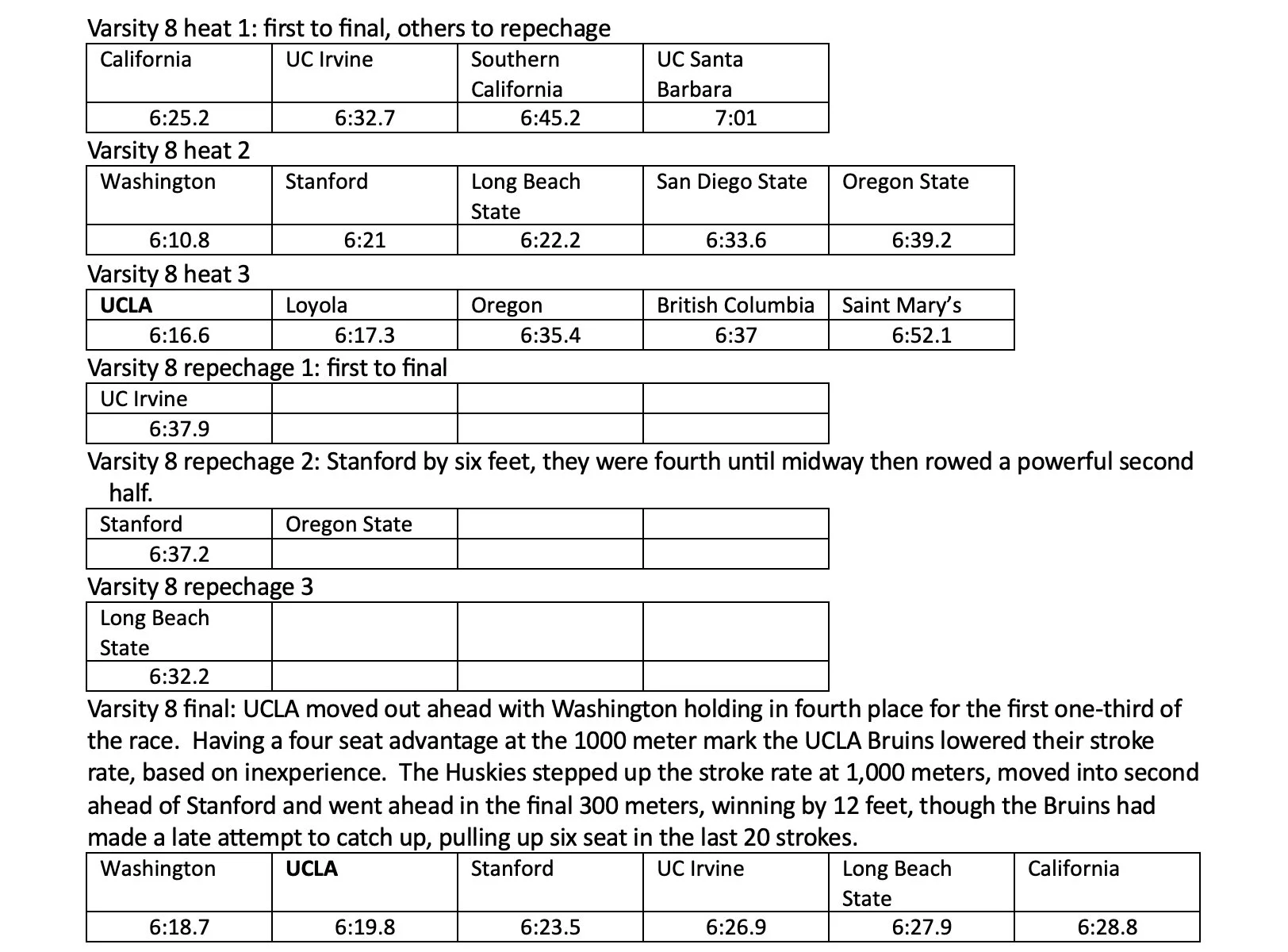
In the Varsity 4+ heat 2, Saint Mary’s finished near the back of one of the heats. UCLA was disqualified for crossing UC Santa Barbara’s path placing Santa Clara as first in that heat. Oregon State posted a time of 7:33.8 ahead of UCLA by 1.5 seconds.
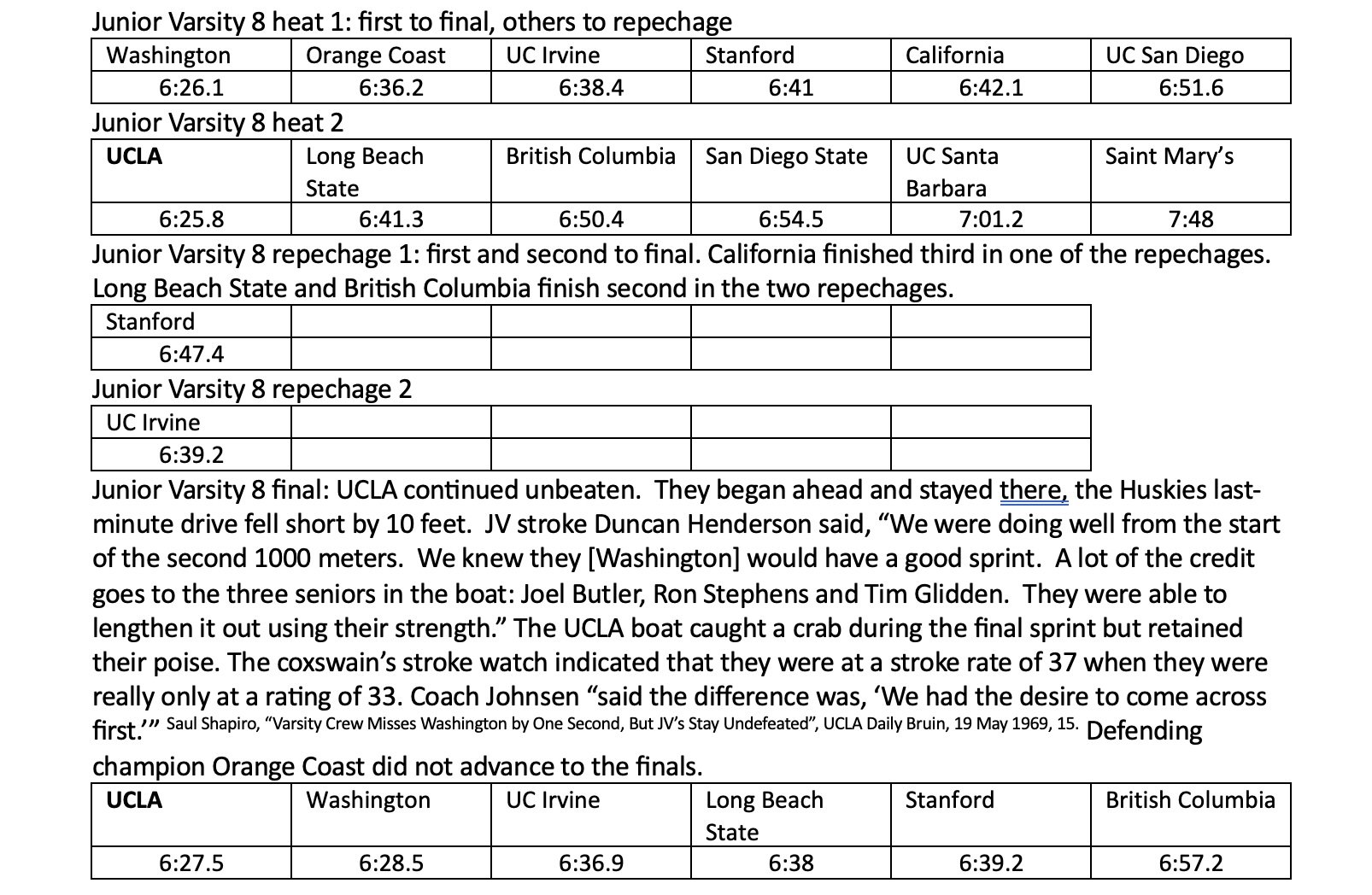
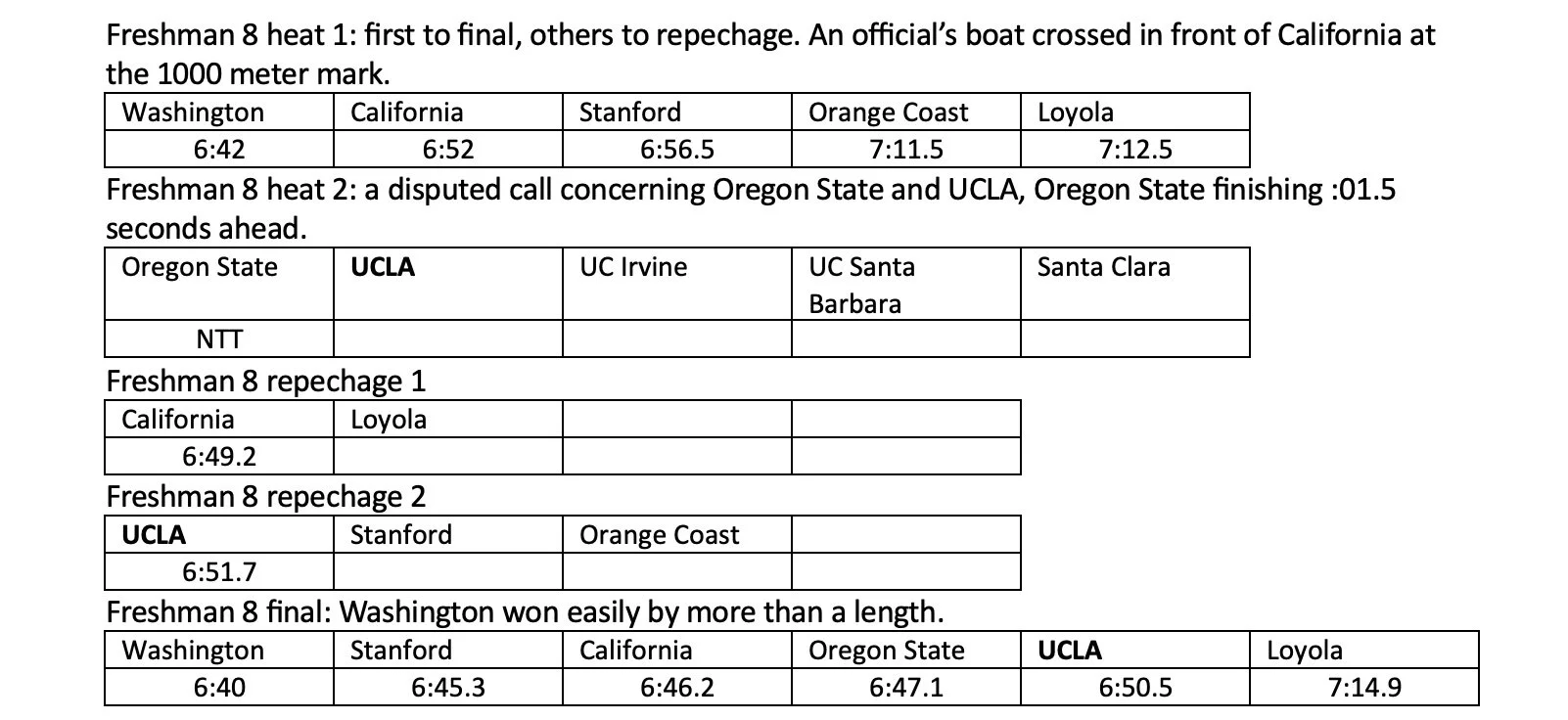
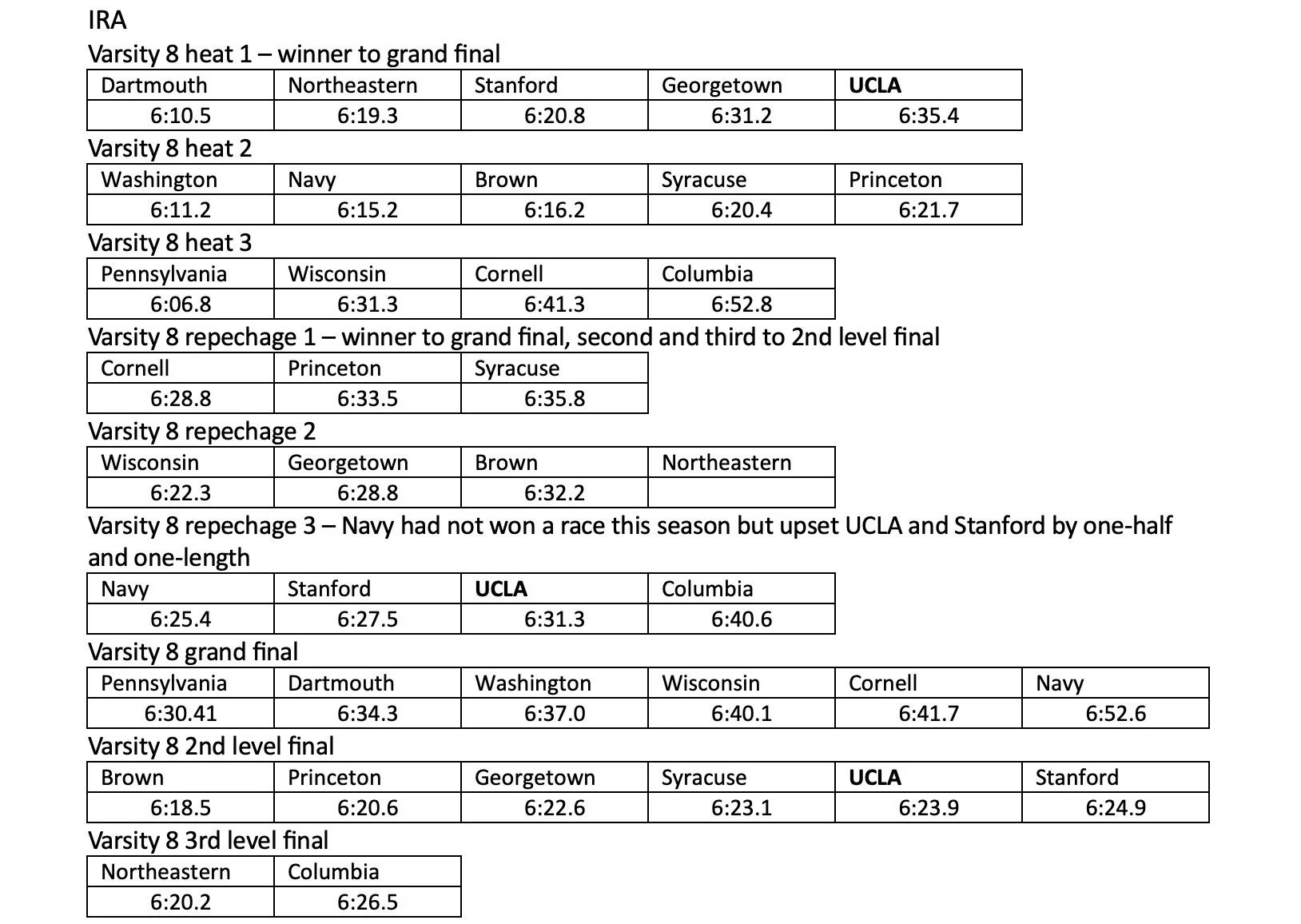
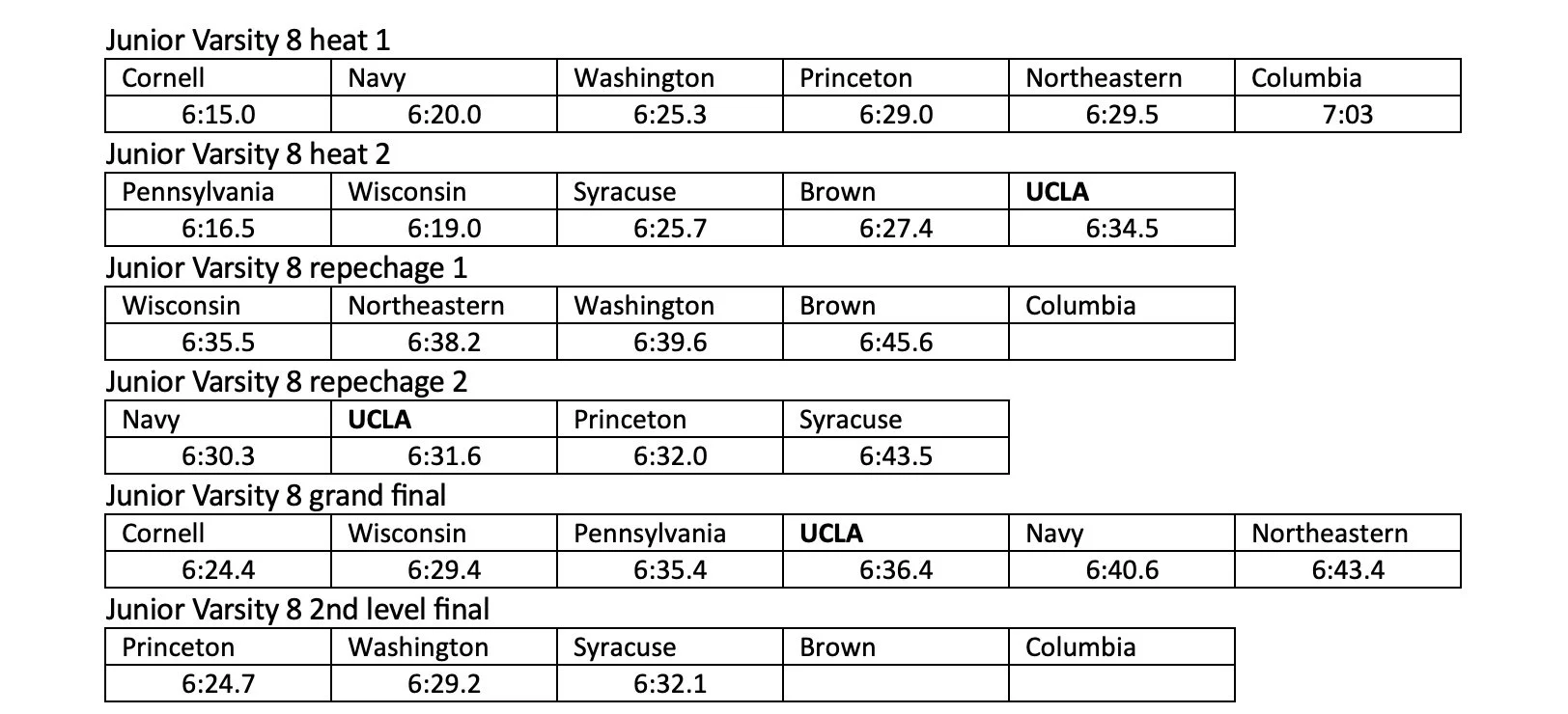
The 1969 IRA: Stanford and UCLA were eliminated from racing in the grand final by Navy in the repechage and Washington was third in the varsity eight final; UCLA placed fourth in the junior varsity with Washington eighth; the freshman eight was a dead-heat between Washington and Pennsylvania; Orange Coast placed second, Loyola was seventh, Oregon State tenth and Long Beach State eleventh in the varsity four. California did not attend.

1970
Assisting head coach Johnsen were freshman coach Jim Sims [1966 UCLA stroke] and lightweight coach Guy Lockhead. A lightweights squad was added to the program with outstanding results. The team began a tradition of training at Big Bear during spring break bring “excellent” training results and team unity. The coed auxiliary Shell & Oar organized a women’s club crew for the first time that competed at the Western Intercollegiate and raced in a few events in 1971 and 1972.
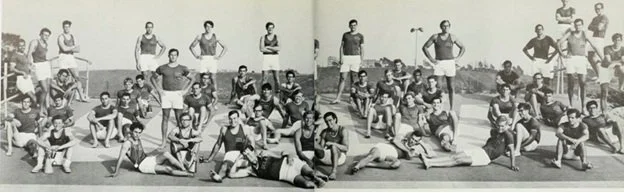
1970 Southern Campus, 208-209.
UCLA had five oarsmen returning from the 1969 varsity, four from the Western Intercollegiate champion JV crew, six from the freshman crew that suffered only one loss in dual races, two transfers from Orange Coast and two red-shirted oarsmen, one returning from a shoulder separation the previous year. Johnsen said, “What I’m mainly concerned about is getting the right people in the right shells.” The Bruins opened their season facing Cal, who had already competed three prior races this season, with wins over USC and Santa Clara, but an eleven second loss to newcomer UC Irvine and also Long Beach State. Saul Shapiro, “Oarsmen Open Season Against Bears”, UCLA Daily Bruin, 10 Apr 1970, 16.
The Bruins earned their fifth consecutive Wallis Cup victory over Cal along with its first freshman victory over Cal as UCLA swept all three events. In the varsity race it came down to the final thirty strokes where the crew were even. The Bruins charged ahead moving with each stroke to a final advantage of six seats in 6:47.1 to Cal’s 6:48.9. The Bruin JV (7:07) won by several boat lengths ahead of Cal (7:14). Jim Sims had been the stroke of the first UCLA varsity to defeat Cal and now in his second year as coach of the Bruin freshman, his crew defeated Cal for the first time. The Bruin freshmen raced at a stroke rate of 29 and extended a two-seat lead at 1000 meters finishing 17.5 seconds ahead in a time of 7:14, and Cal in 7:32. With 3,000 spectators attending, several cars were ticketed for parking along the road leading to the boathouse. In a race at Long Beach, in their first appearance UCLA’s lightweight eight (6:23) finished 5 seconds ahead of Long Beach State (6:28) with UC San Diego (6:29) in third. It was even more significant since six of those in the Bruin crew had never raced before. Saul Shapiro, “Varsity, JV, Freshmen Crews All Beat Cal”, UCLA Daily Bruin, 13 Apr 1970, 16.
The next race was the Newport Regatta that would include UC Irvine, Long Beach State and Orange Coast College. Both UC Irvine, that was undefeated, and Long Beach State had already defeated Cal in a triangular race and also defeated UCLA. The UCLA varsity finished behind UC Irvine (6:07) and Long Beach State (6:07.3). The Bruin JV (breaking the course record in a time of 6:04.9) moved away from Orange Coast 5.5 seconds back. The Orange Coast Barnacle complained that UCLA’s JV crew included “the number two, three, four and five rowers were transplants from the Bruin varsity boat.” “Bruins Hand OCC First Crew First Loss”, Orange Coast Barnacle, 22 Apr 1970, 6. The JV was a “vastly different collection of oarsmen than rowed previously against Cal.” Coach Johnsen had plenty of options to consider among his varsity crews and concluded “we’re going to get back to work tomorrow and get ready for Stanford. We still have yet to put our fastest boat together and there are personnel changes to be made.” Saul Shapiro, “Oarsmen Suffer Regatta Defeat to CSLB”, UCLA Daily Bruin, 20 Apr 1970, 12. Orange Coast’s only victory of the day came in the lightweight freshman eight where they came from behind at the 1000 meter mark to win in a time of 6:14.2. “Bruins Hand OCC First Crew First Loss”, Orange Coast Barnacle, 22 Apr 1970, 6. With ten strokes to go and UCLA’s first freshman crew was a length ahead, and then the Bruins hit a buoy dead on, but UCLA (6:12.4) held on for the win ahead of Orange Coast (6:12.5). Saul Shapiro, “Oarsmen Suffer Regatta Defeat to CSLB”, UCLA Daily Bruin, 20 Apr 1970, 12.
Prior to the Harbach Cup, Johnsen was still looking for his best line-up. The Bruins won the cup finishing 6:26 to Stanford’s 6:40.5 in the varsity eight and was a :02 second winner over Stanford in the JV race. Saul Shapiro, “Oarsmen Beat SC, Tribe to Capture Harbach Cup”, UCLA Daily Bruin, 27 Apr 1970, 10. The UCLA freshman were also victorious twenty seconds ahead of Stanford, staying unbeaten. Stanford finished second in all three races and USC was third finishing 32 and 35 seconds behind UCLA in the varsity and JV races.
The UCLA lightweight crew won a race on Mission Bay against four other crews by five seconds even though they raced with a broken fin. Saul Shapiro, “Oarsmen Hand Huskies 1st Home Loss Since 1954”, UCLA Daily Bruin, 4 May 1970, 14.
In their final dual race, UCLA faced the undefeated, defending Western Intercollegiate champions in Seattle. The Huskies were described as “big and thick limbed.” Coach Johnsen was upbeat after the Bruin victory over Stanford. The Bruin freshmen did not travel to Seattle. Saul Shapiro, “Oarsmen Travel North to Face Washington”, UCLA Daily Bruin, 1 May 1970, 14. Evidently Johnsen had found a strong combination as they defeated the Huskies in Washington’s first loss at home since 1954, but it was exceptionally close, both crossing the line in 6:04.9 but UCLA awarded a victory by the judges by eighteen inches. The Bruins earned a two-seat advantage by the 500 meter mark, as both crews drove through the choppy water, over the next 500 meters the lead was back-and-forth; at 1250 meter the Bruins took a hard 20 strokes moving ahead by 20 feet; the Huskies began an early sprint and the crews were side-by-side to the finish. Johnsen described it as “a win that will rock the rowing world, although it may not carry a lot of weight down here.” In the JV race, Washington used a similar racing strategy but finished in 6:17.9 to UCLA’s 6:19.2.
In Southern California, UCLA’s lightweight crew won a race over the UCLA second freshmen and the USC freshmen. Saul Shapiro, “Oarsmen Hand Huskies 1st Home Loss Since 1954”, UCLA Daily Bruin, 4 May 1970, 14. Following the victory over Washington, UCLA’s varsity combination only rowed intact three times of ten outings the next two weeks owing to “colds, sore ankles and a motorcycle accident (Geoff Strand, not serious).” Saul Shapiro, “Oarsmen Face Husky Rematch”, UCLA Daily Bruin, 15 May 1970, 15.
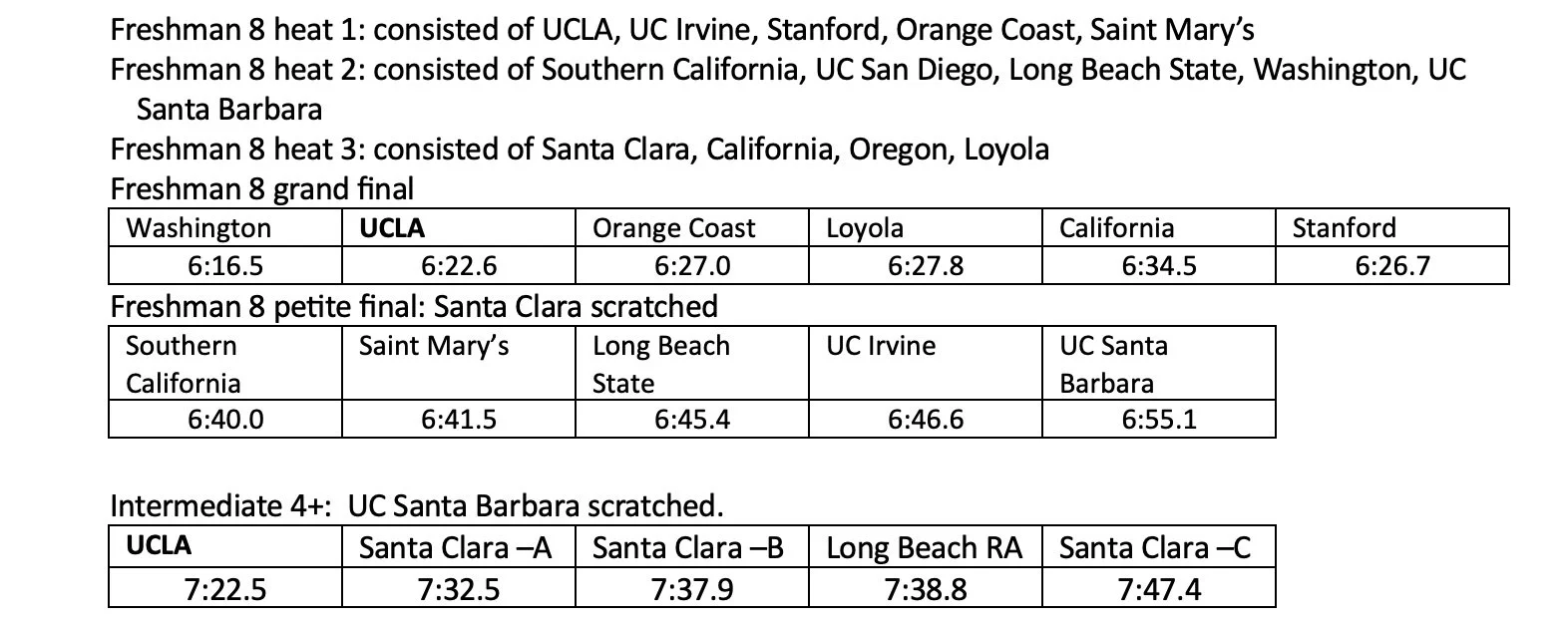
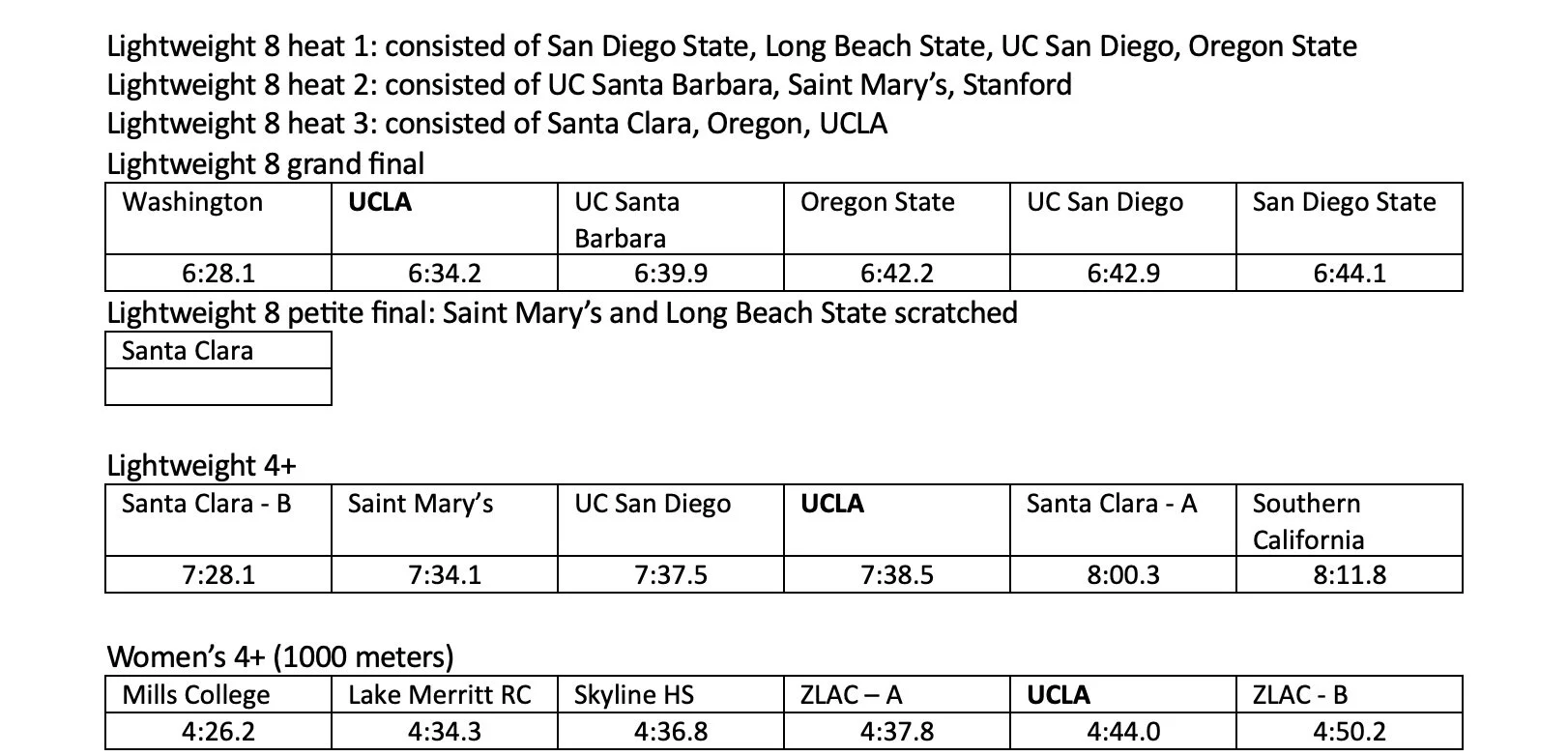
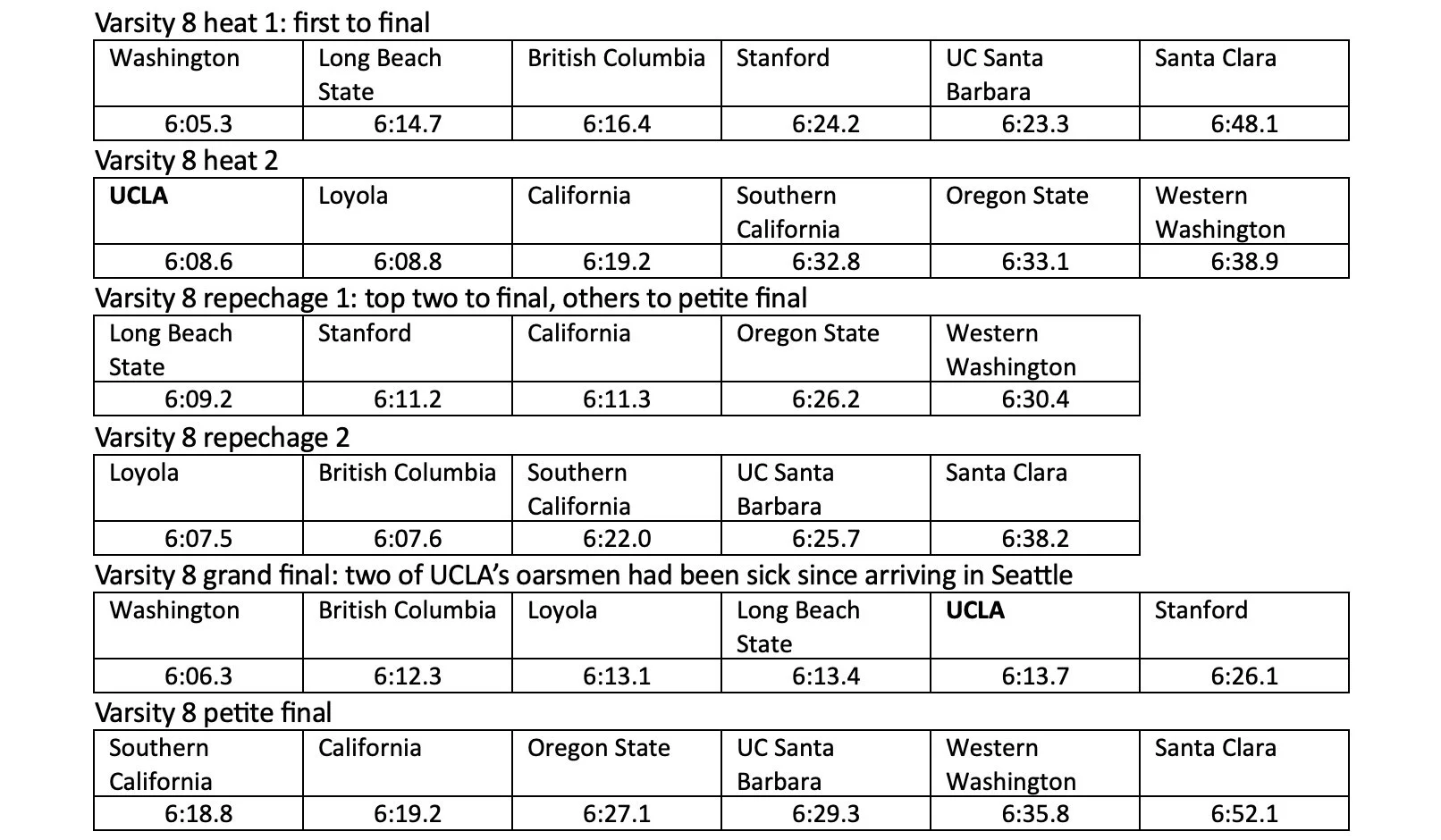
The Western Intercollegiate was held at Long Beach Marine Stadium, on May 15-16. Sixteen college teams attended. A morning fog delayed the start of the regatta on Saturday by an hour, organizational delays and a 5-to-10 knot quartering wind then followed.
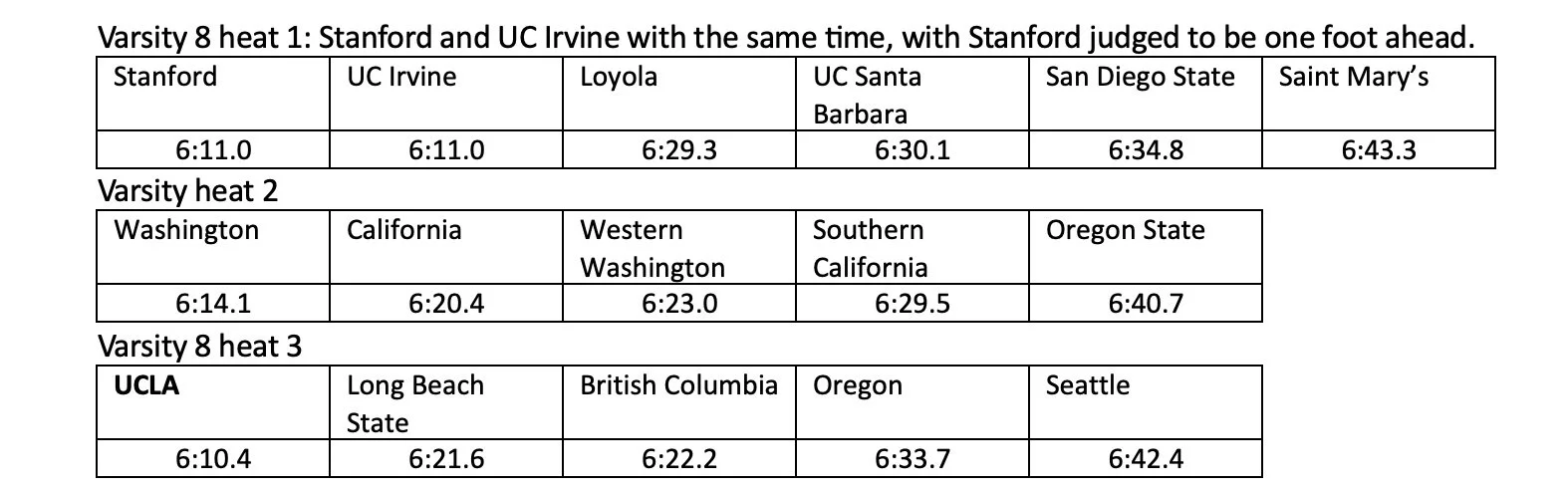
Friday heat winners advanced to the final, second and third place crews from the heats raced in the repechage that afternoon with the top three advancing to Saturday’s final.
Repechage: Long Beach State 6:16.5 over Western Washington 6:21.6
Other Repechage winners: UC Irvine and Loyola
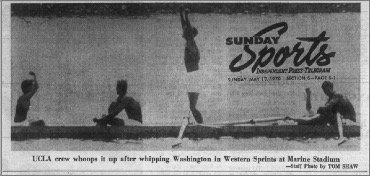
Tom Shaw, Long Beach Independent, 17 May 1970, 49.
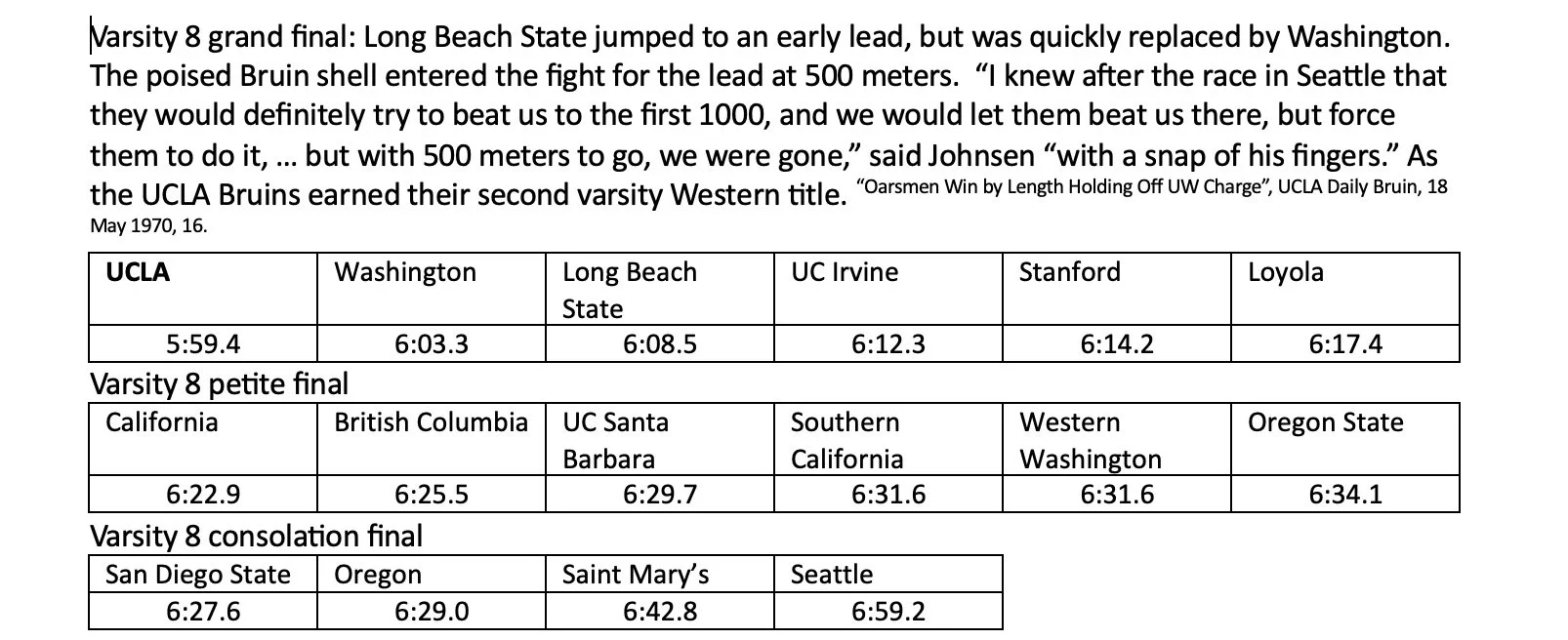

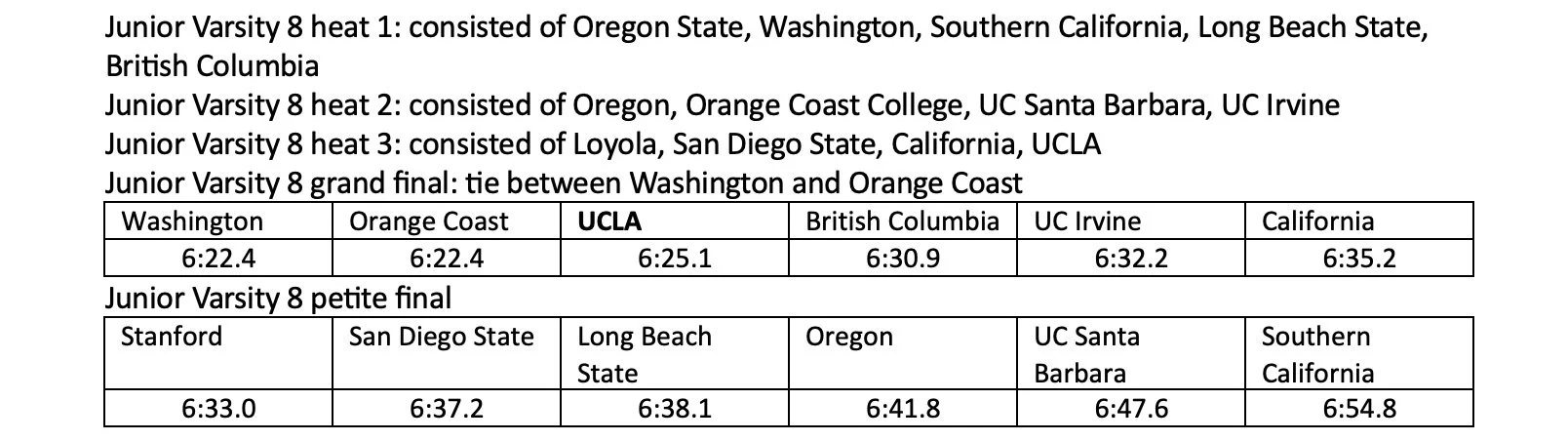
The 1970 IRA was the largest to date with 23 colleges entering 59 crews. Western Sprints varsity eight champion UCLA was not among them since the IRA regatta conflicted with end-of term finals in Westwood. Without the option to attend the IRA UCLA’s coach Johnsen tried to arrange a race against Harvard, however Harvard had its season ending race with Yale scheduled during the IRA and keeping athletes together after that was a challenge. Saul Shapiro, “Crew Season Probably Over: Race With Harvard Unlikely”, UCLA Daily Bruin, 22 May 1970, 16. Johnson claimed “This is the best UCLA crew ever. There can be no doubt about that. The 1967 [ninth at IRA, winner of Western Intercollegiate and several victories over Cal] crew was good but it wasn’t as swift as this one.” Dwight Chapin, “Best UCLA Crew Ever’ Hopes to Down Gloom in Eastern Races”, Los Angeles Times, 6 Aug 1970, 45. The crew was composed of Bob Baldwin, Dean Hanson, Duncan Henderson, Ken Jablonski, Jim Jorgensen, Jim Lasswell, Jack Salyer, Geof Strand and coxswain Sandy Bettelman. Since Long Beach State finished only a boat length behind Washington, finishing third they were invited to the IRA but did not attend for lack of funds.
Freshman eight: Washington second; California tenth (third in the petite).
Junior Varsity eight: Washington second; Orange Coast seventh (first in petite).
Varsity four: Pacific Lutheran third; UC Irvine seventh (first in petite); California tenth (third in petite).
Varsity eight: Washington first. No other West Coast crews were among the fourteen competitors.
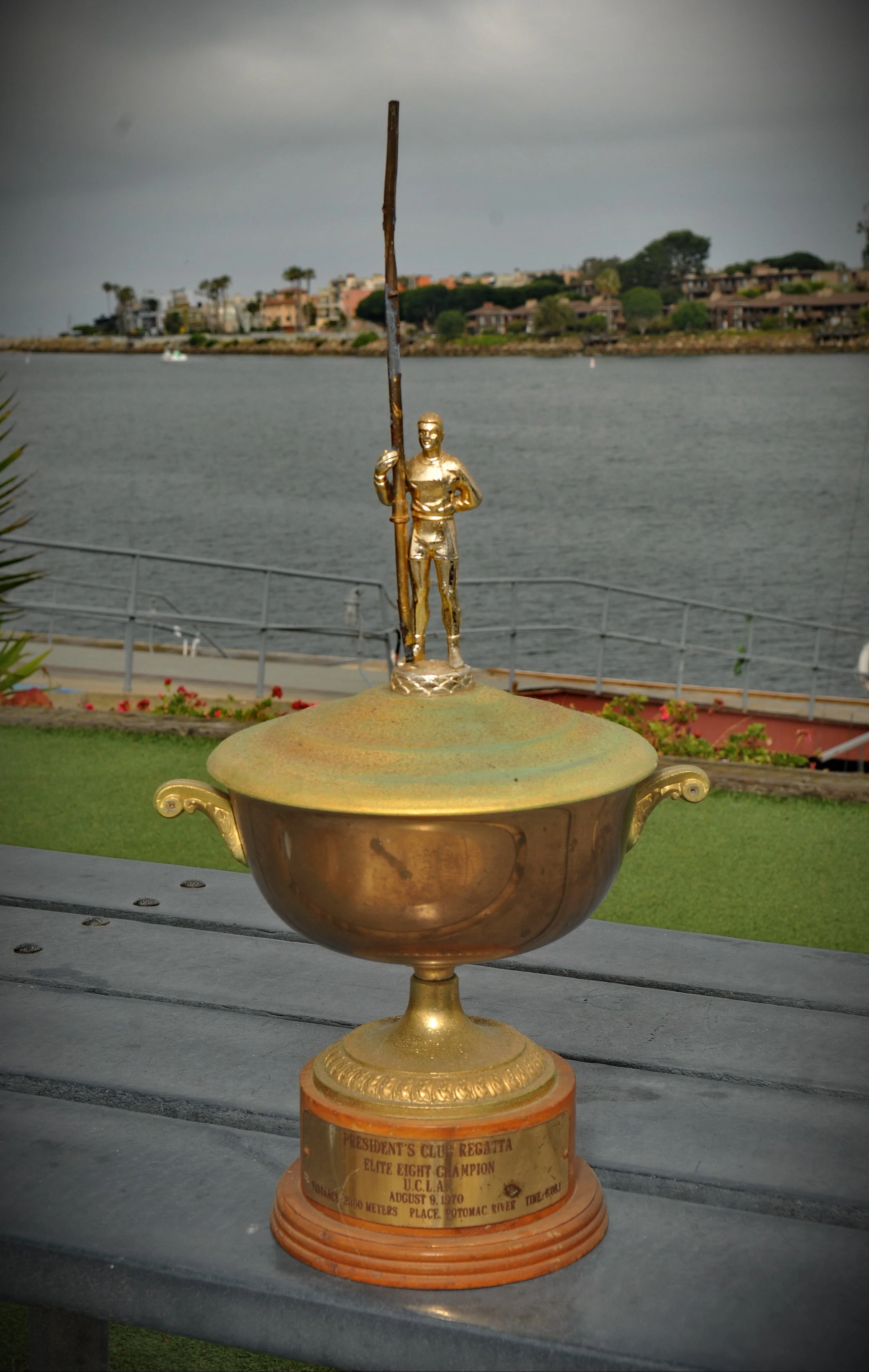
After winning the Western Sprints, and defeating eventual IRA champion Washington in an earlier dual on the Huskies home water, something that had not occurred since 1947, the Bruins took a month off without a goal. Then planned an August trip to race Eastern crews as a tune-up for the NAAO nationals toward the end of August. Dwight Chapin, “Best UCLA Crew Ever’ Hopes to Down Gloom in Eastern Races”, Los Angeles Times, 6 Aug 1970, 45. Among the Bruin’s victories was elite eight at the President’s Cup in Washington, D.C. on August 9. They spent time training in Philadelphia. In an interview Coach Johnson stated “We’re not here to see the East Coast or to have a good time. We’re here to row and to win.” Seymour Smith, “UCLA Seeking Rowing Title”, Baltimore Sun, 15 Aug 1970, 20. The Bruins were using a lightweight shell and the crew had placed a small American flag on one end of the shell. Johnson stated “The Flag was entirely their idea. It’s been there all season. It’s not that they are ultra-patriotic. They just want to let people know that unlike some people, they’re not against their Flag.” Dwight Chapin, “Best UCLA Crew Ever’ Hopes to Down Gloom in Eastern Races”, Los Angeles Times, 6 Aug 1970, 45. The National Association of Amateur Oarsmen (NAAO) nationals held August 20-24 also doubled as the trials regatta to select the U.S. team for the World Championships in St. Catherines, Ontario. There were visiting crews from Australia and New Zealand competing on their way to the Worlds. In the heat of the Championship 8 event, UCLA won with Vesper Boat Club second, IRA champion Washington third, and Long Beach RA being eliminated from that heat. In the afternoon final UCLA “never really settling down” as Vesper and Washington fought back-and-forth for the lead. Vesper won in a blazing time of 5:42.8, with Washington (5:46.0) and Union BC (5:46.1) coached by Harry Parker only 1/10th of a second apart, with UCLA (5:51.3) another five seconds behind finishing in fourth, finishing ahead of New Haven/Potomac combination (5:52.8) coached by Tony Johnsen in fifth. The experienced Vesper crew (including Mike Vespoli and Dick Dreissigacker) earning the nod to represent the U.S. The trials for the eight was held first so unsuccessful crews could try in fours and pairs. UCLA entered two crews in the pair-with-coxswain, both finished fourth in elimination heat and did not advance. In the four-with-coxswain the UCLA entry finished fifth in the elimination heat, and a UCLA-Potomac entry finished third in a heat of the four-without-coxswain. And UCLA posted a fourth place heat finish in the pair-without-coxswain event. Part of the Washington eight, as Lake Washington (6:49.1), won the coxed-four event and the bid to represent the United States. UCLA’s (7:05.2) entry in the event finished behind the other crews in fifth place. On the last day of the regatta an “International Eight” event was raced for the U.S. national championship. Vesper’s winning senior 8 did not participate but the crews from Australia and New Zealand were challenged by UCLA, Washington and Vesper’s winning “intermediate” eight. UCLA (5:54.2) finished in fourth, again defeated fifth placing Washington (6:04.4), with the top three places going to New Zealand (5:29.2), Australia (5:44.2) and Australia-B (5:50.7). Peter Lippett, “The United States National Championships”, The Oarsman, September/October 1970, 4-6. New Zealand and Australia eventually finished in third and fifth in the eight-oared event at the World Championships. The United States finished tenth in the eight and eleventh in the four-with-coxswain at St Catharines.
1971
Head Coach Johnsen had six two-year lettermen returning from the previous season. Geoff Strand was coaching the second-year lightweight program and Jim Jorgensen coached the freshmen crew.
The women’s club team lost a race to women from Cal at the Wallis Cup regatta and raced an exhibition race in Long Beach against a double in May.
While most of the squad competed in Class Day races, the sophomores winning with a time of 6:16.4 over the seniors in 6:17.9, the lightweight squad raced at the Newport Regatta and outdistanced San Diego State by 22 seconds. While in the varsity event at Newport, Loyola finished a strong second 4 seconds behind Long Beach State with San Diego State last. Both Loyola and San Diego State would face UCLA in the home season opener on April 10. John Wood, “Crew Season Begins With Loyola, SDS Tomorrow”, UCLA Daily Bruin, 9 Apr 1971, 16. The Bruins swept Loyola and San Diego State in all three boat categories, though in the varsity race, Loyola was quick of the start. The order of finish from all three races was UCLA first, then Loyola and San Diego State in third. The varsity times were 5:53.0, 5:59.8 and 6:20.4 for San Diego. In the JV race UCLA (6:15.7) won by the largest margin overLoyola (6:34.2) and San Diego State (6:34.2). The freshman race was the closest with UCLA (6:10.1) less than four and five seconds ahead of Loyola (6:14.0) and San Diego (6:15.0). “Bruin Crew Opens Season With Win”, Los Angeles Times, 11 Apr 1971, 46.
On the Oakland Estuary UCLA continued its supremacy over Cal, winning five of the six races, only falling to the Bears in the JV 4+. Johnsen revealed that “Cal had been yelling that the Bears were back,” prior to the confrontation. In the varsity race, UCLA was characterized as rowing a powerful race. In the second 500 meters UCLA moved from a two-seat lead to a six-seat advantage as Cal’s crew lost some control in rough water. While the Bruins also experienced their own challenges battling rough water their sprint helped them regain their margin to finish one length ahead in 6:10.1 to 6:14.7. The JV contest was back and forth for the first 1000 meters until the Cal #2 rower caught a horrendous crab, allowing the Bruins to take control of the lead and finish with a one length advantage 6:21.2. to 6:27.4. The UCLA freshmen (6:31.5) won their first victory over Cal (6:35.8) on the Estuary. The Bruin lightweights had the greatest showing, placing a first and second crew ahead of the Cal lightweights with margins of 28 and 19 seconds. John Wood, “Oarsmen Outrace Cal”, UCLA Daily Bruin, 19 Apr 1971, 19. Cal’s women’s crew scored a length and one-half victory over UCLA women’s crew. “Cal Women’s Crew Outrows UCLA”, Oakland Tribune, 18 Apr 1971, 50.
Going into the Harbach Cup Stanford was characterized as not as strong as in the past, and while USC was “vastly improved over previous years,” neither was expected to rival UCLA. The same weekend Washington was hosting Cal in their annual race. Doug Kelly, “Oarsmen Out For Shirts in Saturday Harbach Cup”, UCLA Daily Bruin, 21 Apr 1971, 12. In the varsity race of the Harbach, the crews were close for the first 1000 meters, the Bruins having a poor start, then the other two crews began to fade both timed in 6:29.5 with Stanford awarded second place by a few inches over USC, and UCLA winning in a time of 6:18.4. UCLA’s JV finished 15 seconds in front of the other two crews, while the freshman were victors by 5 seconds in their roughest race of the season, surging in the last 500 meters to overtake Stanford. The following day UCLA’s lightweight crew posted its biggest win of the season by almost 9 seconds over UC Santa Barbara with Cal in third, and the freshman second crew defeated Stanford by 27 seconds. John Wood, “Oarsmen Retain Harbach Cup”, UCLA Daily Bruin, 26 Apr 1971, 23.
On May 1 UCLA was scheduled to host UC Irvine in preparation for the big race against Washington leading to the Western Sprints. Irvine had defeated the Bruins in a race the previous spring. During the past fall, three West German rowing coaches, including Karl Adams, had held conferences on the East and West Coasts about technique, equipment, training and psychology. Johnsen shared,
“’Bob Ernst, the coach at Irvine, was very taken with Dr. Adams’ ideas and scrapped the most prevalent American theories and went to the European style.’ UCI also switched shells, opting for the Italian Donoratico model in place of the standard American Pocock. UCLA has also put in an order for the Italian boat, but for a different reason than Irvine. ‘We ordered the shell for its portability. It can be taken apart into three sections and we can take it with us at a reasonable cost in a reasonably short period of time.’ However, neither UCI nor UCLA Donoraticos have arrived as yet. Thus, UCLA is a strong favorite. What if Irvine realized the boat wasn’t going to come and changed back to the standard style? ‘They might improve,’ Johnsen says, ‘but the change would happen so late they could not adjust in time for our race.’” “Oarsmen Meet UCI”, UCLA Daily Bruin, 30 Apr 1971, 24.
The race was referred to as a ”rout” of the Anteaters as the Bruin varsity finished three lengths ahead in a time of 5:56.8 to UC Irvine’s 6:06.6. The Bruin JV (6:05) finished 30 seconds ahead in their race, and the freshmen (6:14) were victorious by :08 seconds. In a separate race the UCLA second freshmen defeated the Bruin lightweight JV by 5 seconds. Bruin mentor Johnsen was not impressed with the varsity performance saying that his crew “sat on it,” after posting a good first 1000 meters. The Washington Huskies ”easily disposed” of the visiting Bears in times of 6:13.2 to 6:28.4 at their annual race in Seattle, setting the stage for the next weekend, and the Western Sprints that would follow. Doug Kelly, “Oarsmen Rout UC Irvine”, UCLA Daily Bruin, 3 May 1971, 15.
On May 8 UCLA hosted a dual with Washington [1970 IRA champion, 1971 second place to UCLA at the Western Sprints] and were handed their first defeat in two years in a Ballona Creek record time of 5:51.4, UCLA finishing in 5:56.3. An exciting race with a large crowd of spectators. In a see-saw first 1000 meters with two lead changes, then Washington began to make their move, “but UCLA was waiting for them to do just that. The only trouble was that the Husky shell responded to the increased tempo; the Bruins did not.” The Bruins were unable to close the margin during their sprint so the Huskies maintained their rating and did not sprint. Several Bruin oarsmen cited the Huskies as having a better catch. Coach Johnsen felt the Bruins rowed a “technically” better race but Washington rowed a “tougher race.” The UCLA JV (5:57.7) continued its unbeaten streak in a 2.4 second victory over Orange Coast (6:00.1); the Bruin lightweights (6:18.5) achieved a three length victory over UC Santa Barbara (6:30.3); and the UCLA freshmen (6:07.4) suffered their first defeat of the season falling to Orange Coast (6:03.0). The UCLA second freshmen (6:26.2) defeated Orange Coast’s second freshman (6:46.2) by 20 seconds. John Wood, “Husky Shell Tops Bruins 5:51-5:56”, UCLA Daily Bruin, 10 May 1971, 16.
Approaching the next race in Long Beach coach Johnsen stated, “I’m still not satisfied that we have the eight toughest men in the varsity boat,” as a result he was trying several line-up changes between the varsity and JV crews, saying ”we have 16 men who are capable of a sub-six minute race.” The freshman crew was in a similar situation with Jim Jorgensen moving a few rowers between the first and second freshmen eights. John Wood, “Seat-Shuffling Continues as Oarsmen Visit Long Beach”, UCLA Daily Bruin, 14 May 1971, 15. The following week UCLA defeated Long Beach State in varsity and JV races. The Bruins overcame a six-seat 49ers lead at 1000 meters winning in a time of 5:58.5 to 6:02.7. The UCLA JV won by a closer margin, only three-seats ahead at the end as the 49ers were closing. The meet also included two UCLA women’s 4+ racing a Long Beach RA double in a 1000 meter race. Patrick Barry, “Same Old Story: Bruins Beat CSLB”, Long Beach State 49er, 18 May 1971, 16.
A chartered flight of several Southern California teams left LAX on Thursday for the Sprints in Seattle. Patrick Barry, “Same Old Story: Bruins Beat CSLB”, Long Beach State 49er, 18 May 1971, 16. The Western Intercollegiate was held on Lake Washington in Seattle on May 21-22. While the Bruins were seeded second in the varsity eight event, they finished fifth, other UCLA crews finished second in the JV, and frosh events and third in the lightweight eight, all four events won by Washington. There were questions of the validity of the weights of the two crews finishing ahead of UCLA in the lightweight event. John Wood, “Oarsmen Fifth as Huskies Dominate Sprints”, UCLA Daily Bruin, 24 May 1971, 17. Washington coach Dick Erickson quipped shortly after the Huskies won seven of the eight races they entered, “everybody hates us now.” “Huskies Sweep Sprint Races”, Palo Alto Times, 24 May 1971, 25. While placing second in the lightweight and freshmen events, neither crew was sent to the IRA. The lightweight program had no funds available and the freshmen were “urged to concentrate on their final exams.” Adding to controversy UCLA crews in the afternoon races were placed in the outside lanes in all their races while Washington was placed in middle lanes. John Wood, “Oarsmen Fifth as Huskies Dominate Sprints”, UCLA Daily Bruin, 24 May 1971, 17.
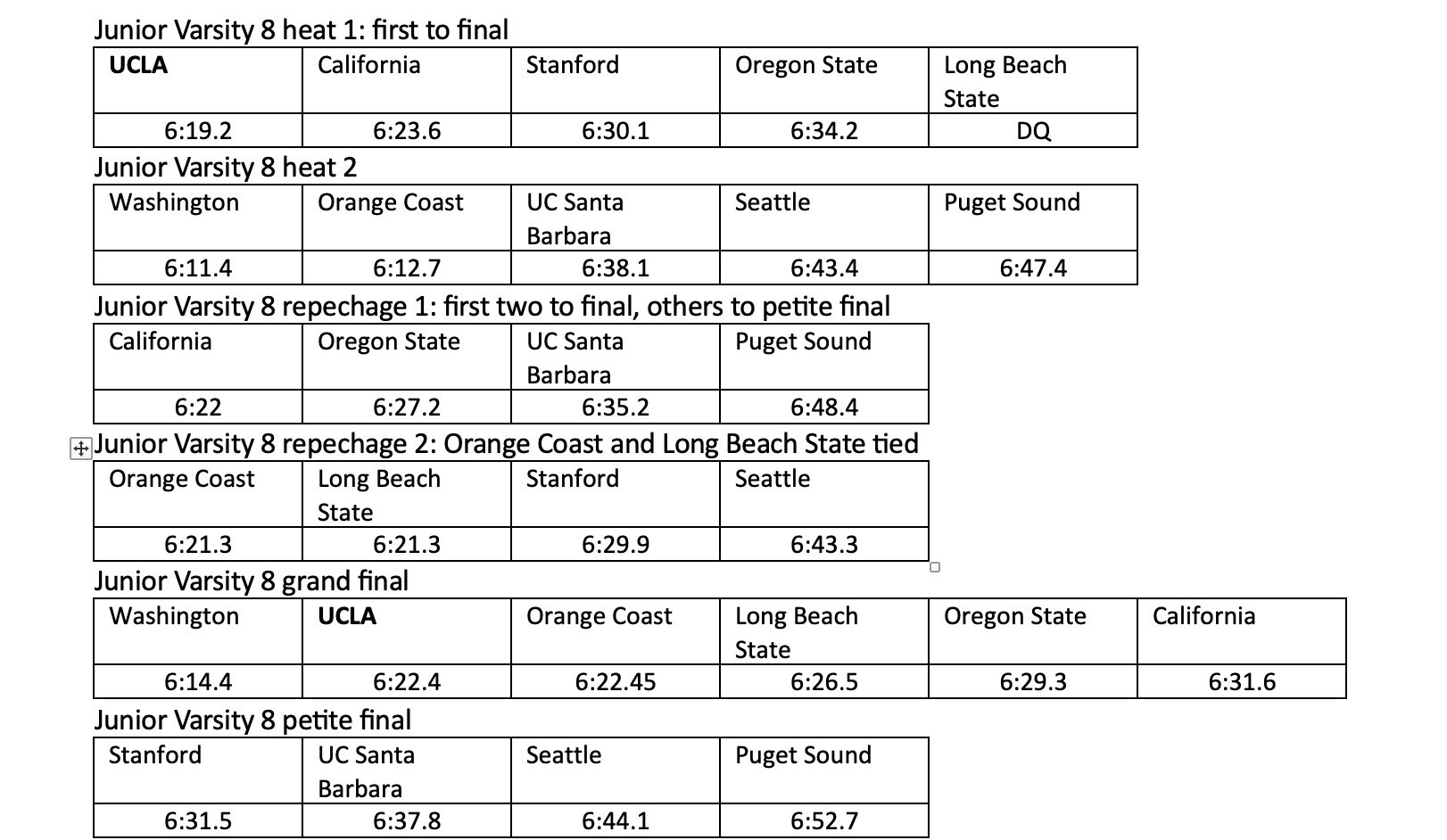
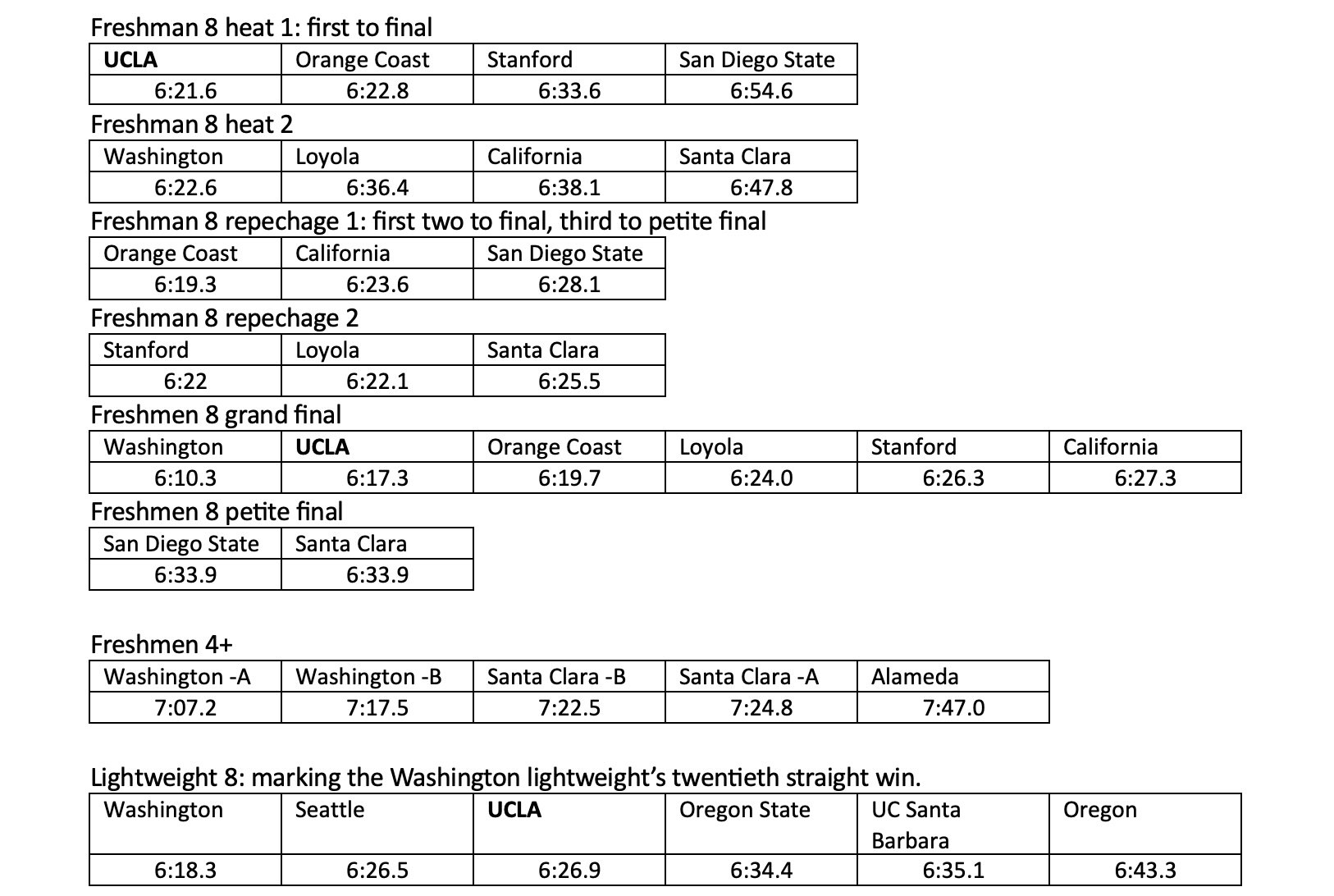
This season was considered the “Finest year since 1966, … crew was added to UCLA’s athletic budget [as a “regular varsity sport” only since 1963-64] after having been subsidized by student body funds for the previous three decades.” Jeff Prugh, “Bruin Crews Seeking Big-Time Recognition”, Los Angeles Times, 7 May 1971, 61.
The IRA regatta was scheduled for June 17-19, thus avoiding UCLA’s final exams June 9-15. The Bruins attended in 1971, racing in the varsity eight and four. Posting another record for participation, there were 75 shells from 27 colleges at the 1971 IRA. Of the twelve West Coast entries, only four advanced to the finals. In the Friday repechages, crews faced crosswinds and choppy water.
Freshman eight [10 entries]: Washington (3rd in rep)
Freshman four [13]: No West Coast crews
Junior Varsity eight [7]: Washington 3rd
Varsity pair [9]: California 1st
Varsity four [17]: California 3rd, Stanford 6th
UCLA (3rd in rep), Santa Clara (4th in rep), Southern California (5th in rep)
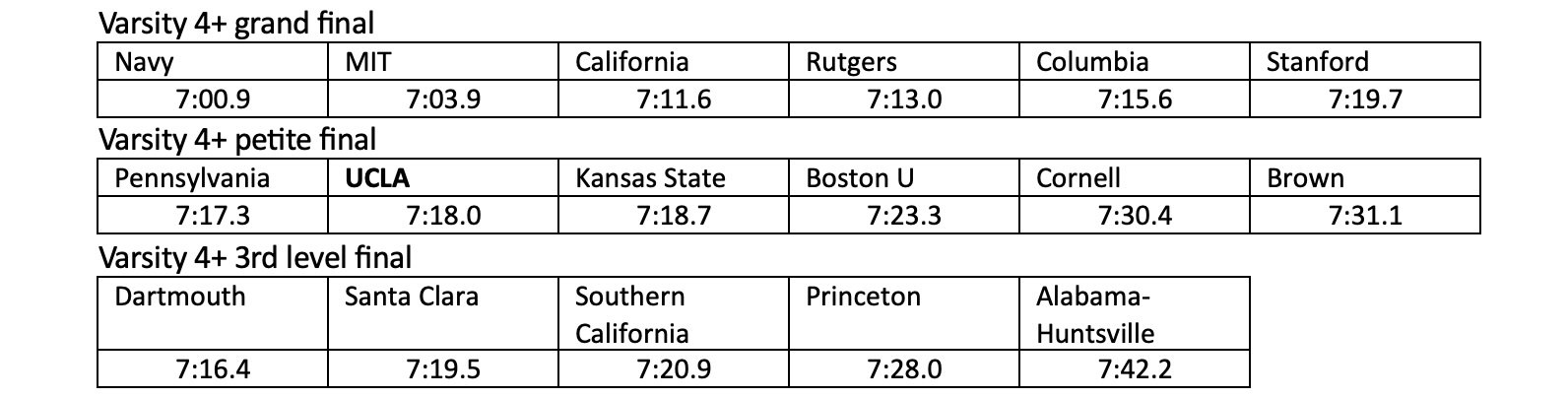
Varsity eight [17]: Washington 2nd
Loyola (3rd in rep), UCLA (3rd in rep), California (5th in rep)
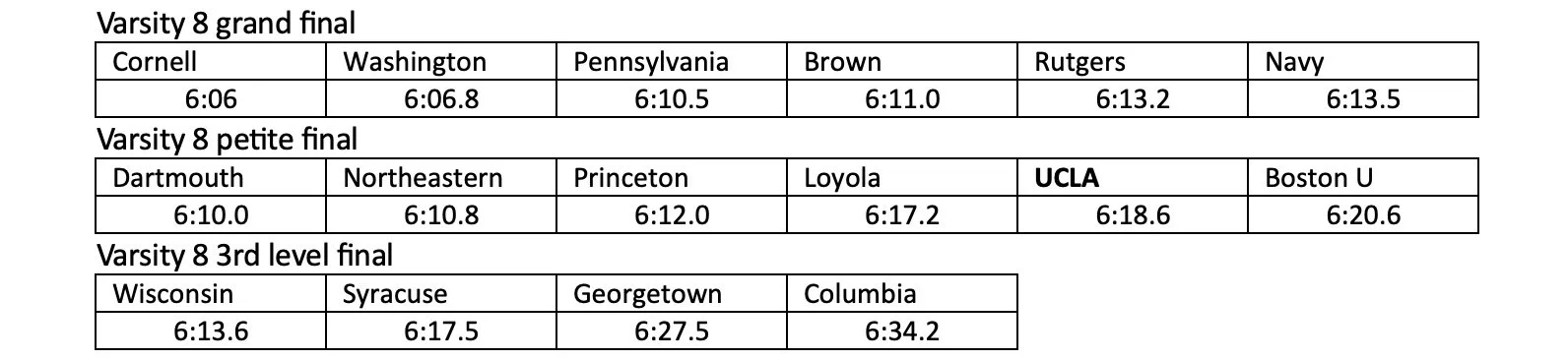
Three days after the IRA final Washington raced against Harvard’s lightweights, Vesper-Penn, and two other composite "all-star" crews in the Pan-American trials. IRA champion Cornell dropped out after losing two of their members. UCLA finished fourth in the four-with-coxswain final. “Boston Club Doubles in Crew Finals”, Oakland Tribune, 27 Jun 1971, 50. Washington won the Pan-American trails in the eight by about one-half a length. The Argentine eight won the Pan-American event by nine seconds over silver medalist Huskies racing ninety miles north of Cali, Columbia at 4,950 feet elevation in the Andes. Washington was the last collegiate crew to be selected to represent the U.S. in international competition.
During 1969-1971 the four crew athletes among the 265 UCLA [male] athletes that received athletic grants-in-aid earned an average GPA of 2.566. The four represented the smallest number per team of the twelve sports listed. “Summary of Athletic Achievements 69-71”, UCLA Daily Bruin, 9 May 1972,
1972
A controversy was swirling about Oregon’s club team using a female coxswain, Vicky Brown, in their varsity eight. Though not on UCLA’s scheduled the controversy was news, even featured in Sports Illustrated “Case of the Ineligible Bachelorette”, Sports Illustrated, 17 Apr 1972, 82-85. Washington State’s club rowing program also made its first competitive appearance, though not at the Western Intercollegiate until 1973. UCLA’s women’s rowing club was cited as defeating Long Beach State.
The Bruins graduated thirteen seniors from the 1971 team, leaving coach Johnsen with a “question mark” with his sophomores, juniors and several talented freshmen, two of them under consideration for a seat in the varsity eight. There was more weight training and altitude training at Lake Arrowhead, in the preparation as Washington and Long Beach State appeared to be the teams to beat this year. Doug Kelly, “Youth Accented as Crew Season Opens Tomorrow”, UCLA Daily Bruin, 31 Mar 1972, 9. UCLA opened its season being swept by Cal after six years of defeating Cal’s varsity in the Wallis Cup, in a race held at Marina del Rey. The varsity race was timed in 6:12.8 for Cal and 6:16.1 for UCLA. This was Cal coach McNair’s first victory over UCLA. Coach Johnsen cited youth and inexperience in the varsity and JV losses. The JV race was also within 3 seconds with Cal’s time 6:09.8 to UCLA’s 6:12.8. The freshman race saw UCLA winning in 6:20.0, one and one-half lengths ahead of Cal in 6:26.0. “Cal Tips Crew; Duck Girl Out”, UCLA Daily Bruin, 4 Apr 1972, 11. and “Cal Varsity Upsets Bruins in LA”, San Francisco Examiner, 2 Apr 1972, 37.
The next race was the Newport Regatta including UC Irvine, Loyola, San Diego State and Orange Coast facing the Bruins. UCLA’s varsity got off to a poor start but won after San Diego State led through the first 500 meters. Pre-race favorite Loyola suffered breakage at halfway with the stroke’s seat and dropped back during the repair. UCLA finished in 6:23.0 without having to sprint. Doug Kelly, “Oarsmen Row to Newport Win in 6:22”, UCLA Daily Bruin, 10 Apr 1972, 12. The UCLA JV, containing two lightweight rowers, placed a disappointing fourth behind Orange Coast, San Diego State and UC Irvine. The Bruin freshman won their race after a slow start in the events first start, that was called back because of equipment breakage in Loyola’s shell. In the restart the Bruins led from start to finish. Up in Oakland, Long Beach State defeated Cal by 17 seconds. UCLA would again race Cal at the All-Cal race April 22 and likely Long Beach at the Western Sprints. Doug Kelly, “Oarsmen Row to Newport Win in 6:22”, UCLA Daily Bruin, 10 Apr 1972, 13.
On April 15 the Bruin (6:14) varsity defeated San Diego State’s (6:36) varsity in San Diego, however the Aztecs (6:58) scored a 20 second victory over the Bruin JV (7:18). The UCLA freshman defeated San Diego State 6:37 to 6:59. The Bruin lightweights swept Long Beach State’s lightweight crews at Marina del Rey. The Bruin varsity lightweights won in 6:05.9 to 6:17.1, and the UCLA lightweight junior varsity finished with a time of 6:43.6 to 6:53.8. “Crew Results”, Los Angeles Times, 16 Apr 1972, 54.
In his planed preparation for the IRA Johnsen scheduled the Harbach Cup in Wilmington on Friday afternoon and the first All-Cal regatta on Saturday morning in Newport. “Busy Weekend Set for Oarsmen”, UCLA Daily Bruin, 21 Apr 1972, 16. UCLA defeated Stanford and USC to win the Harbach, neither crew was in the same class as the Bruins. At the first All-Cal regatta, having made improvements on their start the Bruin varsity did not lose as much ground to Cal and moved ahead at 500 meters to win by open water in 6:09. Cal (6:14) was so disheartened that UC Irvine (6:14) also slipped past the Bears. UC Santa Barbara was fourth in 6:23. The Bruin JV however, had a new line-up, finished in third place in the Harbach and also in third place (6:25) behind Cal (6:15) and UC Irvine (6:20). Having displayed poor performances during the season there was discussion of breaking this crew into two four-oared crews. Craig Anderson, “Crew Captures All-Cal”, UCLA Daily Bruin, 24 Apr 1972, 11, 13. One of the causes was that “several of the men who made last year’s freshman boat so fast decided not to come back.” Craig Anderson, “CSLB a Tough Test For Crew”, UCLA Daily Bruin, 28 Apr 1972, 14. The Daily Trojan reported that the USC JV crew felt extra encouragement during their Harbach victory, supported by the Trojan Band, yell leaders and even mascot Traveler, “’I know it sounds corny, but at 1500 meters, when UCLA and Stanford started to move up on us and we started to falter, the band started ‘Fight On’ and there was just no way we were going to be beaten.’ Recalled [USC] JV oarsman Fred Correa.” “Trojan Crew Aided by Large Student Turnout”, Daily Trojan, 26 Apr 1972, 11. The freshman and lightweight UCLA crews won at both regattas, including a freshman sprint to defeat Cal by only 3 seconds. Craig Anderson, “Crew Captures All-Cal”, UCLA Daily Bruin, 24 Apr 1972, 13. In the All-Cal, UCLA’s lightweight (6:33) was first followed by Cal (6:37), UC Santa Barbara (6:42) and UC San Diego (6:45). The freshman race finished in the same order with UCLA (6:22) first, Cal (6:25), UC Irvine (6:30) and UC Santa Barbara (6:35). “UCLA Takes All-Cal Crew”, San Francisco Examiner, 23 Apr 1972, 36. UCLA was the team champion with 20 points, Cal was second with 14 points.
UCLA anticipated a tough test facing Long Beach State. The reasons for Long Beach’s improvement included “a new full-time coach [Ed Graham], new equipment, and recruiting on campus through the athletic department.” Johnsen also cited having athletes training for the Olympics rowing out of the boathouse to spar against helped too. Craig Anderson, “CSLB a Tough Test For Crew”, UCLA Daily Bruin, 28 Apr 1972, 14. The system that Long Beach coach Graham used was “We wrote letters to every incoming student, and out of 5,000 or 7,000 letters we got 300 responses. At our first meeting we had 75 people. Now we’re down to 45 rowers, only five of whom are seniors.” Jim McCormack, “49er Rowers Shooting High”, Long Beach Press-Telegram, 14 May 1972, 70. However in an article in the Long Beach State 49er the Long Beach program was cited as only receiving approximately $4,000 per year compared to Washington’s $86,000, Cal’s $80,000 and $65,000 for UCLA. Ken Pitts, “Huskies Still Best in the West; Edge 49er Crew”, Long Beach State 49er, 23 May 1972, 16. A listing in the UCLA Daily Bruin listed the combined expenses of nine “Other Sports” without a breakdown by sport, aside from football, basketball and track and field, as $294,054 in 1970-71 and $244,277 in 1971-72 within total UCLA athletic expenditures of $2,886,597 and $2,503,791 during those two years. “Income vs. Expenses – Checks and Balances”, UCLA Daily Bruin, 9 May 1972, 14. The 49ers were working in the late spring to raise $2,000 [of $4,000] needed to attend the IRA regatta at the end of the season, and had to turn down an invitation to travel to Seattle to race the Huskies due to their limited financial resources. Ken Pitts, “Huskies Still Best in the West; Edge 49er Crew”, Long Beach State 49er, 23 May 1972, 16. In the varsity race the Bruins had a good start and rowed well for the first 1500 meters but the 49ers prevailed in a time of 5:52.4, leading the Bruins by five seconds. UCLA’s freshman finished only .7 second behind the Long Beach freshmen. UCLA lost in the JV race but won the lightweight event handily. Craig Andrews, “49er Oarsmen Win by Five Seconds in 5:52.4”, UCLA Daily Bruin, 1 May 1972, 12.
UCLA’s varsity traveled to Seattle to face Washington, while the freshmen, JV and lightweights went to Newport for a dual race against Orange Coast. In Seattle Johnsen mused that the Bruins “lost at the beginning, when Washington got a length lead and Oregon three-quarters of a length on us. We just didn’t row aggressively.” Poor racing conditions helped produce slow times of 6:21.8 for Washington and 6:28.6 for UCLA. Against Orange Coast the UCLA freshmen prevailed in a seven second win. Craig Andrews, “Husky Rowers Win, Bruins Sink Slowly”, UCLA Daily Bruin, 8 May 1972, 15. In looking ahead to the Western Intercollegiate, while things looked good for the UCLA freshman crew, the Washington freshman had only been beaten seven times over a 71-year span. On the varsity side, Johnsen stated that “a win is not in our grasp unless we row the best race we have ever rowed. We will have to give it everything we’ve got to even make it a race.” Craig Andrews, “Washington Favored; Oarsmen Hope for Western Sprints Upset”, UCLA Daily Bruin, 19 May 1972, 17.
The Western Intercollegiate was held at the Long Beach Marine Stadium, May 19-20. Saturday’s finals were rowed on a sunny but windy morning. Santa Clara had been scheduled to host the Western Sprints but decided not to and it was then offered to Long Beach.
Long Beach State had compiled a strong record defeating UCLA by 5 seconds and California by 17 seconds and was Washington’s strongest competition. Six of Washington’s varsity eight were returning after winning a silver medal in the 1971 Pan-American Games in Columbia. Oregon had been restricted for having a female coxswain earlier in the season when Oregon State and Washington refused to race them with their female coxswain. This stemmed from a rule made on August 26, 1967 by the Western Intercollegiate Crew Coaches Association prohibiting females in male competition. This rule was rescinded in January 1973.
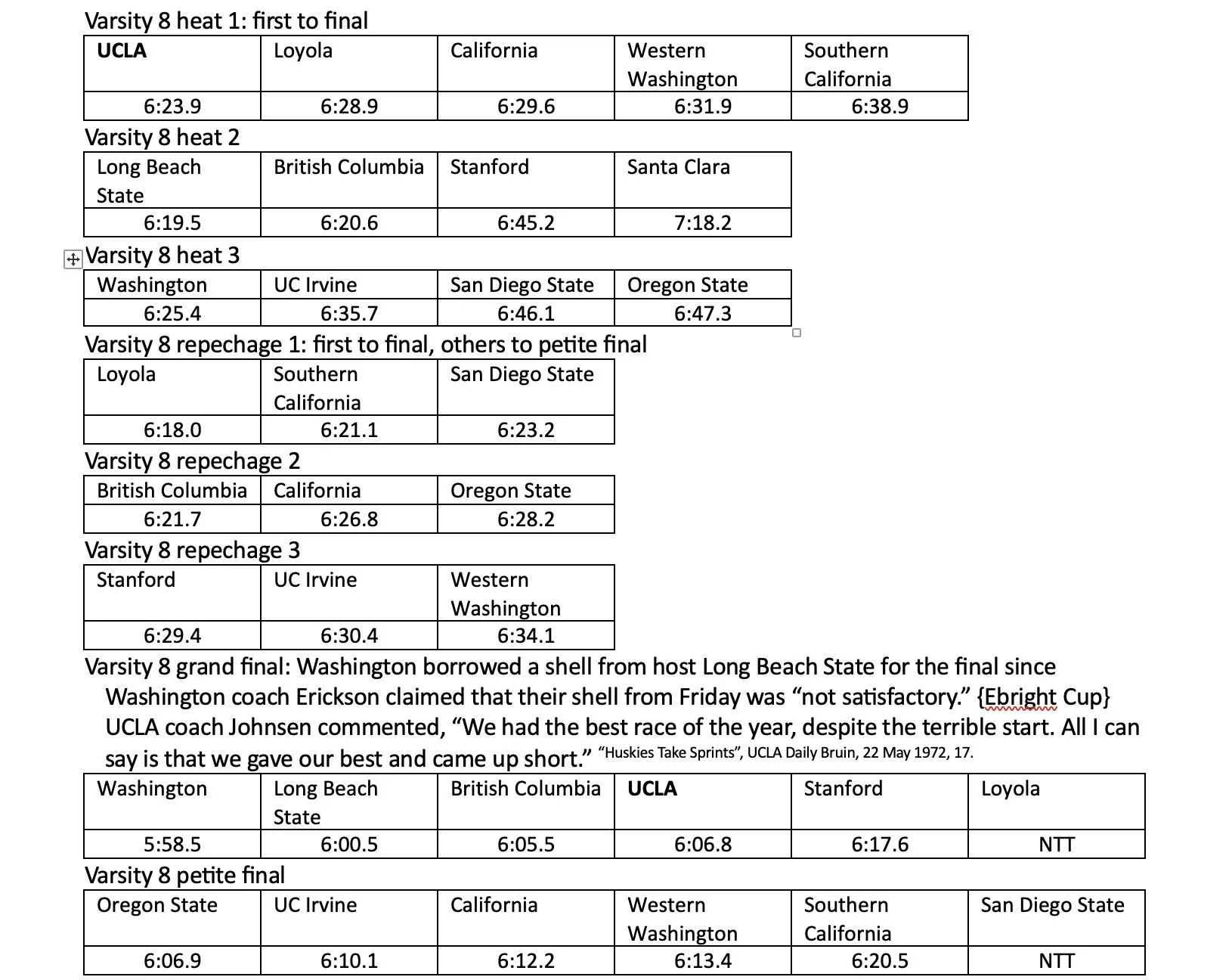
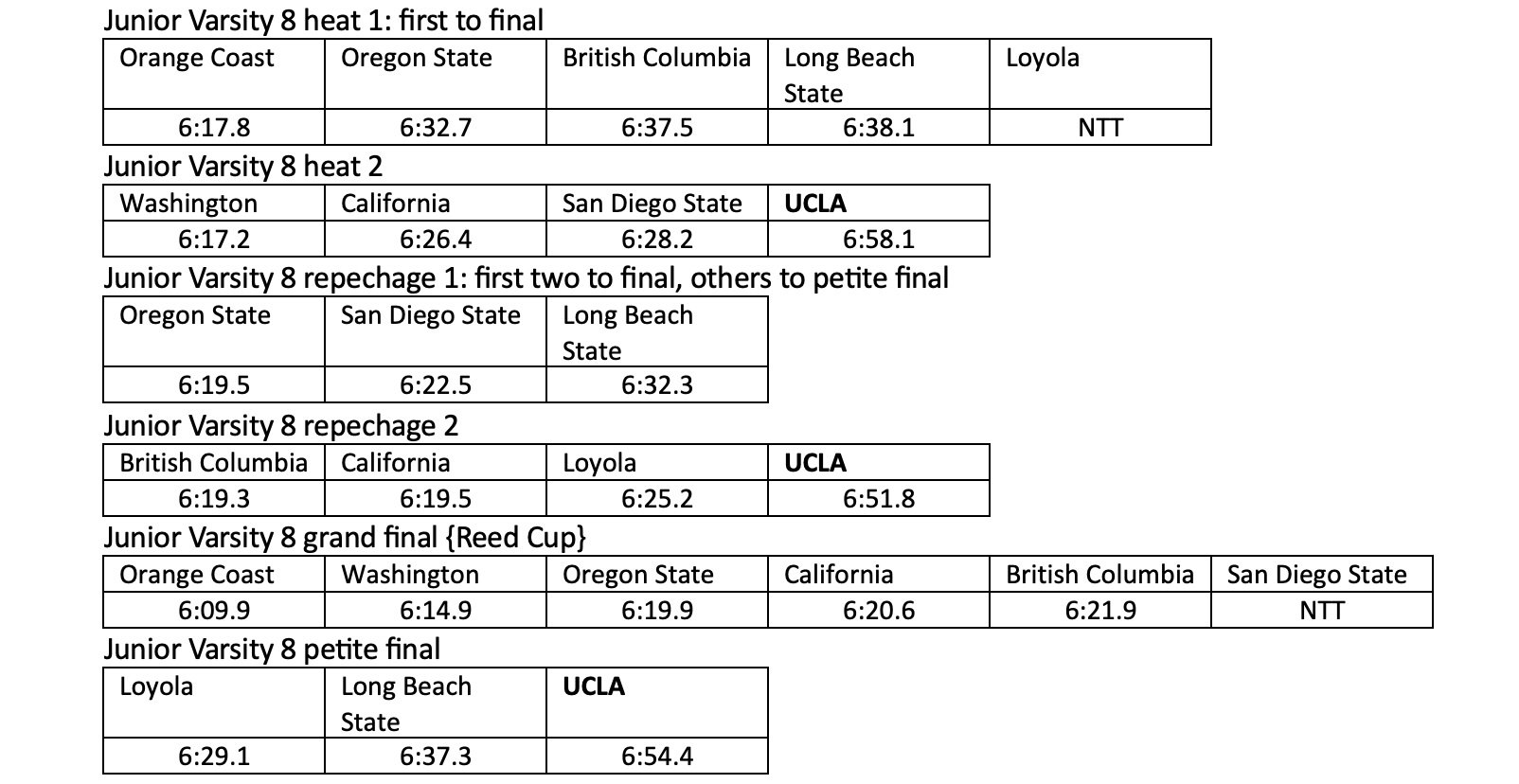
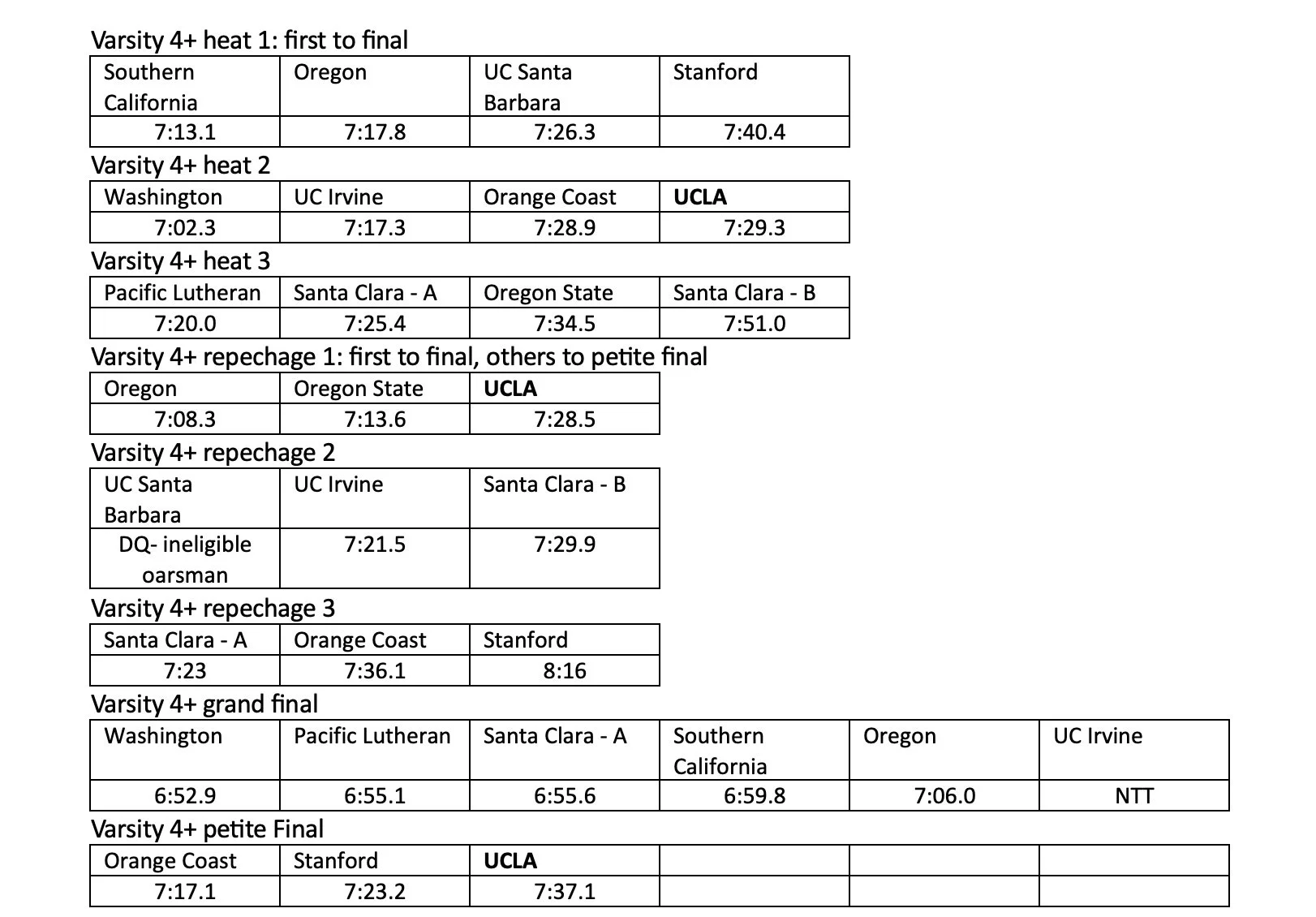
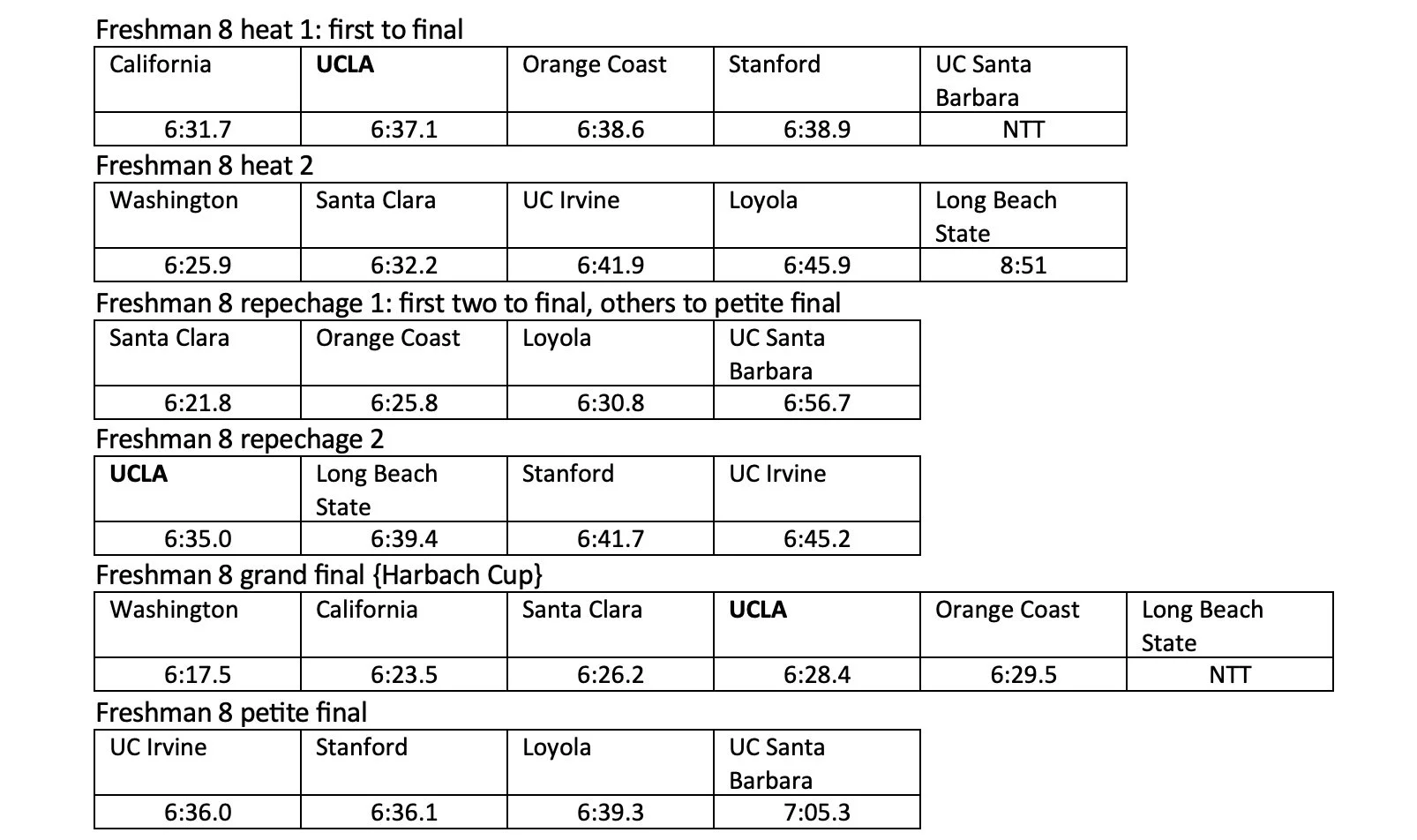
Setting another record for participation, there were 89 crews from 32 colleges entered in the 1972 IRA championship. There were sixteen West Coast entries, eleven advanced to the finals, including championships in two of the six events. UCLA earned a championship in the varsity four-with-coxswain, a bronze medal in the freshman four-with-coxswain and a seventh-place finish in the varsity pair. Of the thirteen colleges entering the varsity four, only Navy and Pennsylvania also entered the varsity and JV eights, and Columbia and MIT were entered in the varsity eight along with the varsity four. Thus, nine of the thirteen were the best crew their team could boat.
UCLA coach Johnsen opted not to send his varsity eight “basically because we were six seconds behind Washington at the Western Sprints and I felt that was as fast as we were going to row. I felt we had good people but we weren’t going to meld as a unit. Four were easier to meld.” He felt there was “considerable individual talent” but it failed to be successful and jell as a large unit. Alex Frasco, Warren Dykstra and Joel Coster were sophomores and Jack Salyer was the team captain and a senior, the coxswain was Tom Follosco. Frasco was after wards invited to workout with the US Olympic team, and Salyer was invited to compete in the Vesper fours but declined due to NROTC commitments. Racing in an outside lane where conditions were rougher the Bruin varsity four was fifth at the back of the pack in the final at a 32 stroke rating, but at 1000 meters “doggedly pushed their way to the lead” staying at a rating of 32 as the others rowed higher than a 36. The UCLA freshman four was a favorite and finished in third, also fighting from an outside lane, and the UCLA pair was eliminated in the repechage but won the petite final. Saul Shapiro, “Bruins Nip Yale by a Second, Win IRA Varsity Fours Crown”, UCLA Daily Bruin, 16 Jun 1972, 17, 18.
Freshman eight [16 entries]: California 4th, Washington 5th
Freshman four [13]: Santa Clara 2nd, UCLA 3rd
Orange Coast (3rd in rep)
Junior Varsity eight [13]: Washington 1st, Orange Coast 6th
Varsity pair [16]: San Diego State 5th
UCLA (2nd in rep), Long Beach State (2nd in rep)
Varsity four [13]: UCLA 1st held off a hard charging Yale crew back-and forth down the course with only 10 feet to spare, after Columbia lead at the start but faded, Oregon State 3rd, Pacific Lutheran 5th
Stanford (2nd in rep)
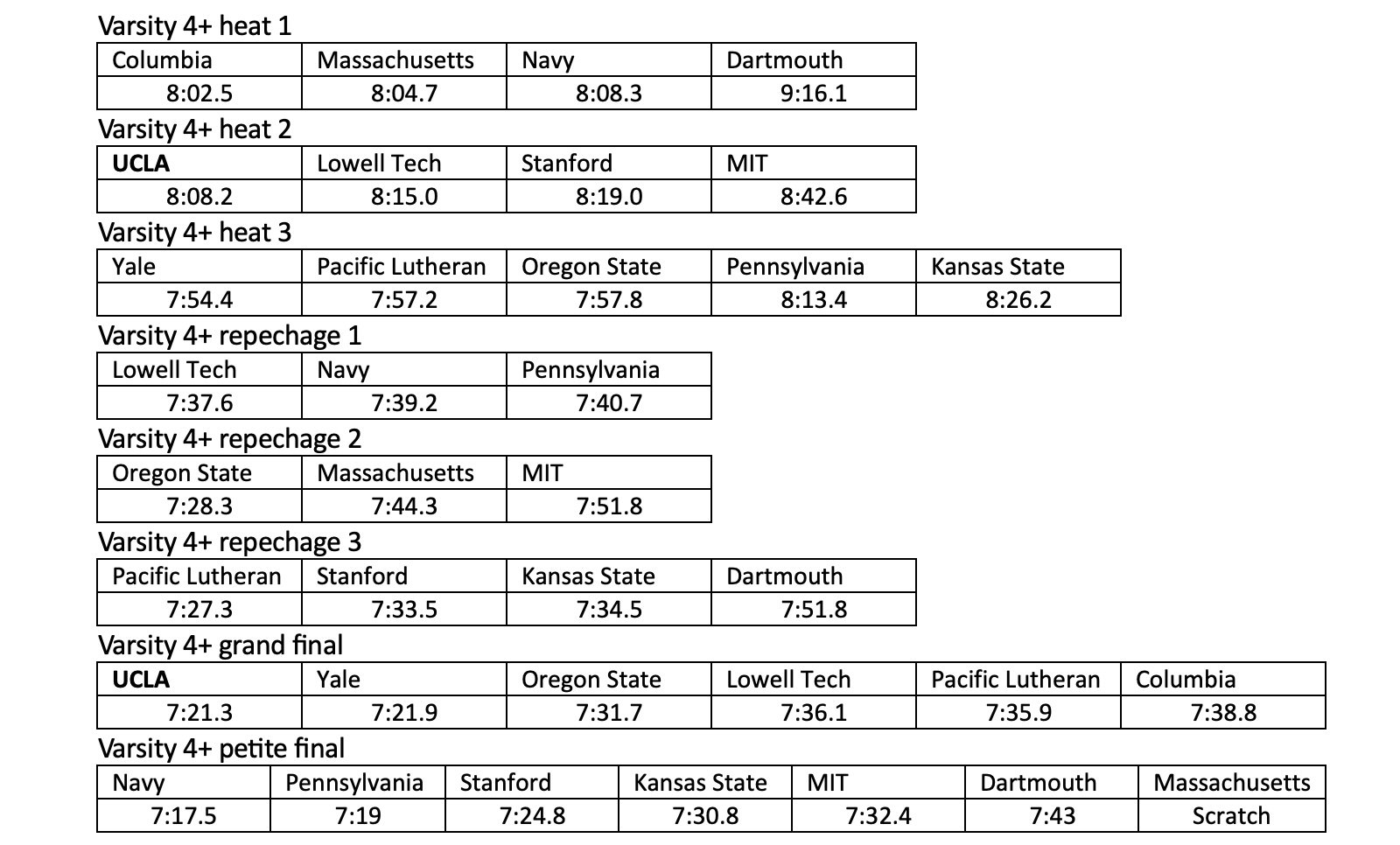
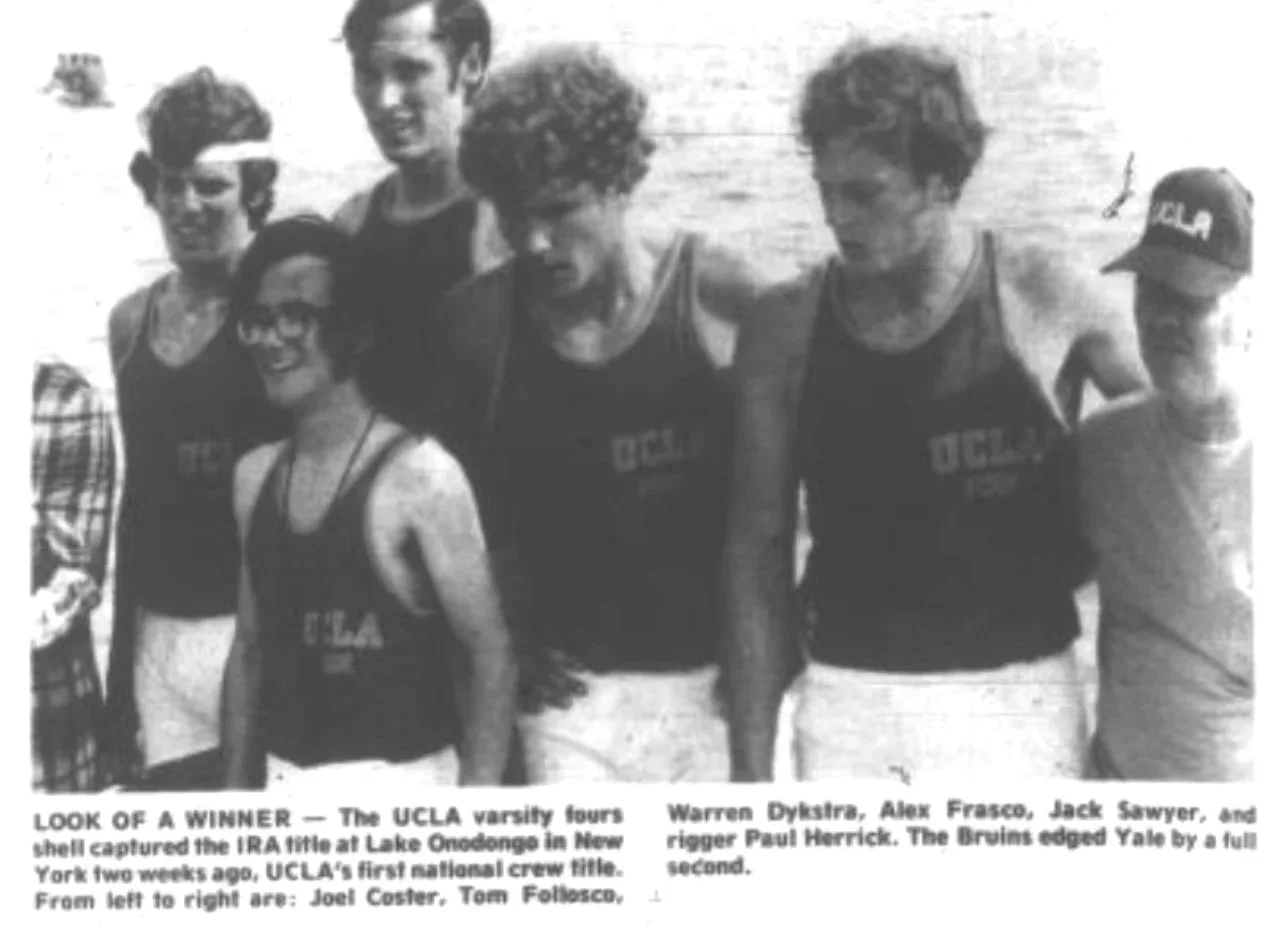
Varsity eight [16]: Washington 4th
Long Beach State (3rd in rep)
1973
The controversy involving women as coxswains for men’s crews was addressed in “October 1972 when the NCAA [Council] voted women eligible for competition with males in non-contact sports. In January of this year at a national coaches [NCAA national convention] meeting in San Francisco, women’s eligibility in crew was confirmed and UCLA then had its first woman coxswain,” freshman Debby Amstadter. Mike Kagen, “Coxswain Amstadter Not Just One of the Guys”, UCLA Daily Bruin, 11 May 1973, 10. Several other men’s teams also added female coxswains beginning this year, including Stanford, Santa Clara (Mimi Sherman being the first at the 1973 IRA coxing their freshman 4+) and Western Washington. There were few competitive women’s rowing opportunities in California with a few women rowing at Lake Merritt (Mills College and club at Cal in 1965-67) in the Bay Area, a few at Long Beach and at the ZLAC club in San Diego. While competitions were few, reporting of their occurrence and results was even more rare. Women’s began rowing at Oregon State in 1966; Washington as an official club sport in 1968/69; UC Santa Barbara in 1972; Long Beach State in 1973; Santa Clara and Washington State in 1974; then San Diego State, USC, Saint Mary’s College, a varsity team at Cal in 1975; with more programs later.
Rick Galliand coached the successful Bruin lightweight squad. The fall of 1972 was the first year of the Head of the Harbor regatta that became a fall feature race. The schedule laid out for the spring season was a challenging one. 1973 was the first year of the San Diego Crew Classic on Mission Bay. In an untypical fashion, Washington’s varsity was quick of the start. After being only one second behind Washington at the 1000 meter mark, while rowing at a stroke rate of 35 in the second 1000 meters, UCLA’s crew collided with a buoy. “The coxswain was not aware of the buoy and the two, three and four men, all sophomores, allowed that to rattle them,” recounted Johnsen, all costing the crew valuable time. Washington (6:14.0) finished first, followed by Navy (6:15.8), then Long Beach State (6:23.6), with the Bruins (6:25.0) fourth, followed by Loyola (6:37.0) and San Diego State (6:38). The first four crews finished within two and one-half lengths.
Washington’s victory in the varsity event was matched in the JV and freshman events, in each of the three events Navy was second. In the JV eight Washington (6:23.1) defeated Navy (6:35.8) by three boat lengths, Orange Coast (6:40.2) followed in third, with UCLA (6:43.6), Long Beach State (6:43.9) and Loyola (6:59.2) completing the field. Washington (6:19.9) was 2.3 seconds ahead of Navy (6:22.2) in the freshman race followed by Orange Coast (6:34.7), UCLA (6:39.0), UC San Diego (6:45.3) and Loyola (7:01.7). In other categories, UCLA won the lightweight eight, lightweight four and freshman four and earned third place in the varsity four.
In the four crew lightweight eight event UCLA (6:45.5) {Chuck Rinck bow, Richard Eberle, Martin Rede, Larry Wolfley, Ted Maynard, Dave Podsadocki, Phil Goulding, Larry Daugherty stroke, Tim Rabun coxswain} placed first followed by Long Beach State (6:47.8), UC Santa Barbara (6:53.7) and UC San Diego (7:05.9). In the lightweight four UCLA (7:46.2) {Howard Weber bow, Andy Jacobs, Jim Koury, Rick Zevnik stroke, Bob Martinez coxswain} edged UC San Diego (7:47.3), with Long Beach State (7:59.8) in third.
The freshman four was won by UCLA (7:40.0) {Stuart Simon bow, John Dvorek, Bob Berry, John Snow stroke, Lee Dinstman coxswain} defeating UC San Diego (7:41.1), San Diego State (7:47.9), Long Beach State-A (7:57.2) and Long Beach State-B (8:00.4). Mike Kagen, “Johnsen Very Upset When Boat Hits Buoy”, UCLA Daily Bruin, 9 Apr 1973, 15. and “LBSU 3rd to Washington, Navy”, Long Beach Independent, 8 Apr 1973, 66. and “College Rowing”, Los Angeles Times, 8 Apr 1973, 57. The varsity four was won by San Diego State (7:20.5), followed by Navy (7:23.5), UCLA (7:54.9) in third, then Orange Coast (7:55.5) and Long Beach State (8:05.3).
The UCLA women’s 4+ (4:38.7) {Marianne Maloney bow, Jeannie Olson, Shari Sprong, Ann Voorhees stroke, Marie Sanders coxswain} placed second, 7.5 seconds behind Long Beach State-B (4:31.2) and defeated ZLAC-A (4:50.5) Rowing Club, ZLAC-B (4:53.8), UC Santa Barbara (5:05.0) with CSU Long Beach-A was disqualified. Mike Kagen, “Women’s Four Tries to Paddle to Success”, UCLA Daily Bruin, 24 Apr 1973, 12. Long Beach State (4:45.0) also won the girls eight “LBSU 3rd to Washington, Navy”, Long Beach Independent, 8 Apr 1973, 66. followed by UC Santa Barbara (4:52.5), ZLAC (5:01.0) and UCLA (6:11.0). “Crew Classic Results”, San Diego Evening Tribune, 9 Apr 1973, C-2.
Coach Johnsen’s preparation the next week consisted of four-oared seat races in preparation for the Wallis Cup. Johnsen characterized the Estuary as “like rowing in a washing machine” due to wakes from tugboats and the typical gusty winds. Steve Gladstone was in his first year as head coach of the Bears. Mike Kagen, “Bruins Bid for Wallace Trophy Against Cal Crew in Berkeley”, UCLA Daily Bruin, 13 Apr 1973, 20.
Cal’s Bears swept the Bruins in the varsity, junior varsity (6:05.6 to 6:11.2) and freshmen (6:04.0 to 6:06.3) races, however the Bruins prevailed in the lightweight race by one and one-half lengths. The Bear’s second lightweight crew defeated UCLA. Johnsen was pleased that his Bruins rowed the type of race they had planned for San Diego and did not get rattled, but the Bears “just rowed better.” He predicted “some awfully interesting races” coming up in the season since he judged the Bears faster than the Huskies. The Bears led the Bruins by seven seconds at halfway and the Bruins closed to four seconds in the second half of the race. Cal finishing in 5:56.3 and UCLA in 6:01.2. Mike Kagen, “Cal Impresses Johnsen as Bears Sink Bruins”, UCLA Daily Bruin, 16 Apr 1973, 13. and “Cal Crews Pin Sweep On Bruins”, Oakland Tribune, 16 Apr 1973, 45. It was going to be a challenging All-Cal meet for the Bruins. In characterizing the “varsity team’s inability to row together” Johnsen said “The only thing our varsity team has in common right now is that we’re all in the same boat. We might do better with eight single skulls passing a baton between each other.” Five University of California campuses would compete in seven events, including a women’s race between UCLA and UC Santa Barbara. Mike Kagen, “Bruins Host All-Cal regatta Tomorrow”, UCLA Daily Bruin, 20 Apr 1973, 7. On April 21 Cal won this second All-Cal regatta earning 18 points to UCLA’s 17, it coming down to the order of finish in the varsity eight. In advance of that final race UCLA led Cal 14-13 points. The scoring was based on a 5-4-3-2-1 points scale. Cal won the varsity and JV races, while host UCLA won the freshman and lightweight eight races. The varsity race featured Cal (5:59.2) placing first, ahead of UC Irvine (6:07.2) and UCLA (6:13.6) a distant third after they faltered at the 500 meter mark and never challenge again for the lead. Johnsen felt the performance was “unexplainable,” since “they were short, high, with no punch, no reach, no nothing.” He felt that Cal had not rowed that much better than the previous weekend when the Bruins finished only 4.1 seconds behind the Bears and now were an additional ten seconds behind them. Johnsen felt it was the varsity’s worst defeat since he had been head coach. Mike Kagen, “Cal Varsity Sinks Bruins, Wins Regatta”, UCLA Daily Bruin, 23 Apr 1973, 13. The lightweight eight race saw UCLA defeat Cal by 8.9 seconds and UC Santa Barbara by 13 seconds. The Bruin lightweight four won by seven lengths of open water over Cal with UC Santa Barbara and UC San Diego farther back in third and fourth. Ann B. Voorhees, “Letter to the Editor: Crew”, UCLA Daily Bruin, 7 Jun 1973, 28. Debby Amstadter coxswained the UCLA freshman 4+ that placed fourth in their event. Competing in the 1000 meter women’s event, UC Santa Barbara won in a time of 4:17.6, followed by UC San Diego (4:23.6) and UCLA in third. “Rowing”, San Francisco Examiner, 22 Apr 1973, 39.
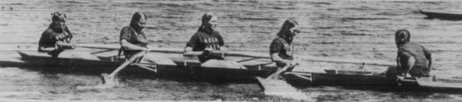
“Women’s Four Tries to Paddle to Success”, UCLA Daily Bruin, 24 Apr 1973, 12.
The women’s club program was reinvigorated in late 1972 by Ann Voorhees. The group received no financial support from UCLA but was guided by four-year coxswain Tom Follosco (1968-72). Follosco stated the goal of the season, “we’d like to do 1,000 meters in four minutes for the Western Sprints in May. That would be equal to last year’s championship time.” However, any collegiate women’s results at the Sprints from 1972-1975 were not published. With their second place finish at the first San Diego Crew Classic, Follosco stated, “They want to row and they want to be fast.” Though Coach Johnsen supported the women by providing access to shells and oars, the women were not on an equal footing with the male rowers. Johnsen was quoted as saying
“It’s high time that women’s intercollegiates got into rowing. The girls sometimes get something out of rowing that the men don’t. Men get caught up in the physicalness and not the aesthetic values or technical niceties that rowing provides. The men are looking at it more like a weight-lifting contest as opposed to an art contest. The girls want to be feminine and they’re doing it for their physical health not their physical growth.”
The women’s racing distance was 1000 meters instead of the 2000 that the men raced. The women’s team consisted of seven women: Marie Sanders, Ann Voorhees, Marianne Maloney, Shari Sprong, Lynn Warrick, Linda Hodges and Jeannie Olson. Follosco added, “the men’s team now admits we exist and that we row well. I was really surprised at the San Diego Regatta when the men’s team applauded us with an eight clap as we headed for the start of our race.” The women’s schedule included a race against UC Santa Barbara and another hosting Long Beach before competing at the Western Sprints. Mike Kagen, “Women’s Four Tries to Paddle to Success”, UCLA Daily Bruin, 24 Apr 1973, 12.
However, in a follow-up letter to the editor Anne Voorhees, complained that men’s coach Johnsen had never had a discussion with the women regarding their reasons for rowing. Voorhees stated that “I for one do not perform a pirouette as I step into the boat” and refuted that the women saw their rowing as an art form as opposed to a combination of strength, grace and coordination just the same whether male or female. Ann B. Voorhees, “Letter to the Editor: Women’s Crew”, UCLA Daily Bruin, 11 May 1973, 11. The back drop was that the 15 intercollegiate varsity women’s sports at UCLA at the time, and when they were added their coaches were unpaid. During the 1971-72 fiscal year the men’s athletic budget was $2.9 million including travel, coaching salaries, repairs and maintenance and grants-in-aid, compared to a total allocation to the women’s sport program of $20,000. In 1972-73 a little over $27,000 was appropriated from student registration fees to support the women’s athletic program. Practice and competition venues were also unequal between men’s and women’s teams. Carole Ann Cinder, “Women’s Athletics money is Just Part of the Problem”, UCLA Daily Bruin, 17 May 1973, 24, 21. When mentioned in the Daily Bruin women’s teams were frequently referred to as the “Doll” instead of “women’s” in headlines.

UCLA Daily Bruin, 14 May 1971, 15.
In preparing to face Washington and Orange Coast (JV8, Fr8, V4+, Fr4+) at Ballona Creek coach Johnsen had still not found the one “conductor” in his “orchestra” to lead the crew to victory. Debby Amstadler was slated to coxswain the freshman eight. Mike Kagen, “Bruin Crew Tries to Regroup Against Huskies”, UCLA Daily Bruin, 27 Apr 1973, 13. Although the Bruin varsity did improve, they were still 13.5 seconds behind Washington, 5:52.4 to 6:05.9. Johnsen felt his crew finally “put it together as a unit.” The Bruins led by one second at the 500 mark, were only .8 seconds behind at midway and 4.9 seconds behind at 1500 meters. While UCLA’s freshman 4+ (7:17.6) narrowly defeated Orange Coast (7:18.2), Orange Coast won the other three events: UCLA’s freshmen losing by 2.7 seconds, the JV 2.4 seconds behind having allowed OCC to get out too far ahead at the beginning, and the varsity 4+ only 1.3 seconds behind. Mike Kagen, “Crew Team Improves, But Huskies Triumph”, UCLA Daily Bruin, 30 Apr 1973, 9.
Preparing for the Harbach Cup at Wilmington on May 4, coach Johnsen felt that the varsity was finally clicking, and “some things have been happening right.” That included breaking into fours and having non-official races with fours from Washington on the day following. After their 13 second loss the day before in the fours, they were only 4 and then 3 seconds behind the Huskies. Mike Kagen, “Oarsmen Finally Clicking, Defend Harbach Cup”, UCLA Daily Bruin, 4 May 1973, 10. In the Harbach Cup, the Bruin varsity achieved their first victory of the season defeating USC and Stanford. USC had been favored to take the varsity race but lost to the Bruins by five seconds with Stanford third. USC Coach Hillen attributing lineup changes as working against the Trojans. “Crew Hurt by Boat Changes”, Daily Trojan, 7. The UCLA JV and lightweights also won, though the freshman crew was unable to continue after breakage of a seat/track allowing USC (6:11.2) to win that event. The next day UCLA faced a more formidable opponent in Long Beach State at the Long Beach Marine Stadium. Though the Bruins lost by 1½ feet, only one-tenth of a second separated Long Beach (5:57.1) and UCLA (5:57.2) as they rowed stroke-for-stroke down the course. At the finish, the 49ers were finishing their final stroke as the Bruins were at the beginning of the stroke. The Bruin lightweight eight (6:09.6) nipped Long Beach by .3 seconds, and the freshman eight far outdistanced the 49er freshmen with times of 6:09.4 and 6:36.4. Mike Kagen, “Oarsmen Retain Harbach Cup”, UCLA Daily Bruin, 7 May 1973, 15. Long Beach won the junior varsity eight and lightweight four events. The 49er women finished first and second in a 1000 meter fours race over UCLA’s women. “49er Crew Nips Bruins”, Long Beach Independent, 6 May 1973, 87.
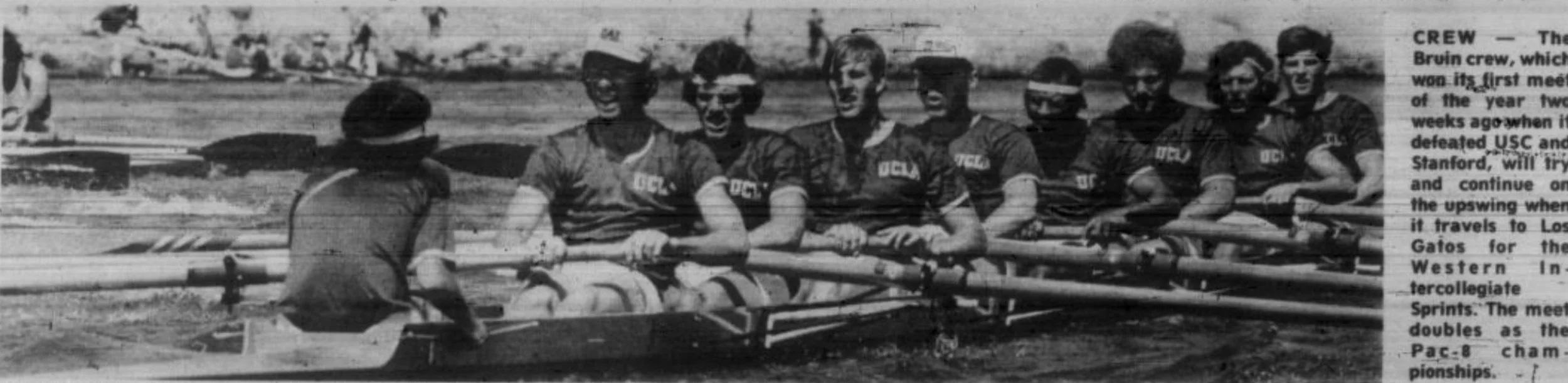
UCLA Daily Bruin, 15 May 1973, 16.
The Western Intercollegiate regatta was run at the Lexington Reservoir, Los Gatos, May 18-19, hosted by Santa Clara with 23 schools and approximately 800 oarsmen in attendance. Pennsylvania was entered but withdrew at the last minute. Santa Clara competed with crews that included some of the first female coxswains, following their allowance based on a January 1973 announcement by the WICCA. For the first time, all eight of the Pacific-8 Conference schools were represented.
The Washington Huskies had breezed through their spring schedule, including an impressive sweep of California two weeks prior. California coach Steve Gladstone stated “Washington is in a class all by itself,…The Husky crews are big, strong and well-conditioned. What may work against them though is that they will be rowing away from home for a change.” Joe Sargis, “Huskies Rated Heavy Favorite in Rowing”, Cumberland (MD) News, 18 May 1973, 19. Washington’s coach Erickson’s opinion after the heats and repechages was “Cal is our competition tomorrow, I know some crews were dogging it out there today, but that won’t help them. I know Cal didn’t dog it. The Bears are racers.” “Four Cal Crews Earned a Second Chance”, Berkeley Daily Gazette, 19 May 1973, 10. At the conclusion of the regatta coach Erickson said “This is the greatest showing we have made in years,” as Washington won six of eleven men’s events. “Huskies Grab Rowing Title”, Long Beach Press-Telegram, 20 May 1973, 45.
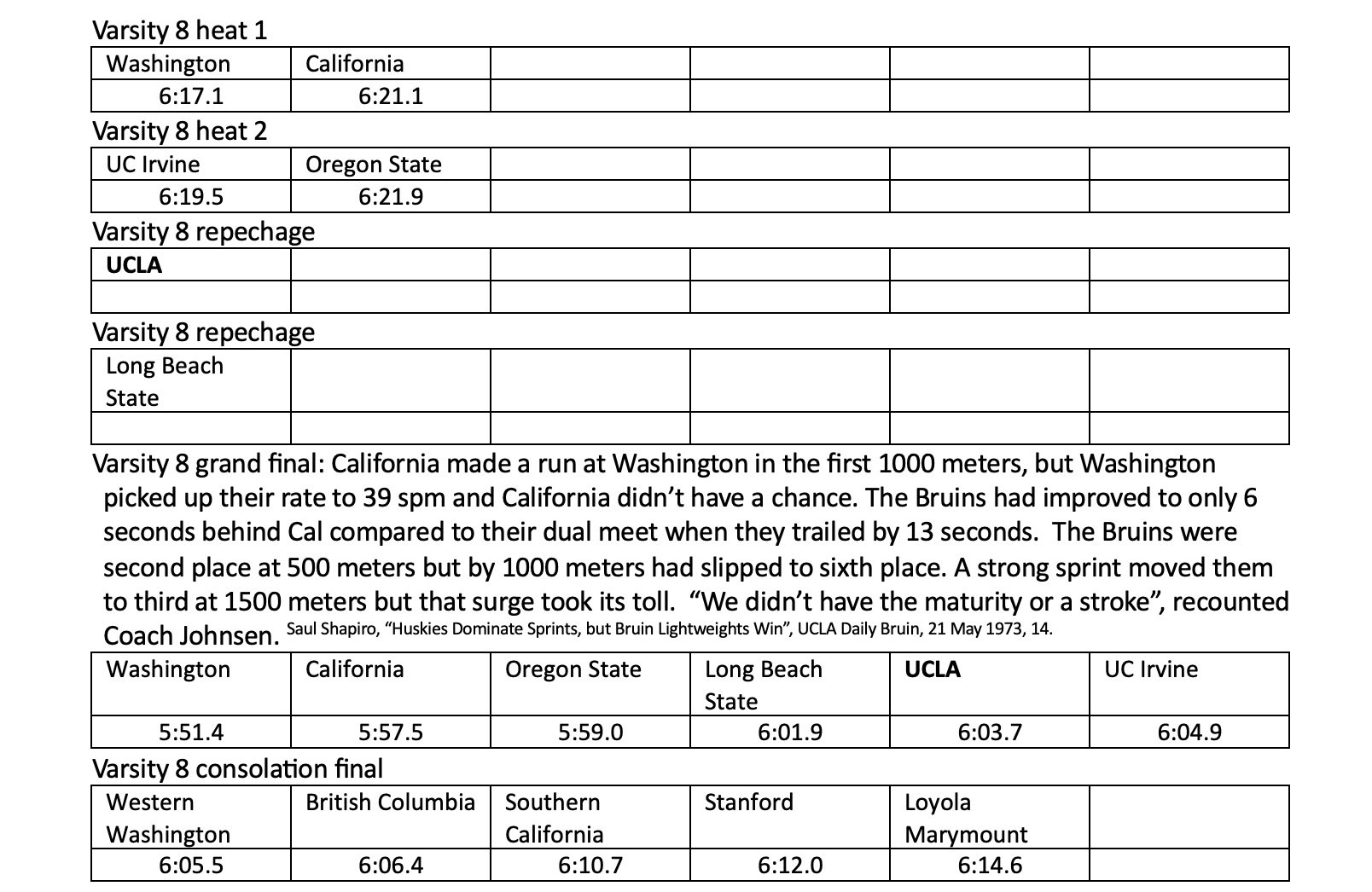
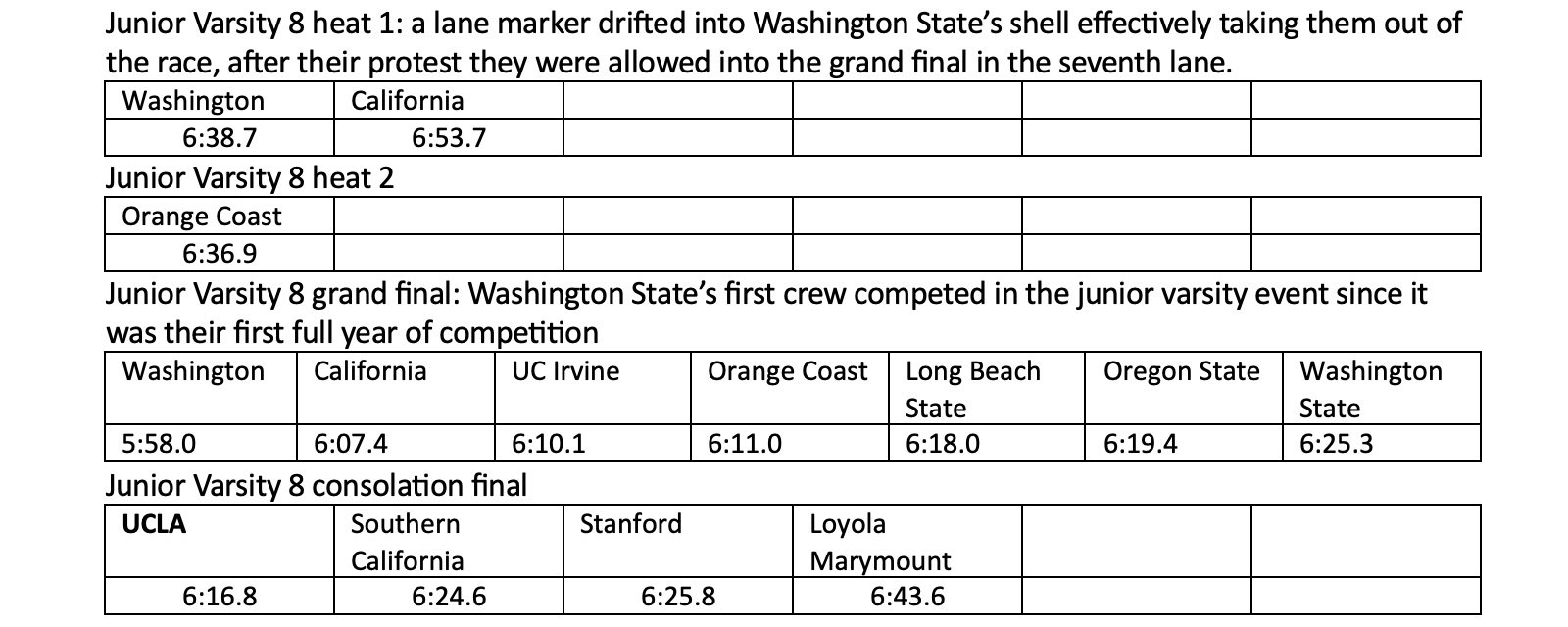

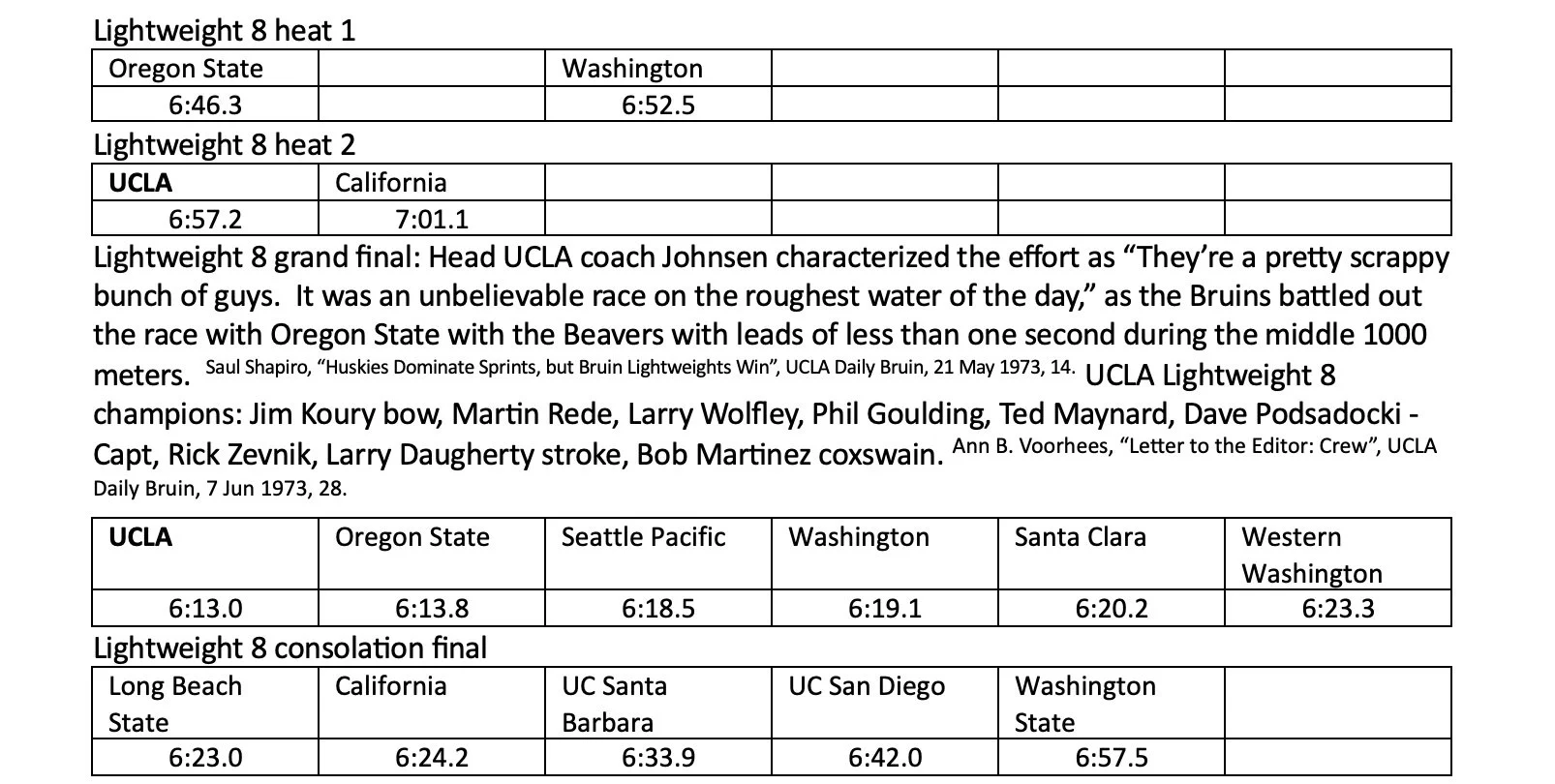
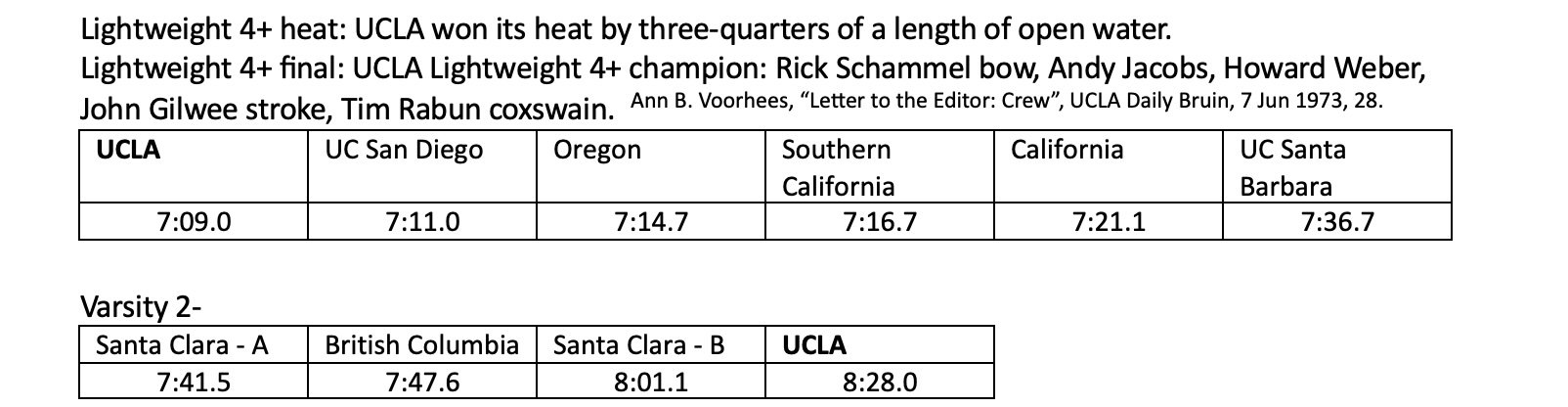
The Bruin lightweight eight was planned self-fund to attend the National Rowing Championship in Camden, New Jersey in July. The athletes each had to contribute $300 for the trip and the potential participants were listed as seniors that had raced in the lightweight eight: Dave Podsadecki, Phil Goulding, Ted Maynord and stroke Larry Daugherty, along with freshman coxswain Steve Hokoda. “Lightweight Crew Preps for Nationals”, UCLA Daily Bruin”, 19 Jun 1973, 12. A UCLA crew placed second to College Boat Club in the intermediate 4+. Philadelphia Inquirer, 15 Jul 1973, 56.
In the 1973 IRA championship there were seven West Coast entries, five advanced to the finals, including a UCLA championship in the varsity four-with-coxswain. Western Sprints champion Washington did not attend and California only sent their freshman crew. Santa Clara’s freshman four included female coxswain Mimi Sherman. For the second year in a row UCLA won the ERIC W. WILL TROPHY in the varsity 4+. The Bruins built a one-length lead by the 1000 meter mark of the final and finished 8 seconds ahead of second-place Coast Guard. The Bruins also placed their freshman four sixth in the grand final. Windy conditions hampered racing.
Freshman eight [14 entries]: California (10th, fourth in petite),
Southern California (11th, fifth in petite)
Freshman four [15]: Santa Clara 5th, UCLA 6th
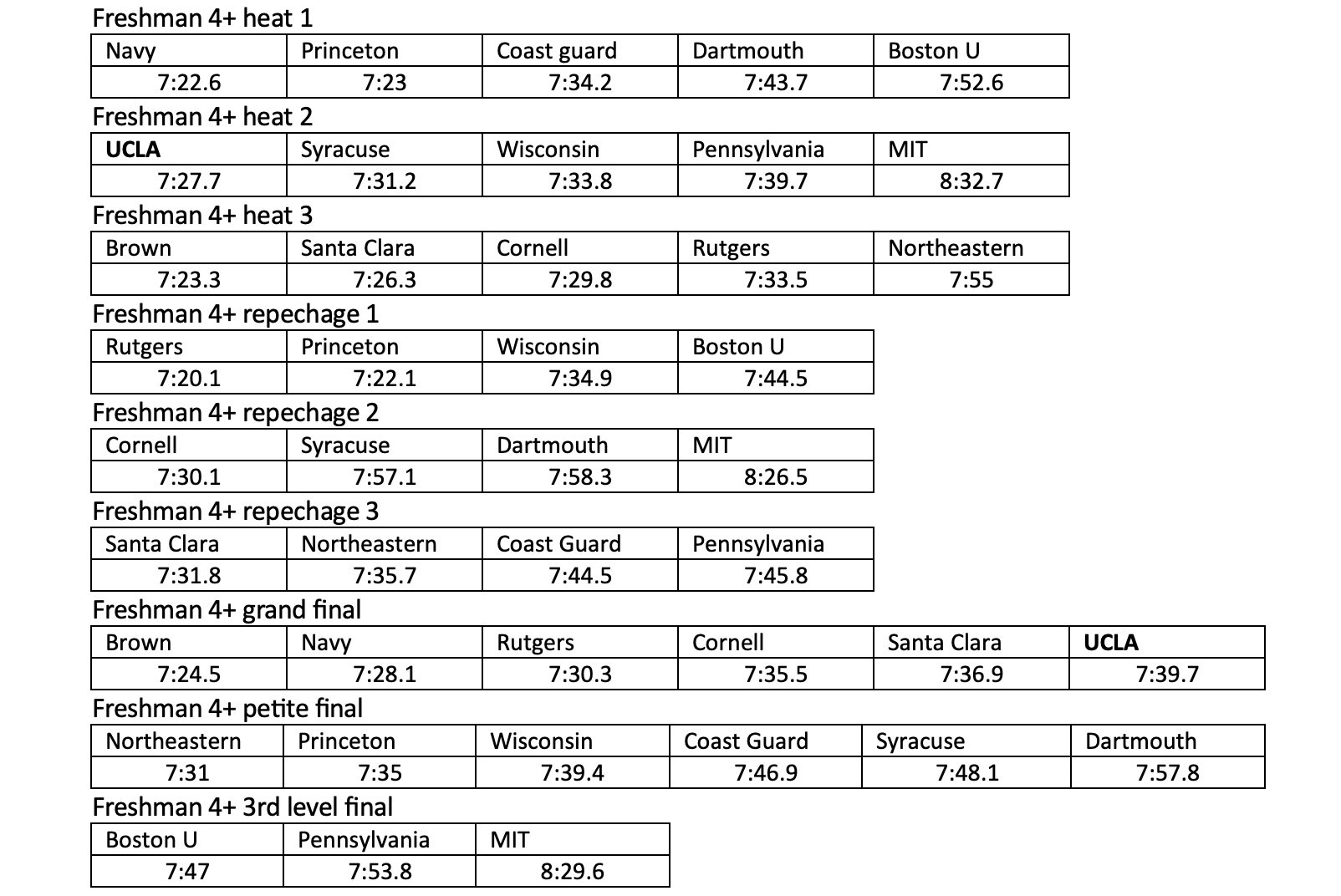
Junior Varsity eight [10]: No West Coast crews
Varsity pair [8]: Santa Clara 2nd
Varsity four [13]: UCLA 1st placing first for the second year in a row, Western Washington 4th
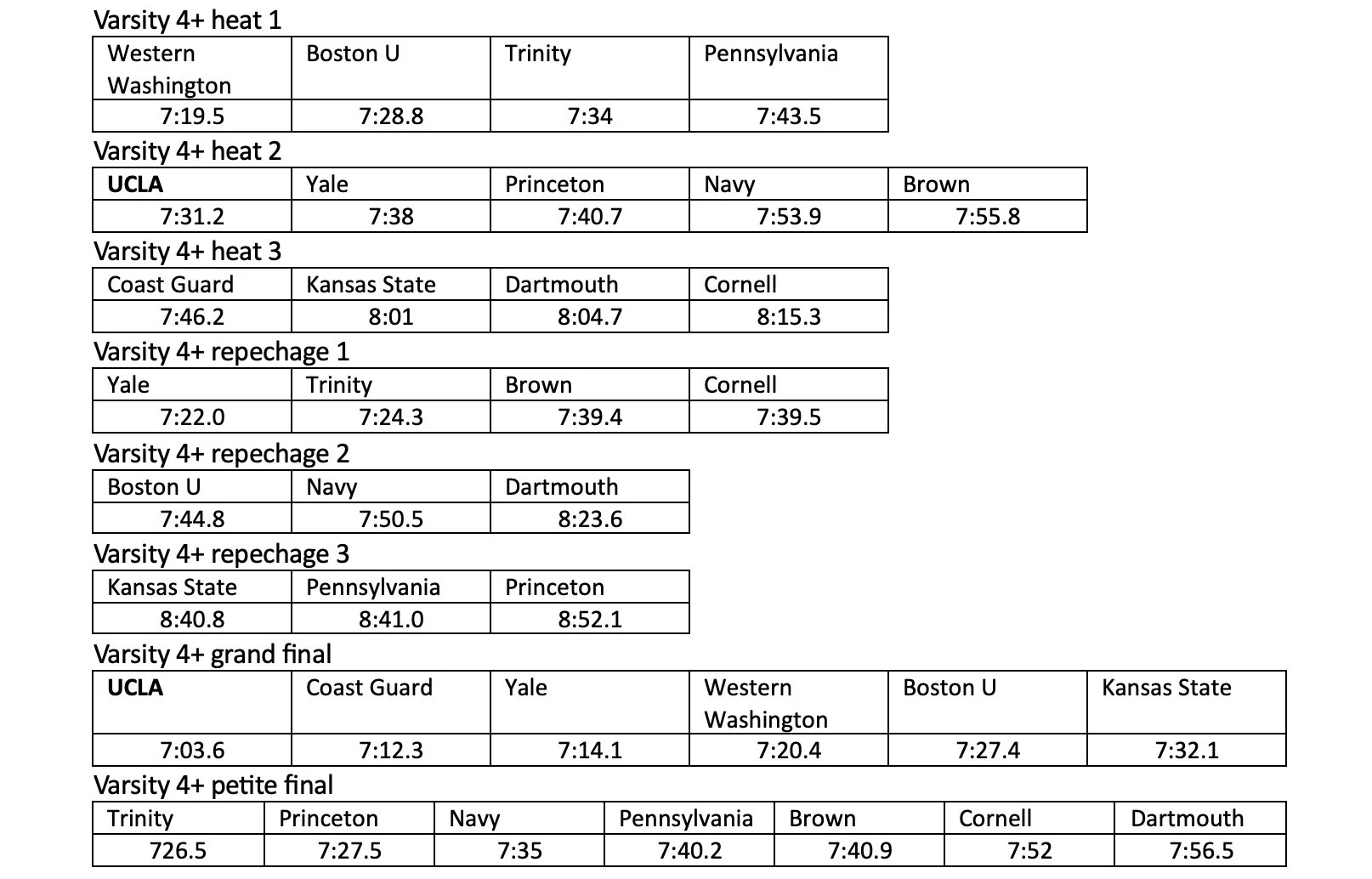
Varsity eight [11]: No West Coast crews
Washington bypassed the IRA (the academic schedule changed and the IRA landed in the middle of spring quarter final exams). Washington’s varsity and junior varsity were given the opportunity of racing at the Nottingham and Lucerne regattas, and the Henley Royal Regatta, if they won at the Western Sprints.
In the Nottingham regatta, the varsity finished last in the final behind national teams from Russia and Hungary, although they also finished behind first and third place finishers at the IRA Wisconsin and Northeastern. The junior varsity had the best race of the day, but finished second to Eastern Sprint winner Harvard by one-half length.
At the Henley Royal Regatta, the varsity advanced through the first round of the Grand Challenge Cup by defeating France, but were eliminated in the next round by Russia, the crew that would go on to win the event. The junior varsity raced in the Ladies Plate advanced well, but were defeated by a Dutch squad, with the event ultimately won by the same Harvard team that had defeated the crew at Nottingham.
Disappointed but not deterred, the team went to Lucerne where they finished in the middle of the pack behind East Germany and West Germany, defeating the Dutch and the Swiss.
Meanwhile, by virtue of their undefeated season and a fund-raising drive of the alums and friends, the Washington freshmen went to Mexico City to compete in the Inter-America regatta. The 7,300 feet high Xochimilco course had been the site of the 1968 Olympics. In the final, the eight, complete with assistant coaches Bill Byrd and Charles Ruthford as the stroke pair (substituting for two freshmen that could not make the trip), came from behind to win the only gold medal of the games for the U.S. “1973”, Husky Crew web, https://www.huskycrew.com/1970.htm
Barry Berkett and Joel Coster, bow pair of the UCLA varsity, were selected to be on the U.S. rowing team competing at the Maccabiah Games in Israel, July 9-20. Julian Wolf, UCLA ’47, was the team coach. “Oarsmen Honored; Frosh Coach Chosen”, UCLA Daily Bruin, 26 Jun 1973, 12. “Six members of the present eight and one alum have been invited to participate in tryouts for the United States national rowing team.” The team would travel to the European [name prior to being called World] championships in Moscow. “Those Bruin oarsmen bidding for spots are Steve Bohlmann, Alex Frasco, Rod Johnsen, Tom Meyer, Jim Everett and Rob Justus.” “Bruin Crew Debuts Today in San Diego”, UCLA Daily Bruin, 6 Apr 1973, 11.
1974
Duvall Hecht joined the coaching staff as a part-time coach of the UCLA freshmen along with holding a job in investment banking and securities. Rick Galliand again coached the lightweight team, though he had lost seven of his 1973 championship crew. The women’s rowing team had an official varsity status and Larry Daugherty, a four-year Bruin oarsmen 1969-1972, was the coach. Cindy Luis, “Crew Opens Season”, UCLA Daily Bruin, 12 Nov 1976, 18.
There was a more substantial women’s team, however missing were the seven named in 1973, though Ann Voorhees was named as the coxswain in the men’s JV eight. Jan Palchikoff, a member of the women’s crew, was the coordinator of a group called the Union of Women Athletes. The primary goal of the union was “to work toward the improvement of the women’s program in a viable and serious way.” Allocation of funds for women’s sports from registration fees was $60,500, compared to “$275,000 to the men plus about $2 million more in gifts and gate receipts to the men.” In addition to overall funding, other issues included non-paid coaches for women’s teams, use of facilities and financial aid for women’s athletes. The union wanted to make to clear that they were not antagonistic to the men’s program but that they were serious about competing. Members of the administration saw the Union as a “pressure group” without official recognition of the student body government, in a process of writing a proposal laying the framework for the future. Since 1965, women’s intercollegiate sports were administered by the Office of Cultural and Recreational Affairs that also directed the campus-wide intramural program. During that year the total expenditure on women’s athletics was $1,900. Norman P. Miller, vice chancellor for Student and Campus Affairs expected that a women’s program would be developed over a number of years and he doubted “that it will be built to the same level as the men’s program.” The national Association of Intercollegiate Women’s Athletics (AIWA) the national governing body at the time, prohibited financial aid for female athletes. Miller thought paid coaching might possibly occur in the next fall for women’s teams. In commenting about use of facilities, Miller stated “there is no space for women’s crew” and that “we want as many women’s sports as facilities will allow.” Holly Kurtz, “Women Athletes Urge Program Equity”, UCLA Daily Bruin, 22 Apr 1974, 4, 14. Even when the women’s rowing program became a recognized varsity sport they had no locker room and only a restroom around the back of the boathouse to share. The official report led to the establishment of a temporary Department of Women’s Intercollegiate Athletics (DWIA) to begin on July 1, with a long range goal of a single Department of Intercollegiate Athletics (DIA). The DWIA had a $180,000 budget for 1974-75, $90,000 from registration fees and $90,000 from emergency funds. Palchikoff and the Union of Women Athletes were leery of the integration of the of the DWIA into the DIA and felt that the amount of funding was inadequate, especially considering travel expenses. In 1972-73 of 691 male athletes, 177 received full grants-in-aid and 140 more received partial scholarships. Women’s scholarships were planned to be $40,000 in the coming year for 1974-75, though coaches would still serve as unpaid volunteers. Although it was reported that in 1972-73 “stipends” totaling $1,414 were paid to women’s coaches in four sports (track: $590; swimming: $518; basketball: $200; and gymnastics: $106) with total of 15 part-time coaches. During the same year, the men’s athletic program had 23 full-time and 21 part-time coaches that together were paid $480,539 in salaries and benefits. Men’s athletic director, J. D. Morgan, and Pete Dalis, Director of Cultural Recreation Affairs supported the volunteer status of women’s coaches citing the success of Joan Martin in golf and Andy Banachowski in volleyball as volunteers leading their teams to national championships. Anticipated Health, Education and Welfare interpretations of the Title IX of the educational Amendment of 1972 as well as the California Concurrent Resolution 65, “helped bring about the landmark decision” on the establishment of the separate DWIA. Ed Burgart, “Will Women Get Fair Deal”, UCLA Daily Bruin, 24 May 1974, 9, 11. and Ed Burgart, “Women’s Athletics to Get $180,000”, UCLA Daily Bruin, 24 May 1974, 9, 12. and Holly Kurtz, “Men’s Athletic Budget Huge”, UCLA Daily Bruin, 24 May 1974, 13. From a budget of $5,000, 4 teams, 20 events and 40 participants in 1965, the women’s intercollegiate program in 1974 grew to $63,000, 20 teams, 165 events and 310 participants. Hunter Kaplan and Karen Sawin, “Athletic Director Struggle Continues”, UCLA Daily Bruin, 18 Apr 1975, 18. The expenditure for men’s crew in 1974 was cited as $72,000. Holly Kurtz, “Union of Women’s Athletes Want to Upgrade Program”, UCLA Daily Bruin, 24 May 1974, 12, 13.
The spring season began April 6 at the second San Diego Crew Classic. The lightweight eight {stroked by Martin Rede and coxed by Lee Dinstman} and four {stroked by Jon Gilwee and coxed by Sue Coon} attended, while the varsity, JV and freshmen would sit-out the regatta preparing for their opener on April 15 against UC Irvine. Greg Denton, “Men’s Crew Season Begins”, UCLA Daily Bruin, 5 Apr 1974, 17. The women’s team planned to field a four {Kim Bloomfield – two years rowing experience at Mills College, Olympic swimmer An Simmons, and Denice Harter and Betsy Keliker} and an eight {Cherie Hargis, Kim Sorenson, Barbara Tovaraz, Jan Hayes, Marni Brown, Jan Palchikoff, Tammy Tyler and Dee Pickens}. Following the Crew Classic the women were to race UC Santa Barbara on April 27. “Women Rowers Also Ready”, UCLA Daily Bruin, 5 Apr 1974, 17. The women’s 4+ (4:13.01) won their race defeating Long Beach State after overcoming a shaky start. The women’s 8 (4:22.8) finished in third following two Long Beach State entries, the winning time was 4:00. “Women’s Crew Wins”, UCLA Daily Bruin, 10 Apr 1974, 14. Washington’s men swept the varsity, JV and freshman events. In the men’s varsity eight Washington (6:09.5) was again the victor, ahead of UC Irvine (6:12.5) who had led 1500 meters but finished in third, defending IRA champion Wisconsin (6:11.2) was second, Navy (6:20.1) was fourth, followed by Long Beach State (6:24.9) and San Diego State (6:31.9). “Navy Fourth”, Annapolis [MD] Capital, 8 Apr 1974, 18. Wisconsin was later disqualified for an illegal lane change. “Washington Rowers Sweep SD Classic”, Tacoma News Tribune, 7 Apr 1974, F-5. The UCLA men’s lightweight four won by three seconds ahead of Long Beach State and six boat-lengths ahead of UC Santa Barbara. The men’s lightweight eight finished in second, eight seconds behind Long Beach State and 15 seconds ahead of San Diego State. The crew of the lightweight eight was at a disadvantage since they were racing in an older, heavier borrowed shell since “the bow section on their regular boat was ripped by a catamaran in a Friday practice.” Greg Denton, “Oarsmen Finish High”, UCLA Daily Bruin, 9 Apr 1974, 14.
The 3-team race in Newport against UC Irvine and San Diego State would be 3-miles for the varsity and JV, the distance that UC Irvine practices several times per week, and the freshman races would be 2-miles. Following UC Irvine’s strong showing against Washington at the Crew Classic coach Johnsen cautioned “Bob Ernst, Irvine’s coach, has a boatload of seniors, some of whom rowed continuously for over two years. To combat this we’ll have to stay cool and not panic, even if we are behind after the first mile.” Johnsen hoped the seniors in the middle of his varsity line-up would serve that role. Greg Denton, “Oarsmen Open at Newport”, UCLA Daily Bruin, 12 Apr 1974, 23. As it was, the Bruins won both the freshman 8 (10:35 for 2-miles) and freshmen 4+ (7:31 for 2000 meters), defeating UC Irvine by ten and seven seconds. UCLA’s varsity held off the Anteaters at the start but lost the advantage during the second mile rowing at 30½ strokes per minute, closed a little of the margin in the last mile but finished 14 seconds behind at the finish in a time of 14:22. The Bruins also lost the JV race. Greg Denton, “Oarsmen at Marina Tomorrow”, UCLA Daily Bruin, 19 Apr 1974, 15.
UCLA hosting the Ben Wallis Cup was swept by Cal. Cal’s varsity (6:25.5) won by four-lengths, bettering the Bruins by 16.8 seconds. The Bears won the freshman (6:34.2) eight by 12 seconds and the JV (6:41.5) race by two-lengths. The Cal lightweight eight (6:32.5) also won by about a four-length margin. Johnsen stated “It’s only the second time our UCLA Lightweights have lost a race in four years of competition.” In the four oared events, UCLA (7:50.6) won the lightweight 4+ and Cal (6:22.4) won the freshman 4+, both races had a margin of victory of about two boat lengths. “Collegiate Oarsmen Begin Racing Season on Ballona Creek ‘Olympic Course’”, Marina del Rey Argonaut, 25 Apr 1974, 17. Johnsen provided the strategy going forward that “we must take it from the start and carry it through. The key for us is aggressiveness.” “Crew Team Rows Today”, UCLA Daily Bruin, 24 Apr 1974, 23. The UCLA women’s eight (3:56.6) defeated USC by six lengths over a 1000 meter race, and won the four by four lengths over USC in a time of 4:58.7. “Collegiate Oarsmen Begin Racing Season on Ballona Creek ‘Olympic Course’”, Marina del Rey Argonaut, 25 Apr 1974, 17.
Following the Wallis Cup, UCLA raced the Harbach Cup in Wilmington on Friday and on Saturday hosted Long Beach State. The aggressiveness that Johnsen asked for resulted in a decisive sweep of the weekend regattas. In the varsity Harbach race UCLA (6:36.9) was followed by USC (6:43.3) and Stanford (6:44.7). The Bruin JV (6:38.8) finished ahead of Stanford (6:469) with USC a distant third. The freshman eight resulted in the same finish order with UCLA completing the sweep.
Against Long Beach, the UCLA varsity (6:17.8) defeated Long Beach State (6:24.8) to win the Major Sievert Cup; the Bruin JV finished in 6:21.4 to 6:24.9. The freshman from UCLA (7:02.8) pulled a narrow victory of 1.1 seconds over Stanford (7:03.9), and USC (7:27.8) was far behind. They made a stronger victory over Long Beach (6:35.7) with a finish time of 6:29.2. The Bruin lightweights were matched by Long Beach as they finished behind the 49ers 6:32.7 to 6:38.1 in the eight, and 7:36.3 to 7:44.8 in the four. “Oarsmen Row to Sweep Over Weekend”, UCLA Daily Bruin, 29 Apr 1974, 23. That weekend, Cal had defeated Washington in their annual match-up.
Racing in San Diego, the UCLA women again lost to UC Santa Barbara, by one boat length, in the eight-oared event. They finished last in fifth place in the 4+, behind San Diego’s ZLAC Rowing Club, UC San Diego, UC Santa Barbara with USC finishing in fourth. Returning to the home waters of Marina del Rey, the women’s eight defeated Santa Clara by three lengths. The Southwest Regionals in Long Beach was their next event. “Women Rowers Lose”, UCLA Daily Bruin, 7 May 1974, 21.
The varsity traveled north to face Washington, while the other men’s crews went to race at the Newport Regatta. Bruin Senior Alex Frasco said, “We’ve had a lot of success with our sprint so if we’re even with 500 to go it will be a dogfight.” Greg Denton, “Oarsmen Meet Washington”, UCLA Daily Bruin, 3 May 1974, 16. The Bruin varsity (6:28) were a distant second behind Washington (6:14) but did narrowly defeat Western Washington (6:33). “Husky Crew Thumps UCLA”, The Olympian (Olympia, WA), 6 May 1974, 12. UCLA had a small two-seat lead before 500 meters when Washington pulled even. The Huskies made additional surges at 1000 and 1700 meters, and pulled farther ahead. “Oarsmen Come Up Empty”, UCLA Daily Bruin, 8 May 1974, 20. At Newport, Cal (6:31.8) was the victor over UC Irvine (6:40.2) and Long Beach State (6:54.9) in the varsity eight. The Bruin JV placed fourth in a race won by Long Beach State. The UCLA freshmen finished third behind Cal and Orange Coast. “Oarsmen Come Up Empty”, UCLA Daily Bruin, 8 May 1974, 20. In the lightweight eight event Long Beach State (6:39.2) was the victor, defeating Santa Clara, previously undefeated Cal, and UCLA finishing in fourth place. In a separate lightweight event in Long Beach, Long Beach defeated UCLA in the lightweight 4+ but lost to the Bruins in the lightweight JV eight. “Rowers Blitzed by Bears”, Long Beach State 49er, 7 May 1974, 10-11.
The Western Sprints were at the newly created Burnaby Lake course in British Columbia, May 17-18, built for the 1973 Canadian Summer Games, for the first time held in Canada. More than 500 oarsmen representing 28 universities and clubs attended. A regatta for women was scheduled the same weekend, the Northwest Women’s Regional Championship regatta on Green Lake in Seattle. The twenty-two 1000 meter races for women’s crews featured 13 crews (Pacific Lutheran University, University of Washington, Long Beach State, Oregon State, Seattle Pacific University, University of Oregon, University of Victoria, Calgary RC, Green Lake RC, Washington RC, Seattle Tennis Club, Vancouver RC and Lakeside High School). Puget Sound had planned to attend however the men’s squad had the team’s only four at the Western Sprints. The UCLA women’s team raced at the first Southwest Regional Regatta hosted by Long Beach on May 11, that offered fifteen races. For the California teams it would be a tune-up to the National Women’s Rowing Association championship to be hosted in Oakland’s Lake Merritt in June. “49er Women Host Regatta Saturday”, Long Beach Press-Telegram, 9 May 1974, 47. UCLA placed sixth in the open four-with coxswain (4:12.3) and open eight (4:12.6) at the NWRA nationals. The open eight was won by Vesper Rowing Club (3:42.1), Radcliffe (4:49.3) was second and Oregon State (4:03.0) finished fourth. Boston University (4:05.6) was first in the open four and Washington (4:10.6) was fifth. Oakland Tribune, 17 Jun 1974, 30.
Coach Johnsen conceded that “the varsity will be shooting for third or fourth” at the Western Sprints. The JV was believed to have a chance to win but had not had two races during the season with the same line-up. “Western Sprints Start Today” UCLA Daily Bruin, 17 May 1974, 15. Washington’s varsity had its only loss of the season to California on April 27 and changed their line-up after that. In the Western Sprints preliminary heats Washington placed first in eight of the sixteen races, while California won the other eight. Washington and California only missed a heat victory in one event each. Washington qualified for eleven of the twelve event finals and won seven and were second in the four others. Coach Erickson stated that the Washington budget for the year was an inclusive $58,000 that included travel, equipment, salaries. British Columbia’s budget was $9,000 and Southern California $15,000. Erickson felt that the greatest advantage that his budget provided was that it allowed more people to be involved. This year he had 150 athletes actively rowing, and he was committed to program depth. Wayne Parrish, “Well Heeled, Too: Huskies Sinking Teeth into All”, Vancouver Sun, 18 May 1974, 25.
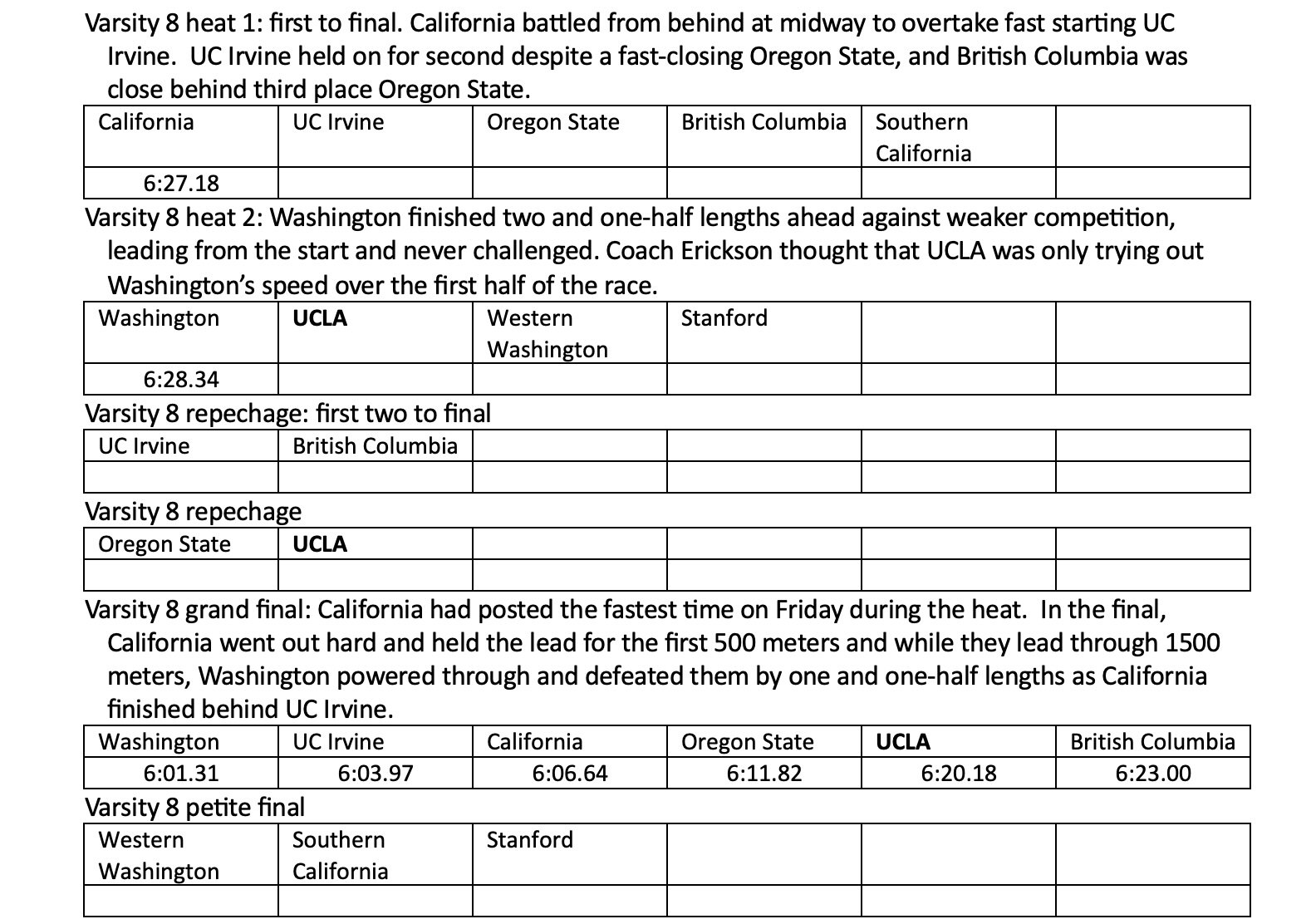


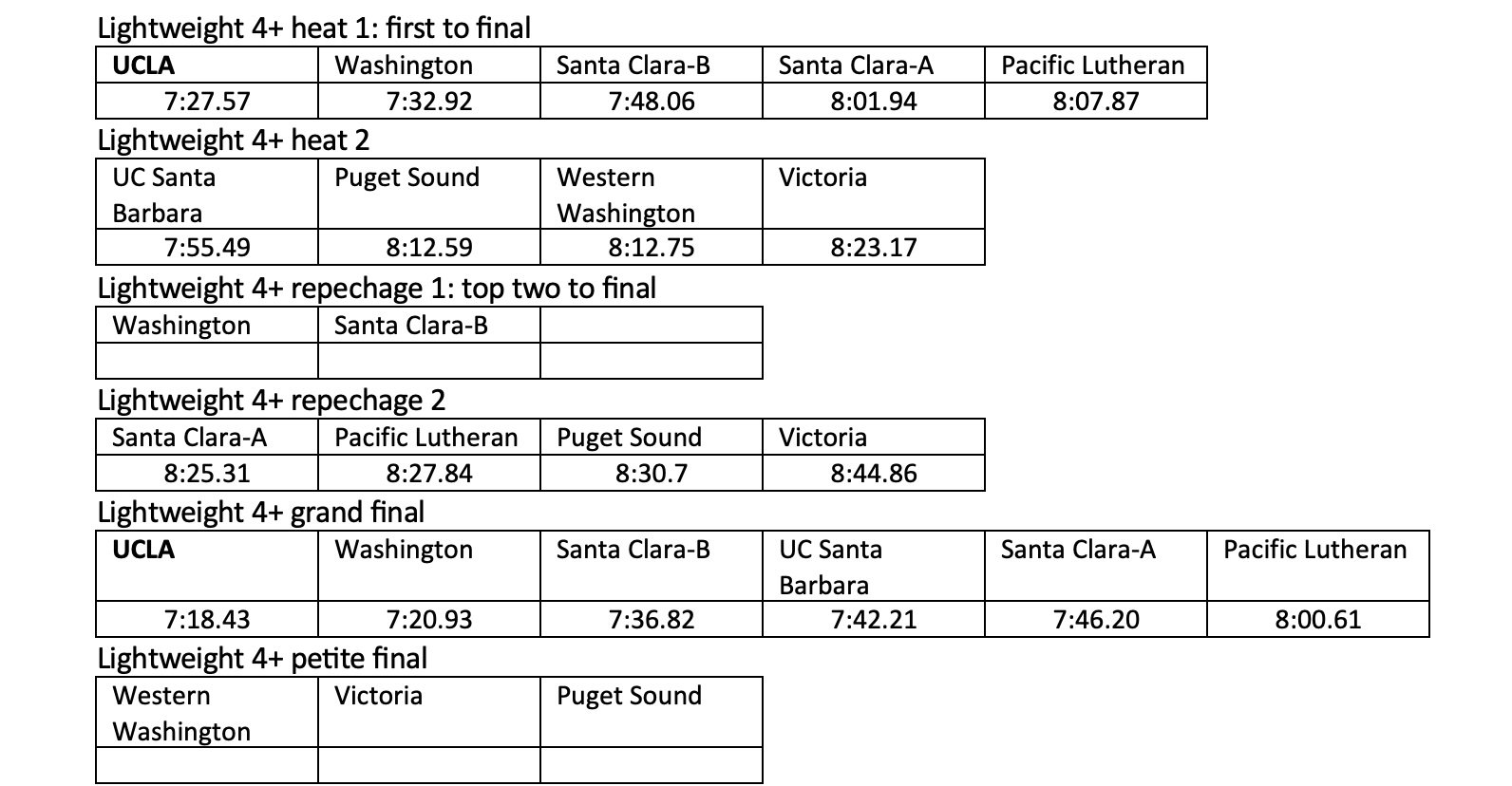
The 1974 IRA championship included only two West Coast entries. Western Sprints champion Washington did not attend due to their academic calendar, and California only sent their freshman crew. Pennsylvania’s winning pair with coxswain at the IRA included a female coxswain (Karen Brunke).
Freshman eight [12 entries]: California 7th (first in petite)
Freshman four [11]: No West Coast crews
Junior Varsity eight [7]: No West Coast crews
Varsity pair-without coxswain [13]: Santa Clara 1st
Varsity pair-with coxswain [7]: No West Coast crews
Varsity four-without coxswain: [4]: No West Coast crews
Varsity four-with coxswain [10]: No West Coast crews
Varsity eight [11]: No West Coast crews
Washington decided to forego the IRA and instead invited the top four Western Sprints finishers and the top four finisher in the Eastern Sprints. The Washington Invitational was to be raced June 20-22 in Seattle. Harvard had already accepted, since they did not attend the IRA anyway. In a rather small field, of only five other West Coast crews and two Washington “B” crews to fill out the schedule, the Washington and Harvard crews won preliminary dual races on Friday and the winners faced off on Saturday. Harvard had defeated IRA champion Wisconsin three times during the season, including the Eastern Sprints, and thus had claim to the undisputed title to the U.S. crown. Washington’s only victory was in the freshmen event. They defeated their Harvard counterparts by almost a length of open water to establish themselves as likely the best in the nation (IRA winner Cornell had narrowly defeated Harvard at the Eastern Sprints), with frosh coach Rick Clothier saying “we peaked perfectly for this weekend.” The Washington junior varsity had a rough time – crabbing early, coming back, but then failed to move in a twenty at the 1000 meter mark and lost by a length to their counterparts.
The varsity came out hard but could not get a good settle, with the Al Shealy stroked Harvard crew pushing a solid thirty-five after an excellent start. By the midway point, Harvard was up by three-quarters of a length and continued to cruise, winning the race by a half-length of open water. “This is the best crew I’ve put together,” said Erickson “and they did it to us… we’re pleased with the success of this regatta, but deep down, it kind of bites.” “1974”, Husky Crew web, https://www.huskycrew.com/1970.htm
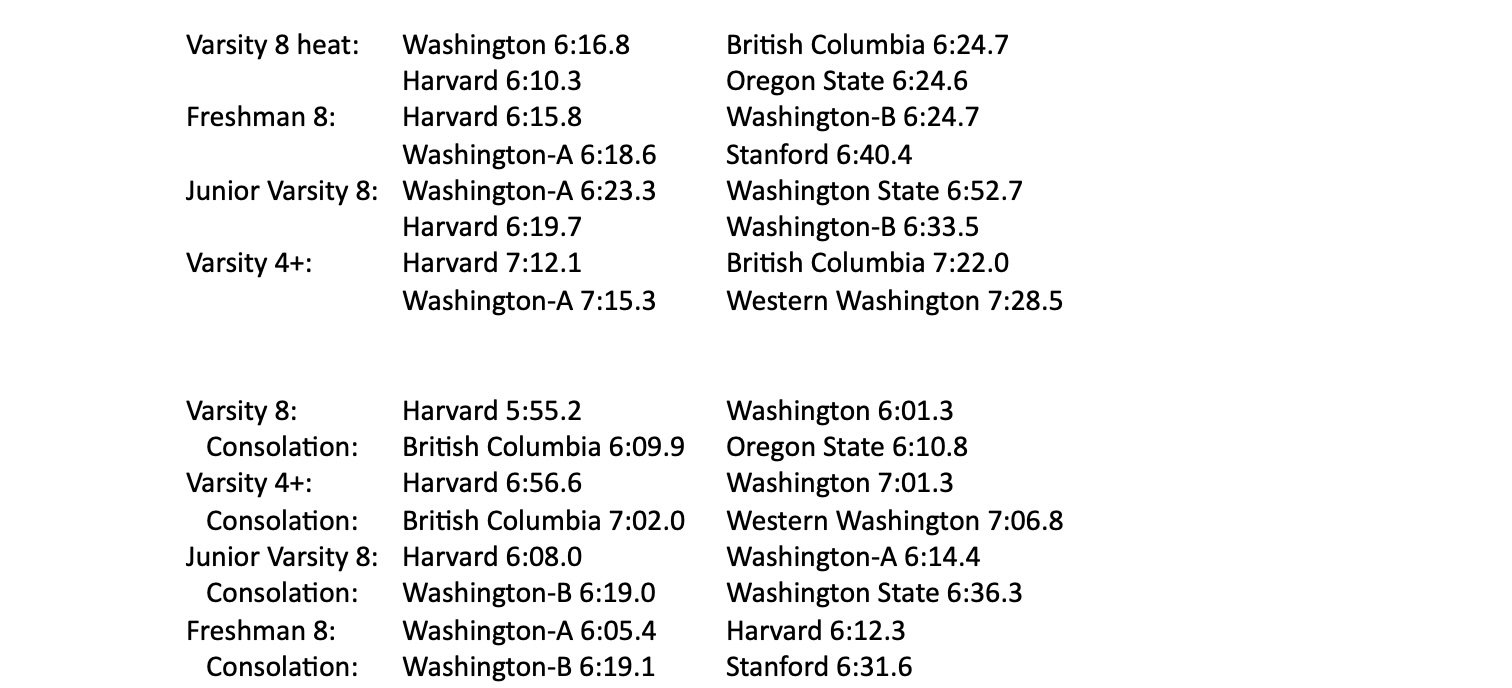
1975
Bob Newman became the freshman coach. The men’s team spent spring break training at Lake Arrowhead. Although the first workouts were good, the weather changed and rowers recall ice on the shafts of the oars and frost forming on the backs of the rower in front of them. There was a good deal of illness among the squad for the remainder of the season.
At the San Diego Crew Classic UCLA’s women (Mary Pat Zumach at bow, Toni Brown, Debbie Wollman, Shelley Wandzura, Betsy Keliher, Kim Bloomfield, D. Picken, Jan Palchikoff at stroke, Sue Coon coxswain) finished second (3:50.7) to Long Beach State (3:50.2) in the eight and fifth in the open 4+ (Kim Palchikoff at bow, Linda Hodges, Louis Moore, Lori Luck at stroke and Chris Shinaski coxswain) . UCLA’s (6:51.2) men’s varsity won the Silver Cup final finishing one boat length ahead of the University of British Columbia, with San Diego State in third. In the preliminary heat the Bruins placed fourth behind Harvard, UC Irvine and Navy, while defeating Long Beach State and British Columbia. Harvard won the Gold Cup with Washington in second. UCLA finished fifth in the JV race, second in the freshman eight and fourth in the freshman 4+. Joe Yogerst, “Crew Team Hosts Invitational”, UCLA Daily Bruin, 11 Apr 1975, 22. UCLA also raced in the lightweight eight and open lightweight four.
In their home opener, UCLA hosted Loyola, UC Santa Barbara and additionally Orange Coast in the freshman and JV races. Because of a particularly low tide, the JV and freshman races would be two flights of two crews. UCLA’s women would race UC Santa Barbara. Joe Yogerst, “Crew Team Hosts Invitational”, UCLA Daily Bruin, 11 Apr 1975, 22. The UCLA varsity defeated Loyola and UC Santa Barbara; the JV and frosh crews both ended in second place behind Orange Coast. All the crews were plagued with lingering illness. Joe Yogerst, “Rowers Travel North”, UCLA Daily Bruin, 18 Apr 1975, 14.
The Cal varsity had only graduated one senior from last year’s varsity, with six seniors this year that have rowed together in the same boat for four years, and finished only two seconds behind Washington in the Gold final of the San Diego Crew Classic, they were expected to be a formidable opponent. Joe Yogerst, “Rowers Travel North”, UCLA Daily Bruin, 18 Apr 1975, 14. In fact, Cal’s crews swept the visiting UCLA team, winning all nine races. Johnsen had come with modest goals for the varsity race, “We came here to be six seconds behind Cal and we did. I know it sounds bad but our goal wasn’t to win. We were twelve seconds behind them [comparing times] in San Diego two weeks ago and cutting that margin in half is really good. You can’t make that all up in two weeks.” Cal’s varsity had a slight lead at 1600 meters, then increased their stroke rate and began their move that the Bruins were not able to “counter effectively,” with the finish times 6:17.5 to 6:23.4. With the Bruins still showing signs of illness. Johnsen continued his optimism, “we sit third on the coast right now behind Washington and Cal. That means we still have a chance to be first or second at the Western Sprints.” In the JV race, UCLA had a one length lead at 500 meters and Cal made their first move at 1000 meters. At about 1500 meters the Bears were only two seconds in the lead, after which the Bruin crew fell apart losing the race by 11 seconds, 6:23.8 to 6:37.2. From his observation, Johnsen felt the crew “got tired and they let ‘em go,” that they “gave up when Cal made its move.” Bob Newman observed that his freshman were “outpunched … all the way down the course,” finishing ten seconds behind the Bears. The Bruin freshman four lost by two seconds. UCLA’s lightweight eight and four each lost by about one boat length, and in the novice eight event Cal won by 6 seconds. The Bruin seniors had never collected a Cal shirt, but still had spirit as the team staged an eight-clap on the plane home that they shared with the USC track team.
For the first time in history, Cal raced an official women’s contingent in varsity eights, “Cal Crew Entertains UCLA”, San Francisco Examiner, 18 Apr 1975, 58. though there had been an unofficial club in the late 1960s. The UCLA women finished one length behind in the four and a length and one-half behind in the eight. The Cal women raced in a lightweight shell compared to UCLA’s heavyweight shell, but coach Daugherty cited line-up changes in the Bruins that decreased synchronization. The UCLA women also experienced illness and injury, “Jan Palshikoff [sic], the eight’s stroke hadn’t been in the boat until Wednesday because of illness. The women at bow, Mary Pat Zumach, pulled a muscle and had to be replaced by Louise Moore off the four crew.” Joe Yogerst, “Crew Rows a Sinking Ship”, UCLA Daily Bruin, 21 Apr 1975, 19.
At the Newport Regatta, UCLA (6:05.0) decreased their margin behind Cal (6:00) and finished second at the regatta. USC finished third and UC Irvine finished fourth after rowing an untypically slow race for them. The Bruins had a typical slow start, but in the second half of the race the UCLA varsity “caught fire and were only down by a tiller at the finish,” The Bruin line-up was shifted when seniors Jim Pentlarge and Norm Witt missed the entire week due to bronchial congestion. The UCLA JV entry had to scratch when two of its oarsmen became ill the night before, Bruce Kassan who had cut his head in Oakland and suffered from headaches and George Pilipovich diagnosed with likely having pneumonia. Some of the remaining members of the JV were placed in the varsity four event, and with only fifteen minutes of practice, placed second to Cal and defeated Orange Coast and behind them USC. The freshman eight race was won by Orange Coast, with Cal second finishing five seconds ahead of UCLA coming from last place. The Bruins were thrown off a bit by the use of a count-down start. The UCLA freshman four finished second to Orange Coast but defeated Cal and improved their relative placement from the last week by 14 seconds. UCLA placed second to Cal in the lightweight eight. Following the regatta, Pentlarge and Witt returned to good health along with Greg Johnson. Joe Yogerst, “Rower Closer to Cal But Still Finish Second”, UCLA Daily Bruin, 29 Apr 1975, 12.
The Harbach and Major Seivert Cups were scheduled to be on the same weekend. Host Long Beach had expanded their race to include Loyola, Stanford and UC Irvine. Most of the health challenges for the Bruins had subsided with only one JV rower still out. The Bruins notched a sweep at the Harbach Cup, but lost the varsity race to UC Irvine the next day in Long Beach. In the uncertain waters of San Pedro it was not entirely surprising that telephone pole appeared in UCLA’s lane during the varsity race. “Steve Hokoda, the coxswain, spotted it just in time and was able to avoid catastrophe. The pole passed between the oar blades and the boat thanks to Hokoda’s excellent steering.” After pulling to an early lead, the Stanford crew sprinted in the last 500 meters attempting to make up UCLA one boat length lead. Although the finish was close the official order of finish was UCLA (6:50.2) two seats ahead of Stanford (6:51.0) and USC (6:58.2) far behind. The JV race had the same order of finish, with the host Trojans hitting a buoy. Stanford’s JV had been undefeated and the Bruin JV had yet to win a race until that point in the season. The Bruin freshman (6:49.9) won their race by seven seconds ahead of Stanford. Stanford “left for Smogville full of hope and returned with only the mutter of ‘next year’” “Crew”, Stanford Daily, 5 May 1975, 5. as a result of their three second-place finishes to the Bruins. At the expanded varsity race in Long Beach the next morning the Bruins got off to a good start but at halfway “began to show signs of tiring” as UC Irvine opened up a two length lead. After sprinting the last 500 meters the Bruins wound up two seconds behind the Anteaters (6:07.4) at the finish. Stanford finished a length behind, Long Beach in fourth and Loyola in fifth. UCLA won the two remaining races. The Bruin lightweights defeated their 49er counterparts, and in a race that combined UCLA’s JV and freshman crews, the JV finished five seconds ahead of the freshmen and the Long Beach State JV in third. In women’s races, UCLA defeated USC in the eight by an open water margin, but lost to USC in the four by two lengths. The next day against Long Beach the UCLA four defeated Long Beach by one and one-half lengths, and lost the eight by less than one-length. Joe Yogerst, “Crew Records Clean Sweep”, UCLA Daily Bruin, 5 May 1975, 24.
The week prior to the Western Sprints the men’s crews raced in class day events for the J. G. Johnsen Trophy, named for coach Johnsen’s father and donated by Keith Jackson of ABC television. The sophomore class defeated the freshmen even though they drew a “shitty boat.” The UCLA women were in San Diego competing in the Southwest Regionals, facing crews including those from Cal, Long Beach State, UC Santa Barbara and USC. UCLA entered the open eight, open four and lightweight four. Because of the location, the course was only wide enough to accommodate four crews in a race. The athletic department had agreed to send the crew to nationals if they finished within five seconds of the event winner. Joe Yogerst, “Women’s Crew Rows in Southwest Regionals Today”, UCLA Daily Bruin, 9 May 1975, 14. The UCLA Lightweight four defeated ZLAC Rowing Club and Oakland Strokes, and the only other collegiate entry, San Diego State had to scratch because they failed to make weight. They took off right from the start. In the open eight
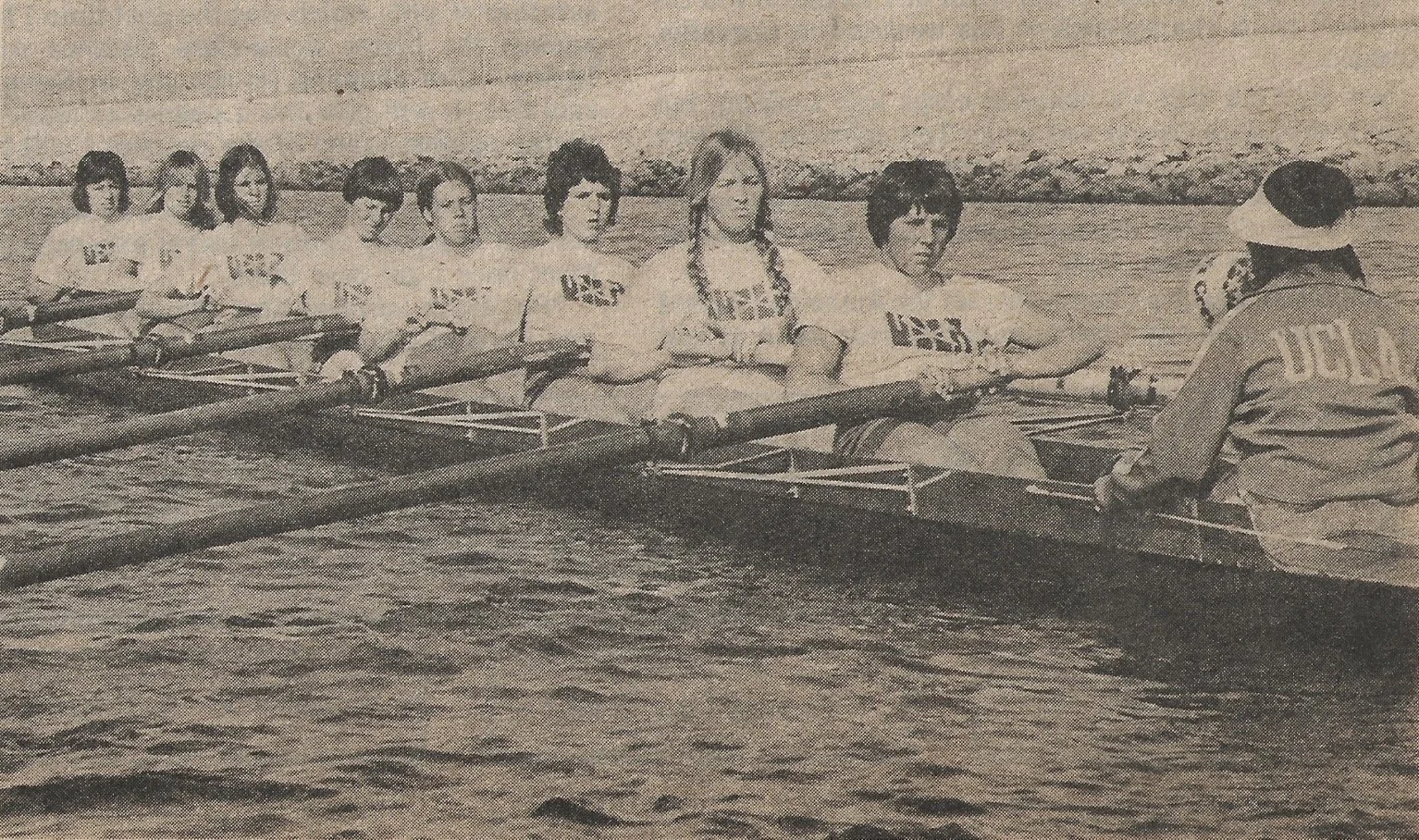
UCLA women’s varsity 8 - “Rowing Teams Have Successful Weekend”, UCLA Daily Bruin, 14 May 1975, 24.
The Bruins finished second in the petite final, 1.9 seconds behind Cal’s second crew, with USC in third and Long Beach State’s second crew in fourth. In the preliminary heat UCLA (3:53.6) had finished fourth following Long Beach Rowing Association (3:36.8), Long Beach State and Cal’s second crew. In the grand final, the finish order was Long Beach Rowing Association, Cal, Long Beach State, and UC Santa Barbara in fourth. In the open four, UCLA had finished second by six seconds to Long Beach Rowing Association in the preliminary heat. Long Beach won the final in 4:00.0 with UC Santa Barbara second and UCLA (4:06.9) in third. Joe Yogerst, “Rowing Teams Have Successful Weekend”, UCLA Daily Bruin, 14 May 1975, 24.
The Western Intercollegiate was held at Long Beach Marine Stadium, May 16-17. Oregon State, as Washington’s top competitor, had faced Washington twice earlier in the season and won one of the encounters, but had not faced Washington top combination that had only been together for three races; the San Diego Crew Classic, the California meet and this regatta. Washington had defeated California by three-lengths on a wind shortened course in Seattle two weeks prior.
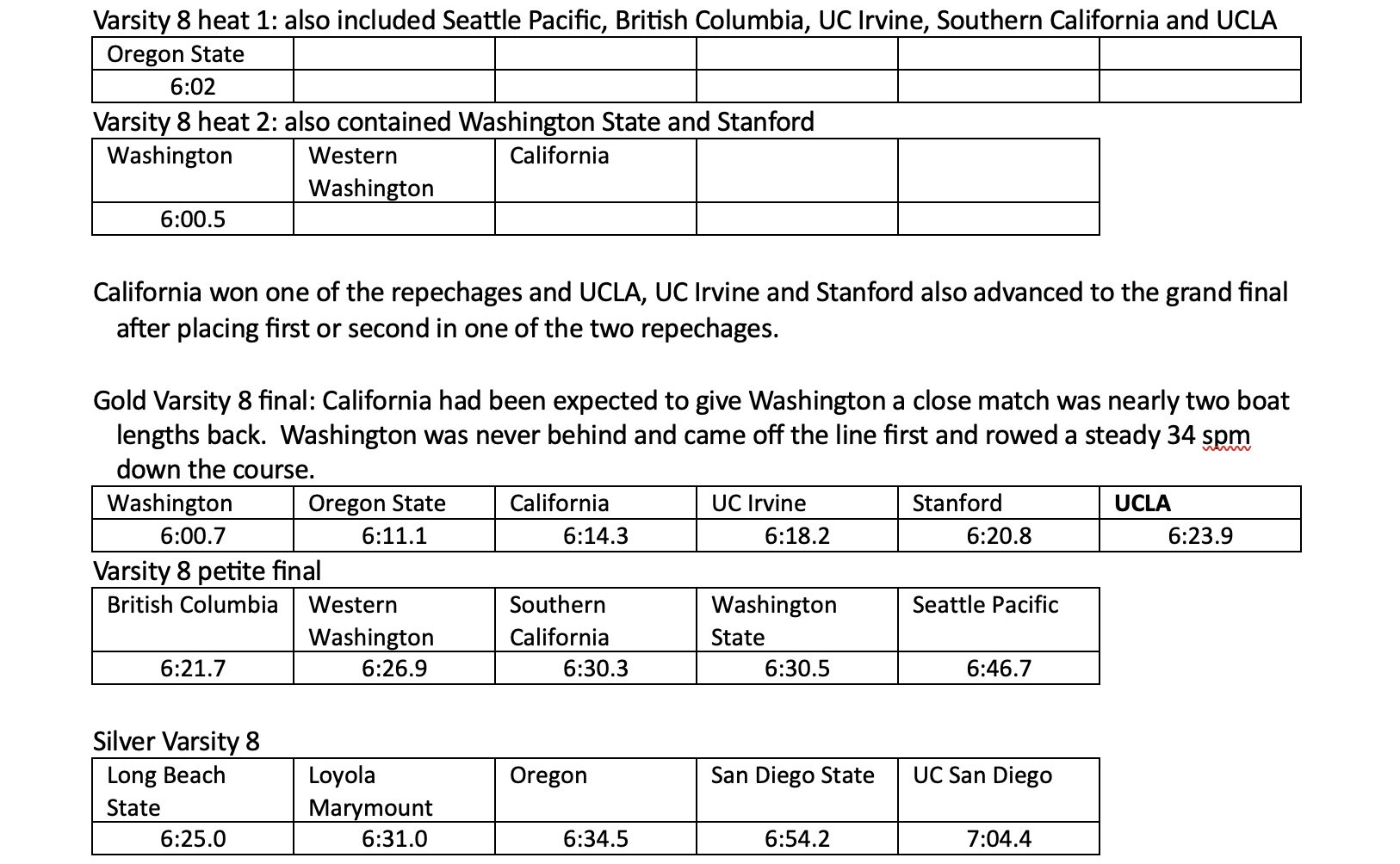
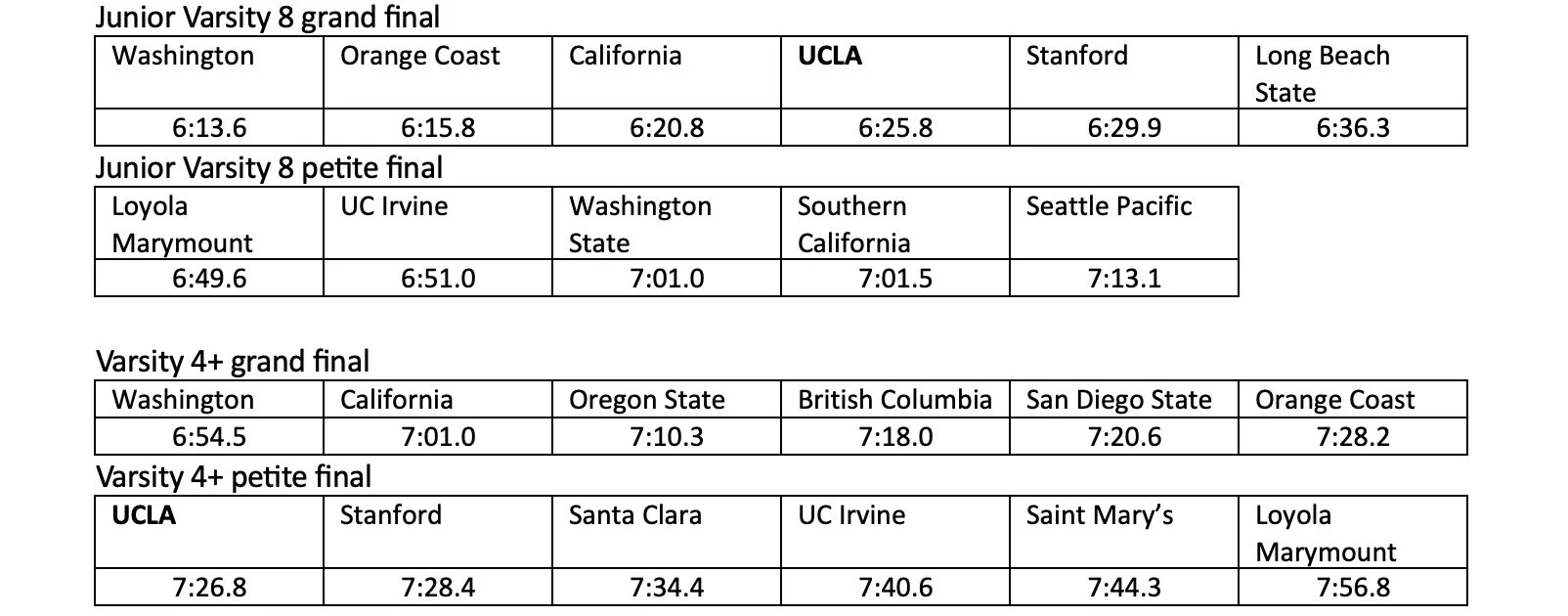
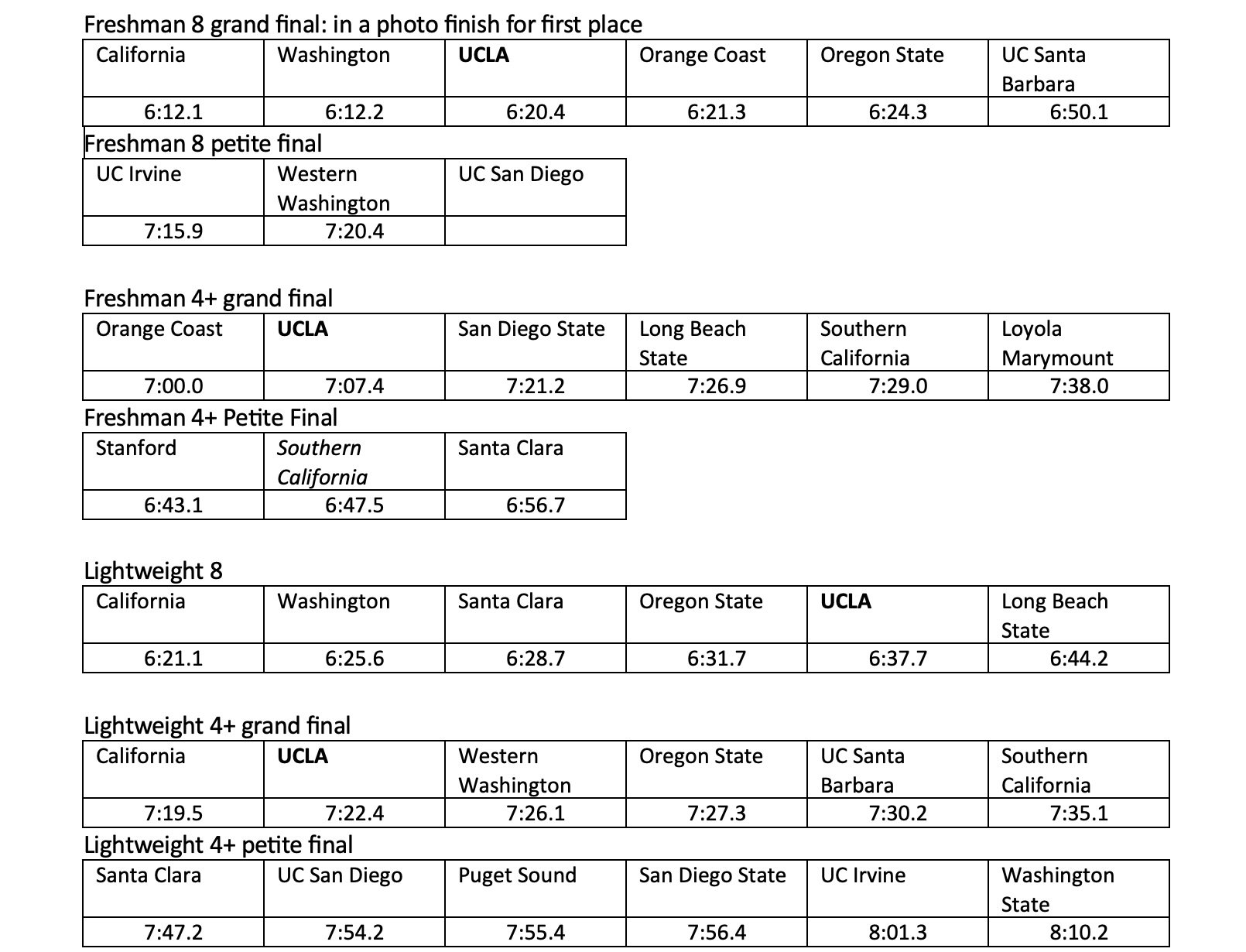
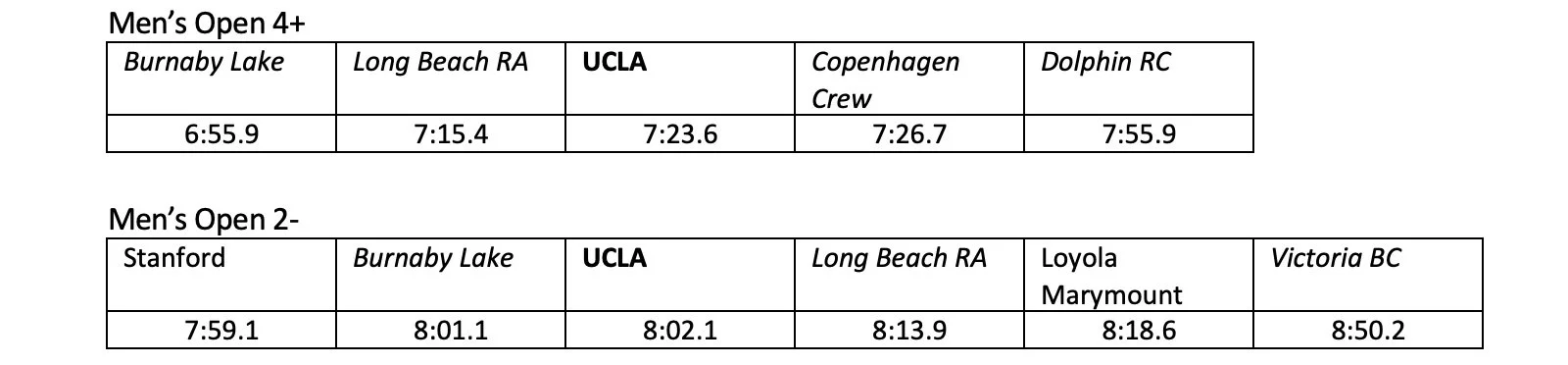
In the 1975 IRA championship the three West Coast entries all made the finals, including two gold medal performances. Western Sprints champion Washington did not attend and California only sent their freshman crew.
Freshman eight [13 entries]: California 5th
Freshman four [13]: No West Coast crews
Junior Varsity eight [12]: No West Coast crews
Varsity pair-without coxswain [7]: No West Coast crews
Varsity pair-with coxswain [6]: Southern California 1st
Varsity four-without coxswain: [3]: No West Coast crews
Varsity four-with coxswain [11]: Oregon State 1st
Varsity eight [14]: No West Coast crews
Instead of the IRA, Washington raced Harvard as yardstick to attend the Henley Royal Regatta:
Off to New London to meet Harvard (who had earlier swept the Eastern Sprints) for the promised distance race on the evening of June 21. In excellent conditions, the freshmen took advantage in their two-miler of a Harvard crab midway through the race to take a two-length victory. The JV’s, in their three-miler, had an excellent start and powered to a dominant six length win.
The varsity lined up for the sweep near the New Haven railroad bridge against a familiar Al Shealy led Harvard squad. The crews stormed out together, but in the second half-mile Harvard moved up by a length, and just held that margin down the course, winning by a half length of open water. “No one ever rowed four miles better than that” said an animated Harry Parker after his varsity prevented a Washington sweep. “I think it is the strongest race any crew of mine has ever rowed.”
And in a scene permanently etched in the minds of every Husky there, the wire report noted “afterwards, a can of beer in his hand, Shealy called the victory ‘decisive’”. Dwight “Ike” Roesch, the humble captain of the Washington team, quietly noted, “it’s become personal”.
And a shame that was. This event arguably featured the two deepest and best crew teams in the nation, fighting it out for the first ever Tom Bolles trophy. Bolles, the former Washington and Harvard coach and the essence of class (see 1930’s), likely agreed with many in the crowd that, from the perspective of pure athletic effort, this was one of the best collegiate crew events seen in many, many years. Had Washington won that race, Erickson planned to take them to Henley. As it was, the Harvard varsity did go to Henley, where they lost in the final of the Grand by two lengths to the British National Team.
Huskies that extended their season as members of the 1975 U.S. Pan Am team (held in Mexico City) included Ted Van Bronkhorst as an alternate, Bill Byrd (gold) in the straight four (coached by UW alum Rick Clothier), and Mark Umlauf (gold) and Mike Hess (gold) in the U.S. eight. Umlauf also rowed in the U.S. 8+ at the World Championships in Nottingham that finished 5th, with Chris Allsopp an alternate to the team. “1975”, Husky Crew web, https://www.huskycrew.com/1970.htm
Aside from an open women’s single and double there were no women’s events offered at Western Intercollegiate and those two events were offered to cater to the women’s club rowing that existed in Long Beach. The UCLA women’s lightweight 4+ (senior Toni Brown at bow, Betsy Keliher, freshman Debbie Woliman, senior Kim Bloomfiel at stroke, Sue Coon coxswain) won both the Southwest regional by ten seconds and then the NWRA national championship. The lightweight event required a crew average of 125 pounds with no rower over 130 pounds. UCLA’s coach Larry Daugherty was very excited, “I couldn’t believe it,” as they rowed to victory in the national championship which was their second time racing the lightweight 4+. Long Beach Independent, 29 Jun 1975, 65. Daugherty shared that “the rowers in our championship lightweight four team had participated in the open eight all season up to regionals. But the open eight team had not been very successful. I knew we could form a good lightweight four team for the regionals and nationals.” The Bruins (4:21.6) placed third in their six crew heat behind Radcliffe (4:20.5) and Washington-A (4:21.6) and Boston University, last year’s winning team, finished fourth. Though off to a slow start in the final, the Bruins pulled even with a fading Radcliffe at halfway and then past Washington. Daugherty said at that point they “were rowing smoothly and appeared to have a lot left.” The Bruins won in a time of 3:47.6, about four meters ahead to earn their first national championship. Hunter Kaplan, “Women’s Crew Takes National Title”, UCLA Daily Bruin, 1 Jul 1975, 14.
Jan Palchikoff
Jan Palchikoff was a 1976 Olympian, the first year women’s rowing was offered. She and her partner finished fifth in double sculls. She qualified for the 1980 U.S. Olympic team but was unable to compete due to the 1980 Summer Olympics boycott. Palchikoff served as head coach of Syracuse University Women's Crew from 1980 to 1982. Palchikoff was named to the Pac-12 Conference's All-Century team in Women's Rowing. She was elected into the UCLA Athletics Hall of Fame in 2015.
One of the true pioneers for women's athletics, Jan Palchikoff was a member of UCLA's rowing program as a club sport in 1973 and as a varsity sport in 1974 and 1975. She also competed on the UCLA swimming team from 1971-74 and competed in the AIAW Swim Nationals in 1971, 1972 and 1974. Palchikoff helped UCLA reach the U.S. Women's Rowing Association National Championships for the first time in 1974. She was a five-time member of the U.S. National Rowing Team, a national champion in double sculls in 1979 and a member of the U.S. Olympic teams in 1976 and 1980, finishing fifth at the Olympics in the double sculls in 1976. In 2014, she established a masters' hour world record for her age group in track cycling. While she had great success as a competitor, perhaps her greatest contributions came off the playing surface. One of the founding members of the Union of Women Athletes, she was a strong advocate for Title IX and served as a student representative on the Chancellor's Advisory Council on the Status of Women and on the UC Athletic Advisory Board. Since 2004, she has served as the Senior Vice President and Chief Program Officer for Special Olympics Southern California. “Jan Palchikoff”, UCLA Hall of Fame web, https://uclabruins.com/honors/hall-of-fame/jan-palchikoff/56